Most washing machine floods begin with a hose nobody looked at. The braid seems fine from the front, the machine is only six years old, and then a crimp lets go at two in the morning while the drum is filling. Burst-proof hoses exist because that failure is common enough to design around.
The label is narrower than it sounds. A burst-proof hose is a rubber or plastic tube wrapped in woven stainless steel. The braid carries the hoop stress, so a weak spot in the core pushes against metal instead of ballooning into a split. It does not stop the core from aging, and it does not improve the fittings. It buys time, and it turns a rupture into a weep you can see.
The ten products below fall into three groups: 304 stainless braided pairs in four- and six-foot lengths, two rubber pairs rated to 1,500 psi, and one drain hose that does not belong in the category but appears in every search for washer hoses. I kept it in and labeled it, because a shopper replacing hoses often needs both.
What separates the good pairs is not the burst number on the package. It is the length that suits your alcove, whether an elbow saves the bend behind the machine, and whether the nuts are brass or plated steel.
Top picks at a glance
【𝟮𝟬𝟮𝟲 𝗨𝗽𝗴𝗿𝗮𝗱𝗲𝗱】Washer Stainless Steel Hoses with 90 Degree Elbow
Check price on Amazon4 Ft Washing Machine Hoses, 2 Pack Premium Stainless Steel Washer Hoses
Check price on AmazonWashing Machine Hoses (4FT)
Check price on AmazonCompare the shortlist
| Model | Type | Capacity | Key feature | Amazon |
|---|---|---|---|---|
| 1. 【𝟮𝟬𝟮𝟲 𝗨𝗽𝗴𝗿𝗮𝗱𝗲𝗱】Washer Stainless Steel Hoses with 90 Degree Elbow | Stain remover | — | Connected controls | Check price |
| 2. 4ft Premium Stainless Steel Washing Machine Hoses Burst Proof 2 | Stain remover | — | Stainless drum | Check price |
| 3. Premium 4 Ft Stainless Steel Washing Machine Hoses | Stain remover | — | Stainless drum | Check price |
| 4. 2 PACK 6FT Rubber Washing Machine Hoses Burst Proof Washer Water | Hose | — | Quick cycle | Check price |
| 5. 6FT Rubber Washing Machine Hoses 2 PACKS Burst Proof | Hose | — | — | Check price |
| 6. Washing Machine Hoses (4FT) | Stain remover | — | Stainless drum | Check price |
| 7. 6FT Washer Stainless Steel Hoses with 90 Degree Elbows by Beaqui | Stain remover | — | Connected controls | Check price |
| 8. 4 Ft Washing Machine Hoses, 2 Pack Premium Stainless Steel Washe | Stain remover | — | Stainless drum | Check price |
| 9. 6FT Premium Stainless Steel Washing Machine Hoses with 90 Degree | Stain remover | — | Stainless drum | Check price |
| 10. FrigeSwift 8FT Washer Drain Hose Kit with Clamp | Hose | — | Front-load | Check price |
Detailed reviews
【𝟮𝟬𝟮𝟲 𝗨𝗽𝗴𝗿𝗮𝗱𝗲𝗱】Washer Stainless Steel Hoses with 90 Degree Elbow

A four-foot pair in 304 stainless braid over a lead-free PVC core, with a 90-degree elbow at one end of each hose. The elbow lets the machine sit closer to the wall without a hard bend at the inlet. Connections are 3/4-inch female hose thread, the range is 15 to 158 degrees Fahrenheit, and each coupling has an extra-thick rubber washer. Ten-year after-sales cover.
What stands out
- The 90-degree elbow eases the bend in a shallow alcove
- Ten years of after-sales cover on both hoses
- True 304 stainless braid over a lead-free PVC core
Watch out for
- Four feet is too short for a recessed outlet box
- Elbow adds a joint that needs its own leak check
4ft Premium Stainless Steel Washing Machine Hoses Burst Proof 2 Pack by Techecook
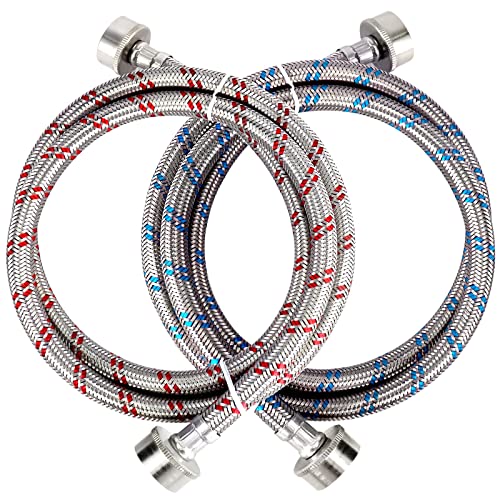
A four-foot pair of 304 stainless braided hoses from TOMOON, sold under the Techecook listing. The core is two layers of PVC, the fittings are brass with brass ferrules and nipples, and the maker rates the assembly to 1,500 psi. Water pipe outside diameter is listed at 0.512 inch and the coupling opening at 0.986 inch, both standard for 3/4-inch connections. Ten-year warranty with spare washers.
What stands out
- Rated to 1,500 psi with brass nuts, ferrules and nipples
- Ten-year warranty plus spare sealing gaskets in the box
- Published body and coupling dimensions make fitment easy
Watch out for
- Four-foot length leaves little slack around a dryer
- No elbow, so a tight wall clearance bends the hose
Premium 4 Ft Stainless Steel Washing Machine Hoses

A four-foot two-pack with an EPDM inner core under a stainless jacket, brass 3/4-inch female hose thread fittings and red and blue color coding. The maker quotes a 250 psi maximum working pressure, well above household supply but the lowest figure in this batch. The selling point is flexibility: the hose is meant to bend without collapsing in cramped quarters. Each pair weighs about 0.88 pound.
What stands out
- EPDM core handles hot water without hardening quickly
- Brass fittings instead of plated zinc at both ends
- Light pair that bends easily in tight quarters
Watch out for
- 250 psi working rating is modest for the class
- No elbow and no burst figure beyond the claim
2 PACK 6FT Rubber Washing Machine Hoses Burst Proof Washer Water Hoses

A six-foot rubber pair rated to 1,500 psi, with nickel-plated brass fittings at both ends and 3/4-inch NPT connections. The hose is built from rubber over a reinforced PVC layer, which makes it softer and more flexible than a braided stainless line but harder to inspect for age. Color coded red and blue, ten-year after-sales support, and no adapters needed for a standard U.S. machine.
What stands out
- Six feet of soft rubber for awkward routing behind a machine
- Nickel-plated brass fittings resist rust at both hose ends
- Rated to 1,500 psi despite the flexible rubber body
Watch out for
- No braid to show a bulge before the core fails
- Rubber can stiffen after years of hot-water cycles
6FT Rubber Washing Machine Hoses 2 PACKS Burst Proof

Another six-foot rubber pair, this one from MIFLUS, rated to 1,500 psi with brass nuts and pre-installed sealing gaskets. The listing leans on color coding and universal 3/4-inch NPT fit rather than on a distinctive design. No dimensions are published, and the copy repeats itself, but the construction described is the same rubber-over-reinforcement build as the Fetechmate pair. Ten years of warranty cover both hoses.
What stands out
- Six-foot rubber pair arrives with brass nuts already fitted
- Sealing gaskets come pre-installed, so nothing is loose
- Ten-year warranty covers both hoses in the pack
Watch out for
- No published dimensions and no burst test figure
- Listing copy repeats itself and reads as filler text
Washing Machine Hoses (4FT)

A four-foot braided pair with octagon-shaped fittings, which give a wrench or fingers something to grip when the space behind the machine is tight. The braid is 304 stainless, the maker rates the hose to 1,500 psi, and the listing carries UPC certification and an AB 1953 lead-free claim. The warranty is five years, half of what most sets here offer.
What stands out
- Octagon nuts are easier to tighten in a tight space
- UPC certified with an AB 1953 lead-free claim
- Rated to 1,500 psi on a short four-foot pair
Watch out for
- Five-year warranty is the shortest in this batch
- No elbow, so a close wall still bends the hose
6FT Washer Stainless Steel Hoses with 90 Degree Elbows by Beaquicy

A six-foot pair with a 90-degree elbow at one end, 304 stainless braid and a lead-free PVC core. Each hose runs 3/4-inch female hose thread at both ends, and the elbows are meant to sit at the machine so the body stays parallel to the wall. Rated for 15 to 158 degrees Fahrenheit, with ten-year cover and a compatibility list that names Samsung, Whirlpool, GE and Kenmore.
What stands out
- Six feet of reach plus an elbow for a deep alcove
- Ten-year cover and thick rubber washers at each end
- Rated from 15 to 158 degrees Fahrenheit either line
Watch out for
- The longer body stays stiff around a sharp corner
- Elbow must face the machine, not the wall valve
4 Ft Washing Machine Hoses, 2 Pack Premium Stainless Steel Washer Hoses

A four-foot pair in 304 stainless braid with burst-resistant inner tubes and thickened rubber gaskets. The body outside diameter is 0.513 inch and the connector opening 0.985 inch, both matching the common 3/4-inch pattern. The listing is short on warranty detail and long on installation advice about matching hot to hot and cold to cold. There is no stated cover period, which is worth knowing before you buy.
What stands out
- Standard 3/4-inch fit with useful published body dimensions
- Thick rubber gaskets seal without heavy wrench tightening
- The four-foot pair suits a compact laundry closet
Watch out for
- No warranty period is stated anywhere in the listing
- No elbow for a machine set against the wall
6FT Premium Stainless Steel Washing Machine Hoses with 90 Degree Elbow

A six-foot braided pair with a 90-degree elbow on one end, 3/4-inch female hose thread at both ends, and a pure rubber inner tube under 304 stainless braid. The maker quotes 15 to 158 degrees Fahrenheit and a ten-year warranty. Color coding is red for hot and blue for cold, and the elbows are the main reason to choose this over a straight four-foot set.
What stands out
- Six feet of reach with a space-saving 90-degree elbow
- Ten-year warranty backed by a pure rubber inner tube
- Handles 15 to 158 degrees Fahrenheit on either line
Watch out for
- Bulkier coil than a four-foot pair when stored
- Elbow fitting adds a second place to check for drips
FrigeSwift 8FT Washer Drain Hose Kit with Clamp

Not a supply hose. This is an eight-foot PVC drain hose with a high-density spiral core, sold with a stainless steel clamp and cut-to-fit instructions. It fits front-load and top-load washers plus dishwashers and dehumidifiers, and the maker lists LG, GE, Samsung and Whirlpool compatibility. It carries wastewater at low pressure and cannot replace a braided inlet line, so buy it as a drain part only.
What stands out
- Cut-to-fit length handles an awkward drain run well
- High-density spiral core resists crushing behind the machine
- A stainless clamp is included for the outlet end
Watch out for
- Drain hose only, so it is not a supply line
- Outlet diameter must match before you cut the hose
Buying guide
What the burst-proof label actually covers
A burst rating is a pressure figure, usually in psi, that the assembly is built to survive. Household supply pressure is typically well under 100 psi, so the 1,500 psi numbers on several of these hoses sound absurd until you think about water hammer. A valve closing quickly can spike pressure far above the static reading, and an aged hose takes that spike at its weakest point. The braid earns the number because it wraps the inner tube and carries the load the rubber cannot. Without it, the core is the only thing standing between the supply main and your floor. Ratings are not standardized: some quote a burst point, others a working pressure, and the working figure is often the more honest one.
What the label does not cover is everything downstream of the braid. The rubber washer inside the coupling, the crimp where the braid meets the nut, and the threads on a twenty-year-old gate valve all fail independently of the burst rating. A hose rated to 1,500 psi will still drip at the nut if the gasket is folded, and it will still split at the crimp if the hose was bent hard during installation. Warranties usually cover the hose body rather than the water damage, so the number on the package is a starting point. Read burst-proof as the tube is armored, not as the installation is safe. That distinction matters most in a second-floor laundry, where a slow leak has a ceiling to soak before anyone notices.
Braid or rubber, and the length that fits
Stainless braid does three jobs. It raises the pressure ceiling, it resists abrasion where the hose rubs the back of the machine, and it makes aging visible. A failing core pushes the braid out into a bulge you can feel with a thumb, and rust spots at the crossover points tell you moisture is sitting in the weave. Rubber hoses such as the Fetechmate and MIFLUS pairs here are rated to the same 1,500 psi and bend more easily in a tight run, but they hide their age. There is no braid to inspect, so you replace them on schedule rather than on evidence. In a laundry that runs hot washes daily, that schedule arrives sooner than the label suggests.
Length is the other half of fit. Four feet is right when the valves sit beside the machine. Six feet covers a recessed box or a washer set slightly forward. More length is not more safety. A six-foot hose coiled behind a close-coupled machine will rub on the frame and bend sharply at the coupling, which is exactly where a braid fatigues. The same applies to a four-foot hose stretched tight: tension pulls on the crimp every time the machine walks during a spin cycle. Measure the path from valve to inlet, add about a foot for a gentle loop, and stop there. An elbow at the machine end is worth more than an extra two feet of slack.
Fittings, gaskets and the leak at the nut
Washer inlets use 3/4-inch garden hose thread. The seal is a flat rubber washer compressed inside the female coupling, not a tapered pipe thread, so thread tape does nothing useful and can keep the washer from seating. Hand-tighten, then no more than a quarter turn with pliers. Brass and nickel-plated brass nuts survive a damp laundry far better than plated steel, and octagon nuts, like the ones on the Hippohose pair, give you something to grip when the machine sits close to the wall. If a nut will not turn by hand, the threads are crossed or an old washer is jammed, and force will only make it worse. Check the fit before you push the machine back; a cross-thread found early costs nothing.
Gaskets are the part people lose. Several sets here ship spares, and the Beaquicy and Eastman listings both make a point of thick washers. A thin gasket compresses once and stays compressed; a thick one keeps some spring and seals again after you take the hose off for a move. If a connection drips, take the coupling apart and look at the washer before you tighten harder. A folded or hardened gasket will leak no matter how much torque you apply, and overtightening can crack the nut or crush the seat the washer sits in. Replacing a washer takes a minute; replacing a cracked nut means a new hose. Keep two spares in the laundry drawer.
A replacement schedule, and the drain hose in the batch
Five years is the usual advice, and it is not marketing. Rubber and PVC cores harden with chlorine, heat and time, and a hose that has been in place for a decade is running on luck. Write the date on the new pair with a marker. Check the braid once a year for rust spots, fraying or a bulge, and replace both hoses together, because they were installed on the same day and have seen the same water. A hose that has survived a freeze, a house move or a nearby burst deserves replacing early. If your home runs high pressure or a pressure-reducing valve has failed, hoses age faster, and a gauge on an outdoor spigot will tell you in a minute.
The FrigeSwift eight-foot hose in this batch is a drain line, not a supply line, and it is included because most people replacing hoses need both. It is PVC with a spiral core and a stainless clamp, cut to fit. It carries wastewater at low pressure and will not substitute for a braided inlet hose. If the drain hose is as old as the supply pair, replace it in the same session and save a second trip behind the machine. The two fail for different reasons, but they fail in the same closet and usually at the worst time. A drain that has been kinked behind the washer is already partly blocked.
Frequently asked questions
Are burst-proof hoses worth it over plain rubber?
A braided hose holds a weak spot together under pressure and shows damage as a bulge or rust spot instead of a sudden split. Plain rubber can match it on paper, as the 1,500 psi rubber pairs here show, but it ages invisibly.
How often should washing machine hoses be replaced?
Every five years is the common guidance from makers and insurers, and sooner if the braid is frayed, rusted or bulging. Write the install date on the new hose. A pair that has been kinked, frozen or dragged during a move has less life left than its age suggests.
Do I need four-foot or six-foot hoses?
Measure the path from the valve to the inlet, including the loop behind the machine, then add about a foot. Four feet suits a machine close to its valves. Six feet covers most rooms and a recessed box. Extra length that coils behind the washer is more likely to kink than to help.
Should I replace hot and cold hoses at the same time?
Yes. They were installed on the same day and see the same pressure, heat and water chemistry, so a failure in one is a warning about the other. Matched pairs also arrive color coded with fresh washers, which removes two easy ways to mix up hot and cold.
Can I use a supply hose as a drain hose?
No. Supply hoses are built for pressurized water and use 3/4-inch hose-thread couplings. Drain hoses carry wastewater at low pressure and clamp over a larger outlet. The FrigeSwift kit in this batch is the right part for the drain side. A supply line there will leak or slip off.
Verdict
The Beaquicy four-foot pair (B087WH3MVB) is the top pick for a standard laundry closet. The 304 braid sits over a lead-free PVC core, the 90-degree elbows keep the hose off the wall, and the ten-year cover is the longest here. If your valves already sit a comfortable distance from the machine, the Hippohose pair is the value choice: octagon nuts, a 1,500 psi rating, UPC certification and a lead-free claim for a short run.
The Beaquicy six-foot pair (B08JLPWD5D) is the upgrade when the outlet box is recessed or the machine sits deep in an alcove. Add the FrigeSwift drain hose if the drain line is just as old.