Fill a bathtub and the water heater has a few minutes to keep up. Run a washing machine and it dumps twenty to thirty gallons in a burst, then asks for hot water again four minutes later when the rinse cycle starts. That pattern, repeated three or four times on a Saturday, is why a water heater that performs fine in a bathroom can fail badly in a laundry. The tank is not empty because the family used it up. It is empty because the machine drained it faster than the burner or element could recover.
Most commercial laundry advice jumps straight to boilers and recirculating loops, which is the right answer for a hotel with forty rooms and the wrong one for a small inn, a salon, a gym or a workshop. The units on this page are storage tanks, tankless heaters and one heat pump, all of them aimed at light-commercial and heavy residential duty. Nobody here is selling you a boiler.
We compared specifications, features and owner reports on five water heaters. Two are large enough for a real laundry load, one is a point-of-use unit that belongs under a sink, and two are storage tanks that suit a small building. Matching the unit to the demand is the whole exercise.
Top picks at a glance
GE Appliances 30 Gallon Electric Water Heater with Built-In Wifi & Digital Dis
Check price on AmazonRheem 3.5kW Point-of-Use Thermostatic Tankless Electric Water Heater
Check price on AmazonRinnai REHP80 Electric Heat Pump Water Heater 80 Gallon Energy Star
Check price on AmazonCompare the shortlist
| Model | Type | Capacity | Key feature | Amazon |
|---|---|---|---|---|
| 1. GE Appliances 30 Gallon Electric Water Heater with Built-In Wifi | Electric | — | Connected controls | Check price |
| 2. Rheem 18kW 240V Tankless Electric Water Heater, Gray | Electric | — | Drum light | Check price |
| 3. Rheem 3.5kW Point-of-Use Thermostatic Tankless Electric Water He | Electric | — | Compact footprint | Check price |
| 4. Rinnai REHP80 Electric Heat Pump Water Heater 80 Gallon Energy S | Heat pump | — | Heat pump | Check price |
| 5. VEVOR Electric Water Heater 18-Gallon 1600W Storage Tank with Kn | Electric | — | Drum light | Check price |
Detailed reviews
GE Appliances 30 Gallon Electric Water Heater with Built-In Wifi & Digital Display, 240 Volt, Smart Water Heat

A 30-gallon electric storage heater on 240 volts with two 5500-watt elements, built-in Wi-Fi and a digital display. GE claims a true 30 gallons and 60 gallons of first-hour delivery, which is respectable for a tank this size. It is aimed at households of one to three people, and the standard connections make it a direct replacement for an older tank.
What stands out
- 60-gallon first-hour rating from a small 30-gallon tank
- Two 5500-watt elements recover the tank quickly between loads
- Wi-Fi adds scheduling, alerts and a vacation mode
Watch out for
- 30 gallons is tight for two washers running back to back
- 240-volt circuit and a drain pan are required
Rheem 18kW 240V Tankless Electric Water Heater, Gray
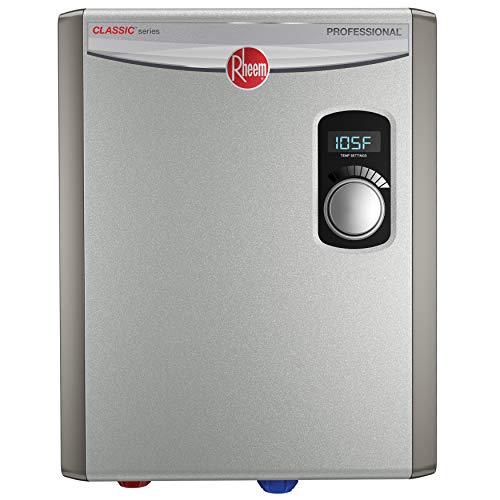
An 18 kW tankless electric heater on 240 volts, rated for up to 4.4 gallons per minute with digital thermostatic control accurate to about one degree. It uses copper immersion elements that are field serviceable and standard 3/4-inch NPT connections at the bottom. At under 15 pounds it mounts on a wall, but it needs a very large dedicated circuit.
What stands out
- Up to 4.4 GPM covers a washer fill easily
- Digital thermostat holds the temperature within one degree
- Copper immersion elements are field serviceable by a plumber
Watch out for
- 75 amps at 240 volts needs a service upgrade
- No storage, so flow rate is the hard limit
Rheem 3.5kW Point-of-Use Thermostatic Tankless Electric Water Heater

A 3.5 kW point-of-use tankless heater on 120 volts, delivering about 0.5 gallons per minute at a temperature adjustable from 80 to 140 degrees Fahrenheit. It needs a 30-amp single-pole breaker and number 10 copper conductors, and the listing recommends a 100-amp service panel. It is positioned for a basement sink, garage workshop or outdoor kitchen, which is exactly the right scale for it.
What stands out
- Runs on 120 volts, no 240-volt circuit needed
- Digital control adjusts the temperature in one-degree increments
- Compact enough to fit under a sink cabinet
Watch out for
- 0.5 GPM is far too low for a washer
- 30-amp breaker is more than a 15-amp circuit
Rinnai REHP80 Electric Heat Pump Water Heater 80 Gallon Energy Star

An 80-gallon heat pump water heater on 240 volts and 30 amps, with 91 gallons of first-hour delivery and a claimed UEF of 3.90 in the specification bullet. It has a glass-lined tank, UL and NSF certification, and zero clearance on top, back and sides. The residential warranty is ten years on tank and parts, but the commercial term drops to one year.
What stands out
- 91-gallon first-hour rating handles a real laundry volume
- Heat pump efficiency cuts the running cost sharply
- Zero clearance on three sides simplifies a closet install
Watch out for
- Needs air volume and a condensate drain line
- Commercial warranty is only one year on tank and parts
VEVOR Electric Water Heater 18-Gallon 1600W Storage Tank with Knob Control
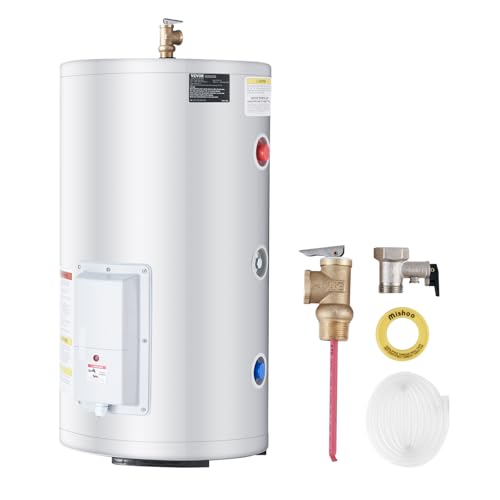
An 18-gallon, 1600-watt storage tank with a rotary control adjustable from 86 to 167 degrees Fahrenheit, an LED display and IPX4 splash protection. The enamel-coated inner tank sits inside 20 mm of foam insulation and a metal shell, and the listing claims heat retention for up to 24 hours. It publishes capacity and wattage but no first-hour rating, which places it in light-duty territory rather than in a laundry with two machines.
What stands out
- 18 gallons fits under a counter or in a cabinet
- Rotary control reaches 167 degrees for sanitizing loads
- 20 mm foam insulation holds heat between draws
Watch out for
- No first-hour rating is published for this tank
- 18 gallons is one washer load at most, not two
Buying guide
What a laundry actually asks of a water heater
The number that matters is not tank capacity. It is the first-hour rating, which measures how much hot water a heater can deliver in an hour starting from a full tank, including the water it reheats along the way. A 30-gallon tank with powerful elements can beat a 50-gallon tank with weak ones, because the rating rewards recovery. Manufacturers publish the figure on the data plate and in the manual, and it is the only fair way to compare a tank, a tankless unit and a heat pump on the same page. If a listing does not publish it, that is a reason to keep looking. A standard 40- or 50-gallon tank often lands near 70 gallons in the first hour, which is less headroom than the tank size suggests.
Then work out your own peak hour. A residential washer uses roughly 20 to 30 gallons of hot water per cycle depending on the model and the temperature setting, and a commercial machine can use more. Two loads back to back with a third within the hour is 60 to 90 gallons, which is a normal Saturday morning in a household with children. If the first-hour rating is below that peak, the third load starts cold, the detergent never dissolves properly, and the whites gradually go grey. Peak hour, not daily average, is the design condition. If you cannot find the draw for your machine, assume 30 gallons per hot wash and you will be close enough to size against.
Tank, tankless or heat pump
A storage tank is simple and forgiving. It holds hot water ready, recovers at a rate set by its elements, and works with a standard 240-volt circuit. Its weakness is standby loss and the fact that a burst draw can outrun recovery. A tankless electric heater never runs out, but it heats only as fast as its elements allow, so flow rate is the constraint: an 18 kW unit delivers about 4.4 gallons per minute, and a 3.5 kW point-of-use model delivers roughly half a gallon per minute, which is a sink, not a washer. Hybrid tanks combine a heat pump with resistive elements for faster recovery. An electric tankless heater concentrates all of its power into a small flow, which is why the electrical service, not the water, usually decides whether one is practical.
A heat pump water heater moves heat from the room air into the tank instead of making it with resistance elements, which is why its efficiency number is so much better. The tradeoffs are real: it needs air volume around it, produces condensate that must drain somewhere, cools and dehumidifies the room it sits in, and recovers more slowly than a big resistive element. It also has a compressor, and a compressor makes noise, which matters if the laundry shares a wall with a bedroom. In a hot, damp laundry the cooling is a bonus; in a cold basement it is a nuisance. Put a heat pump where the noise and the cool air will not bother anyone, and never in a sealed closet with no return air.
Sizing on first-hour rating, with real numbers
The five units here span the range. The GE 30-gallon tank lists 60 gallons of first-hour delivery from a true 30-gallon tank, which covers one to three people and a washer doing a couple of loads. The Rinnai heat pump lists 91 gallons in the first hour from an 80-gallon tank, which is a different class of supply and suits a household of five or a small business with steady demand. The VEVOR 18-gallon tank publishes capacity and wattage but no first-hour figure, which places it in light-duty work. Comparing a tank and a tankless unit on gallon capacity alone is meaningless, because one stores and the other produces on demand. That gap in published data is itself a sorting tool.
For a laundry, pick the unit whose first-hour rating exceeds your peak hour with a margin, then check the recovery time for the next hour. Two washers sharing a 60-gallon first-hour rating will fight each other during a changeover. If the arithmetic is tight, the cheaper fix is usually to stagger the loads rather than to buy a bigger heater, because the electrical upgrade for a larger unit can cost more than the tank. Write the peak-hour number down before you shop, along with the temperature you actually wash at, because a cold wash changes the whole calculation. If your busiest hour is Sunday morning, say so in the sizing, and do not average it across the week. Your plumber will thank you for the number.
Electrical service is where projects stall
The Rheem 18 kW tankless unit draws 75 amps at 240 volts, which is a dedicated circuit most homes do not have spare. The GE tank uses two 5500-watt elements on 240 volts, and the 3.5 kW point-of-use model needs a 30-amp single-pole breaker with number 10 copper conductors on 120 volts. The VEVOR's 1600 watts works out to about 13 amps, which is close enough to the limit of a 15-amp circuit that it deserves its own breaker rather than a shared one, especially in a garage where a freezer may sit on the same run. Wire gauge and run length matter as much as breaker size, and an old 10-gauge run may not be legal for a modern unit.
Before you buy anything, photograph the panel and count the spare slots. An electrician will want to know the service amperage, the wire gauge to the existing heater and the distance to the panel. Upgrading a 100-amp service to 200 amps is a project with permits, and it can cost more than every appliance on this page combined. If the panel is full, a heat pump running on a 30-amp circuit is often the only path that does not require a service change, which is a strong argument for it even before efficiency enters the conversation. A load calculation takes an electrician twenty minutes, and it is the cheapest part of the project. Do it before the old heater dies, not after.
Installation, venting and the warranty trap
A heat pump water heater needs about a thousand cubic feet of air around it in most installations, a condensate drain, and enough clearance for service. The Rinnai listing states zero clearance on top, back and sides, which is unusually generous and worth confirming against the manual before you build a closet around it. Tankless units need clearance for the front cover and room for the water connections at the bottom, and they cannot be installed where the pipes might freeze. Storage tanks need a pan and a drain, plus strapping in seismic areas, because a tank failure is a flood. A drip pan with a drain line is cheap insurance against the day the tank lets go. Check the local code for strapping.
The warranty is where commercial buyers get caught. The Rinnai unit carries a ten-year tank and parts warranty for residential use, but the same listing states one year on tank and parts for commercial applications. Put that machine in a business and the decade becomes twelve months. Read the commercial column for any heater you install in a laundry that serves customers, and budget for replacement rather than assuming the residential terms apply. Flushing sediment once a year and changing the anode rod every few years is the cheapest way to make a tank reach the end of its warranty at all. Labor is usually covered for a shorter period than parts, and the difference matters when a control board fails in year three.
Frequently asked questions
Can a residential water heater serve a commercial laundry?
For a small salon, a bed and breakfast or a gym with a few machines, yes, if the first-hour rating covers the peak. The catch is warranty: most residential heaters drop to a one-year commercial term when installed in a business. Read that clause before you buy, and size with a margin so the unit is not running flat out all day.
How much hot water does a washing machine use per cycle?
A residential washer typically draws 20 to 30 gallons per cycle, depending on drum size and temperature setting. A hot wash on a large machine can approach 30. Commercial machines vary widely. Multiply by the number of loads you run in your busiest hour, and that is the figure your heater has to meet.
Will a tankless heater keep up with back-to-back laundry loads?
Only if the flow rate and electrical service are sized for it. The 18 kW Rheem delivers about 4.4 gallons per minute, which handles a washer fill comfortably. A 3.5 kW point-of-use unit delivers about half a gallon per minute, which is not enough for a washer. Tankless never runs out, but it can be overwhelmed by flow.
What size breaker does the 18 kW Rheem need?
At 240 volts, 18,000 watts is 75 amps, so the unit needs a dedicated circuit rated above that, typically 80 amps, installed by a licensed electrician. Most homes have 100-amp or 200-amp service, and a load calculation decides whether the panel can take it. Do not assume a spare double-pole breaker is enough.
Does a heat pump water heater make the laundry room cold?
Yes, it cools and dehumidifies the air around it, because it moves heat out of the room and into the tank. That is welcome in a hot laundry and unwelcome in a cold basement. It also needs air volume and a condensate drain, so a sealed closet is the wrong location regardless of efficiency.
Verdict
The Rinnai REHP80 is the top pick for a laundry with real volume. Ninety-one gallons of first-hour delivery covers a family or a small business, the heat pump cuts running cost, and the zero-clearance design makes a tight mechanical closet possible. Confirm the efficiency figure, because the title says 4.00 UEF and the specification bullet says 3.90.
The GE 30-gallon tank is the value pick: a standard 240-volt install, 60 gallons in the first hour, Wi-Fi for scheduling, and no condensate to route. The Rheem 18 kW tankless is the upgrade when the panel can carry 75 amps and the laundry never wants to wait. Skip the 3.5 kW point-of-use model for laundry duty; it is a sink heater.