Most people clean the lint screen and call the vent done. The screen catches the big pieces, but the fine dust that passes through it settles on the duct walls, and that is the material that narrows a 4-inch pipe year after year. By the time a dryer starts taking two cycles, the duct is usually the reason.
The tools split into two families: brushes on flexible rods for the wall run, and vacuum attachments for the transition hose and the blower housing. A kit with 35 feet of rods is useless if you cannot reach behind the dryer, and a vacuum nozzle is useless if the duct is packed solid. Most homes need a little of both.
Two of the eight products here are not brushes at all. They are replacement lint filters for LG and Kenmore dryers that happen to ship with a brush. If your screen is torn, that is the right purchase; if your duct is clogged, it is not, and this guide says so plainly.
Below is how the kits differ, what each one actually reaches, and the routine that keeps a duct clear between deep cleans.
Top picks at a glance
Uszily ADQ56656403 Lint Filter Replacement for LG Dryers and WashTowers, Rim w
Check price on AmazonPetOde 2Pcs Dryer Vent Cleaner Kit Universal Vacuum Hose Attachment & Brush
Check price on AmazonSealegend 58-Pieces 35-Feet Dryer Vent Cleaner Kit, Dryer Cleaning Tools
Check price on AmazonCompare the shortlist
| Model | Type | Capacity | Key feature | Amazon |
|---|---|---|---|---|
| 1. Uszily ADQ56656403 Lint Filter Replacement for LG Dryers and Was | Vent | — | Stainless drum | Check price |
| 2. Uszily 5231EL1001C Lint Filter Replacement for LG and Kenmore Dr | Vent | — | Stainless drum | Check price |
| 3. 4 Pieces Dryer Vent Cleaner Kit,Vacuum Hose Lint Cleaner Tool | Hose | — | Quick cycle | Check price |
| 4. PetOde 2Pcs Dryer Vent Cleaner Kit Universal Vacuum Hose Attachm | Hose | — | Connected controls | Check price |
| 5. Sealegend 58-Pieces 35-Feet Dryer Vent Cleaner Kit, Dryer Cleani | Vent | — | Connected controls | Check price |
| 6. Holikme Dryer Vent Cleaner Kit | Vent | — | Low noise | Check price |
| 7. Holikme Dryer Vent Cleaner Kit | Vent | — | Low noise | Check price |
| 8. Holikme Dryer Vent Cleaner Kit | Vent | — | — | Check price |
Detailed reviews
Uszily ADQ56656403 Lint Filter Replacement for LG Dryers and WashTowers, Rim without Felt Seal, Ultra Durable

A replacement lint filter for a long list of LG dryers and WashTowers, sold with a flexible lint brush. The ADQ56656403 has no felt seal along the rim and no ear at the top, which the listing says helps it avoid catching clothes. It measures about 11.2 by 10.9 inches and replaces several cross-referenced part numbers. Measure the old screen before ordering.
What stands out
- Fits a long list of LG dryer and WashTower models
- No top ear, so clothes are less likely to snag
- Includes a flexible brush for the filter slot
Watch out for
- No felt seal, unlike some original LG filters
- Only fits dryers with the exact frame size
Uszily 5231EL1001C Lint Filter Replacement for LG and Kenmore Dryers, Rim with Felt Seal, Ultra Durable Lint S

The 5231EL1001C is a replacement filter for specific LG and Kenmore dryers, with a felt seal around the rim and air holes in the top. It measures about 12.2 by 10.6 by 1.5 inches and ships with a flexible lint brush. The listing is emphatic that it is not universal: if your original filter has no holes in the top, this one will not fit.
What stands out
- Felt seal helps the frame sit tight in the slot
- Air holes match the original LG and Kenmore design
- Brush included for cleaning the lint trap opening
Watch out for
- Fits only a specific list of LG and Kenmore models
- Easy to confuse with the similar W10120998 filter
4 Pieces Dryer Vent Cleaner Kit,Vacuum Hose Lint Cleaner Tool

A four-piece cleaning set built around a flexible vacuum hose and two brushes. The long hose bends into tight spaces behind the dryer, and the brush attachments work on vent slats, coils and the lint trap slot. The parts rinse clean and store in a drawer. It is a hand tool set, not a rod kit, so it reaches the transition hose rather than a long wall run.
What stands out
- Flexible hose reaches behind the dryer without moving it far
- Brushes rinse clean and can be reused indefinitely
- Compact set stores neatly in a laundry drawer
Watch out for
- No rods, so it cannot clean a long wall duct
- Short reach limits it to the first few feet
PetOde 2Pcs Dryer Vent Cleaner Kit Universal Vacuum Hose Attachment & Brush

A two-piece kit with a stretch universal vacuum connector and a long lint brush. The hose is designed to fit most household vacuums, with a 0.4-inch inner height and a 0.73-inch outer height that slips into narrow gaps. The brush also works on refrigerator coils and radiator fins. It is the simplest way to clean the space behind the dryer without pulling the machine out.
What stands out
- Stretch connector fits most standard household vacuum hoses
- Slim profile reaches narrow gaps behind most appliances
- Brush doubles as a coil and radiator cleaner
Watch out for
- No rigid rods, so a wall run is out of reach
- Connector may not seal on oversized vacuum hoses
Sealegend 58-Pieces 35-Feet Dryer Vent Cleaner Kit, Dryer Cleaning Tools
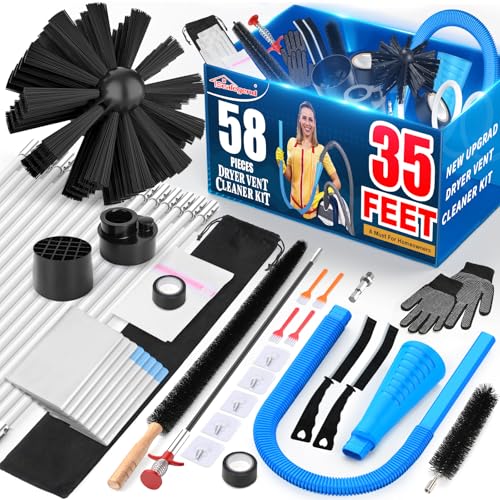
The most complete kit in the batch: 35 feet of flexible rods, a 4-inch brush, a vacuum attachment, a lint trap brush, drill and vacuum adapters, gloves, tape, collection bags and a blockage tool. Rods screw together and can be driven by a drill. The vacuum hose fits most vacuums but not some Dyson and Shark models. It is a whole-system kit rather than a single brush.
What stands out
- 35 feet of rods covers long and upstairs duct runs
- Vacuum adapters let you clear lint while brushing
- Includes gloves, tape, bags and a blockage tool
Watch out for
- Many small parts are easy to lose between jobs
- Vacuum adapter does not fit every Dyson or Shark
Holikme Dryer Vent Cleaner Kit

Holikme's 15-foot kit pairs a 4-inch brush with flexible nylon rods, a drill adapter, a lint brush and gloves. It is aimed at the common layout: a dryer against an outside wall with a short run and one or two elbows. The drill connection speeds up the work, and the whole set packs into a small box. It is the sensible first kit for most houses.
What stands out
- 15 feet covers the typical short wall run
- Drill adapter speeds up the brush without extra tools
- Small box stores easily in a garage or closet
Watch out for
- Too short for second-floor or long horizontal runs
- Single 4-inch head, with no smaller option in the box
Holikme Dryer Vent Cleaner Kit

The same Holikme kit stretched to 35 feet, with a 4-inch brush, nylon rods, a drill adapter, a lint brush and gloves. The extra length suits a dryer that sits well away from the outside wall or a duct that crosses a basement ceiling. Everything else about the kit is unchanged, including the screw-together rods and the clockwise-only drill use.
What stands out
- 35 feet of rods for long or upstairs duct runs
- Same simple screw-together rod system as the short kit
- Drill adapter, lint brush and work gloves included
Watch out for
- Long rod strings are awkward in tight laundry rooms
- Still only one brush diameter in the box
Holikme Dryer Vent Cleaner Kit

Holikme's longest kit at 40 feet, with two brush heads: a 4-inch brush for the duct body and a 1.5-inch brush for tight sections. The rods work by hand or with a drill, and the listing advises turning clockwise and slowing down at corners. It also includes a drill attachment. This is the kit for a ranch house or a duct that takes the long way around.
What stands out
- 40 feet of reach, the longest kit in this batch
- Two brush sizes handle duct body and tight sections
- Works with a power drill or entirely by hand
Watch out for
- Long rods can buckle if pushed hard through elbows
- More reach than most homes will ever need
Buying guide
Two Jobs: the Transition Hose and the Wall Run
The transition hose is the short flexible duct between the dryer outlet and the wall. It is where most lint collects, because it bends, sags and compresses against the back of the machine. A vacuum attachment and a short brush handle it in minutes. The wall run is different: rigid pipe inside the wall, often with two or three elbows, ending at an outside hood. That is the part a 15-foot rod kit reaches in a simple laundry and a 35-foot kit reaches in a house where the vent exits at the far end of the foundation. A 15-foot kit usually covers that job, which is why the short Holikme set is the sensible first purchase for most houses.
Lint does not distribute evenly. It builds at the first elbow after the dryer, in the low sag of a flexible hose and against the outside damper. A brush that only travels straight will miss the elbow ledge where the deposit is thickest. Work from both ends when you can: push rods from the laundry, then remove the outside hood and pull the loosened lint back toward you. A vacuum alone will not break the mat loose, and a brush alone leaves the dust it stirs up inside the duct. Wear gloves and a mask, because the dust that comes out of a duct is fine and unpleasant. Work slowly and let the brush do the cutting, and stop if the rods jam.
Rod Kits: Length, Brush Size and Drill Use
The brush head has to match the duct. A 4-inch brush is right for standard dryer pipe, and the 1.5-inch head on the Holikme 40-foot kit is for tighter runs, older 3-inch pipe or the last few feet near a hood. Rods screw together in sections, and the drill adapter turns the whole string. Turn clockwise only. Reversing the drill unscrews the rods inside the wall, and fishing a lost section out of a duct is a worse job than the cleaning. The Sealegend and both Holikme kits use this pattern. Cheap rods with square-cut threads are the ones that strip, so check each coupling as you add a section, and stop if a brush spins freely without resistance.
Length ratings are measured end to end, not by how far you can push. A 35-foot kit does not clean 35 feet of duct in one pass; the rods flex, and every elbow costs reach. For most houses, a 15-foot kit covers the transition hose and the wall run. The longer kits earn their place in ranches with long horizontal runs, second-floor laundry rooms and any layout where the vent exits well away from the dryer. Buy the length your house needs, not the longest one on the page. Rigid metal pipe is easier to clean than flexible hose, and a short flexible transition at each end is the best compromise. That layout also dries clothes faster. It is worth doing.
Vacuum Attachments Do the Fine Work
A vacuum attachment is a narrow flexible hose that fits between the dryer and the wall and reaches into the blower housing. The PetOde kit uses a stretch connector that fits most household vacuums, with an outer height of 0.73 inches so it slips into narrow gaps. The Sealegend kit includes a similar hose plus a dryer adapter, and the listing notes that it does not fit some Dyson and Shark models. Check your vacuum's hose diameter before assuming an adapter will seal. A shop vacuum with a long hose is easier to manage than a canister balanced on the dryer, and either works if the adapter fits. Tape the joint if it is loose, because a leaky adapter cuts suction sharply.
Suction matters less than contact. A narrow nozzle pulled slowly along the bottom of the transition hose lifts more lint than a wide one waved around. Use the vacuum after brushing, not instead of it: the brush loosens the mat, and the vacuum removes what falls. The same attachment cleans the lint trap slot, the area under the drum and the coils behind the refrigerator, which is why it earns drawer space. A whistling noise usually means the hose is pinched or the adapter is leaking. Do not use the vacuum on a hot drum or while the dryer is running, and let the machine cool first. The lint trap slot is easy to overlook, and it collects a surprising amount.
Lint Screens Wear Out Too
The two Uszily filters are replacements, not cleaning tools. The ADQ56656403 fits a long list of LG dryers and WashTowers, has no felt seal along the rim, and measures about 11.2 by 10.9 inches. The 5231EL1001C fits specific LG and Kenmore models, has a felt seal and air holes in the top, and measures about 12.2 by 10.6 inches. Both include a flexible lint brush. Neither is universal, and the listings are unusually direct about measuring the old screen before ordering. The two parts are easy to confuse, and the listings spell out the differences because buyers get it wrong. Write the part number inside the dryer door; that is the cheapest insurance in this guide.
A screen with a tear, a warped frame or a flattened seal lets lint straight into the duct. That is the quiet beginning of most vent problems, and it is a cheap fix. Measure the old frame, check whether it has a felt seal and whether the top has air holes, then match the part number. Do not buy on the shape in the photo. The included brush is a bonus for the lint trap slot, not a reason to choose one filter over the other. A screen should slide in with light pressure and sit flush when the door closes; if it pops out, the frame is wrong even when the listing says it fits. Return it rather than trimming it.
A Cleaning Routine That Holds Up
Clean the screen every load and wash it with soap and water once a month. Softener film builds a translucent layer that looks clean but blocks airflow, and a quick rinse under the tap does not remove it. Once a quarter, pull the dryer out, disconnect the transition hose and vacuum both ends. Once a year, or whenever cycles lengthen, run the rods through the wall duct, vacuum out the loosened lint and check the outside hood with the dryer running. Mark the calendar, because a reminder matters more than any tool here. Do it before the heating season, when the house is closed up and a slow dryer is most obvious. An hour is normal in a simple layout.
Put the system back together properly. Use foil tape or a proper clamp on the transition hose, not screws driven through the duct, and keep the hose as short and straight as the space allows. Support it so it does not sag. A crushed hose is the most common installation mistake, and it costs airflow every cycle. Leave a little slack so the dryer can slide back without kinking it, then check it after the first load. That check takes a minute. Then watch the next few loads: a dryer that still runs hot, smells scorched or takes longer than before needs a professional, not another brush. Lint is fuel, and a duct fire is the one laundry failure worth spending money to avoid.
Frequently asked questions
How often should I clean my dryer vent?
Clean the lint screen every load, wash it monthly, and inspect the transition hose and outside hood every few months. A full duct cleaning once a year suits most households. Homes with pets, long runs or heavy use may need it twice a year. Lengthening cycles are the signal to do it sooner.
Can I clean a dryer vent without a drill?
Yes. The rod kits turn by hand; the drill adapter only speeds up the work. Hand turning is slower and harder on the wrists in a long run, but it works. Start with short sections and add rods as you go. Never force a brush past a blockage, because the rods can buckle.
Will a vacuum attachment alone clean the duct?
No. A vacuum removes loose lint from the transition hose and blower housing, but it will not break up the mat that clings to the duct walls. Brush first, then vacuum. On a packed duct, the vacuum may barely move anything until the brush has loosened the deposit.
How do I know which lint filter my dryer takes?
Measure the old filter and note whether it has a felt seal and air holes in the top. Then match the part number to your model. The Uszily listings for ADQ56656403 and 5231EL1001C show the dimensions and the differences clearly. A filter that is close but not exact will not seal.
Is a 35-foot brush kit overkill for a small house?
Usually yes. A 15-foot kit handles the transition hose and most short wall runs. Buy the longer kit if the dryer sits far from the outside wall, the vent runs through an attic or the laundry is on a second floor. Extra rods are harmless; paying for reach you never use is not.
Verdict
Top pick: the Sealegend 58-piece kit. It has the 35 feet of rods, the vacuum attachment, the adapters, the lint grabber and the bags, so one box covers the transition hose and a long wall run. Value pick: the Holikme 15-foot kit, which handles the usual short run and costs little more than a single replacement brush.
Upgrade: the Holikme 40-foot kit if your duct is genuinely long, since it adds a 1.5-inch head for tight sections. If your lint screen is torn, skip the brushes and buy the right Uszily filter first; a clean duct behind a leaking screen will not stay clean.