A pilled sweater is not worn out. The fibers on the surface have tangled into small balls, and underneath them the knit is usually sound. A fabric shaver cuts those balls off at the base, which is why ten minutes with one can make a five-year-old cardigan look like it came back from the cleaners. It is one of the few garment-care tools that pays for itself the first time you use it.
The tools themselves are simple: a rotating blade behind a perforated guard, a small motor, and a container for the fuzz. What separates a good one from a bad one is how the guard treats the fabric, how the speed is controlled, and whether the blade is sharp enough to cut rather than tug. A dull blade pulls the knit, and a pulled knit pills again faster than the original surface did.
The seven shavers here range from a two-battery Conair with a two-inch head to rechargeable units with six blades, digital displays and 90-minute runs. The inexpensive ones are not automatically worse, and the expensive ones are not automatically gentler. The notes below separate the useful features from the spec-sheet theater.
We compared specifications, features and owner reports rather than running a lab. Where a maker's claim, such as a precise fabric-texture percentage, cannot be verified from the listing, we leave it out of the recommendation.
Top picks at a glance
Electrolux Rechargeable Fabric Shaver
Check price on AmazonConair Fabric Shaver and Lint Remover, Battery-Operated Portable Clothes Shave
Check price on AmazonBEAUTURAL Fabric Shaver and Lint Remover, Portable Sweater Defuzzer
Check price on AmazonCompare the shortlist
| Model | Type | Capacity | Key feature | Amazon |
|---|---|---|---|---|
| 1. Electrolux Rechargeable Fabric Shaver | Electric | — | Connected controls | Check price |
| 2. Conair Fabric Shaver and Lint Remover, Battery-Operated Portable | Portable | — | Compact footprint | Check price |
| 3. BEAUTURAL Fabric Shaver and Lint Remover, Portable Sweater Defuz | Portable | — | Compact footprint | Check price |
| 4. Sunytree Fabric Shaver, Lint Remover Rechargeable,6-Blade Lint S | Portable | — | Compact footprint | Check price |
| 5. Fabric Shaver, Lint Remover Rechargeable with 3 Speeds, 6 Leaf B | Fabric shaver | — | Low noise | Check price |
| 6. Fabric Shaver, Ziitty Lint Remover for Clothes, Type-C Rechargea | Fabric shaver | — | Quick cycle | Check price |
| 7. Fabric Shaver, Lint Remover Rechargeable, Electric Portable Swea | Portable | — | Quick cycle | Check price |
Detailed reviews
Electrolux Rechargeable Fabric Shaver

A rechargeable shaver with three speeds, a 2,000mAh lithium cell and a USB-C port. The maker claims up to 180 minutes per charge, and the LED screen shows battery level, speed and charging status. It ships with a spare blade, a cleaning brush, a protective cover and a reusable storage box, and it weighs 0.63 pounds. The handle is shaped for a full-hand grip rather than a pen grip.
What stands out
- Maker claims up to 180 minutes of runtime per charge
- LED screen shows battery, speed and charging status
- Spare blade, cleaning brush and storage box included
Watch out for
- At 0.63 pounds it is heavier than battery models
- Needs a USB-C cable and regular charging between uses
Conair Fabric Shaver and Lint Remover, Battery-Operated Portable Clothes Shaver with 3 Settings, Fuzz Remover

A battery-operated shaver that runs on two AA cells and has a two-inch shaving head, three depth settings and a detachable lint catcher. The ergonomic grip is designed for comfortable use over furniture and clothing, and the compact body stores in a drawer. At 0.4 pounds it is light enough to pack, and batteries are easy to replace anywhere. Batteries are not included.
What stands out
- Two-inch shaving head covers sweaters and furniture quickly
- Three depth settings handle several different fabric surfaces
- Runs on AA batteries that are easy to replace anywhere
Watch out for
- Two AA batteries are not included in the box
- No spare blade or rechargeable option is listed
BEAUTURAL Fabric Shaver and Lint Remover, Portable Sweater Defuzzer
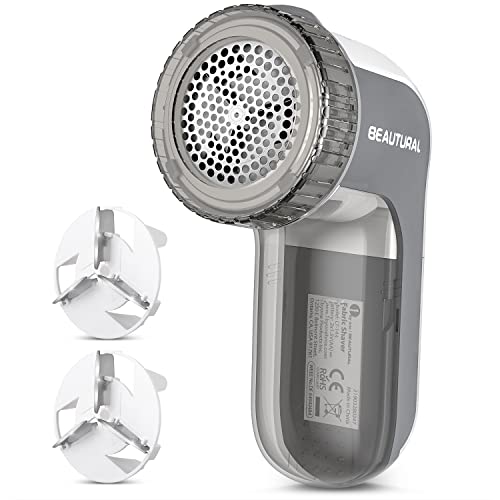
A battery shaver with two speeds, three shaving heights and three hole sizes in the guard, plus an adjustable spacer that keeps the blade off delicate wool. Two spare stainless steel blades are included. The maker lists sweaters, blankets, sheets and upholstery as suitable, but says it is not for removing pet hair. It weighs 0.36 pounds and runs on batteries, which are not included.
What stands out
- Adjustable spacer protects delicate wool from the blade
- Three hole sizes handle small and large pills
- Two spare stainless steel blades included in the box
Watch out for
- Not designed for removing pet hair from fabric
- Battery power feels modest on thick upholstery and coats
Sunytree Fabric Shaver, Lint Remover Rechargeable,6-Blade Lint Shaver

A rechargeable shaver with a 40mm six-blade head and a motor the maker claims turns at 18,000 rpm. It has three speeds, an LCD screen and USB-C charging, and the maker says a 10-minute charge gives 20 minutes of use, with up to 90 minutes from full. Three replacement blades are included, and the unit weighs 156 grams, which is light enough for a carry-on.
What stands out
- Six-blade 40mm head clears pills from heavy fabrics quickly
- Three replacement blades are included in the box
- At 156 grams it is light enough for travel
Watch out for
- 18,000 rpm claim is hard to verify in normal use
- High speed needs a very light hand on fine knits
Fabric Shaver, Lint Remover Rechargeable with 3 Speeds, 6 Leaf Blades, Digital LED Display to Remove Fuzz Lint
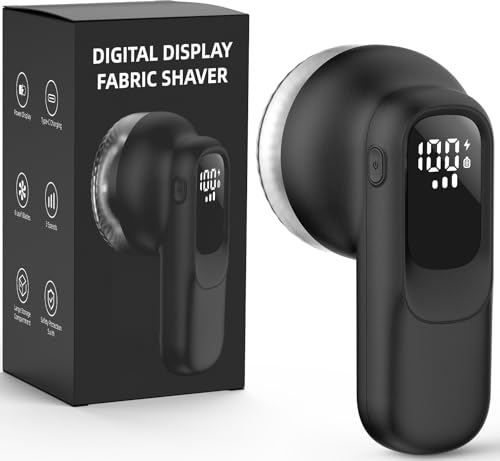
A rechargeable shaver with three speeds, a six-leaf blade and a digital display showing power, speed and charging status. The 800mAh battery charges by USB-C in about 2.4 hours, and the lint container holds 130ml. The maker lists a maximum sound level under 85 decibels and includes three hole sizes in the guard for different pill sizes. It is a full-size handheld rather than a travel tool.
What stands out
- 130ml container holds a sweater's worth of fuzz
- Digital display shows remaining power and speed clearly
- Three hole sizes in the guard for different pills
Watch out for
- The 2.4-hour charge is slow compared with rivals
- The maker's under-85-decibel claim is still fairly loud
Fabric Shaver, Ziitty Lint Remover for Clothes, Type-C Rechargeable Lint Shaver with LCD Display & 6-Blade, Sw

A rechargeable shaver with six stainless steel blades, three speeds and an LCD screen for battery and speed. The stainless steel honeycomb guard has three pore sizes, and a safety lock stops the blade when the lid is open or loose. It charges by USB-C and ships with three replacement blades, a cleaning brush and a cable. The maker pitches it for coats, blankets, sofas and bedding as well as sweaters.
What stands out
- Safety lock stops the blade when the lid opens
- Honeycomb guard has three pore sizes for different pills
- Three replacement blades are included in the box
Watch out for
- Bulkier body than the pen-style shavers sold for travel
- No runtime figure is published for the battery
Fabric Shaver, Lint Remover Rechargeable, Electric Portable Sweater Defuzzer with 3 Speeds, 6 Leaf Blades, Dig

A rechargeable shaver with three speeds, six blades and an LED display. The 1,200mAh battery charges in about two hours and the maker claims three and a half to four and a half hours of use, which is the longest runtime here. The lint container is removable and washable, two spare blades and a cleaning brush are included, and the unit weighs 0.46 pounds. The maker recommends laying the garment flat on a hard surface.
What stands out
- Maker claims 3.5 to 4.5 hours per charge
- Removable lint container can be washed out clean
- Two spare blades and a cleaning brush included
Watch out for
- The long runtime claim assumes use on low speed
- LED display is basic compared with the LCD rivals
Buying guide
Battery or built-in cell: pick the one you will charge
The Conair and BEAUTURAL run on AA batteries; the Electrolux, Sunytree, SHOBES, Ziitty and Peiyuu have built-in lithium cells charged by USB-C. A battery unit is the better choice for a drawer that gets opened twice a winter, because it will still work when you need it and it costs nothing to store. A rechargeable unit is better for weekly use, since it avoids buying batteries and usually delivers more power as the cell drains. Rechargeables also tend to carry larger lint containers, simply because there is more room inside the handle. A battery shaver also runs at full power until the cells fade, while a lithium unit slows as the battery drops, so the last ten minutes feel weaker.
The trade is convenience against waste. Rechargeable shavers need a cable, a free USB port and a little planning; a battery shaver needs two AAs that are never in the house when you want them. If you travel, check the weight and whether the shaver can run while charging. If you have a whole wardrobe to refresh in one sitting, look at the runtime claims: the Electrolux says up to 180 minutes, Sunytree says 90, and Peiyuu says three and a half to four and a half hours from a two-hour charge. Treat all three as best-case figures measured on low speed. Whichever you choose, buy the spare blades at the same time, because model numbers change and blades disappear from sale.
Blade count is not the same as gentleness
Six blades cut faster than three, and every rechargeable unit here except the Electrolux advertises six. More cutting edges mean you can move the shaver faster across a sweater, which reduces the chance of dwelling in one spot and gouging the knit. But the blade is only half the story. The guard, a perforated metal or mesh screen, decides how much fabric can reach the blade, and a fine screen on a slow speed is gentler than a coarse screen on a fast one. Stainless steel blades hold an edge longer than coated steel, which is why spare blades matter as much as blade count. A blade that rattles or chatters is dull or bent, and it will tear rather than cut.
The BEAUTURAL is the clearest example of guard-first design: three shaving heights, three hole sizes and an adjustable spacer that keeps the blade off delicate wool. The Ziitty uses a stainless steel honeycomb shield with three pore sizes, and the Sunytree calls its guard a texture guard. Whatever the marketing name, the test is the same. Run the shaver over the inside of a hem first, watch whether it cuts pills cleanly or snags a loop, and only then move to the visible surface. A guard that snags on the test patch will snag on a collar. If the guard is removable, take it off and brush the underside after every second use; clogged holes stop cutting long before the blade wears out.
Speeds, and why the lowest setting matters
Three speeds have become standard, and the low setting is the one you will use most. Cashmere, fine merino and loosely knit acrylic need the slowest speed and the lightest touch, because the fibers are long and easy to catch. Medium suits cotton knitwear, sweatshirting and furniture. High is for thick wool coats, blankets and upholstery that has pilled into hard balls. Starting on high because it is faster is how people put a bald patch in a sweater, and the patch does not grow back. A garment washed with fabric softener can be slippery, so work more slowly than usual. Wool coats need the high setting and a firm, flat surface underneath, and a loose wrist helps more than pressure.
Speed also interacts with pressure. Pressing down does not cut more; it pushes the fabric into the guard and increases the chance of a snag. Let the head glide, work in small circles, and stop when the pills are gone rather than when the surface is perfectly smooth. On a dark garment, check the result under a bright light, since a shaved sweater can look slightly lighter where the surface fibers have been cut. That is normal and settles after a wash. Overlap your passes by half a head width so you do not leave stripes. A lint brush is not a substitute, because it flattens pills instead of removing them. Wash the garment after shaving to lift any loose fibers.
What a fabric shaver will not fix
A shaver removes pills; it does not repair a thin knit. If the fabric has worn into a hole, or the surface feels papery where the pills were, shaving will make the damage more obvious. It also does not remove pet hair, and BEAUTURAL says so directly in its listing. Hair wraps around the blade and smears across the guard, so use a lint roller or a rubber glove for hair and keep the shaver for pills. Neither tool lifts embedded hair from a dense weave, and a shaver clogged with hair cuts poorly until it is cleaned. Pills around cuffs and underarms are usually the first sign, because those areas rub most. Shave them last, after the flat panels.
Pilling usually returns, because the conditions that created it, friction and loose surface fibers, have not changed. Shaving buys a season or two, not a permanent fix. Garments that pill badly are often made from short-staple fibers or loose blends, and no tool changes that. The realistic goal is to keep a favorite sweater wearable for another winter, not to restore it to new. If a sweater pills within a week of shaving, the knit is the problem, not the shaver, and further passes will only thin the surface. Expect to repeat the job once a season. A shaver is a maintenance tool, not a cure, and the sweaters that respond best are the ones with tight, dense knits. That is the honest limit of the tool.
Containers, noise and the blade you cannot see
The lint container is the feature people underestimate. The SHOBES lists a 130ml box, which is large enough to finish a sweater without stopping, and the Conair uses a detachable catcher that empties from the head. Small containers fill fast and compact the fuzz, so you end up opening the shaver every few minutes. A container that can be rinsed is better still, because the fine dust clings to plastic and smells stale after a few weeks. Empty it over a bin rather than a sink, since the fuzz clumps and blocks a drain once it is wet. A clear window on the container sounds trivial until you own one; it tells you when to stop and empty. Without it you judge by sound, which is unreliable.
Noise is the other daily annoyance. The SHOBES lists a maximum of 85 decibels, which is roughly the level of a kitchen blender on low, so it is not a silent tool. Blade replacement is the long-term cost: the Electrolux, BEAUTURAL, Sunytree, Ziitty and Peiyuu all include spare blades, and the Conair does not list any. Replace the blade when the shaver starts pulling, when you have to press harder, or when the cut looks ragged rather than clean. A fresh blade is cheaper than a replacement sweater. Store the shaver with the guard in place so the blade cannot be knocked against a drawer, and never oil the blade, because lint sticks to oil. Rinse the container in warm water rather than hot.
Frequently asked questions
Do fabric shavers ruin sweaters?
Not when used with the right guard and a light hand. The risk is pressing hard, using a high speed on a delicate knit, or holding the blade in one spot. Test on an inside hem first, keep the head moving and stop while the surface still has some texture. A shaver removes surface fibers, so a very thin knit will always be at risk.
Can I use a fabric shaver on cashmere?
Yes, on the lowest speed and with minimal pressure, after testing an inside seam. Cashmere fibers are long and fine, so a coarse guard or a fast blade can catch a loop and pull it. Use a fine mesh guard, work in small sections and stop before the surface looks polished. If the cashmere is already thin at the elbows, leave those areas alone.
Will a fabric shaver remove pet hair?
No, and BEAUTURAL says so in its listing. Pet hair wraps around the blade and smears across the guard instead of being cut, and it can clog the container quickly. Use a lint roller, a rubber glove or a damp sponge for hair, and keep the shaver for pills and fuzz. Trying to shave hair off a sofa usually makes the mess worse.
How often should I replace the blades?
There is no fixed interval, because it depends on how much you shave. Replace the blade when the shaver starts pulling the fabric, when you have to press harder to get results, or when the cut leaves ragged edges instead of clean pills. Spare blades are included with most rechargeable models here, so keep one on hand and change it at the first sign of tugging.
Is a rechargeable shaver better than a battery one?
For weekly use, yes: it is more powerful, avoids battery waste and usually has a larger lint container. For occasional use, a battery model is the smarter buy because it does not self-discharge in a drawer. If you travel, check the weight and whether the unit can run while charging. Either type works; the difference is how often you remember to power it.
Verdict
The Electrolux earns the top spot for most households. It has three speeds, a 2,000mAh cell the maker rates at up to 180 minutes, a clear LED display and a USB-C port, and it ships with a spare blade, a brush and a protective cover in a storage box. The Conair is the value choice: two AA batteries, a two-inch head, three depth settings and a detachable catcher for very little money.
The Sunytree is the upgrade for anyone with a lot of pilling to clear, with six blades, a 40mm head and a claimed 18,000 rpm motor. Choose the BEAUTURAL instead if you want the most adjustable guard for delicate knits, and the Peiyuu if runtime matters more than a digital display.