Budget front loaders have a reputation problem, and it is only half earned. The half that is true: below this line you give up drum size, quiet hardware, and sometimes a national service network. The half that is not: the wash action itself is the same physics at every price. A drum turns, clothes fall through a shallow pool of water, and gravity does the work. Nobody has invented a better way to clean a shirt.
What actually changes as you move down the market is the cabinet, not the cleaning. Thinner steel, lighter counterweights, fewer suspension components, plastic where metal used to be. That shows up as noise, as walking across the floor during a spin, and as a shorter life if you routinely stuff the drum past full.
There is a second surprise in this band: most of what you can buy is compact, not full-size. The 4.0 cubic foot machines here are the big ones. Several are 2.2 to 2.5 cubic feet, which is a genuine load-size decision rather than a spec-sheet detail, and one of these listings publishes dimensions that do not describe the machine at all.
We compared specifications, features and owner reports across the group, and read the listings closely enough to catch the places where the data contradicts itself. That matters more in this band than in any other.
Top picks at a glance
TABU 4.0 Cu.Ft. Front Load Washer with 15 Washing Cycles, Black
Check price on AmazonMuhub Compact Front Load Washer 4.0 Cu. Ft. for Apartments & RVs Black
Check price on AmazonAvanti 2.2 Cu. Ft. Front Load Washing Machine Compact Freestanding or Stackabl
Check price on AmazonCompare the shortlist
| Model | Type | Capacity | Key feature | Amazon |
|---|---|---|---|---|
| 1. TABU 4.0 Cu.Ft. Front Load Washer with 15 Washing Cycles, Black | Front-load | 4.0 cu ft | Sanitize cycle | Check price |
| 2. Muhub Compact Front Load Washer 4.0 Cu. Ft. for Apartments & RVs | Front-load | 4.0 cu ft | Steam | Check price |
| 3. Avanti 2.2 Cu. Ft. Front Load Washing Machine Compact Freestandi | Front-load | 2.2 cu ft | Steam | Check price |
| 4. TABU 2.5 Cu.Ft. Front Load Washer with 15 Washing Cycles, Black | Front-load | 2.5 cu ft | Sanitize cycle | Check price |
| 5. West Bend Washer Compact Front Load Washing Machine with 15 Wash | Front-load | 2.2 cu ft | Quick cycle | Check price |
Detailed reviews
TABU 4.0 Cu.Ft. Front Load Washer with 15 Washing Cycles, Black
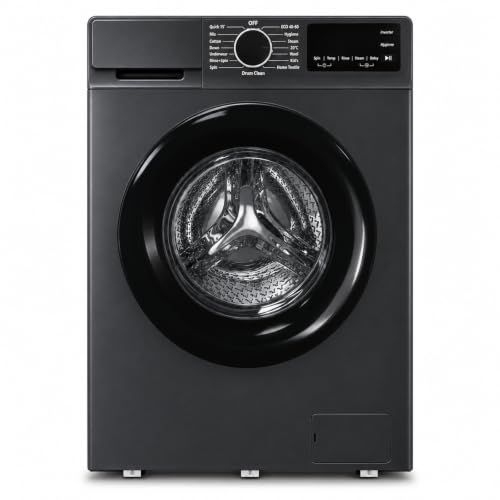
A 4.0 cubic foot front loader in a 23.4-inch cabinet, which is the largest drum you can get in this compact class. Fifteen cycles cover quick, high-temp, cotton, wool, underwear and drum clean, and the LED panel adds delay start and a child lock. It is stackable with a compatible dryer, sold separately. Nothing here is fancy; the drum size is the argument.
What stands out
- Four cubic feet in a cabinet under 24 inches wide
- Fifteen cycles including high temp and drum clean
- Delay start and child lock on a simple panel
Watch out for
- No steam cycle offered on this particular model
- Stacking dryer is sold separately and brand specific
Muhub Compact Front Load Washer 4.0 Cu. Ft. for Apartments & RVs Black

The most complete machine in this group: 4.0 cubic feet, fourteen cycles, and steam and hygiene programs that the cheaper 4.0 does without. The inverter motor keeps wash and spin noise down, and the stainless drum should outlast a coated one. Its cabinet is listed at 23.62 inches wide and 33.46 tall, so measure the opening rather than trusting the round number.
What stands out
- Steam and hygiene cycles at a compact size
- Inverter motor keeps wash and spin noise low
- Stainless steel drum resists rust in damp rooms
Watch out for
- Listing width differs slightly from the feature copy
- Control panel is busier than it needs to be
Avanti 2.2 Cu. Ft. Front Load Washing Machine Compact Freestanding or Stackable Washer with 15 Wash Cycles, LE

Avanti's 2.2 cubic foot compact, with fifteen automatic cycles, five water temperatures and five spin speeds. It adds a steam wash and a stainless steel tub, which is unusual at this size, and the see-through door lets you watch a cycle without stopping it. At 33.25 inches tall it slides under a counter, and it can run freestanding or stacked.
What stands out
- Steam wash and stainless tub at 2.2 cubic feet
- Five wash temperatures and five spin speeds to choose from
- Fits under a standard counter at 33 inches
Watch out for
- 2.2 cubic feet will not take a comforter
- At 164 pounds it takes two people on stairs
TABU 2.5 Cu.Ft. Front Load Washer with 15 Washing Cycles, Black
The 2.5 cubic foot TABU, sharing its fifteen-cycle layout with the larger 4.0 but giving up drum volume for a shallower cabinet. That makes it a candidate for hallway closets and narrow utility rooms where depth is the binding constraint. The listing gives 17.72 inches of depth, which is shallow even for a compact, so verify against the manufacturer's drawing before you build around it.
What stands out
- Smaller footprint suits closets, hallways and narrow alcoves
- Same fifteen-cycle set as the larger TABU, in less space
- Child lock and delay start are both included here
Watch out for
- 2.5 cubic feet limits bedding and big towels
- Published depth looks too shallow for a washer
West Bend Washer Compact Front Load Washing Machine with 15 Wash Cycles, LED Display, See-Through Door, Stacka

West Bend's 2.2 cubic foot compact, listed with fifteen cycles, five temperatures, five spin speeds, a see-through door and a stackable design. The feature copy is word for word the same as the Avanti, which suggests a shared platform with a different badge. Its listed dimensions and 110-pound weight do not match a washer of this capacity, so confirm the real cabinet size.
What stands out
- Compact 2.2 cubic foot drum for small spaces
- Stackable or freestanding, with a see-through loading door
- Fifteen cycles and five temperature settings are listed
Watch out for
- Listing dimensions and weight both appear to be incorrect
- Feature set duplicates the Avanti almost word for word
Buying guide
What This Band Actually Buys: Compacts, Not Stripped Full-Sizers
The first thing to understand is that this is not a cheaper version of the previous article. A full-size front loader is 27 inches wide and holds 4.5 cubic feet. Most of what sits in this price range is a compact: 23 to 24 inches wide, 2.2 to 4.0 cubic feet, built for apartments, closets, RVs and guest houses. The two biggest machines here reach 4.0 cubic feet, which is close to a small full-size washer from a decade ago and genuinely usable for a household of three. Below that, capacities cluster at 2.2, 2.5 and 2.7, and the differences between them are smaller than the numbers suggest. The two 4.0 models are the only ones here that will take a queen comforter without a fight.
The trade is not mainly cleaning performance. It is cycle time, spin speed and the drum's ability to take a comforter without a fight. A 4.0 cubic foot compact will wash a queen comforter; a 2.2 will not, and no amount of clever loading changes that. If your laundry includes bedding every week, stay at 4.0. If it is clothes, towels and the occasional sheet, the smaller machines do the job and fit where nothing else will. Buy the drum you need and spend the rest on a machine that does not walk. Capacity is the one specification you cannot fix later, so it deserves more attention than the cycle list.
Measure Twice: Doors, Closets and 24-Inch Cabinets
Compact washers are sold on their footprint, so the footprint is the thing to verify. The models here run about 23.4 inches wide, with depths from roughly 18 to 23 inches and heights around 33 inches. That height matters: 33 inches fits under a standard counter, which is why so many of these end up in kitchens and hallways rather than laundry rooms. The listed depth on one TABU model is 17.72 inches, shallower than the rest, so confirm it before you plan a cabinet around it. Cabinet dimensions in marketplace listings are frequently copied from the wrong variant. If the machine goes into a closet with a bifold door, that door may have to come off during the install and go back on afterward.
Then measure the path, not just the hole. A 23-inch cabinet still needs the door open past 90 degrees, plus a few inches behind for the inlet hoses and the drain. In a closet, the door has to swing somewhere, and a machine pushed tight against a side wall will transfer spin vibration into the frame. Leave an inch on each side, and if the machine sits under a counter, check that the control panel does not foul the overhang as you slide it in. Lift the machine onto a dolly rather than dragging it; the feet bend easily. A slight slope in the floor shows up as a drift during the spin, not during the fill, so check with a level before you commit to a spot.
Water, Drain and Power in a Rental
Almost everything in this group runs on a standard 120-volt household circuit, which is what makes compact washers viable in apartments. Check the plug type and whether the outlet is shared with a kettle or a microwave; a washer drawing power mid-cycle on an overloaded circuit is a nuisance you only discover at 9 p.m. on a Sunday. A dedicated circuit is ideal, and a GFCI outlet near water is not optional in most jurisdictions. Do not run the machine from an extension cord or a power strip, however tempting the reach of the cord. Read the breaker panel label before you assume an outlet is dedicated to the laundry.
Plumbing is the other half. These machines fill from a cold supply and drain into a standpipe or a sink, and the drain hose needs a high loop so dirty water cannot siphon back into the drum. If you are installing in a rental, a temporary connection to a laundry sink is common, but the hose must be secured or it will jump out under pressure and spray the floor. Check whether the machine is cold-fill only before you plan around a hot connection you may not need at all. Ask the landlord before you tap a standpipe, because some leases prohibit it outright.
Spin Speed and the Drying Bill
The spin is where an inexpensive washer costs you money later. Water left in the fabric has to be evaporated by the dryer, and the dryer is the most expensive appliance in the laundry room to run. A faster, better-balanced spin leaves clothes closer to damp than soaked, which shortens every dry cycle that follows. That is why a machine rated for a high spin speed is worth more than one with an extra wash program, provided the suspension can handle it without walking across the floor. Check the spin rating in revolutions per minute, then check whether the machine has balance correction to go with it.
Compact machines vary widely here, and the listing rarely tells you how well the suspension copes at maximum speed. Read owner reports for complaints about banging and wandering rather than for star ratings. A machine that shakes at 1,200 rpm in a second-floor apartment will be run at 800 rpm forever, and the theoretical advantage disappears. If you dry on a rack or a line, spin speed matters less and gentleness matters more. If you use a dryer, pay attention. A drum that stays balanced at speed is worth more than one that reaches a higher number on paper and rattles the cabinet apart doing it.
Build, Warranty and What to Check on Delivery
At this price the cabinet is lighter, and lighter cabinets move. Before the first wash, remove the shipping bolts — all of them — level the machine with a spirit level on the top edge, and lock the feet. Run an empty cycle with a cup of white vinegar to clear manufacturing residue, then check for leaks at both hose connections while it fills and again while it drains. Do that in the first week, while returns are still simple, rather than in month four when the retailer has moved on. Photograph the serial plate and the inside of the drum before the first wash; it makes any later claim much easier to argue.
Warranty terms matter more here than on premium machines, because parts availability is the real risk. One year on the whole machine is typical, with longer coverage on the motor or drum from some brands. Keep the receipt and register the product the week it arrives. If a control board fails in year three and nobody stocks it, the warranty length is irrelevant, which is why the machines with the widest parts network are worth a premium even in a budget guide. Service coverage thins out fast outside metro areas, so check whether the brand lists an authorized servicer near you before the pump fails.
Frequently asked questions
Is a 2.2 cubic foot washer enough for two people?
Usually yes, if you wash every few days rather than weekly. A 2.2 cubic foot drum holds a small-to-medium load: a couple of days of clothes for one person, a set of towels, or a few shirts. It will not take a comforter. Two people who batch a week of laundry into one session should look at the 4.0 cubic foot machines instead.
Can these compact washers be stacked with a dryer?
The TABU and Avanti models are listed as stackable, but stacking is brand and model specific. You need a kit designed for the pair, and the dryer usually has to be the matching unit. Do not assume a universal bracket will work. If stacking is the plan, buy the pair together so the widths and mounting points match.
Do compact front loaders need a special outlet?
They run on ordinary 120-volt household current, which is one reason they suit apartments. What matters is the circuit: a shared kitchen circuit may trip when the washer and a microwave run together. A dedicated circuit is best, and a GFCI outlet is required near water in most places. Check the plug shape before delivery.
Why do some listings show impossible dimensions?
Marketplace listings are often populated from a feed, and feed errors are common. A 2.2 cubic foot washer listed at 44 inches tall and 110 pounds is almost certainly wrong, because compact washers of that size typically weigh closer to 160 pounds. Treat any single source as a claim and confirm the cabinet size with the manufacturer before ordering.
How long should a budget front loader last?
Five to eight years is a realistic expectation with regular use, and rather less if the drum is routinely overloaded. The common failures are drain pumps, door boots and control boards, not drums. Cleaning the pump filter, leaving the door ajar to dry the gasket and running a hot drum-clean cycle monthly will do more for lifespan than any feature on the spec sheet.
Verdict
The Muhub 4.0 is the pick. It fits a 4.0 cubic foot drum and a steam cycle into a 24-inch cabinet, adds a quiet inverter motor and a stainless drum, and covers fourteen programs without pretending to be a full-size machine. The Avanti 2.2 is the value pick for anyone with a genuinely small space: fifteen cycles, five temperatures, steam and a stainless tub in a body that slides under a counter.
Choose the TABU 4.0 if you want the largest drum in the band and do not care about steam. Choose the 2.5 cubic foot TABU if one person is doing the laundry and the machine lives in a closet. And be honest about the ceiling: nothing here matches the suspension and drum of a 27-inch washer, so if floor space allows one, that is the real upgrade.