A pair of floor-length curtains is the largest thing most people ever steam. Two 96-inch panels carry more fabric than a king-size duvet, and unlike a duvet they are already hanging, often above a radiator, a sofa or a window that cannot get wet. That combination of volume and verticality is what separates a steamer that can handle curtains from one that merely claims to.
The practical problems arrive in a predictable order. First the tank runs dry halfway up the second panel. Then the hose kinks, or the head spits brown water onto a cream lining. Then your shoulder gives out from holding a two-pound handheld above your head. Finally you notice the creases at the header are still there because you worked from the hem upward.
An upright with a tall pole, a hose long enough to reach the rod and a tank measured in hours rather than minutes solves three of those four. The fourth is technique, and it is easy to learn. The eight models below range from a 1,300-watt Jiffy that has lived in alterations rooms for decades to a 1,875-watt handheld that is better suited to a single cafe curtain.
If you steam curtains once a year, a mid-size upright will do. If you have sheers, blackout lining and a cat, read the section on water before you buy anything.
Top picks at a glance
SALAV Heavy Duty Commercial Full-Size Garment Steamer with Foot Pedals and Ext
Check price on AmazonDUMOS Garment Steamer for Clothes Standing, 1500W Efficient Clothes Steamer St
Check price on AmazonJiffy Steamer J-4000 Garment Steamer with Plastic Steam Head, 120 Volt, 20 x 1
Check price on AmazonCompare the shortlist
| Model | Type | Capacity | Key feature | Amazon |
|---|---|---|---|---|
| 1. SALAV Heavy Duty Commercial Full-Size Garment Steamer with Foot | Garment steamer | — | Steam | Check price |
| 2. Conair Handheld Garment Steamer for Clothes, Turbo ExtremeSteam | Portable | — | Steam | Check price |
| 3. J-2S Jiffy Garment Steamer with Plastic Head and Stainless Steel | Garment steamer | — | Steam | Check price |
| 4. Rowenta Pro Style Standing Steamer 30g/min 45-Sec Heat-Up, 1500W | Ironing | — | Steam | Check price |
| 5. Jiffy Steamer J-4000 Garment Steamer with Plastic Steam Head, 12 | Garment steamer | — | Steam | Check price |
| 6. DUMOS Garment Steamer for Clothes Standing, 1500W Efficient Clot | Garment steamer | — | Steam | Check price |
| 7. Jiffy Steamer J-2000 Jiffy Garment Steamer with Plastic Steam He | Garment steamer | — | Steam | Check price |
| 8. SALAV Professional Grade Garment Steamer for Clothes w/Smart Aut | Garment steamer | — | Steam | Check price |
Detailed reviews
SALAV Heavy Duty Commercial Full-Size Garment Steamer with Foot Pedals and Extra Large 3L (101.5 oz) Water Tan

A commercial upright with 1,800 watts and a 3-liter tank, built for boutiques but equally at home in a room with tall windows. The foot pedal starts steam without your hand leaving the curtain, and the low-water alert beeps for 90 seconds before the unit shuts itself down. It rolls on casters and the pole collapses for storage. That alert matters when you are up a ladder.
What stands out
- Foot pedal leaves a hand free to steady the panel
- A 3-liter tank covers a full room of curtains
- The low-water alert prevents a dry-boiler sputter mid-panel
Watch out for
- Its large base needs a permanent storage corner at home
- No dedicated low-steam setting for sheer voile or lace
Conair Handheld Garment Steamer for Clothes, Turbo ExtremeSteam 1875W Fabric Steamer, Portable Handheld Design

A 1,875-watt handheld with a 7.3-ounce tank, a 40-second heat-up and a quilted aluminum plate plus creaser. The three attachments include a silicone band for tension and a spacer for delicate cloth. It is useful for the top of a single panel or a cafe curtain, but 20 minutes of steam does not stretch to a full window. It is a touch-up tool rather than a room-sized solution.
What stands out
- Light enough to work overhead without tiring your arm
- The silicone band helps hold a stubborn pleat steady
- A 40-second heat-up is handy for quick curtain refreshes
Watch out for
- About 20 minutes covers roughly one full-length curtain panel
- Plate can flatten a soft pleat if pressed
J-2S Jiffy Garment Steamer with Plastic Head and Stainless Steel Face, 120 Volt,Grey

A compact Jiffy with a 1,300-watt stainless element, a die-cast brass housing and steam in about a minute. The plastic head has a stainless face, which resists scorching when you work close to a hem. Water comes from a separate bottle with a check-valve cap, and a fusible link shuts the heater down if it overheats. It is happiest on a windowsill job rather than a bay window.
What stands out
- The stainless steel face stands up to close work
- Simple controls and a fast one-minute start from cold
- A repairable build that is backed by US-based support
Watch out for
- Its separate bottle needs refilling during longer curtain panels
- No pole, so the base must sit near the window
Rowenta Pro Style Standing Steamer 30g/min 45-Sec Heat-Up, 1500W, IS3440
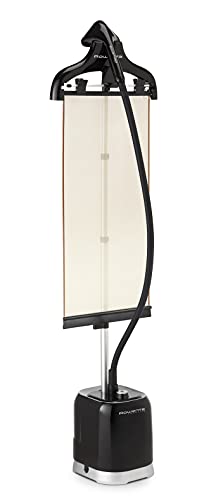
A 1,500-watt upright rated at 30 grams per minute, with a 51-ounce removable tank, three steam settings and an XL Delta head. The Steam and Press support gives you a vertical surface to press a pleat against, and the anti-calc function matters if your tap water is hard. A thick fabric brush is included for heavier weaves. It is the most controllable upright in this group.
What stands out
- Three steam settings make sheer and lining work much safer
- The Steam and Press support helps set crisp pleats
- The anti-calc function protects steam output over the years
Watch out for
- The 51-ounce tank needs a refill partway through a room
- Tall frame takes up floor space when stored
Jiffy Steamer J-4000 Garment Steamer with Plastic Steam Head, 120 Volt, 20 x 11 x 64, Gray
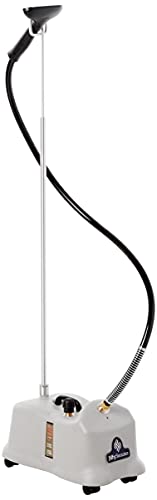
Jiffy's heavier domestic model, with a 1,500-watt incoloy element, a six-inch plastic head and a 5.5-foot rubber hose. The hose is the point here: it lets the base sit across the room while you work along a rod. Standby and steam settings keep the boiler ready between panels, though Jiffy specifies 15 minutes to reach standby. It is a machine for a planned session, not a whim.
What stands out
- The 5.5-foot hose reaches across a wide bay window
- Standby setting avoids a full reheat between panels
- Six-inch head covers a pleat in one pass
Watch out for
- A fifteen-minute warm-up demands a little forward planning
- Its heavy base is awkward to carry up a flight of stairs
DUMOS Garment Steamer for Clothes Standing, 1500W Efficient Clothes Steamer Standing, 1.7L Water Tank for 55 M

A 1,500-watt standing steamer with a 1.7-liter tank rated for 55 minutes, a 45-second heat-up and four named fabric settings. The three-section pole reaches 63 inches and the body weighs just over eight pounds, so it moves between rooms without a struggle. Two clips are included for holding fabric steady. It is the lightest upright model in this group.
What stands out
- Four settings give a lower option for sheers
- Just over eight pounds is easy to reposition
- 55 minutes covers a standard pair of panels
Watch out for
- 63-inch pole is short for very high rods
- Its steam density trails the 1,800-watt machines here
Jiffy Steamer J-2000 Jiffy Garment Steamer with Plastic Steam Head, 120 Volt, Beige

The J-2000 uses a 1,300-watt brass-element boiler, a six-inch plastic head and a three-quarter-gallon tank rated for 1.5 hours of steam. Heat-up takes about two minutes. There is no pole; the unit is a base and hose, which suits a room where the curtains are already at working height. A fusible link provides automatic shut-off. It is the least fussy machine in this group.
What stands out
- 1.5 hours of steam per filling is hard to beat
- Its six-inch head speeds up large flat curtain panels
- It is simple, quiet and built for daily trade use
Watch out for
- No pole, so high rods still need a ladder
- There are no steam settings for delicate sheers or voile
SALAV Professional Grade Garment Steamer for Clothes w/Smart Auto-Off, XL 3L (101.5 oz) Water Tank, Strong 180

SALAV's 1,800-watt professional upright pairs a 3-liter tank with foot-pedal control and a 70.5-inch adjustable pole. The low-water alert beeps for 90 seconds before the unit powers down, and the wheels roll in any direction. It is the tallest machine here, which is exactly what a floor-length panel asks for. The tank detaches for filling and the pole collapses.
What stands out
- 70.5-inch pole reaches the rod without a ladder
- Foot pedal keeps one hand on the fabric
- 3-liter tank finishes a room on one fill
Watch out for
- Twelve pounds plus water is a two-hand lift
- No dedicated low setting for sheer or lace panels
Buying guide
Curtains are a square-footage problem
A garment steamer is sold on garment counts, but curtains are measured in square feet. Two lined panels on a wide window can present forty square feet of cloth on the face alone, and every inch of it has to be reached from a standing position. That is why the tank specification matters more here than anywhere else in the category. Seven ounces gives you 20 minutes, which is one panel if you are quick. A 1.8-liter tank gives an hour. The Jiffy J-2000 gets 1.5 hours from three-quarters of a gallon, and the 3-liter SALAV models hold the biggest reserve even though their listings do not quote a run time.
Refilling mid-panel is worse than it sounds. The head cools, condensate collects in the hose, and the first few seconds after restart are when a machine is most likely to spit. Plan the job in panels rather than rooms: fill once, steam the left panel from header to hem, then the right. If you must stop, hang the head above the fabric and let it run for ten seconds before you bring it back to the cloth.
Reach decides whether the job is pleasant
Curtain rods sit high, often above a window that leaves no room for a step stool. A pole that extends to 70 inches, as the SALAV Professional does, puts the head at rod height without a ladder. The Rowenta reaches just over 63 inches, the DUMOS 63, and the Jiffy J-2000 is a squat base that relies on its hose rather than a pole. Working overhead with a handheld is possible for one panel and miserable for four.
Hose length is the other half of reach. Five and a half feet, as on the Jiffy J-4000, lets the base sit against the opposite wall while you work along a bay window. Shorter hoses force you to drag the unit, which is where casters earn their keep. Check where the nearest outlet is before you start; a long cord and a short hose is a frustrating combination, and extension leads across a doorway are a trip hazard with a hot appliance in your hand.
Water on cream linen is unforgivable
Curtains hang in place, so a drip cannot be rinsed out in a sink. It dries where it lands, and on lined cotton or linen it leaves a watermark at eye level. The usual cause is a head held too close, a tank filled past the line, or a hose with a low sag that traps water. Keep the head a couple of inches off the cloth, fill to the mark and lift the hose into a gentle arc while you work. A heated soleplate helps, but only if you keep it moving.
Blackout and thermal linings are less forgiving than the face fabric. They are often coated, and they hold moisture against the coating rather than letting it pass. Use the lowest setting that produces steam, work in short passes and let the panel dry fully before you close the curtains, or you will trap damp between the layers. Sheer voile is the opposite: light enough that a strong burst can blow it away from the head, so use one hand to steady the fabric and the other to steer.
Pleats, headers and working top to bottom
Start at the header and work down. The pleats at the top are where creases from storage are deepest, and they are also the part of the curtain people see first. Steam the pleat from the inside, pinch it lightly to set the fold, and let it cool before you move on. Working upward from the hem pushes damp air into the header and leaves the bottom of the panel over-steamed, which is how curtains end up with wavy hems.
Do not stretch the fabric while it is hot. Curtains are heavy, and a panel that is pulled sideways while damp will dry out of shape. Let the weight of the hem do the straightening, steam the lining separately if it is a separate layer, and leave the curtains hanging with the window closed until they are dry. If the hem still curls, a light pass with the head held further back is safer than a second soaking.
Dust and odor come before steam
Steam does not remove dust; it can bake it into the weave. Vacuum the panels first with an upholstery attachment on low suction, working from the top down and supporting the fabric with your free hand. Kitchen curtains carry grease that steam will spread rather than lift, and cigarette smoke has penetrated the fibers in a way no steamer can reverse. In both cases, wash or dry clean first and steam afterward to restore the drape.
Odor is a separate issue. Steam can freshen curtains that smell faintly of cooking or closed rooms, but it will not sterilize mold or remove pet accidents. If you see dark spots along a hem or behind a lining, stop and have the curtains cleaned properly. Sun damage is permanent as well; steam will not bring back a faded edge, and heat can make the decay worse. Know when the job is cleaning and when it is presentation.
Frequently asked questions
Can I steam curtains while they are still hanging?
Yes, and that is the usual method. Work from the header down, hold the head a couple of inches off the fabric and keep the hose above the head so condensate runs back toward the machine. Close the window and let the panels dry in place. Take them down only if they need washing or the lining is badly creased.
Will steaming shrink curtains?
It can, depending on the fiber. Loose linen and some rayons may shrink slightly with heat and moisture, and lined panels can pucker if the face and lining shrink differently. Test a hidden corner first, use the lowest steam setting and avoid soaking the cloth. If the label says dry clean only, follow it.
How do I steam sheer curtains without damaging them?
Use the lowest setting, keep the head several inches away and steady the fabric with one hand so it does not blow into the steam. Work in short passes and stop before the voile looks damp. A handheld is easier for a single sheer panel; an upright with a wide head is too much for lightweight fabric.
Is a handheld steamer enough for curtains?
For one cafe curtain or a quick refresh, yes. A 7-ounce tank gives about 20 minutes, which is roughly one full-length panel. For a whole room you will refill several times and your arm will tire above shoulder height. A standing model with an hour or more of steam is the practical choice.
How often should curtains be steamed?
Twice a year is typical, at the start of summer and winter, or whenever they look creased after being taken down and rehung. Kitchens and homes with pets may need it more often. Steam is for appearance and light freshening; actual soil, grease and smoke call for a wash or a professional clean first.
Verdict
The SALAV Professional Grade 3-liter upright is the top pick for curtains. Its pole reaches 70.5 inches, so the header is workable without a ladder, the foot pedal keeps one hand free to steady the panel, and the 3-liter tank is the largest here, which matters across a full room of lined drapes. The low-water alert is the difference between a pause and a brown spot on cream linen.
The DUMOS is the value choice: 55 minutes of steam, four fabric settings and a body just over eight pounds, which matters when you move it between rooms. If you steam curtains and formalwear regularly, the Jiffy J-2000 is the upgrade, with 1.5 hours per filling and a six-inch head that covers a pleat in one pass. For sheers and delicate linings, the Rowenta Pro Style gives you the finest control of the group.