The first thing a silk blouse teaches you about steamers is that heat is not the problem. Moisture is. A steamer that spits a single drop onto a charmeuse panel leaves a ring that no amount of re-steaming will lift, and the damage shows up under dressing-room lighting long after the garment has dried.
That is why the useful specification on a delicates steamer is not wattage. It is how the machine handles water when the tank is nearly empty, when the head is tilted, and when the boiler has been running for twenty minutes. Conair fits a removable 7.3-ounce tank and a heated soleplate; Rowenta adds an anti-calc function and three steam settings; SALAV ships a descaler packet with its GS18. None of those features exist for cotton sheets.
Capacity matters less than you would think for this wardrobe. A delicate pass is fast: thirty seconds on a blouse, a minute on a wool skirt. The 3-liter SALAV uprights here carry the largest tanks in the group, while a handheld with 20 minutes of steam covers a week of office wear before it needs a refill. What the big tanks buy is patience for curtains, bedding and the occasional wedding guest dress.
Below are eight steamers that can be used on silk, wool, rayon and blends without drama, ordered by how much control they give you near the fabric. Three are professional uprights, one is a tailor's workhorse, and the rest are handhelds or mid-size standing models. We compared specifications, features and owner reports rather than running a lab.
Top picks at a glance
SALAV Heavy Duty Commercial Full-Size Garment Steamer with Foot Pedals and Ext
Check price on AmazonConair Handheld Steamer for Clothes & Upholstery, 3 Attachments, Black
Check price on AmazonJ-2S Jiffy Garment Steamer with Plastic Head and Stainless Steel Face, 120 Vol
Check price on AmazonCompare the shortlist
| Model | Type | Capacity | Key feature | Amazon |
|---|---|---|---|---|
| 1. SALAV Heavy Duty Commercial Full-Size Garment Steamer with Foot | Garment steamer | — | Steam | Check price |
| 2. SALAV GS18-DJ Professional Standing Clothes Steamer w/Roll Wheel | Ironing | — | Steam | Check price |
| 3. Conair Handheld Steamer for Clothes & Upholstery, 3 Attachments, | Ironing | — | Steam | Check price |
| 4. Steamer for Clothes, Jenaely 1500W Standing Garment Steamers, 35 | Garment steamer | — | Steam | Check price |
| 5. J-2S Jiffy Garment Steamer with Plastic Head and Stainless Steel | Garment steamer | — | Steam | Check price |
| 6. Rowenta Pro Style Standing Steamer 30g/min 45-Sec Heat-Up, 1500W | Ironing | — | Steam | Check price |
| 7. Jiffy Steamer J-2000 Jiffy Garment Steamer with Plastic Steam He | Garment steamer | — | Steam | Check price |
| 8. SALAV Professional Grade Garment Steamer for Clothes w/Smart Aut | Garment steamer | — | Steam | Check price |
Detailed reviews
SALAV Heavy Duty Commercial Full-Size Garment Steamer with Foot Pedals and Extra Large 3L (101.5 oz) Water Tan

A commercial-grade upright with a 3-liter tank, 1,800 watts and foot-pedal steam control, sold for boutiques as much as for homes. The low-water system blinks and beeps for 90 seconds before shutting the unit down, which is unusually civil for a machine this size. It rolls on 360-degree casters and the aluminum pole collapses when the job is done.
What stands out
- Foot pedal keeps both hands on the garment
- 3-liter tank runs long sessions without a refill
- Low-water alert and auto shut-off are genuinely useful
Watch out for
- Commercial footprint needs permanent floor space in a small home
- Full-power steam is more than a delicate wardrobe requires
SALAV GS18-DJ Professional Standing Clothes Steamer w/Roll Wheels for Easy Movement, 1.8L Water Tank for 1 Hou

The GS18 is the mid-size SALAV: 1,500 watts, a 1.8-liter tank rated for an hour of steam and a 45-second heat-up. It stands 65 inches with the pole extended, rolls on casters and includes a descaler packet. The tank detaches for filling, the hanger folds down for storage, and nine pounds is light enough to move easily between rooms.
What stands out
- One-hour run time covers a whole wardrobe on one fill
- 45-second heat-up is quick for a standing unit
- Descaler packet included, which matters in hard water
Watch out for
- Hose can collect condensate when you steam low
- No fabric-specific settings, only a continuous steam output
Conair Handheld Steamer for Clothes & Upholstery, 3 Attachments, Black

A 1,875-watt handheld with five steam settings, a removable 7.3-ounce tank and a heated quilted aluminum soleplate that lets it press a collar like an iron. Conair lists heat-up at 35 seconds in one place and 40 in another; either way it is fast. The tank is BPA-free, a creaser is built into the head, and three attachments are included.
What stands out
- Five settings give real control on silk and wool
- Heated soleplate and creaser handle collars and cuffs
- Three attachments clip to the unit for storage
Watch out for
- 20 minutes per tank is short for curtains or bedding
- The handheld weight tires your wrist during longer sessions
Steamer for Clothes, Jenaely 1500W Standing Garment Steamers, 35s Fast Heat-up, 80 Mins of Continuous Powerful

A 1,500-watt standing steamer with a 2.8-liter tank rated at 80 minutes, a 35-second heat-up and an electronic pump intended to stop spitting. It ships with a pants clip and a child-size hanger, and carries a three-year warranty. At about 17.5 pounds it is a floor appliance, not something you tuck into a closet. The tank is removable and easy to fill at a sink.
What stands out
- The electronic pump resists spitting on dark fabrics
- 80-minute tank suits long curtain and bedding sessions
- Three-year warranty is longer than most rivals offer
Watch out for
- 17.5 pounds makes it awkward to carry upstairs
- Pants clip and child hanger feel like filler
J-2S Jiffy Garment Steamer with Plastic Head and Stainless Steel Face, 120 Volt,Grey

Jiffy's compact professional model, built in the US since 1940 with a 1,300-watt stainless element in a die-cast brass housing. It makes steam in about a minute, uses a separate water bottle with a check-valve cap, and has a plastic head with a stainless face. A fusible link shuts the heater down if it overheats. It is the smallest machine here built for daily trade use.
What stands out
- A one-minute heat-up with simple, repairable mechanical controls
- Stainless steel face resists scorching, scratches and wear
- Three-year limited warranty backed by US-based customer support
Watch out for
- Separate bottle refills are fiddly compared with tanks
- No steam settings, just on and off operation
Rowenta Pro Style Standing Steamer 30g/min 45-Sec Heat-Up, 1500W, IS3440
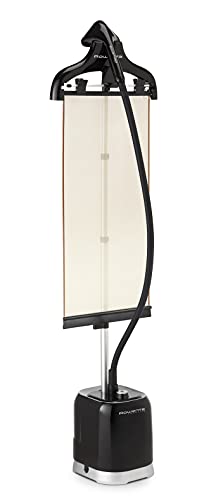
A 1,500-watt upright rated at 30 grams per minute with three steam settings, a 51-ounce removable tank and an XL Delta head. The Steam and Press vertical support gives you a surface to press against with one hand, the closest a steamer gets to an ironing board. An anti-calc function handles scale and a thick fabric brush is included. It stands 63 inches tall.
What stands out
- Three settings and 30 g/min are easy to modulate
- Steam and Press support helps with collars and seams
- Anti-calc function is a real asset in hard water
Watch out for
- Tall 63-inch frame needs a dedicated corner at home
- The premium build costs noticeably more than imported rivals
Jiffy Steamer J-2000 Jiffy Garment Steamer with Plastic Steam Head, 120 Volt, Beige

The J-2000 is the steamer you see in bridal shops: a 1,300-watt brass-element boiler, a 6-inch plastic head and a three-quarter-gallon tank rated for 1.5 hours of steam. Heat-up takes about two minutes. The housing is high-impact plastic and a fusible link provides automatic shut-off. It is a fixture in alterations rooms for a reason: few parts, all serviceable.
What stands out
- 1.5 hours of steam per filling is class-leading
- Brass element and US build keep it serviceable
- Simple, quiet operation with very few failure points
Watch out for
- Two-minute warm-up feels slow next to a 35-second handheld
- No steam settings and no built-in anti-calc system
SALAV Professional Grade Garment Steamer for Clothes w/Smart Auto-Off, XL 3L (101.5 oz) Water Tank, Strong 180

A 1,800-watt upright with a 3-liter tank, foot-pedal control and a smart low-water alert that beeps before the unit shuts itself off. The pole adjusts to 70.5 inches, the wheels roll in any direction and the frame collapses for storage. SALAV markets it for boutiques and hotels as well as homes. That height matters when you steam a floor-length dress.
What stands out
- Foot pedal leaves both hands free for fabric
- 70.5-inch height keeps long dresses off the floor
- Auto shut-off protects the heating element when dry
Watch out for
- Twelve pounds plus water is a two-hand move
- No dedicated low-steam setting for silk or rayon
Buying guide
Heat is rarely the problem; moisture is
A steamer at full output holds a lot of water in suspension, and the moment that vapor cools on a silk panel it becomes a droplet. That is the whole failure mode. It happens when the head is held too close, when the hose has a low loop that collects condensate, and when a tank runs nearly dry and the pump starts drawing air. A single drop on charmeuse leaves a darker ring that dries with a hard edge, and a second pass with more steam usually makes it worse: the stain is mineral and heat-set, not water you can blot away. The tell is a faint tide line around the spot, so test any new steamer on a hem.
The practical defense is distance and pace. Hold the head two or three inches off the fabric, keep it moving, and let the steam do the work instead of pressing the head into the weave. Work from the top of the garment down so condensate runs back toward the head rather than onto dry cloth. Uprights with a foot pedal, such as the two SALAV commercial models, are easier to control this way because both hands stay on the hanger. Handhelds ask you to squeeze a trigger and hold the garment at once, which is where people drift closer than they meant to. A low-water alert gives you time to refill before the spitting starts.
Steam settings matter more than the wattage number
It is tempting to read 1,875 watts as more aggressive than 1,500, but wattage mainly sets how fast the boiler recovers after a burst. The control that protects a delicate garment is the setting dial. The Rowenta Pro Style offers three levels, the Conair handheld offers five, and the DUMOS names four fabric types outright. A 1,500-watt upright on its lowest setting is gentler than a 1,875-watt handheld with one speed, because you can reduce steam volume without changing your distance from the fabric. On a garment you cannot replace, that adjustability is worth more than any output claim.
Head design matters just as much. A wide head covers the back of a shirt in two passes, so the fabric spends less time damp. A narrow head concentrates steam and is easier to keep away from seams and trims. Brushes belong on heavier weaves: dragged across silk, a stiff bristle can pull a float in the weave. On wool, a brush used with light pressure raises the nap and helps steam reach the fiber. A heated soleplate is a different tool again, useful for collars but risky on anything with a raised surface. Know which attachment is on the head before it touches the garment.
Standing, handheld, or a tailor's upright
Tank size decides the rhythm of the job. A handheld with 7.3 ounces runs about 20 minutes, which is four or five delicate pieces if you work briskly. The SALAV GS18 lists 60 minutes from 1.8 liters, the Jenaely claims 80 from 2.8, and the Jiffy J-2000 gets 1.5 hours from three-quarters of a gallon. For a closet of silk blouses, the handheld is enough and a refill takes less than a minute. For a twice-yearly pass over a duvet cover and curtains, an upright saves three refills and a lot of patience.
Storage is the other half of the decision. The Rowenta and SALAV uprights stand 63 to 70 inches tall and want a corner where they can stay assembled; the poles collapse, but the base still claims floor space. Handhelds live in a drawer. The Jiffy machines sit in between: a squat base with a hose, happy on a shelf but needing somewhere to drip dry. Consider hose length, too. A long hose lets the base sit on the floor while you work at chest height, which is easier on your shoulder than holding a two-pound head at eye level.
Water, scale and the flakes that ruin a dark dress
Every steamer in this group will scale eventually. Hard water leaves calcium in the boiler, and the first symptom is a white flake spat onto a navy skirt. SALAV includes a descaler packet with the GS18 and builds an anti-calc function into the Rowenta. Jiffy's bottle-fed models sidestep part of the problem by design: you fill a separate bottle, and the check-valve cap keeps water where it belongs. Filtered water is a reasonable middle ground if your tap leaves crust on a kettle, and it costs far less than replacing a scaled boiler.
After each session, empty the tank. Standing water is where scale starts and where a stale smell develops. Let the tank and hose air dry with the cap off, and wipe the head with a soft cloth once it has cooled. If output drops or the steam starts pulsing, descale before you assume the element is failing. A packet of descaler and an hour of patience will revive most machines, while a neglected boiler will eventually cost you the appliance. Skip vinegar unless the manual allows it; the smell lingers in the hose for weeks.
Frequently asked questions
Can I steam silk without ruining it?
Yes, if you keep the head off the fabric. Hang the garment, hold the steamer two or three inches away, use the lowest setting and keep the head moving. Test an inside seam first. Never let the head touch printed or beaded silk, and let the piece dry before wearing it. Water spots, not heat, cause most silk damage.
Will steaming shrink wool?
Steam alone does not shrink wool; agitation and heat in a washing machine do. Steaming relaxes the fibers and lifts wrinkles, which is why tailors use it. Keep the head moving and avoid soaking the fabric. If the wool is loosely woven, steam from the inside and let it hang dry away from direct heat.
Should I use distilled water in a garment steamer?
Check the manual first. Some makers want tap water because their sensors expect minerals; others recommend distilled to reduce scale. If your tap leaves crust on a kettle, use filtered water and descale on schedule. Empty the tank after every use either way, and never store the unit full.
Is a handheld steamer enough for a whole wardrobe?
For shirts, blouses and a suit between wearings, yes. A 7-ounce tank gives roughly 20 minutes, enough for four or five garments. You will refill often, and your wrist will tire on curtains or long dresses. A standing model makes more sense if you steam bedding, drapes or several pieces at once.
How often can I steam the same garment?
As often as it needs it, within reason. Steam is gentler than washing, but repeated wet-dry cycles stress fibers and can dull some finishes. Air the garment between wearings, steam when it looks tired, and reserve full cleaning for soil and odor. Delicates usually need less frequent steaming than cotton shirts.
Verdict
The Rowenta Pro Style IS3440 is the pick for a wardrobe built on silk, wool and rayon. Three steam settings and 30 grams per minute give you somewhere to retreat when a fabric is fragile, the Steam & Press support steadies a sleeve, and the anti-calc function pays off if your water is hard. It is the one machine here designed around control rather than volume.
The Conair handheld with five settings is the value choice for a small closet: fast, light and gentle on its low settings, with a soleplate that handles collars. Step up to the Jiffy J-2000 if you steam constantly; its 1.5-hour tank and serviceable brass element are why bridal shops keep them for a decade. The SALAV 3-liter models sit in between, with foot pedals and a footprint to match.