A suit does not wrinkle the way a shirt does. The sleeves crease at the elbow, the back of the jacket folds across the shoulder blades, and the trousers hold a sharp fold that is supposed to be there. An iron flattens all of it, including the lapel roll that gives a jacket its shape. Steam lifts the first three problems and leaves the fourth alone, which is why every alteration shop has a steamer standing in the corner.
The catch is that wool is a sponge with a memory. Too much moisture and the cloth swells; too much heat and the surface goes shiny at the seam; one mineral spot on navy is visible from across a room. A steamer built for suits needs a way to throttle output, a head that does not spit, and enough hose to reach a hanging jacket without dragging the base across the floor.
The eight models here cover that range: two 3-liter SALAV uprights, a light DUMOS with named fabric settings, a 1.8-liter SALAV, two Jiffys built for trade use, and two handhelds for travel and small apartments. We compared specifications, features and owner reports rather than running a lab, and we flag where a listing contradicts itself.
If you wear a suit twice a week, a mid-size upright with an hour of steam is the sensible buy. If you travel, a handheld with a heated plate and a creaser will do more for a jacket than the iron bolted to a hotel wall.
Top picks at a glance
SALAV GS18-DJ Professional Standing Clothes Steamer w/Roll Wheels for Easy Mov
Check price on AmazonSteamer for Clothes, 1000W Handheld Clothes Steamer for Garments
Check price on AmazonJiffy Steamer J-4000 Garment Steamer with Plastic Steam Head, 120 Volt, 20 x 1
Check price on AmazonCompare the shortlist
| Model | Type | Capacity | Key feature | Amazon |
|---|---|---|---|---|
| 1. SALAV GS18-DJ Professional Standing Clothes Steamer w/Roll Wheel | Ironing | — | Steam | Check price |
| 2. DUMOS Garment Steamer for Clothes Standing, 1500W Efficient Clot | Garment steamer | — | Steam | Check price |
| 3. SALAV Professional Grade Garment Steamer for Clothes w/Smart Aut | Garment steamer | — | Steam | Check price |
| 4. J-2S Jiffy Garment Steamer with Plastic Head and Stainless Steel | Garment steamer | — | Steam | Check price |
| 5. SALAV Heavy Duty Commercial Full-Size Garment Steamer with Foot | Garment steamer | — | Steam | Check price |
| 6. Conair Handheld Garment Steamer for Clothes, Turbo ExtremeSteam | Portable | — | Steam | Check price |
| 7. Steamer for Clothes, 1000W Handheld Clothes Steamer for Garments | Ironing | — | Steam | Check price |
| 8. Jiffy Steamer J-4000 Garment Steamer with Plastic Steam Head, 12 | Garment steamer | — | Steam | Check price |
Detailed reviews
SALAV GS18-DJ Professional Standing Clothes Steamer w/Roll Wheels for Easy Movement, 1.8L Water Tank for 1 Hou

SALAV's best-known upright, with a 1,500-watt element, a 1.8-liter tank rated for an hour and a 45-second warm-up. The pole extends to 65 inches so a jacket hem clears the floor, and the whole unit rolls on casters. A descaler packet comes in the box, and the dual-insulated hose keeps condensate from dripping onto a dark shoulder. The nine-pound body moves easily between rooms.
What stands out
- One hour of steam covers several suits in a row
- The dual-insulated hose reduces condensate dripping onto wool
- Descaler packet included for homes with hard water
Watch out for
- No fabric settings, so you modulate by distance and pace
- Tank must be detached and carried to the tap
DUMOS Garment Steamer for Clothes Standing, 1500W Efficient Clothes Steamer Standing, 1.7L Water Tank for 55 M

A 1,500-watt upright with four named fabric settings, a 1.7-liter tank rated for 55 minutes and a 45-second heat-up. Three telescopic sections let you set the head at shoulder or floor height, and two clips hold a jacket steady. At just over eight pounds it is the lightest standing model here, and it shuts off automatically when the tank runs low.
What stands out
- Four fabric settings include a dedicated wool cycle
- At just over eight pounds it is easy to move
- Two clips hold a jacket steady while you work
Watch out for
- Steam output feels less dense than the 1,800-watt uprights
- 55 minutes falls short of a full wardrobe session
SALAV Professional Grade Garment Steamer for Clothes w/Smart Auto-Off, XL 3L (101.5 oz) Water Tank, Strong 180

SALAV's 1,800-watt professional upright with a 3-liter tank, foot-pedal control and a low-water alert that beeps for 90 seconds before shutting down. The pole rises to 70.5 inches, high enough to hang a jacket by the collar and work the hem without stooping. It rolls on 360-degree casters and collapses for storage. The extra output shortens each pass when you have five suits to do.
What stands out
- Foot pedal leaves both hands free for the garment
- 70.5-inch pole keeps long jacket hems off the floor
- 3-liter tank lasts through a whole rack of suits
Watch out for
- Twelve pounds plus water is heavy to move around
- No dedicated low-steam preset for summer-weight worsted wool suits
J-2S Jiffy Garment Steamer with Plastic Head and Stainless Steel Face, 120 Volt,Grey

A compact Jiffy built around a 1,300-watt stainless element and a die-cast brass housing, with steam in about a minute. The plastic head has a stainless face, and the unit draws from a separate water bottle with a check-valve cap. A fusible link cuts the heater if it overheats. Trade tailors like it because the parts are simple and the machine is repairable.
What stands out
- Steam in about a minute from a cold start
- Stainless face is tough and easy to wipe clean
- Simple mechanism with very few parts to fail
Watch out for
- Bottle refills interrupt the rhythm of a long session
- No steam adjustment beyond switching it on and off
SALAV Heavy Duty Commercial Full-Size Garment Steamer with Foot Pedals and Extra Large 3L (101.5 oz) Water Tan

The navy version of SALAV's commercial upright: 1,800 watts, a 3-liter tank and steam controlled by a foot pedal. A low-water alert blinks and beeps for 90 seconds, then the unit powers itself down rather than running dry. It is built for boutiques and hotels, but the specification reads well for a household with a lot of tailoring. The base is large and wants a permanent spot.
What stands out
- Its commercial-grade build stands up to daily, repeated use
- Foot pedal keeps both hands steady on the jacket
- 3-liter tank runs for 90 minutes or more
Watch out for
- Its large base takes up a permanent corner of the room
- No fabric dial, only the pedal and continuous steam
Conair Handheld Garment Steamer for Clothes, Turbo ExtremeSteam 1875W Fabric Steamer, Portable Handheld Design

A 1,875-watt handheld with a 7.3-ounce tank, a 40-second heat-up and a quilted aluminum plate with a built-in creaser. The three attachments cover a silicone band for tension, a spacer for delicate cloth and a bristle brush for heavier weaves. It is the travel option here, and the plate gives it more pressing authority than most handhelds. Conair lists the Good Housekeeping Seal for the line.
What stands out
- Quilted plate and creaser can press lapels and cuffs
- Three attachments cover both delicate cloth and heavy weaves
- A 40-second heat-up with about 20 minutes of steam
Watch out for
- 20 minutes is not enough for a three-piece suit
- The handheld design tires the wrist on padded shoulders
Steamer for Clothes, 1000W Handheld Clothes Steamer for Garments

A 1,000-watt handheld that heats in 30 seconds and runs roughly 10 minutes on its 180-milliliter tank. The pump is designed to steam at any angle without dripping, which matters when you work under a lapel. A thermal fuse cuts power if the unit overheats. It is small enough for a carry-on and honest about its limits. Treat it as a touch-up tool, not a wardrobe workhorse.
What stands out
- A 30-second heat-up is ideal for last-minute touch-ups
- Steams at any angle without dripping on the wool
- Small tank and body fit easily into carry-on luggage
Watch out for
- 10 minutes covers one jacket at most, not two
- At 1,000 watts it feels weak on heavy worsted wool
Jiffy Steamer J-4000 Garment Steamer with Plastic Steam Head, 120 Volt, 20 x 11 x 64, Gray
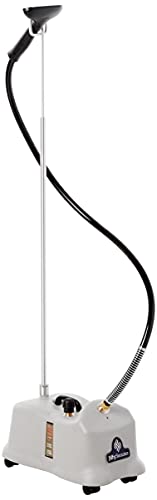
Jiffy's top domestic model: a 1,500-watt incoloy element in a die-cast aluminum housing, a 6-inch plastic head and a 5.5-foot rubber hose. It has standby and steam settings, so the boiler can idle between garments instead of reheating. The catch is warm-up, since Jiffy specifies reaching standby within 15 minutes. That is a professional rhythm, not a five-minute morning one.
What stands out
- The standby setting keeps the boiler hot between garments
- A 5.5-foot hose reaches across a full garment rail
- The die-cast aluminum housing feels built to last decades
Watch out for
- Fifteen minutes to reach standby is slow for home use
- Bulky base needs a permanent spot on the floor
Buying guide
What steam does to wool that an iron cannot
Wool is a protein fiber with a natural crimp, and steam relaxes that crimp without flattening it. An iron does the opposite: heat plus pressure rearranges the fibers and leaves the cloth smooth and slightly compressed. On a jacket, that compression is fatal to the lapel roll, the soft curve that runs from the collar to the button. Press it flat and the jacket looks cheap no matter what it cost. Steam from the inside, with the jacket hanging, keeps the roll intact.
Shoulder padding is the other reason to keep pressure out of the equation. A steamer head held an inch away penetrates the wool and the canvas beneath it without crushing the wadding that gives the shoulder its line. Hold the head against the fabric and you are effectively ironing with vapor, which is how shoulders go soft and dimpled. Work in short passes, let the jacket rest on a broad hanger for ten minutes, and check the result before you go back for more.
The crease is not a wrinkle
Trouser creases are set deliberately, usually with a damp cloth and a hot iron, and a steamer will soften them. That is fine if you plan to re-press the leg afterward. It is not fine if you steam the trousers and hang them straight away, because the crease will drift and the leg will look round. If the crease matters, steam the trousers from the inside to lift wrinkles around it, then touch up the fold with an iron and a pressing cloth. Some steamers ship with clips for holding a crease; use them only while the cloth is cooling.
Sleeves are the opposite problem. A crease down the front of a sleeve is a wrinkle, often set by hanging the jacket badly or by folding it into a case. Steam the sleeve while it hangs free, supporting the cuff with one hand so the weight of the cloth does not pull the seam out of shape. If the seam puckers, stop. Puckering usually means the fabric has shrunk against the stitching, and more steam will make it worse rather than better.
Tank size and hose length for a suit rack
A two-piece suit takes about six to ten minutes to steam properly, depending on how creased it is and how carefully you work the shoulders. A handheld with 7 ounces of water gives you roughly 20 minutes, enough for two suits before a refill. The DUMOS runs 55 minutes and the SALAV GS18 an hour, while the 3-liter SALAV models hold the largest reserve even though those listings do not quote a run time. If you keep five suits in rotation and steam them on Sunday, the difference between 20 minutes and an hour is the difference between a chore and a habit.
Hose length decides where the base lives. A short hose forces you to bring the jacket to the machine, which is fine in a laundry room but awkward in a bedroom with a rail. Five and a half feet, as on the Jiffy J-4000, lets you stand back and work the full length of a jacket. Height matters too: a pole that reaches 65 to 70 inches keeps the hem off the floor and saves your back. Check the ceiling above your rail before you buy the tallest model.
Spitting, hard water and dark cloth
Navy and charcoal show every flaw. A steamer that spits leaves a pale ring that reads as a stain under office lighting, and on worsted it will not brush out. Spitting usually comes from a tank that is too full, a head held at an angle that lets condensate pool, or a boiler that is scaling. Look for a unit with a heated plate or an electronic pump, keep the head upright, and empty the tank before you carry the machine upstairs. Never fill past the line marked on the tank.
If your water is hard, plan on descaling from the start. SALAV includes a descaler packet with the GS18, and Rowenta builds an anti-calc function into its upright, though that model is not in this group. Jiffy's bottle-fed design limits the volume of water sitting in the boiler between sessions. Filtered water helps, but it is not a substitute for emptying the tank. A white flake on a black lapel is the first sign that you have waited too long.
A ten-minute routine for a two-piece suit
Hang the jacket on a broad wooden hanger and button it so the fronts hang straight. Start at the back of the shoulders, hold the head an inch off the cloth and work downward in slow passes. Move to the sleeves, then the chest and lapels, then the trousers from the waist down. Turn the jacket inside out for the lining if it is creased; lining takes steam well and dries fast. Give the whole thing five minutes to dry before you put it on, or the wool will stretch at the elbows.
Do not steam a suit you are about to wear in a cold room. Condensation forms as the cloth cools, and you will feel damp patches under the arms. Steam the night before, or give it twenty minutes with a window open. If the suit smells of smoke or food, steam alone will not fix it; the odor has soaked into the canvas, and only a proper clean will lift it. Steam is for shape and freshness, not for soil.
Frequently asked questions
Can I steam a suit instead of dry cleaning it?
No. Steam relaxes wrinkles and freshens the cloth, but it does not remove body oils, sweat salts or the dust that settles into wool. Dry clean a suit every two or three wears if you wear it often, and spot-clean spills promptly. Steaming between cleans extends the time between trips and keeps the shape crisp.
Will steaming ruin the crease in my trousers?
It will soften it. If you want a sharp crease, steam the trousers from the inside to lift surrounding wrinkles, then re-press the fold with a damp cloth and a warm iron. Hanging the trousers by the cuffs while they are still damp will pull the crease out entirely. Decide which result you want before you start.
How do I steam a jacket without flattening the shoulders?
Keep the head off the cloth. Hang the jacket on a broad hanger, button it, and work from the inside of the shoulder where the padding sits. Short passes, an inch of clearance and no downward pressure. Let it dry on the hanger. Never rest the steamer head on the shoulder to steady it, which is the most common way padding gets crushed.
Is a handheld steamer strong enough for wool?
For a jacket that has been worn once or twice, yes, if you work slowly and keep the head moving. Heavy worsted and flannel need more steam than a 7-ounce tank can sustain, and you will refill midway. A standing model with an hour of run time is a better fit for a suit you wear weekly.
How often should a suit be steamed?
After every two or three wears is typical, or whenever the jacket looks tired at the elbows and back. Air it overnight first; many wrinkles fall out on their own. Over-steaming is possible: repeated wet-dry cycles can dull the finish and soften the canvas, so stop when the cloth looks smooth rather than soaking it.
Verdict
The SALAV Professional Grade 3-liter upright is the top pick for a working suit wardrobe. The foot pedal leaves both hands for the jacket, the 70.5-inch pole keeps the hem clear of the floor, and 1,800 watts with a 3-liter tank give you the biggest reserve in this group. The low-water alert is a small thing that saves a good jacket from a mineral spot.
The DUMOS is the value pick: four fabric settings including wool, a 55-minute tank and a body just over eight pounds, which is easy to move between rooms. If you want the longest-lived machine, the Jiffy J-4000 is the upgrade, with a standby setting and a 5.5-foot hose built for trade use. For travel, the Conair handheld and its heated plate is the one to pack.