Indoor drying is a moisture problem before it is a hardware problem. A wet load releases enough water vapour to fog a small room, and if that vapour has nowhere to go it condenses on the coldest surface available: a window, an external wall, the back of a wardrobe. The line you choose matters less than where the water ends up.
That said, the line still has to fit. A wall-mounted retractable is the only type that works in a room you also live in, because it disappears when the laundry is done. The models here run from 13.8 to 16.7 feet, with one 45-foot outlier for a long utility room.
The differences between these units are smaller than the differences between rooms. A 44-pound twin-line model in a windowless bathroom will underperform a 30-pound single line in a spare room with the door propped open.
Specifications, feature lists and owner reports informed the comparison, and we left out the outdoor drums that sometimes get marketed as indoor dryers. What follows is six wall-mounted lines that suit a house or an apartment rather than a garden.
Top picks at a glance
Retractable Clothesline Indoor & Outdoor, 16.7 Ft Non-Sagging Double Clothes L
Check price on AmazonEsoes Retractable Clothesline Indoor & Outdoor, 15.74 Ft Non-Sagging Heavy-Dut
Check price on AmazonRetractable Clothesline
Check price on AmazonCompare the shortlist
| Model | Type | Capacity | Key feature | Amazon |
|---|---|---|---|---|
| 1. Retractable Clothesline Indoor & Outdoor, 16.7 Ft Non-Sagging Do | Clothesline | — | Child lock | Check price |
| 2. Retractable Clothesline | Clothesline | — | Stainless drum | Check price |
| 3. Esoes Retractable Clothesline Indoor & Outdoor, 15.74 Ft Non-Sag | Clothesline | — | Compact footprint | Check price |
| 4. MUSTORN Retractable Clothesline Indoor, Non-Sagging Outdoor Clot | Clothesline | — | Stainless drum | Check price |
| 5. Retractable Clothesline, 16.7 Ft Stainless Wire Double Clothes L | Drying rack | — | Child lock | Check price |
| 6. Retractable Clothesline | Portable | — | Compact footprint | Check price |
Detailed reviews
Retractable Clothesline Indoor & Outdoor, 16.7 Ft Non-Sagging Double Clothes Line, Retracting Heavy Duty Cloth
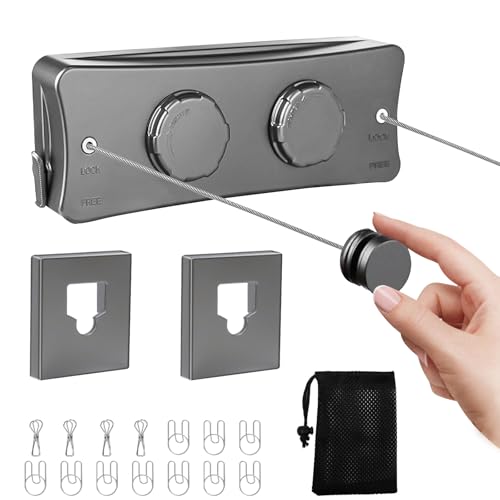
Two 16.7-foot lines on one housing, rated together at 44 pounds and supplied with 14 clips. The ABS case has an aluminum base and 304 stainless rope, and a lock button plus rotary knob keeps both runs taut. For indoor use the twin lines are the appeal: they dry a mixed load without needing a wall long enough for a single 33-foot span. Glue mounting is offered for smooth tile.
What stands out
- Two 16.7-foot lines suit a mixed indoor wash
- A rotary knob tightens both lines after loading
- The 44-pound rating covers towels and delicates together
Watch out for
- Requires two receivers aligned on the far wall
- Glue mount fails on painted or textured plaster
Retractable Clothesline

A 14.1-foot single line in a stainless steel housing that weighs about a pound, with all mounting hardware included. There is no tension collar, just a one-touch retract, so the reel spring holds the line. GorillaLine lists it for laundry rooms, bathrooms, balconies and RVs, and at this length it suits a small bathroom or the end of a kitchen where a full-size unit would crowd the room.
What stands out
- Compact stainless steel housing suits the smallest bathrooms
- All hardware needed for mounting arrives in the box
- One-touch retract keeps the wall clear when empty
Watch out for
- No tension collar to take up slack over time
- 14.1 feet is short for bedding or big towels
Esoes Retractable Clothesline Indoor & Outdoor, 15.74 Ft Non-Sagging Heavy-Duty Stainless Steel Clothes Line,

A 15.74-foot line rated to 44 pounds with a built-in hanger slot at the housing, which is the detail that makes it useful indoors. The line is 304 stainless with a nano coating and the case is ABS, so humid air is less of a problem than with coated steel. Esoes offers screw mounting or an adhesive install, and the housing measures roughly 3.6 by 3.6 by 2.3 inches.
What stands out
- Hanger slot dries shirts without pegs or creases
- The 44-pound rating is high for a 15.74-foot line
- 304 stainless steel resists damp air in bathrooms
Watch out for
- Adhesive install still depends on a perfect surface
- Single line means bedding must drape over it
MUSTORN Retractable Clothesline Indoor, Non-Sagging Outdoor Clothes Line Retracting Heavy Duty Clothes Drying

A 13.8-foot line rated to 40 pounds in a small ABS housing with a space-aluminum base. The locking device holds the line at length and a rotating collar takes up the slack, the same two-step system used on larger units. It is the shortest line here and the smallest housing at about 4.7 by 3.9 inches, which makes it the practical choice for a narrow bathroom or a cloakroom wall.
What stands out
- The 40-pound rating is generous for a short line
- A small housing that fits narrow bathroom walls
- The lock and rotate system removes sag under towels
Watch out for
- 13.8 feet will not take a full set of bedding
- The adhesive mount needs smooth tile to hold
Retractable Clothesline, 16.7 Ft Stainless Wire Double Clothes Line, Grey

A 16.7-foot double line rated to 44 pounds, with an ABS case, aluminum base and stainless rope. The built-in tightener works in three steps: pull out the length you need, press the lock button, then turn the knob to take out sag. Jekyeroyme offers punch-free or drilled installation, and the housing is described as small enough to be unobtrusive. No dimensions are listed, so check the footprint before ordering.
What stands out
- The double 16.7-foot line gives generous indoor space
- A three-step tightener is simple to use daily
- The 44-pound rating matches the best units here
Watch out for
- No housing dimensions are listed by the maker
- Two receivers must line up accurately on the wall
Retractable Clothesline

A 45-foot PVC line in a closed plastic case, shipped fully assembled and rated to 30 pounds. The lock button holds the line at any length, which matters indoors because you rarely need all 45 feet. In a long utility room or a basement with a dehumidifier it covers a lot of washing, but in a normal bathroom the extra length just stays on the reel. It mounts indoors or out.
What stands out
- 45 feet covers a long utility room or basement wall
- Lock button sets any length without a collar
- The closed case protects the line between uses
Watch out for
- 30 pounds is the lowest rating in this group
- Too long for most bathrooms to use in full
Buying guide
The room sets the limit, not the line
A retractable line needs a clear run between two solid surfaces, and most bathrooms do not have one as long as the box claims. A 16.7-foot unit in a room with nine feet between the walls will spend its life half wound in, which is harmless but means you paid for line you cannot use. Measure wall to wall, subtract a foot at each end for the housing and your reach, and plan around the result rather than the headline figure. The same arithmetic applies to a hallway or a landing, where a diagonal run looks clever until someone walks into it with an armful of towels. A hallway run needs head clearance as well as wall space.
Laundry rooms and spare bedrooms are more forgiving. A utility room with a door you can close keeps the moisture in one place, and a spare bed makes a decent drying frame for sheets if you cover it with a clean sheet first. Basements need a dehumidifier running, because the air is already damp and the washing will not dry so much as move its water into the joists. Renters usually get one usable wall, often the least convenient one, so measure before ordering and check what the wall is made of before drilling. A spare room also gives you somewhere to move the rack when guests arrive.
Airflow does the drying, not the line
Outdoors, wind does the work. Indoors, you have to supply it. Still air sits against wet fabric in a boundary layer that slows evaporation to a crawl, which is why laundry hung in a closed bathroom over a weekend comes out smelling of damp even though it is dry to the touch. A cheap pedestal fan aimed along the line cuts drying time dramatically, and a ceiling fan on low does almost as well. The gap between garments matters more than the length of the line. Hang shirts at the ends of the line and towels in the middle, where airflow is strongest.
The other half is ventilation. Cracking a window an inch is better than nothing, and a trickle vent does more than most people expect, but neither moves enough air through a small tiled room. An extractor fan running on its normal setting will pull moisture out while the line is loaded. If the room has no fan and no window, dry there only in summer with the door open, and run a dehumidifier rather than pretending the air will cope. A closed internal door keeps the moisture in one room, which is the point, but that room then needs its own extract.
Mounting indoors: tile, plasterboard and the no-drill question
The housing carries the full pull of a loaded line, so it needs to land on something structural. In a bathroom that usually means the studs behind the tile, found with a detector before you drill, or a masonry wall if the building is older. Hollow plasterboard alone will not hold a 40-pound load through the anchors in a hardware kit. If the only available wall is plasterboard, fit a timber batten across two studs and mount the housing to that. A batten also spreads the load across two studs, which matters more on older plasterboard than on modern sheet.
The adhesive option on some units is tempting indoors, and it works on glazed tile, marble or glass if the surface is spotless and the adhesive gets its full cure time. It does not work on painted plasterboard, and it does not like steam. A bathroom that fogs twice a day will loosen a glue-mounted housing faster than any other room in the house. If you rent and cannot drill, use a freestanding rack instead, or accept a short line with very light loads. Landlords tend to prefer a freestanding rack to four holes in the tile, and it is easier to take with you.
Loads that suit an indoor line
Indoor lines earn their keep on the wash that does not go in the dryer: wool, cashmere, bras, swimwear, anything with an elastic waistband. Those items are light, which is exactly what a short wall-mounted line handles well. Towels are heavier and take longer indoors, and a full set of bedding is a stretch for anything under 16 feet unless you drape the sheets over the line rather than pegging them along it. A hanger slot is genuinely useful for shirts. Wool takes a day indoors, cotton takes longer, and anything with a thick hem takes longest.
The load ratings of 30 to 44 pounds refer to the whole line, spread out, and they assume the housing is properly fixed. A wet bath towel is heavy, and four of them clustered at one end of a 14-foot span will pull the reel housing away from the wall before the line itself gives way. Spin laundry properly before hanging it, because a fast spin removes more water than wringing by hand, and never hang dripping items over a floor that will not take the puddle. If the line is rated at 30 pounds, treat three wet towels as the practical ceiling, not six.
Condensation, mildew and the warning signs
A cheap hygrometer takes the guesswork out of indoor drying. Below about 50 percent relative humidity, most rooms cope. Above 60 percent, and certainly when windows stream with condensation, you are putting more water into the air than the room can remove, and mold will follow within weeks on grout, window frames and cold external walls. The smell is the second warning, and by then the spores are already there. A simple humidity meter tells you whether the room is coping long before the paint does.
The fix is not a better clothesline. Run the extractor, open a window on the opposite side of the room for cross flow, or put a dehumidifier next to the line and empty it daily. In winter, a heated room holds more moisture before it condenses, which is why drying indoors is easier in January than in a cool, damp October. If you consistently fill a 44-pound line in one small room, the honest answer is a condenser dryer or a launderette for the bedding. If the windows run with water every wash day, the room is telling you something.
Frequently asked questions
How long should an indoor clothesline be?
Long enough for the room, not the box. Measure the clear wall, subtract a foot at each end, and choose a unit that reaches that distance without being permanently half retracted. For most bathrooms that means 10 to 14 feet. A utility room can take 16 feet or more, and the extra length is worth having for towels and bedding.
Can I dry laundry in a bathroom with no window?
Yes, if there is an extractor fan and you run it. Without either, a windowless bathroom is the worst room in the house for drying because the moisture has nowhere to go. In that case use a dehumidifier with the door shut, keep loads small, and move bedding to a room with better ventilation rather than letting it hang for days.
Will indoor drying cause mould?
Only if the moisture has nowhere to escape. Drying one load in a ventilated room is normal and safe. Drying three loads a week in a sealed bedroom raises humidity until it condenses on cold surfaces, and mould follows. Watch for fogged windows, a damp smell or dark spots on grout, and treat them as a signal to ventilate more or dry less indoors.
What is the best indoor clothesline for an apartment?
A wall-mounted retractable unit in the 14 to 16-foot range, fixed into a stud or a batten, with a fan nearby. It disappears when empty, which matters when the laundry area is also the living space. Twin-line models suit apartments with a narrow balcony or a long hallway, because they double the hanging space without needing a longer wall.
Can I mount a retractable line above a bathtub?
Yes, and it is a common solution, but the far receiver has to be fixed to solid structure rather than to a shower surround or a tile backer with nothing behind it. Hang the line high enough that towels clear the tub and low enough that you can reach it. Keep the load modest, because a fall into a bath is worse than a fall onto a floor.
Verdict
The Yimerlen twin-line unit is the best indoor choice: two 16.7-foot lines give about 33 feet of hanging space, the rotary tightener keeps both spans firm under towels, and 44 pounds is the highest rating here. In a small bathroom, the GorillaLine 14.1-foot line is the value pick, with a stainless housing and all the hardware in the box.
Choose the Esoes if you dry shirts on hangers and want the built-in slot, or the Riveda 45-foot line for a long utility room where reach matters more than load. The Jekyeroyme is the alternative twin-line buy when the Yimerlen is unavailable; the two are close in spec.