A down jacket that has been washed in ordinary detergent usually feels wrong before it looks wrong. The shell is clean, the color is fine, but the jacket has gone flat across the chest and the baffles feel empty at the corners. That is not the down escaping. It is the cluster structure collapsing because a film of detergent residue stayed inside the fill and stopped the feathers from opening back up as they dried.
Down works because each cluster traps air in a three-dimensional lattice. Anything that coats the filaments, whether it is soap residue, fabric softener or an optical brightener, adds weight and reduces the space between them. Water repellency suffers too, because the same coating that flattens the loft also attracts moisture to the shell and the fill.
We compared specifications, certifications and owner reports across ten products, and the honest headline is that this category is thin. Four bottles are genuine down washes. The other six are general detergents that can be made to work in narrow situations, and the notes below explain exactly how narrow.
Top picks at a glance
IMPRESA Down Wash Detergent
Check price on AmazonIMPRESA Concentrated Down Wash Detergent
Check price on AmazonArm & Hammer Powder Laundry Detergent, Professional Soap for Washing Clothes,
Check price on AmazonCompare the shortlist
| Model | Type | Capacity | Key feature | Amazon |
|---|---|---|---|---|
| 1. IMPRESA Down Wash Detergent | Liquid | — | Efficiency | Check price |
| 2. Grangers Down Wash (300ml/10fl oz) | Detergent | — | — | Check price |
| 3. Grangers Down Wash Kit (Includes 3 Wool Dryer Balls) | Wool | — | — | Check price |
| 4. Nikwax Down Wash, 1L, Detergent for down jackets and sleeping ba | Detergent | — | — | Check price |
| 5. IMPRESA Concentrated Down Wash Detergent | Detergent | — | Efficiency | Check price |
| 6. Rockin' Green Active Wear Laundry Detergent Powder & Odor Elimin | Powder | — | High efficiency | Check price |
| 7. Clean Revolution Pet Hair Remover for Laundry 2-Pack | Detergent | — | Softening | Check price |
| 8. Arm & Hammer Powder Laundry Detergent, Professional Soap for Was | Powder | — | High efficiency | Check price |
| 9. Tide Ultra Odor Defense Plus Oxi Liquid Laundry Detergent, 148 f | Liquid | — | — | Check price |
| 10. Tru Earth Laundry Detergent Sheets, Up to 64 Loads, Unscented | Detergent sheets | — | High efficiency | Check price |
Detailed reviews
IMPRESA Down Wash Detergent

A 32-ounce unscented down wash covering about twenty loads, with a water-based formula that contains no PFCs or optical brighteners. IMPRESA says it removes dirt and odors, restores loft and warmth, and preserves the water-resistant qualities of the shell. It is designed for machine washing and priced for people who wash jackets and comforters regularly. It is a plain, unscented formula.
What stands out
- Unscented and water-based, with no PFCs at all
- Around twenty full machine loads from one bottle
- Restores loft and warmth according to the brand
Watch out for
- No third-party certification appears anywhere on the label
- Large bottle is awkward to store in a small closet
Grangers Down Wash (300ml/10fl oz)

A 300ml concentrated down wash covering about twelve washes, formulated for down and synthetic down insulation. Grangers says it restores loft, renews breathability and removes dirt and odors, and the label lists it as suitable for Gore-Tex, eVent, Pertex and FutureLight shells. It is PFC-free, Bluesign approved and cruelty-free. The bottle is small enough to live in a gear bin.
What stands out
- Concentrated formula covers about twelve full wash cycles
- Suitable for Gore-Tex and other technical shell fabrics
- PFC-free and Bluesign approved for technical outdoor use
Watch out for
- Small bottle goes fast when washing a comforter
- No dryer balls are included at this size
Grangers Down Wash Kit (Includes 3 Wool Dryer Balls)

The same Grangers Down Wash bundled with three natural wool dryer balls, which makes it the most complete kit in this lineup. The balls are designed to break up clumps and restore loft without the impact of tennis balls, and Grangers rates them for up to a thousand dry cycles. Twelve washes per bottle plus reusable balls covers a couple of jackets and a comforter for a season.
What stands out
- Includes three reusable wool dryer balls in the box
- Wash restores loft and renews breathability in the fill
- PFC-free, Bluesign approved and cruelty-free in its production
Watch out for
- Costs more than the bottle on its own
- Twelve washes is still a fairly modest supply
Nikwax Down Wash, 1L, Detergent for down jackets and sleeping bags, outdoor apparel, clean, care, protect

A 1-liter bottle of Nikwax Down Wash, which makes it the largest dedicated down product here by a wide margin. The formula is water-based and PFAS-free, with no optical brighteners and no added scent, and the brand says it improves water repellency on both the fill and the outer fabric while maintaining loft. It is machine wash safe and works on down blends and hydrophobic down.
What stands out
- The large 1-liter bottle covers many wash cycles
- PFAS-free with no added scent and no brighteners
- Improves water repellency on the shell as it cleans
Watch out for
- Cap-based dosing is less precise than a scale
- Plain packaging offers little guidance for first-time users
IMPRESA Concentrated Down Wash Detergent
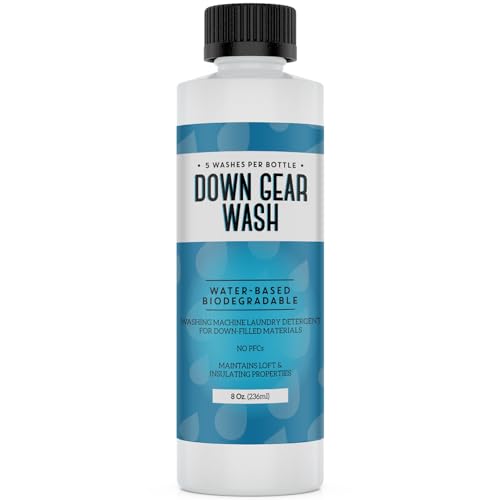
The small version of the IMPRESA down wash: 8 ounces covering about five loads, made in the USA with a water-based formula free of optical brighteners. It is the sensible way to try the brand before buying the 32-ounce bottle, and it fits in a drawer rather than a shelf. Five loads is enough for one jacket and a pair of gloves, or a single comforter.
What stands out
- Small bottle suits occasional down washing and travel
- Water-based, with no optical brighteners in the formula
- Made in the USA according to the label
Watch out for
- Highest cost per load of anything in this lineup
- Five loads disappears quickly when washing a comforter
Rockin' Green Active Wear Laundry Detergent Powder & Odor Eliminator for Sportswear & Workout Clothes, Plant-B

A 45-ounce powder for activewear, not down. Rockin' Green uses plant-based enzymes to break down sweat and body oils, and the label claims 90 loads with one scoop per wash. It is unscented, free of SLS, SLES, dyes and phosphates, and works in HE machines. Enzymes and a powder format are both wrong for down fill, so this belongs in the gym hamper rather than the gear closet.
What stands out
- Plant-based enzymes target sweat, body oil and odor
- Unscented and free of dyes, phosphates and parabens
- Up to 90 loads from a single 45-ounce bag
Watch out for
- Powder and enzymes are unsuitable for down fill
- Scoop dosing is imprecise for small wash loads
Clean Revolution Pet Hair Remover for Laundry 2-Pack

A two-pack pet hair removal system with a 40-ounce detergent and a matching fabric softener, built around enzymes and a silicone anti-static barrier. It is designed to lift pet hair over repeated washes and soften fabric at the same time. The softener alone disqualifies it for down, because a conditioning film is exactly what collapses loft. Keep it for pet bedding and cotton, where the hair-lift technology makes sense.
What stands out
- Enzyme complex targets pet oils, dander and hair
- Includes a matching fabric softener and liquid detergent
- Light lavender and sandalwood scent from essential oils
Watch out for
- Fabric softener coats down fibers and kills loft
- Two large bottles take up significant shelf space
Arm & Hammer Powder Laundry Detergent, Professional Soap for Washing Clothes, 290 Loads, Free and Clear, Bulk

An 18-pound pail of commercial-grade powder covering 290 loads, free of perfumes and dyes and dermatologist tested. It works in standard and HE machines, handles cold water and is safe for septic systems. For down, the powder format is the problem: incomplete dissolution leaves grit in the baffles and residue in the fill. For bulk cotton it is good value.
What stands out
- 290 loads in one pail at a very low cost
- Free of perfumes and dyes, and dermatologist tested
- Works in both HE and standard washing machines
Watch out for
- Powder can leave gritty residue inside down baffles
- Bulk pail is heavy and awkward to store
Tide Ultra Odor Defense Plus Oxi Liquid Laundry Detergent, 148 fl oz, 105 Loads, Advanced Odor and Stain Fight
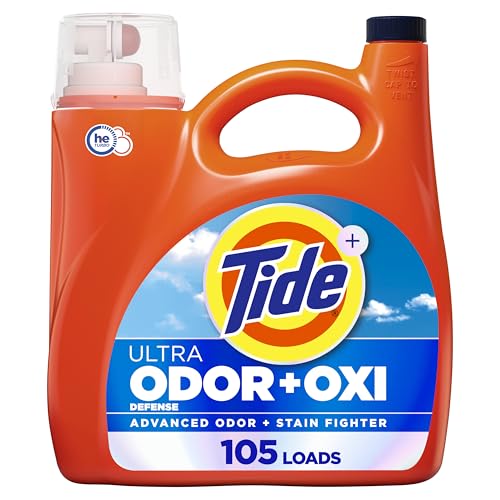
A 148-ounce, 105-load liquid built around odor and stain removal, with an Oxi boost and a clear measuring cap. It is a strong general detergent and a reasonable choice for the shell of a rain jacket that needs a proper clean. It is not a down wash: the formula is designed to leave nothing behind for odor, but it has no low-residue or water-repellency claim, and the added fragrance is not something you want trapped in a fill.
What stands out
- Powerful odor and stain fighting for general loads
- Clear cap makes the dosing easy to read
- 105 loads per bottle for general household laundry
Watch out for
- No low-residue claim that would suit down fill
- Added fragrance can linger inside a down jacket
Tru Earth Laundry Detergent Sheets, Up to 64 Loads, Unscented

Sixty-four unscented loads in a compact sheet format, vegan and free of parabens, phosphates, dyes and chlorine bleach. Tru Earth sheets work in hot or cold water and in HE machines, and they are genuinely useful for travel and small apartments. For a down jacket, a sheet is a poor tool: it needs to dissolve completely before the fill goes in, and any undissolved fragment becomes residue in the baffles.
What stands out
- Unscented and free of dyes and chlorine bleach
- Compact packaging with no plastic jug to recycle
- Works in hot or cold water and HE machines
Watch out for
- Sheets may not dissolve fully in a hand wash
- No water-repellency or low-residue claim on the label
Buying guide
What washing actually does to a down cluster
Down is a feather structure, not a fiber, and its performance comes from volume rather than weight. The barbs branch off a central quill and interlock with the barbs of neighboring clusters, and that mesh is what holds still air against your body. When the cluster is clean and dry, it springs back. When it is coated with residue, the barbs stick together and the mesh collapses. The jacket still weighs roughly the same, but it stops insulating the way it did when it was new, and no amount of shaking restores a fill that has been glued shut by soap. You can often feel the difference through the shell before you see it: the baffles feel slack and the jacket seems thinner across the back.
Water is hard on down in a different way. Wet down clumps, and if it dries in a tight ball the cluster can stay compressed even after the fabric is dry. That is why drying matters as much as washing, and why a down wash is formulated to rinse out completely rather than to leave a conditioning layer behind. A product that makes the shell feel soft and smooth may be doing exactly the wrong thing to the fill inside it. This is also why fabric softener is the worst thing you can add to a down load, even in a small amount. It coats every filament it touches, and the rinse water in a front loader is not generous enough to carry it all away. If a jacket has been softened, two washes with a proper down product are usually needed to strip it.
Why a down wash is not just a mild detergent
The defining characteristics of a real down wash are low residue, no optical brighteners, no added fabric conditioner and a pH that will not strip the oils from the feathers. Some also add a hint of water repellency, which is useful on the shell and on treated down. Nikwax and Grangers both build their reputations on this combination, and both are explicit about being PFAS-free or PFC-free. If a bottle does not state those things, it is probably a general-purpose detergent with a picture of a jacket on the label. The wording to look for is plain: down wash, down cleaner, or a care brand that sells nothing else and says so on the front. These formulas also skip the whiteners that streak a dark shell.
The distinction matters most for treated down, the kind sold as hydrophobic or water-resistant. The treatment is a durable water repellent applied to the cluster, and ordinary detergent can strip it over repeated washes. That is the argument for a dedicated product rather than a gentle one: it is not about being kinder to feathers, it is about not removing the finish that makes them perform. On untreated down the stakes are lower, but residue still costs you loft, and the difference between a treated and untreated jacket is invisible from the outside. If the care label mentions water-resistant or hydrophobic down, treat the dedicated wash as mandatory rather than optional. A stripped jacket will still keep you warm in dry cold; it just stops handling drizzle the way it used to.
Machine or tub, and the agitator problem
A front loader is the safest machine for a down jacket. There is no central agitator to pull at the baffles, the drum turns the load through the water rather than thrashing it, and the rinse cycle is thorough. Use a cold or cool setting, a low spin and an extra rinse if the machine offers one. Zip every zipper and close every pocket, then turn the jacket inside out. If you own a top loader with an agitator, do not put a down jacket in it; the post will work the fill into clumps and can damage the shell seams. If the drum is small, wash one item at a time and let the jacket move freely rather than packing in a second.
Hand washing in a bathtub is slower but very reliable. Fill the tub with cool water and a small dose of down wash, submerge the jacket and press it gently until it is soaked through, then let it sit for fifteen minutes. Drain, refill with clean water and press again until the water runs clear. Never lift a soaked jacket by one shoulder; support the whole body of it with both arms, because wet down is heavy and the baffles will stretch. A top-loading machine without an agitator can also work on a gentle cycle. Whichever route you take, resist the urge to scrub a dirty cuff with a brush; abrasion on a wet shell is how the face fabric starts to pill.
Drying is half the job
A down jacket takes far longer to dry than its size suggests, and under-drying is the most common reason a wash goes wrong. Use the lowest heat setting and expect two or three cycles, checking the jacket every twenty minutes. Add two or three dryer balls to break up clumps as the fill dries. Wool dryer balls are gentler than tennis balls, which work but can be noisy and can abrade lightweight shells. If you have no dryer, drying flat in a warm room with air moving around it is possible, but the fill will need to be broken apart by hand several times. A fan pointed at the jacket speeds that up considerably and does less damage than heat.
The jacket is dry when it feels light, the baffles are evenly full and there is no cool, damp weight at the hem. Give it a final ten minutes on air-only with the balls to separate anything that clumped. Store it loosely on a hanger or in a breathable bag rather than compressed in a stuff sack, which is fine for a backpack but bad for a season in a closet. A jacket that has been stored compressed for months may need a wash and a tumble simply to recover its shape. That is not damage, just flattened clusters that need water and movement to open again. Check the hem and the cuffs last when you test for dryness, since that is where water collects.
Frequently asked questions
Can I wash a down jacket in a regular washing machine?
Yes, if it is a front loader or a top loader without a central agitator. Use a cool, gentle cycle, a dedicated down wash, and an extra rinse. Avoid any machine with an agitator post, because it works the fill into clumps. Wash one jacket at a time unless the drum is large enough to let them move freely.
What happens if I use normal detergent on down?
It usually survives one wash. The risk is cumulative: residue coats the filaments, the clusters stop opening fully, and the jacket gets flatter each season. Ordinary detergent can also strip the water-repellent finish from treated down. If you have, a wash with a dedicated down product and a long tumble dry often recovers some loft.
Do I need to dry clean a down jacket?
No, and it is usually the worse option. Dry cleaning solvents can strip the natural oils from the feathers and remove the durable water repellent from the shell. A home wash with a down-specific detergent and a low tumble dry is the method most manufacturers recommend. Check the care label first, since a few shells have finishes that need professional care.
How many dryer balls should I use?
Two or three is enough for a jacket, and three or four for a comforter. More does not speed things up much and makes a surprising amount of noise. Wool balls are gentler on lightweight shells; tennis balls work but are heavier and can scuff a thin fabric. Add them at the start of the cycle and leave them in for the full dry.
Can I wash a down comforter at home?
Only if your machine is large enough to let it move, which usually means a front loader with at least a 4-cubic-foot drum. A queen comforter in a small machine will not rinse or dry evenly. Use a down wash, an extra rinse, and expect several low-heat cycles with dryer balls. A laundromat machine is safer for anything larger than a twin.
Verdict
Nikwax Down Wash is the top pick. The 1-liter bottle is PFAS-free, unscented, free of optical brighteners and built to restore water repellency as well as clean. The IMPRESA 32-ounce down wash is the value choice, covering around twenty loads with a plain unscented formula. The Grangers kit is the upgrade: the same well-regarded wash with three wool dryer balls included, so the drying half is covered out of the box.
Buy the Grangers 300ml bottle if you only wash one jacket a season. Ignore the Rockin' Green, Clean Revolution, ARM & HAMMER, Tide and Tru Earth for down fill; the notes explain why each is a poor fit rather than a bargain.