Most laundry leak detectors are bought after the fact. A supply hose lets go at 2 a.m., the homeowner finds an inch of water in the morning, and the next purchase is a small puck that screams when it gets wet. That is a sensible response, and it is also only half the problem solved. A puck tells you water has arrived. It does not tell you where it came from.
The other half of this category is acoustic. A listening tool with a probe and a pair of headphones amplifies the hiss of water escaping a pressurized pipe, which is how a plumber finds a leak inside a wall or under a slab without opening the whole floor. Those tools look nothing like a leak sensor and cost a good deal more, and they are the only option once the water is hidden.
This batch contains both kinds, plus a pair of kits that pair sensors with a hub for phone alerts. The split matters more than any single specification: buy a puck for the laundry room floor, and hire or buy ears only when the leak is somewhere you cannot see. Confusing the two is how people end up with a beeping sensor and no idea where the water is coming from.
Top picks at a glance
Diymore Water Leak Detector Tool, Professional Water Leak Detectors for Home U
Check price on AmazonWater Leak Detector Sensor Alarm: Home Water Flooding Monitor Smart Sink Overf
Check price on AmazonPQWT PQ125A Underground Water Leak Detectors for Home Pressure Sewer
Check price on AmazonCompare the shortlist
| Model | Type | Capacity | Key feature | Amazon |
|---|---|---|---|---|
| 1. Diymore Water Leak Detector Tool, Professional Water Leak Detect | Smart Energy | — | Sensor drying | Check price |
| 2. YoLink Water Leak Sensor 1 Kit: 4-Pack + Hub | Smart Energy | — | Sensor drying | Check price |
| 3. YoLink Water Leak Sensor 4 105 dB Alarm Kit: 6-Pack + Hub | Smart Energy | — | Sensor drying | Check price |
| 4. Water Leak Detector Sensor Alarm: Home Water Flooding Monitor Sm | Smart Energy | — | Sensor drying | Check price |
| 5. Underground Pipe Leak Detector, Dual Sensors, Display, Not for D | Smart Energy | — | Sensor drying | Check price |
| 6. PQWT PQ125A Underground Water Leak Detectors for Home Pressure S | Smart Energy | — | Sensor drying | Check price |
Detailed reviews
Diymore Water Leak Detector Tool, Professional Water Leak Detectors for Home Underground Water Pipe Leakage De

A compact acoustic detector with a probe, a pair of headphones and a rechargeable 200 mAh battery that charges over USB-C. It quotes 13,000-times amplification with adjustable volume, and the small body is meant to fit in a tool bag or a pocket. This is a locating tool for tracing a leak behind a wall or under a floor, not a flood alarm for a laundry room.
What stands out
- Very high amplification picks up faint leak sounds
- Rechargeable over USB-C, so no disposable batteries needed
- Small enough to carry in a tool bag
Watch out for
- No display, so readings are by ear alone
- No published dimensions or probe length are given
YoLink Water Leak Sensor 1 Kit: 4-Pack + Hub

A starter kit with one hub and four Water Leak Sensor 1 units. The sensors are IP68, run up to five years on two AAA cells, and use top and bottom probes to catch drips and pooling water. Alerts arrive by app, email and text through the hub, which connects by Ethernet or 2.4 GHz Wi-Fi. The sensors are silent; there is no local siren in this version.
What stands out
- Four sensors cover a laundry room and nearby areas
- LoRa range quoted up to 2,034 feet in open air
- IP68 housing and a five-year battery life claim
Watch out for
- No siren in the sensors, so alerts need the hub
- Shutoff hardware is sold separately from this kit
YoLink Water Leak Sensor 4 105 dB Alarm Kit: 6-Pack + Hub

The Sensor 4 kit pairs a hub with six sensors, each with a 105 dB alarm, leak and freeze alerts, and an IP67 housing. Battery life is quoted at up to five years from two AAA cells per sensor, and the LoRa link reaches the same 2,034 feet in open air. It is the version to choose when you want the alarm to be audible in the room as well as on your phone.
What stands out
- Six sensors with 105 dB local alarms built in
- Freeze alerts flag a cold unheated laundry room
- Hub included, so app alerts work out of the box
Watch out for
- The hub needs constant power for remote alerts
- Higher upfront cost than a single standalone puck
Water Leak Detector Sensor Alarm: Home Water Flooding Monitor Smart Sink Overflow Monitoring Adjustable Wet Mo

A standalone alarm with four rear probes and two front drip probes, a 100 dB siren and a mute button. It has no Wi-Fi or Bluetooth, which is the point: nothing to configure, nothing to lose when the router reboots. The IP66 shell suits humid rooms, and the listing claims more than two years from one battery with a low-battery beep and a red light.
What stands out
- Works with no hub, app or network connection
- Six probes catch drips as well as pooling water
- IP66 shell is suited to a damp laundry floor
Watch out for
- No phone alerts when you are away from home
- Mute button can silence a real leak if forgotten
Underground Pipe Leak Detector, Dual Sensors, Display, Not for Drip Leak
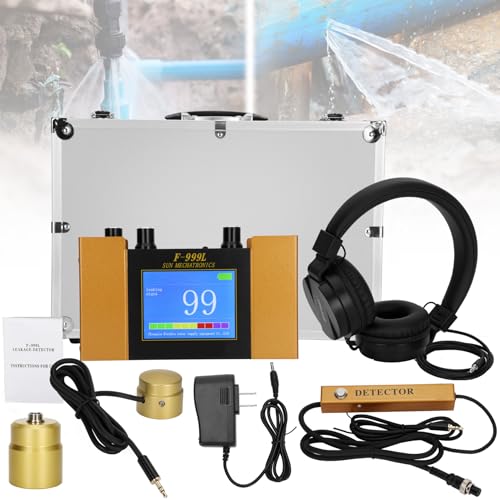
A pipe and underground leak locator with an LCD display, two sensor sizes and four selectable frequencies for metal, PVC, noisy sites and low-flow leaks. The frame is aluminum alloy with an ABS shell, and the kit includes noise-cancelling headphones and a carrying case. The maker is direct that it is not for drip leaks, because a slow seep makes too little sound to locate.
What stands out
- Display gives a numeric reading, not just audio
- Four selectable frequencies suit several different pipe materials
- Rugged carry case and two probe sizes included
Watch out for
- Not suitable for slow drips or seeping leaks
- Professional tool at a professional size and cost
PQWT PQ125A Underground Water Leak Detectors for Home Pressure Sewer
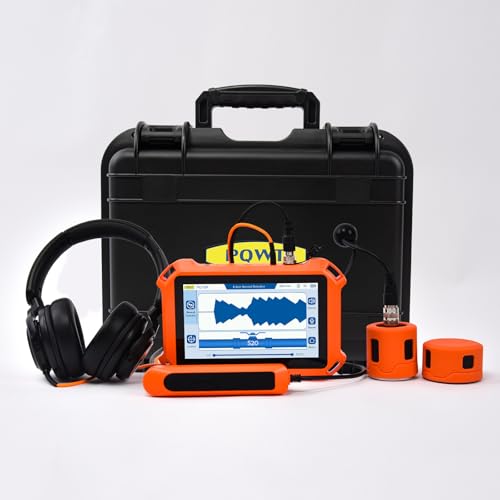
PQWT's touchscreen locator has a general detection mode for scanning a wide area and a location mode that compares signal strength from sixteen stored points. Two dual-membrane resonance sensors are included, and the unit carries a two-year warranty with a quoted 11.8-pound weight. It is a serious instrument aimed at plumbers and maintenance crews rather than a homeowner with a wet floor.
What stands out
- Sixteen-point comparison helps narrow down the leak location
- Two sensors cover different surfaces, depths and angles
- Comes with a two-year warranty and twelve interface languages
Watch out for
- Expensive for a single household repair job like this
- Heavier and slower to use than a simple probe
Buying guide
Where a laundry sensor has to sit to be useful
A leak sensor only works if water reaches its probes. In a laundry room that means the floor behind the washer, the floor under the water heater, and the low point where the floor slopes. A puck on a shelf or on top of the machine will stay dry while the room floods underneath it. Put it on the floor, probe side down, within a foot of the likeliest failure.
The three common failures are the supply hoses, the drain hose and the pump seal. Hoses burst at the crimp, usually at the back of the machine, so the sensor belongs behind the washer rather than in front. A drain hose that pulls out of the standpipe dumps water at the wall, not at the machine. If the laundry shares space with a water heater or a utility sink, one sensor is not enough; that is why the multi-packs here make sense.
One more placement rule: keep the sensor out of the drip line but inside the puddle. Directly under a hose connection, a slow drip can splash past a puck and land beside it. A foot back and slightly to the side catches the water that spreads across the floor, which is how most leaks actually announce themselves. If the floor slopes toward a drain, put the sensor between the machine and the drain rather than in the dry corner.
Acoustic locators answer the question a puck cannot
An acoustic leak detector is a microphone with a probe. You press the probe against a pipe, a wall or a floor, put on headphones, and listen for the sound of pressurized water escaping. The diymore unit quotes 13,000-times amplification and runs from a rechargeable 200 mAh battery over USB-C, which makes it a compact tool for tracing a leak behind a wall or under a cabinet.
The Redants and PQWT tools add the features that make locating practical. Redants offers an LCD readout, two sensor sizes and four frequency settings for metal, PVC, noisy sites and low-flow leaks, and it is explicit that slow drips make too little noise to find reliably. The PQWT PQ125A uses a touchscreen, a general scan mode and a location mode that compares readings from sixteen points to pin down the source.
Using one takes patience rather than training. Start with the probe on the exposed pipe nearest the wet area, follow the loudest point, and work toward the wall or slab. If the sound fades and you lose it, raising the line pressure makes the leak louder and easier to hear, which is the standard field trick both makers recommend. A quiet house helps more than any feature on the spec sheet; run the tool at night if you can.
A local siren, a phone alert, or both
A standalone puck with a 100 dB siren is the simplest thing that works. It needs no hub, no app and no Wi-Fi, and it will still be working when the router is not. The limit is obvious: you have to be home to hear it. If the washer runs while you are at work, a siren in an empty basement protects nothing but the cat.
Hub-based sensors trade that simplicity for distance. The two YoLink kits include a hub that connects by Ethernet or 2.4 GHz Wi-Fi and sends app, email and text alerts, with SMS limits. The Sensor 4 version adds a 105 dB local alarm and freeze alerts, so a cold snap in an unheated laundry room also triggers a warning. Both kits use LoRa radio, quoted at up to 2,034 feet in open air, which is more than enough to reach a basement corner.
Batteries, IP ratings and a damp room
Laundry rooms are humid, and a sensor that sits on the floor behind a washer will eventually get splashed. The METAK unit is IP66 and the YoLink Sensor 1 is IP68, while the Sensor 4 is IP67. Those numbers describe water resistance, not waterproofness; none of these should be submerged for long periods, and YoLink says as much about its own sensor.
Battery life is the other long-term cost. YoLink quotes up to five years from two AAA cells per sensor, and METAK claims more than two years from one battery with a low-battery beep and a red flashing light. Treat both as best-case figures in a cool room. A sensor that dies quietly is worse than no sensor, so check the app's battery status or the unit's own indicator every few months, ideally when you change the smoke alarm batteries.
The IP number is worth reading properly. The first digit is dust protection and the second is water, so IP67 and IP68 both survive a splash and a brief dunking, while IP66 handles jets of water but is not built for immersion. None of that matters if the sensor is placed where water pools for days; a sensor sitting in a puddle will eventually corrode its probes, and a corroded probe can read as dry.
Pairing a sensor with a shutoff, and what that costs
An alert is a notification; a shutoff is a repair. YoLink's Control-D2D feature lets a sensor trigger compatible YoLink shutoff devices directly, including motorized valves and the FlowSmart meter, and that local link keeps working without internet or hub power as long as both devices have power and are in range. The shutoff hardware is sold separately, and the battery-powered options are the ones that keep working in an outage.
That is the real decision in this category. A sensor alone limits the damage to whatever the floor can hold. A sensor plus a motorized valve stops the water at the main or at the washer, which is the difference between a wet floor and a flooded house. If you are buying the hub kit anyway, check which shutoff models pair with it before you finish the installation, because the list is specific.
Frequently asked questions
Where should I put a leak detector in a laundry room?
On the floor behind the washer, close to the supply hoses and the drain connection, and again under a nearby water heater or utility sink. Water spreads along the floor, so the low spot matters more than the middle of the room. Keep the probes on the floor rather than on a shelf or on top of the machine.
Do I need a hub for a smart leak detector?
Only for the hub-based models. The METAK alarm works alone with no app. The YoLink kits include a hub, and the Sensor 4 three-pack requires one that is sold separately. A hub adds phone and email alerts; it also means one more device that needs power and a network connection.
Will a leak detector still work during a power outage?
A battery-powered sensor will still detect water and sound its own alarm. App alerts need a powered hub and an internet connection. YoLink's direct sensor-to-shutoff pairing is designed to keep working locally without internet or hub power, provided both devices are powered and within range.
Can a leak detector find a leak inside a wall?
Not a puck-style sensor. Those only respond once water reaches them. An acoustic locator such as the Redants or PQWT presses a probe against the surface and amplifies the sound of escaping water. These tools work best on leaks with enough flow to make noise, so a slow drip may still need a plumber.
How often do leak sensor batteries need changing?
YoLink quotes up to five years from two AAA batteries per sensor, and METAK claims more than two years from one battery. Real life in a cold basement is usually shorter. Check the app or the unit's low-battery indicator twice a year, and replace the cells before a long trip rather than after.
Verdict
The YoLink Sensor 4 six-pack kit is the top pick because it covers a laundry room and the rooms around it in one purchase: six sensors, a hub, a 105 dB local alarm, app alerts and freeze warnings, all on a radio link that reaches across a large house. The METAK alarm is the value buy for a single laundry room, with a 100 dB siren, six probes and no hub to maintain. The PQWT PQ125A is the upgrade, not because it detects floods but because it finds the leak that a puck can only confirm.
If you want the water stopped rather than announced, budget for the compatible shutoff valve alongside the YoLink kit. A sensor that texts you from the basement is useful. A sensor that closes the valve is the one that saves the floor.