The word portable in this category is doing a lot of work. The lightest dryer here weighs 110 pounds and the heaviest 178, which is portable in the sense that a refrigerator is portable: it can be moved, once, by two people with a dolly. What these machines really are is ventless, and that is the property that matters. No duct means a closet, an interior room or a basement corner can host a dryer that would otherwise need a hole in an exterior wall.
All five machines in this group are 24-inch cabinets with drums between four and 4.4 cubic feet. Three are described as heat pumps; the Electrolux and the Bosch are listed simply as ventless, without naming the drying method. The distinction changes how they dry, how much energy they use and how long a load takes. It also changes what you should expect on a cold morning when the towels are still slightly damp and the cycle has already run for two hours.
We compared specifications, features and owner reports for the five. The list is shorter than the search results suggest because most machines sold under this phrase are variations on the same European cabinet. Where a listing hides the details, we point that out rather than filling the gap with a guess.
Top picks at a glance
LG DLHC1455W 24 in. W 4.2 Cu. Ft. Ventless Stackable Compact Smart Electric Dr
Check price on AmazonElectrolux 24 in. 4.0 cu. ft. Compact Stackable Electric Ventless Dryer in Whi
Check price on Amazon800 Series 24 in. 4 cu. ft. Stackable Ventless Compact Front Load Smart Electr
Check price on AmazonCompare the shortlist
| Model | Type | Capacity | Key feature | Amazon |
|---|---|---|---|---|
| 1. LG DLHC1455W 24 in. W 4.2 Cu. Ft. Ventless Stackable Compact Sma | Ventless | 4.2 cu ft | Sensor drying | Check price |
| 2. Electrolux 24 in. 4.0 cu. ft. Compact Stackable Electric Ventles | Ventless | 4.0 cu ft | Stackable | Check price |
| 3. Samsung 4.0 cu. ft. Compact Ventless Heat Pump Dryer with AI Sma | Heat pump | 4.0 cu ft | Sensor drying | Check price |
| 4. 800 Series 24 in. 4 cu. ft. Stackable Ventless Compact Front Loa | Ventless | 4 cu ft | Connected controls | Check price |
| 5. Techomey 4.4 Cu.Ft Ventless Heat Pump Clothes Dryer, 24" Compact | Heat pump | 4.4 cu ft | Sensor drying | Check price |
Detailed reviews
LG DLHC1455W 24 in. W 4.2 Cu. Ft. Ventless Stackable Compact Smart Electric Dryer in White with Dual Inverter

LG's 24-inch heat-pump dryer pairs a 4.2-cubic-foot drum with dual-inverter technology, fourteen programs, sensor drying and Wi-Fi control through the ThinQ app. It is the second-largest drum in this group and the most connected, with remote start and cycle alerts. The listing's dimension field shows a ten-inch cube, which is clearly a placeholder, so verify the real cabinet depth before planning a closet around it.
What stands out
- 4.2 cubic feet is near the top of this compact class
- Dual-inverter heat pump keeps energy use lower than resistance
- Sensor dry and ThinQ alerts suit unattended loads
Watch out for
- Published dimensions are a placeholder and need confirming
- Heat-pump cycles run longer than vented drying does
Electrolux 24 in. 4.0 cu. ft. Compact Stackable Electric Ventless Dryer in White with Instant Refresh ELFE4222

Electrolux's ventless compact has a 4.0-cubic-foot drum, twelve cycles and an Instant Refresh setting for clothes that need airing rather than washing. It stacks over a matching washer and needs no exterior vent, which makes it a natural fit for an apartment closet. The listing puts it near 32 inches tall and 24.5 inches deep, and the 178.6-pound weight means delivery and installation are a two-person job.
What stands out
- Four cubic feet with twelve named drying cycles
- Stacks neatly over a matching compact front-load washer
- Ventless design needs no exterior duct or vent
Watch out for
- At 178.6 pounds it is the heaviest machine here
- Deep cabinet leaves very little slack behind it
Samsung 4.0 cu. ft. Compact Ventless Heat Pump Dryer with AI Smart Dial, Wi-Fi Connected, Smart Dry Technology
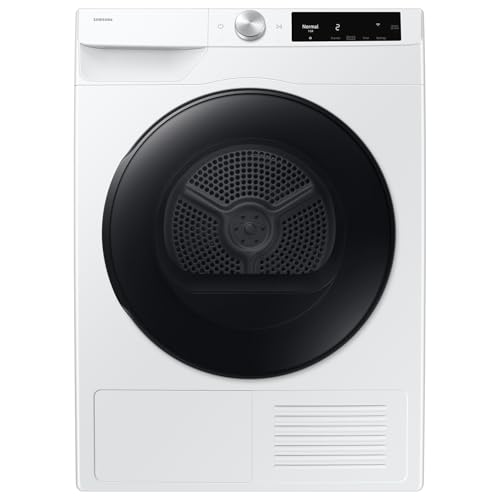
Samsung's compact heat-pump dryer offers a 4.0-cubic-foot drum, AI Smart Dial controls, Wi-Fi through SmartThings and sensor-based Smart Dry. It is ENERGY STAR certified. The dial learns which cycles you use and puts them first, which is genuinely useful on a long cycle list, and the app sends end-of-cycle notifications and supports remote start. The listing gives only the 110.2-pound weight, so ask for cabinet dimensions before you commit.
What stands out
- ENERGY STAR certified heat-pump drying with lower running costs
- AI dial keeps everyday cycles within one turn
- SmartThings app remote start plus end-of-cycle push notifications
Watch out for
- Cabinet dimensions are missing from the product listing
- Four cubic feet still will not take a comforter
800 Series 24 in. 4 cu. ft. Stackable Ventless Compact Front Load Smart Electric Dryer in Pearl Steel, Energy

The Bosch 800 Series is a 24-inch, four-cubic-foot ventless dryer in Pearl Steel, described as stackable and ENERGY STAR certified. It is the premium finish option in this group and matches the Samsung and Electrolux on capacity. The listing is nearly empty of detail: one generic feature line, and dimensions that describe a 27-inch-wide, 23-inch-tall box rather than a 24-inch cabinet. Verify every number with the seller.
What stands out
- Four cubic feet in a nominal 24-inch cabinet
- Pearl Steel finish suits a visible laundry area
- ENERGY STAR rated and described by Bosch as stackable
Watch out for
- Feature copy gives no cycle or installation detail
- Listed dimensions openly contradict the claimed 24-inch width
Techomey 4.4 Cu.Ft Ventless Heat Pump Clothes Dryer, 24" Compact 120/240V Electric Front Load Drying Machine,

Techomey's heat-pump dryer is the largest cabinet here at 4.4 cubic feet, with sixteen cycles and sensor drying that pauses when the load reaches the chosen dryness. The listing says the heat-pump loop keeps air below 50 degrees Celsius and reuses heat, which is the usual efficiency argument for the design. It measures about 33.5 inches tall and 23.5 inches deep, and it ships with a four-prong cable that needs an adapter for a three-prong outlet.
What stands out
- 4.4 cubic feet leads this compact cabinet class
- Sixteen cycles, all with automatic sensor-based dryness control
- Published dimensions and cable type are unusually clear
Watch out for
- Water tank must be emptied after every load
- Four-prong cable needs an adapter for older outlets
Buying guide
Portable Means Movable, Not Carryable
Start with weight, because it decides who installs the machine. The Samsung is 110.2 pounds, the LG 127.9, the Techomey ships in a cabinet around 33.5 inches tall, and the Electrolux is 178.6. Two healthy adults can move any of them across a flat floor with a strap and a furniture dolly. Stairs are a different job, and a narrow stair with a turn is a job for professionals. Budget for delivery and installation rather than assuming you will wrestle it into place yourself. A boxed 178-pound cabinet also has to pass through the front door and around the hallway corner, which is often the tightest part of the job. Measure the doorway and the stair turn before delivery, because those decide whether the crew can get it in.
The footprint is what makes the category useful. A 24-inch cabinet fits under a counter, beside a washer or on top of one with a stacking kit, and it leaves enough room to open the door in a closet that would never take a full-size dryer. Depth is the number to check, not width. The Electrolux lists about 24.5 inches, the Techomey about 23.5, and both need clearance behind for the cord and a drain hose or tank. Measure the opening with the door closed, then measure the path into the room. If the machine goes under a counter, check the toe kick and the overhang too, because the door has to clear both. Leave an inch or two on each side for the door and for air.
Heat Pump or Condenser: What Actually Differs
A heat pump uses a small refrigeration circuit to move heat rather than generate it with a resistance element. The drum air stays cooler, which is gentler on wool, synthetics and anything with elastic, and the machine uses less electricity per load. The trade is time and complexity: cycles run longer, the condenser needs occasional cleaning, and the cabinet costs more to build. LG, Samsung and Techomey all describe heat-pump designs, and Samsung carries ENERGY STAR certification for its version. Budget for a little maintenance as well: the condenser and lint filter both need cleaning on a schedule, and a clogged condenser turns a slow dryer into a useless one. A heat pump also takes longer to reach temperature on a cold morning.
A condenser dryer also avoids a duct, but it removes moisture with a heat exchanger rather than a full heat-pump loop. The Electrolux is listed simply as ventless, which at this size usually means a condenser; it has twelve cycles and an Instant Refresh setting for freshening clothes between washes. In practice the difference shows up in running cost and in how warm the laundry room gets. A condenser is simpler and often quicker; a heat pump is more efficient and gentler. Neither is wrong, but they suit different budgets and different patience levels. Ask the seller which one you are actually buying, because the marketing copy often blurs the line. The Electrolux listing emphasizes cycle count over drying method, so read the specification rather than the badge on the door.
Where the Water Goes
Every machine in this group produces water, and every one needs a plan for it. Most collect condensate in a pull-out tank that you empty by hand. Techomey's instructions are explicit: empty the tank after each use, or the program pauses. That pause is not a malfunction; it is the machine refusing to keep drying into a full tank. A tank that fills halfway through a bedding cycle leaves you with damp sheets and a wait, which is why a drain hose is worth having when the room allows one. A load can produce more water than most people expect, especially from towels that came out of the washer still heavy. Empty the tank into a sink rather than a toilet, and rinse it before it goes back.
A drain hose turns the dryer into a plumbed appliance. It needs a standpipe, a laundry sink or a floor drain within reach, and the hose has to run downhill without a kink. If the closet has none of those, the tank is the answer, and the routine becomes part of laundry day: empty it, rinse it, put it back. Check where the tank sits before you buy. A tank at the bottom of a stacked pair is harder to reach than one at waist height, and a full tank is heavier than it looks. If you plumb a drain, leave a loop or a high point so odors from the standpipe do not travel back into the drum. A hose that sags holds water and smells after a month.
Volts, Cords and the Adapter Trap
Most 24-inch ventless dryers want a 240-volt circuit, and the listings are inconsistent about saying so. Techomey is the most forthcoming: the machine is listed as 120/240-volt, ships with a four-prong cable and notes that a three-prong outlet needs a conversion adapter. That note is a warning, not a solution. The adapter changes the plug shape, not the voltage or the available current, and the circuit still has to be sized for the dryer. A 30-amp dryer circuit will not become a 15-amp one because the plug fits. Techomey's four-prong cable is the kind used on newer dryer circuits, and it will not fit an older three-prong receptacle without the adapter the listing mentions. Confirm the receptacle type with a tester rather than by looking at the slot pattern.
Before you order, photograph the panel and the receptacle and ask the seller for the nameplate rating in writing. Then have an electrician confirm the circuit, the breaker and the grounding. A dedicated 240-volt circuit is the clean installation; a shared one is a compromise that may trip when the washer fills. If the room has only 120 volts and no way to add a circuit, these machines are not for you, and no adapter will make them work. Ask the landlord before you ask the electrician, since drilling and wiring are usually the landlord's call. If the panel is full, a subpanel is possible but rarely worth it for one appliance. Get the electrician's estimate in writing before you order the dryer.
Four Cubic Feet and a Real Load
A four-cubic-foot drum takes a normal mixed load: jeans, shirts, socks, underwear and a couple of towels. It does not take a queen comforter, and it struggles with a full set of bath towels plus bath mats. The Techomey's 4.4 cubic feet is the largest here and the LG's 4.2 is close, but the difference is a few garments rather than a whole extra load. Load loosely and shake items out; a compact drum punishes a stuffed load with damp patches and deep wrinkles. The Techomey's 17.6-pound fabric rating is a dry-weight ceiling, not a target, and a wet towel weighs far more than a dry one. The LG and Electrolux drums are close enough that the difference is a folded shirt or two.
Expect 70 to 120 minutes for cottons and longer for heavy items, especially from a heat pump. Sensor drying stops the cycle when the load is dry rather than when the timer runs out, which matters more in a small drum, where twenty extra minutes can over-dry a light load. If you need a shirt dry in forty minutes, this is the wrong category. If you can start a load before dinner and fold it before bed, a ventless cabinet is a quiet, efficient way to dry without a duct. Hang shirts as soon as the cycle ends, because a warm compact load creases if it sits in the drum. A drying rack for the items that come out slightly damp saves a second cycle.
Frequently asked questions
What makes a dryer portable and ventless?
Ventless means it condenses moisture into a tank or drain instead of pushing it through a duct. Portable usually means it can be moved and installed without major work, not that you can carry it. These cabinets weigh 110 to 178 pounds, so plan on two people and a dolly.
Is a heat pump better than a condenser dryer?
A heat pump uses less energy and dries at a lower temperature, which is easier on delicate fabrics. A condenser is simpler, often faster and usually cheaper to buy. Both need a tank or drain and neither needs a duct. Choose on running cost and fabric care versus upfront simplicity.
Do ventless dryers need a drain?
No, but the water has to go somewhere. Most collect it in a tank you empty by hand, and some accept a drain hose. A drain is more convenient and avoids mid-cycle pauses. A tank is fine in a rental, provided you empty it after every load rather than when it overflows.
Can I plug a ventless dryer into a normal outlet?
Usually not. Most 24-inch models need a 240-volt circuit, and some ship without the right cord. Techomey lists 120/240 volts and a four-prong cable, with an adapter note for three-prong outlets. An adapter changes the plug, not the voltage, so confirm the circuit before delivery.
How long does a ventless dryer take?
Plan on 70 to 120 minutes for cottons and longer for towels or heavy items. Heat pumps are slower than condensers because they dry at lower temperatures. Sensor cycles help by stopping at the right moment, but they cannot make a compact drum dry faster than the physics allow.
Verdict
The LG DLHC1455W is the best all-round choice. Its 4.2-cubic-foot drum is the second largest here, the dual-inverter heat pump keeps running costs down, and fourteen programs with sensor drying and ThinQ alerts make it easy to live with. Confirm the cabinet depth with the seller, because the listing's dimension field is a placeholder.
The Electrolux ELFE4222AW is the value pick: four cubic feet, twelve cycles and a ventless cabinet that stacks without a duct. The Samsung is the upgrade if you want ENERGY STAR certification and the AI Smart Dial, while the Techomey offers the largest drum at 4.4 cubic feet and the clearest cable specification. Match the machine to your circuit before you match it to your closet.