The hard part of drying laundry in an apartment is rarely the drying. It is getting a machine the building will accept, a landlord will allow and the wiring will actually run. A dryer is one of the few appliances that can demand a dedicated circuit, a hole through an exterior wall and a conversation with a property manager, and any one of those can end the project before the drum turns.
There are two routes through. A ventless heat pump dryer needs no duct, which removes the wall and the permission slip. It usually needs 240 volts, and it produces water that has to go somewhere, either into a tank you empty or down a hose you rig to a standpipe. A vented compact dryer needs a duct but can be simpler to place in a building that already has one, which is the trade most renters end up weighing.
We included full-size vented machines for apartments with a real laundry room, alongside compact ventless heat pumps for closets and kitchens. The comparison weighted drum size, cabinet width, venting, cord and circuit requirements, condensate handling and noise, because a dryer in a shared-wall apartment is heard by the neighbors whether or not it is seen.
We compared specifications, features and owner reports rather than running timed loads. Where a listing offers no usable dimensions, this guide says so and points you to the spec sheet instead of inventing a number.
Top picks at a glance
Electric Dryer 8 cu.ft, 27" Front Load Clothes Dryer Machine with 10 Cycles, S
Check price on AmazonSmad 8.0 Cu.ft Electric Dryer, 27" Full Size Clothes Dryer Machine, 120V 240V
Check price on AmazonMidea Heat Pump Ventless Front Load Dryer Stackable 4.4 Cu.ft White
Check price on AmazonCompare the shortlist
| Model | Type | Capacity | Key feature | Amazon |
|---|---|---|---|---|
| 1. Electric Dryer 8 cu.ft, 27" Front Load Clothes Dryer Machine wit | Front-load | 8 cu ft | Steam | Check price |
| 2. Smad 8.0 Cu.ft Electric Dryer, 27" Full Size Clothes Dryer Machi | Front-load | 8.0 cu ft | Steam | Check price |
| 3. Midea Heat Pump Ventless Front Load Dryer Stackable 4.4 Cu.ft Wh | Heat pump | 4.4 cu ft | Sensor drying | Check price |
| 4. LG DLHC1455W 24 in. W 4.2 Cu. Ft. Ventless Stackable Compact Sma | Ventless | 4.2 cu ft | Sensor drying | Check price |
| 5. Techomey 4.4 Cu.Ft Ventless Heat Pump Clothes Dryer, 24" Compact | Heat pump | 4.4 cu ft | Sensor drying | Check price |
| 6. 800 Series 24 in. 4 cu. ft. Stackable Ventless Compact Front Loa | Ventless | 4 cu ft | Connected controls | Check price |
Detailed reviews
Electric Dryer 8 cu.ft, 27" Front Load Clothes Dryer Machine with 10 Cycles, Steam, Wrinkle Care,Stackable, Wh

The largest machine in this guide, and the one that needs the most from the room: 27 inches of width, a 240-volt outlet and a duct. In exchange it takes eight cubic feet per load, offers steam and an ECO cycle, and reverses its door for awkward closets. A four-hole cord is in the box. For an apartment with a real laundry room, that trade is usually worth making.
What stands out
- Eight-cubic-foot drum takes a week of family laundry
- Reversible door and child lock on a full-size cabinet
- Steam and ECO dry on the same machine
Watch out for
- Twenty-seven inches wide is too much for small closets
- Three-prong apartments need to buy a different cord
Smad 8.0 Cu.ft Electric Dryer, 27" Full Size Clothes Dryer Machine, 120V 240V Stackable Large Capacity Front L
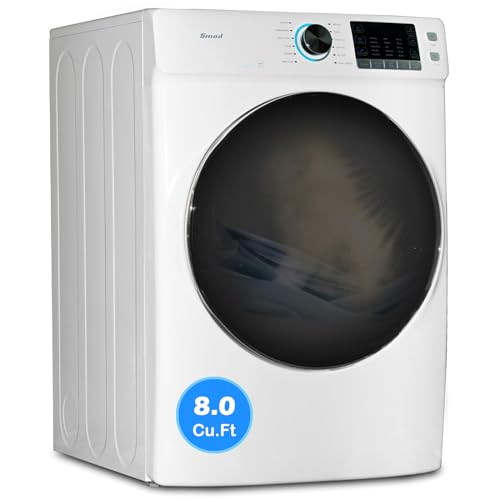
Smad fits a moisture sensor and a steam wrinkle cycle to an 8-cubic-foot drum, then gives the installer three exhaust directions to work with. In an apartment, that last detail matters more than the cycle list, because the only usable wall may be the one beside the machine. The outlet requirement is specific: a three-wire or four-wire 240-volt receptacle, with a cord for the four-wire version.
What stands out
- Three exhaust routes help with awkward duct runs
- Moisture sensor stops the cycle at the chosen dryness
- Large drum makes short work of a family's towels
Watch out for
- Needs a duct, which many leases will not allow
- Dimension data conflicts between two sections of the listing
Midea Heat Pump Ventless Front Load Dryer Stackable 4.4 Cu.ft White

The argument for this machine is what it does not need: no duct, no exterior wall, no hole in a rental. It holds 4.4 cubic feet in a 24-inch cabinet, senses humidity to set the cycle, and carries ENERGY STAR certification. Wrinkle care tumbles the dry load for roughly 90 minutes. The cord is not included, and the unit runs on 240 volts, so plan for both.
What stands out
- No duct, so no exterior wall or landlord permission
- ENERGY STAR rated, with humidity-based cycle control built in
- Compact 24-inch cabinet fits a narrow hall closet
Watch out for
- Cord sold separately, easy to forget before delivery
- Small drum for a household that dries everything
LG DLHC1455W 24 in. W 4.2 Cu. Ft. Ventless Stackable Compact Smart Electric Dryer in White with Dual Inverter

A compact heat pump for someone who starts laundry and leaves. Fourteen programs, sensor drying and ThinQ remote start let you check a cycle from work, and the dual inverter compressor keeps temperatures low enough for fine fabrics. The cabinet is 24 inches wide, but LG does not publish usable depth or height figures in the listing, which is exactly the information a closet install needs.
What stands out
- Remote start and alerts through the ThinQ app
- Fourteen programs is generous for a compact machine
- No duct required, so the installation stays reversible
Watch out for
- Cabinet dimensions are absent from the product listing
- Smaller drum than the vented Smad models offer
Techomey 4.4 Cu.Ft Ventless Heat Pump Clothes Dryer, 24" Compact 120/240V Electric Front Load Drying Machine,

Techomey's 4.4-cubic-foot heat pump keeps drum air below 50 degrees Celsius and offers sixteen cycles, more choice than most compact machines provide. Sensor drying pauses at the level you set. It comes with a four-prong cable, so an older three-prong outlet needs an adapter, and the condensate tank has to be emptied after each load or the program halts.
What stands out
- Sixteen cycles packed into a compact 24-inch cabinet
- Low drum temperature protects wool, silk and delicates
- Four-prong cable is included rather than sold separately
Watch out for
- Tank emptying after every load gets old fast
- An adapter is needed on older three-prong outlets
800 Series 24 in. 4 cu. ft. Stackable Ventless Compact Front Load Smart Electric Dryer in Pearl Steel, Energy

Bosch's 800 Series entry is a ventless 24-inch dryer rated at 4 cubic feet and ENERGY STAR, finished in pearl steel. The listing is unusually thin: one line of feature copy, no cycle list, and a measurement block that contradicts the 24-inch description. For a rental, that is a reason to call the seller before ordering rather than after the box arrives.
What stands out
- Ventless design that also carries ENERGY STAR certification
- Finish that suits an open kitchen or hallway
- Compact footprint works in the tightest rental layouts
Watch out for
- Feature and cycle detail is almost absent from the page
- Listed dimensions do not match the 24-inch claim
Buying guide
Three Questions Before You Order Anything
Start with the duct. Walk the room and look for an exterior wall, an existing vent hood or a capped hole where a previous dryer exhausted. In a rental the answer may be no, and drilling a four-inch hole is exactly the kind of change a lease forbids. Next, find the outlet and read the receptacle: a large three-prong or four-prong 240-volt face is a dryer outlet, while a standard 120-volt duplex is not. Last, read the lease. Some buildings ban vented dryers outright because of lint and fire risk in shared ducts, and a co-op board can be stricter than the landlord. If the room has a gas line but no 240-volt outlet, the whole calculation changes and you should price an electrician before anything else.
Permission is not only about holes. Stacking a dryer on a washer adds load to the floor and height to the room, and many leases require written consent for any appliance installation. Ask by email, keep the reply, and confirm who pays if the machine damages a floor or a wall. If the answer is no to a duct, the ventless heat pumps here become the shortlist. If the answer is no to new wiring as well, the field shrinks to machines that can share the circuit you already have, and that rules out most of this group. Get the approval in writing before the return window closes, because a dryer that cannot be installed is a dryer you have to ship back.
Ventless Means No Duct, Not No Plumbing
A heat pump does not vent air, but it does make water. Moisture pulled from the load condenses on a cold coil and drips into a reservoir or a hose. Every ventless machine here can collect that water in a tank, and most can send it to a drain instead. In a rental, the tank is the safer choice because it needs no plumbing and leaves nothing behind when you move out. The catch is the schedule. Techomey says to empty the tank after every load or the program pauses, which is a real constraint when the dryer sits above shoulder height. A full tank is heavier than it looks, and lifting one overhead twice a week gets old by the second month.
If you can reach a standpipe, a laundry sink or a floor drain, use the hose. A drained machine runs unattended, which matters in an apartment where you start a load and leave for work. Do not run the hose into a toilet tank or a kitchen sink without thinking about backflow and the mess if it slips off. Plan for heat as well. A ventless dryer puts warm, damp air into the room, so a closet needs the door open or a louvered panel, and a kitchen installation will feel humid through a long cycle. In winter that moisture lands on cold windows, and in a small apartment you will notice it on the glass within a week, and the machine will take longer to finish a load in that damp air.
The 240-Volt Problem
Most dryers here want 240 volts, and the cord is often the part that trips people up. Midea's listing says the power cord must be bought separately. Techomey includes a four-prong cable and tells you a three-prong outlet needs an adapter. Smad includes a four-hole cord on one model and warns that a three-hole socket needs a different one. LG's copy is silent on the subject. In an apartment the receptacle is whatever the building installed, so check it before you order and photograph the face for the seller. The plug shape tells you the voltage and the amperage at a glance, and a photo ends the guessing that turns into a return. If the outlet sits behind the machine and cannot be reached, that is worth knowing before delivery day too.
An electrician is the only person who should touch the circuit, and in a rental even that needs approval. Ask whether the panel has a spare double-pole breaker, whether the wiring is copper or aluminum, and whether the outlet is grounded. A dryer on an undersized circuit will trip at the worst possible moment, and repeated tripping is a signal to stop rather than reset. If the building will not allow new wiring, the honest answer may be that a dryer is not viable in that unit, and the shared laundry room is the practical fallback. The electrician's visit belongs in the budget from the start, not in the surprise column after the dryer arrives. Ask for a written quote that names the breaker size and the wire gauge.
Fitting It Through the Door
A 24-inch cabinet is the difference between a dryer that fits a hall closet and one that lives in the middle of the kitchen. Midea, Techomey and LG all build around that width. Bosch's page claims 24 inches but prints a dimension block that does not match, so confirm before delivery. The Smad machines are 27 inches wide, which is standard for a full-size pair and too wide for most apartment closets. Measure the narrowest point on the delivery path too: a 24-inch machine still needs a doorway, a stair turn and a landing. Measure with the closet door open and off its hinges, since a door that swings inward eats six inches of the space you just counted. A machine that fails at the stairs never reaches the closet.
Height matters more than width once you stack. A compact dryer on a compact washer lands around five and a half feet, and a full-size pair sits closer to six, so check the ceiling, the light fixture and any shelf above. The closet door has to close with the pair inside, which usually means lifting the door off its hinges to install and refitting it afterward. A reversible dryer door is worth having in a hallway where the hinge side decides whether you can open the drum at all. The stacking kit adds an inch or two of height as well, and that is the number people forget when they measure the machines alone. On a low ceiling, a compact pair is the only arrangement that leaves room to load the top machine.
Noise, Vibration and Neighbors
A dryer transmits vibration into the floor, and in an apartment that floor is somebody's ceiling. Put the machine on a level surface, use a rubber mat or anti-vibration pads, and avoid backing it against a shared bedroom wall. Heat pumps add a steady compressor hum that many people find easier to live with than the rush of vented air, but the cycle runs longer, so the sound lasts longer too. If the laundry closet shares a wall with a neighbor, a late load is a poor idea regardless of which machine you buy. A front-load washer underneath doubles the vibration, so balance the washer first and the stack will settle down. Rubber pads under the feet cost little and help a lot.
Timing helps more than soundproofing. Run loads in the afternoon and early evening, and use the delay start if the machine offers one. A vented dryer also pushes air outside, and in a building where the vent run is shared or partly blocked, the machine will run louder and slower. Ask the landlord when the duct was last cleaned. If nobody knows, budget for a cleaning before you trust the machine with a full load of towels, because a clogged run is a fire risk and not only a noise problem. A short, straight, clean duct is the difference between a dryer that finishes in one pass and one that needs two. Ask for the date and the name of the company that last cleaned it.
Frequently asked questions
Can I install a dryer in a rental apartment?
Usually yes, with conditions. A ventless heat pump needs no exterior hole, which avoids the hardest permission to get, but it still needs a 240-volt circuit and somewhere for the condensate to go. Read the lease, ask for written approval, and confirm the outlet type before you order anything.
Do ventless dryers need a drain?
No. Every machine here can collect water in a tank you empty by hand, which suits a rental where you cannot touch the plumbing. A drain hose is more convenient and lets the machine run unattended. Some models require the tank to be emptied after every load, so check that detail before buying.
What if my apartment only has a standard 120-volt outlet?
Then a 240-volt dryer will not run, and a plug adapter will not fix it because the voltage itself is wrong. Techomey lists 120/240V without saying which version ships, so ask the seller in writing. Otherwise the practical options are a machine designed for 120 volts or the building's shared laundry room.
Can I stack a dryer in a rental without damaging anything?
Stacking itself is reversible: the bracket comes off and the machines separate. The risk is the floor and the wall. Use the manufacturer's kit, anchor the top unit, and avoid drilling into a wall for an anti-tip strap unless the lease allows it. Photograph the room before installation.
How loud is a stackable dryer in an apartment?
Loud enough to notice through a shared wall, especially on a wood floor. Vibration is the bigger issue than the motor, so a level surface and a rubber mat help more than anything else. Heat pumps run longer but at a steadier, lower sound than a vented machine pushing air outside.
Verdict
The Midea heat pump is the best fit for most renters because it removes the duct from the equation entirely. It is ENERGY STAR rated, holds 4.4 cubic feet in a 24-inch cabinet, senses moisture and tumbles the load after the cycle to cut wrinkles. Buy the 240-volt cord at the same time as the dryer, since it is not in the box.
The Techomey is the value pick: sixteen cycles, the same 4.4 cubic feet and a low drying temperature, at the cost of emptying a tank after every load. Step up to the LG DLHC1455W for fourteen programs, sensor drying and ThinQ remote start, which is genuinely useful when a load finishes while you are still at work.