The duct is the cheapest part of a dryer installation and the most likely reason the machine underperforms. A dryer moves a surprising volume of air, and every foot of pipe, every elbow and every wrinkle adds resistance the blower has to overcome. When resistance wins, cycles stretch, lint settles in the run, and the appliance gets blamed for a problem that lives in the wall.
Most of the failures we see described in owner reports share a pattern: a long flexible run crushed behind the machine, a screen in the outside cap, or a transition hose looped twice because the dryer was pushed back against the wall. None of that is exotic, and none of it requires a new appliance. All of it is fixable with a trip to a hardware store and an hour with a screwdriver.
We compared specifications, features and owner reports for four machines that illustrate the choices, from a 1.8 cu. ft. compact dryer with an exhaust duct in the box to a 220-volt coin-operated combo with a top vent. The duct rules below apply to all of them, and to whatever dryer is already in your basement.
Top picks at a glance
Euhomy Compact Dryer 1.8 cu. ft. Portable Clothes Dryers with Exhaust Duct wit
Check price on AmazonCOSTWAY Portable Clothes Dryer, 13.2 LBS Front Load Compact Laundry Dryer with
Check price on AmazonINTSUPERMAI Coin-Op Washer Dryer Combo 26.4lbs Washer Dryer Combo Automatic La
Check price on AmazonCompare the shortlist
| Model | Type | Capacity | Key feature | Amazon |
|---|---|---|---|---|
| 1. Euhomy Compact Dryer 1.8 cu. ft. Portable Clothes Dryers with Ex | Portable | 1.8 cu ft | Delay start | Check price |
| 2. COSTWAY Portable Clothes Dryer, 13.2 LBS Front Load Compact Laun | Front-load | — | Stackable | Check price |
| 3. INTSUPERMAI Coin-Op Washer Dryer Combo 26.4lbs Washer Dryer Comb | Front-load | — | Low noise | Check price |
| 4. Midea MLTW41A1BGK1 Top Load Washer and Electric Dryer Laundry Pa | Top-load | 4.1 cu ft | Top-load | Check price |
Detailed reviews
Euhomy Compact Dryer 1.8 cu. ft. Portable Clothes Dryers with Exhaust Duct with Stainless Steel Liner Four Fun
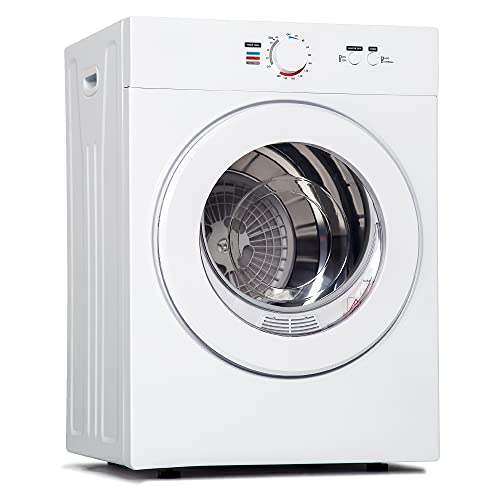
Euhomy's compact dryer holds 1.8 cu. ft., about 10.5 pounds of wet clothes, with a 1,020-watt element and a 140-degree maximum. Seven modes include cool down, anti-wrinkle, air dry, an intelligent humidity setting and an eco cycle, and the box includes an exhaust fitting and pipe. The features list 27 inches tall while the specification block says 29.9, and both heights need checking against the shelf above.
What stands out
- Exhaust duct and fitting included in the box
- Seven drying modes including eco, air dry and anti-wrinkle
- 1020 watts runs on a standard household circuit
Watch out for
- Two conflicting heights appear in the same listing
- 1.8 cu. ft. drum handles only small loads
COSTWAY Portable Clothes Dryer, 13.2 LBS Front Load Compact Laundry Dryer with Stainless Steel Drum, 5 Drying
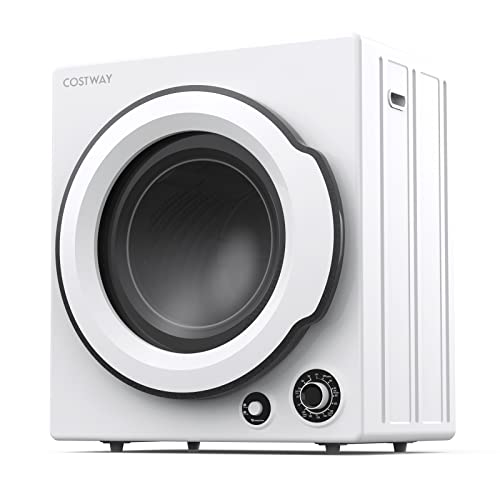
A 13.2-pound front-load dryer with a 1,350-watt element and a 153-degree maximum, built around a 430 stainless drum and five programs with two heat levels. The exhaust vent rotates to vertical or horizontal, which helps when the wall box sits low or to the side, and the cabinet can be freestanding, stacked or wall-mounted. Wall brackets are not included. The maker notes it is not sold in California.
What stands out
- Adjustable exhaust vent turns to vertical or horizontal
- Three mounting options cover freestanding, stacked and wall-mounted use
- A 13.2-pound capacity in a compact front-load cabinet
Watch out for
- Wall-mount brackets are sold separately from the dryer
- Not sold to buyers in California, per the listing
INTSUPERMAI Coin-Op Washer Dryer Combo 26.4lbs Washer Dryer Combo Automatic Laundry Washer Spinner Dryer Machi

A 26.4-pound coin-operated washer and dryer combo with a 304 stainless drum, a 46 RPM spin and a top-mounted dryer vent measuring 110mm. It runs on 220 volts, draws 1.5kW for washing and 6kW for drying, and is built for laundromats, gyms and small apartment buildings where the machine earns its keep. At 83 inches tall and 41.7 deep, it needs a commercial footprint and a real electrical service.
What stands out
- The coin mechanism supports unattended self-service operation all day
- 304 stainless drum, lint filter and vent resist corrosion
- Top vent keeps the duct run short in a stack
Watch out for
- Requires 220-volt service and a 6kW drying draw
- 83 inches tall, too big for a home closet
Midea MLTW41A1BGK1 Top Load Washer and Electric Dryer Laundry Pair Bundle 4.1 Cu Ft Washer 7 Cu Ft Dryer with
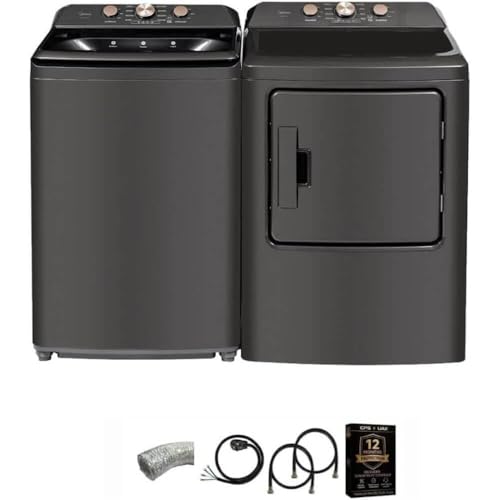
A Midea bundle with a 4.1 cu. ft. top-load washer and a 7.0 cu. ft. electric dryer, plus a vent kit, power cord and 12-month protection plan. The washer offers eight cycles, the dryer eight cycles and four temperature settings, and the top-load lid saves bending. Listed at 44 inches tall, 33 deep and 32 wide at 220 pounds, the pair needs a standard 240-volt dryer circuit and a short, clean run to the outside.
What stands out
- Vent kit and power cord included in the bundle
- A 7.0 cu. ft. dryer with four temperature settings
- The top-load washer is easier on the back than a front door
Watch out for
- The dryer needs a 240-volt circuit and a vent
- Bundle dimensions cover only the taller of the two units
Buying guide
What the Duct Actually Has to Do
A dryer is an air pump as much as a heater. The blower pulls room air through the drum, picks up moisture from the clothes, and pushes the whole mixture out of the building. That job runs against static pressure, which rises with every foot of pipe, every elbow and every crushed section. If the path is too long or too narrow, the blower cannot move enough air, the drum runs hotter than it should, and the moisture stays in the load longer. A dryer on a bad run takes 70 minutes for a job that should take 40, and the high-limit thermostat eventually trips. Restriction builds up gradually, so nobody notices the decline until a comforter comes out damp after ninety minutes. By then the vent is usually half closed with felt.
The other job is lint removal. Dryer lint is fine and slightly sticky, and it settles wherever the air slows down: at elbows, at the transition behind the machine, and on the inside of the outside cap. A smooth, short, gently routed pipe keeps velocity up and carries lint to the exterior where it can blow away. A long corrugated run gives lint somewhere to catch. That blockage does not stay stable. It grows with every load, which is why a dryer that worked fine in October can be useless by February. A blocked duct also raises drum temperature: less air passing through means more heat stays in the metal, which is hard on elastics and on the thermal fuse.
Rigid, Semi-Rigid and Flexible
Rigid galvanized pipe is the best performer. A smooth interior creates the least resistance, elbows are available as swept fittings rather than sharp corners, and joints can be sealed with foil tape. It is also the least forgiving, because you have to measure, cut and fit it, and a run that needs four elbows is a run that needs rethinking. Where the path is straight and accessible, rigid pipe will outperform everything else for the life of the house, and it is sold in straight lengths at any hardware store. The one place rigid pipe loses is a tight turn, where two 45s beat a single 90 if the framing allows it.
Semi-rigid aluminum is the practical compromise for the last few feet behind the machine. It bends without collapsing and holds its shape, so it can make a short offset into a wall box without sagging. Flexible foil and plastic are the ones to avoid. They crush under the weight of the dryer, the corrugation breaks up airflow, and plastic adds a fire risk that most codes forbid outright. If the only way to connect the machine is a slinky of foil, the real problem is that the wall box sits in the wrong place. Short and smooth beats long and clever every time. A five-foot run with one elbow is worth more than any flexible kit marketed as an easy fix.
Routing Rules That Prevent Callbacks
Manufacturer manuals and most residential codes converge on the same limits. A typical maximum is 25 feet of equivalent length from the dryer outlet to the outside cap, with each 90-degree elbow counted as about 5 feet and each 45 as about 2.5. A transition duct of up to 8 feet is usually allowed in addition, though some manuals count it. Subtract for a roof cap, subtract for a damper, and the usable run gets short fast: two elbows and a roof termination can eat 15 feet before the pipe leaves the laundry room. Check the manual for your specific machine before trusting the general number, because compact dryers often allow less than the full 25 feet.
The rest is craft. Support horizontal runs every few feet so the pipe does not sag and collect lint. Keep the run as straight as possible and slope it slightly downward toward the outside so condensation and lint move out rather than back. Never hide a joint behind drywall without an access panel. Never join two dryers to one duct, and never terminate in an attic, crawlspace, garage or under a deck, where moisture and lint have nowhere to go and everything nearby stays damp. If a run must pass through an unconditioned space, insulate it so moist air does not condense inside the pipe and drip back into the drum.
Terminations: Wall Cap, Roof, Window
A wall cap is the easiest termination to live with. It should have a hinged damper that opens with airflow and closes when the dryer stops, and it should have no screen or cage. Screens catch lint, lint blocks air, and a blocked cap is the single most common cause of a dryer that suddenly takes twice as long. Keep the cap clear of the ground, the snow line and any window or fresh-air intake that would pull exhaust back into the house. Ten feet of separation is a reasonable target when a window sits nearby. Inspect the cap from outside once a year. A flap that stays open in winter is usually lint holding it, and a flap that stays shut is worse.
A roof termination works when the laundry sits under the roof, but it adds equivalent length, collects lint at the transition, and is unpleasant to inspect. Choose it only when a wall penetration is impossible, and use a dedicated roof cap rather than a modified plumbing vent. Window terminations are for temporary setups and renters. They work, they are ugly, and they dump a great deal of humid air right outside the glass, which in cold weather comes back as condensation on the pane and eventually on the sill. A periscope vent is the better answer when the laundry backs onto an exterior wall with a shallow cavity, and it keeps the run smooth.
When There Is Nowhere to Vent
Ventless dryers solve the duct problem by condensing moisture inside the cabinet and sending it to a tank or a drain. Heat pump models do it with a compressor and use the least electricity; condensing models do it with a heating element and a cold surface, which is cheaper to buy and hotter to run. Both need a drain or a tank routine, and both release some warmth into the room, which is fine in a basement and less welcome in a closet with the door shut during a cycle. The tank is the part owners underestimate. A full tank stops the cycle, and a machine that pauses overnight leaves clothes creased in the drum.
Indoor vent kits are the other option, and they deserve a warning. They route the exhaust through a bucket of water or a lint bag to catch moisture and debris, then release the air back into the room. They are permitted in some jurisdictions and banned in others, and they always add humidity. One load can put several pints of water into the air. In a sealed apartment that shows up as fogged windows and damp drywall, which is a much larger bill than the duct would have been. If an indoor kit is the only option, run it with a window open and never in a room where a gas appliance is drawing air for combustion.
The Annual Check That Saves the Machine
Once a year, unplug the dryer, pull it out, and disconnect the transition duct. Vacuum the blower housing and the lint screen slot, then look inside the pipe with a flashlight. A brush on a flexible rod clears a straight run in minutes. Reconnect with foil tape rather than screws, because a screw that pierces the duct catches lint on its point and starts a slow blockage. Then go outside and confirm the damper opens freely and the flap drops closed when the machine stops. While the dryer is out, check the transition hose for kinks and replace it if the wire helix has collapsed under the weight of the machine.
The symptoms of a restricted duct are consistent: longer cycles, clothes that feel hot but still damp, a faint burning smell, and a laundry room that feels humid after a load. Any of those means stop using the machine until the run is clear. The four machines below all depend on that airflow, and the compact models with short flexible ducts are the most sensitive of the group, because their blowers are small and their drums are shallow. A compact dryer on a long run has almost no margin, so keep those installations under ten feet whenever the floor plan allows it.
Frequently asked questions
How long can a dryer vent be?
Most manuals allow about 25 feet of equivalent length, counting each 90-degree elbow as roughly 5 feet and each 45 as about 2.5. A roof cap or a louvered wall cap may deduct more. Fewer elbows and a shorter run always beat a number that just fits the chart.
Can I vent a dryer out a window?
Yes, with a proper window cap that seals around the sash. It is a reasonable solution for a rental or a temporary install. The cap must open freely and have no screen. Expect condensation on the glass in winter and check the cap for lint every few weeks.
Is flexible foil duct allowed?
Most codes require rigid metal or semi-rigid metal and forbid foil or plastic. Foil crushes easily, the ribbing cuts airflow, and plastic adds a fire risk. Use semi-rigid aluminum for the last few feet and rigid pipe for everything hidden in the wall.
Can two dryers share one vent?
No. A shared duct cannot handle two blowers, and the dryer that is not running becomes an exhaust path for the one that is. Each dryer needs its own run to the outside, sized for its own airflow, with its own damper at the termination.
Does a ventless dryer need any duct at all?
No duct, but it does need somewhere for the water to go. Condensing and heat pump models collect moisture in a tank or send it through a drain hose. They also need clearance around the cabinet for air movement and should not be sealed inside a closed closet during a cycle.
Verdict
The COSTWAY is the pick for a small-space install: 13.2 pounds of capacity, five programs, two heat levels and an exhaust vent that can be set vertically or horizontally, plus freestanding, stacked or wall-mounted options. The Euhomy is the value choice if the opening is tighter, with 1.8 cu. ft., seven modes and an exhaust duct in the box, though its published height varies between the features and the spec block.
The Midea pair is the sensible choice for a whole laundry room, since the 7.0 cu. ft. dryer arrives with a vent kit and a 12-month protection plan. The INTSUPERMAI is a commercial tool rather than a household appliance, and its 220-volt, top-vent design only makes sense where coin operation pays for itself.