Three of the eight machines in this guide have dimensions that cannot all be true. One lists a front-loader as 42 inches wide, another reports 10 inches on every side, and a third publishes zeroes. That is not a reason to avoid shopping online. It is a reason to treat the spec table as a starting point and the tape measure as the decision. The gap between the two is where returns are born, and it costs nothing to close that gap before you order.
A washing machine is a box that has to pass through a door, sit on a floor that can carry it, and connect to plumbing that already exists. Each of those is measurable before you buy, and each one has sunk an installation that looked fine on a product photo. The measurements take ten minutes. The return freight on a 200-pound appliance takes a lot longer. None of this needs a contractor, only a notebook and the willingness to write the same four numbers down twice.
We compared specifications, features and owner reports for eight washers from 1.62 to 5.5 cu. ft., including front-load, top-load and stackable designs, and noted which published numbers hold up and which need checking.
Top picks at a glance
Equator Premium Stackable 15 Lbs Washer 1.62cf 110V+Vented Digi Dryer 3.5cf 11
Check price on AmazonMidea MLTW41A1BMG 4.1 Cu. Ft. Gray Top Load Washer
Check price on AmazonBespoke 4.6 cu. ft. Large Capacity Single Unit AI Laundry Hub Washer with 7.6
Check price on AmazonCompare the shortlist
| Model | Type | Capacity | Key feature | Amazon |
|---|---|---|---|---|
| 1. Equator Premium Stackable 15 Lbs Washer 1.62cf 110V+Vented Digi | Stackable | — | Stackable | Check price |
| 2. Bespoke 4.6 cu. ft. Large Capacity Single Unit AI Laundry Hub Wa | Electric | 4.6 cu ft | Capacity | Check price |
| 3. Kenmore 4.5 cu. ft. Front Load Washer | Front-load | 4.5 cu ft | Steam | Check price |
| 4. Midea MLTW41A1BMG 4.1 Cu. Ft. Gray Top Load Washer | Top-load | 4.1 cu ft | Top-load | Check price |
| 5. BLACK+DECKER 4.1 Cu. Ft. Top Load Washing Machine with Agitator, | Top-load | 4.1 cu ft | Delay start | Check price |
| 6. LG WT8400CW 5.5 Cu. Ft. White Mega Capacity Smart Top Load Washe | Top-load | 5.5 cu ft | Connected controls | Check price |
| 7. GE GTW500ASNWS Top Loading Washer with Stainless Steel Basket, 4 | Top-load | 4.6 cu ft | Top-load | Check price |
| 8. LG WM4000HBA 4.5 Cu. Ft. Smart Front-Load Washer, High-Efficienc | Front-load | 4.5 cu ft | High efficiency | Check price |
Detailed reviews
Equator Premium Stackable 15 Lbs Washer 1.62cf 110V+Vented Digi Dryer 3.5cf 110V in White

Equator's stackable set pairs a 1.62 cu. ft. washer with a 3.5 cu. ft. vented dryer, both on 110 volts, which makes it one of the few pairs that can go into a room without a dedicated dryer circuit. A pet cycle, four memory programs and a child lock cover the practical extras. The published 33.5-inch height fits one unit rather than the stack, so measure both before you plan the column.
What stands out
- Both units run on standard 110-volt household power
- Pet cycle plus four memory programs for regular loads
- Stackable design fits a narrow closet or alcove
Watch out for
- Published height covers one unit, not the stack
- The 1.62 cu. ft. washer is a small drum
Bespoke 4.6 cu. ft. Large Capacity Single Unit AI Laundry Hub Washer with 7.6 cu. ft. Electric Dryer in Brushe

Samsung's Bespoke laundry hub combines a 4.6 cu. ft. washer and a 7.6 cu. ft. electric dryer in one cabinet in brushed black, with a center control panel and the capacity to handle bedding in a single pass. It weighs about 330 pounds. The listing publishes zero for height, width and depth, so the only reliable number here is the weight; get the cutout dimensions from Samsung before ordering.
What stands out
- 4.6 cu. ft. washer with a 7.6 cu. ft. dryer
- Center controls keep both drums reachable in one cabinet
- Electric dryer avoids the cost and permit of a gas line
Watch out for
- No usable height, width or depth in the listing
- At 330 pounds, it needs a professional delivery crew
Kenmore 4.5 cu. ft. Front Load Washer

Kenmore's 4.5 cu. ft. front-loader adds steam treatment for stains, a 25-minute express wash for small loads and Accela Wash for full ones, across 12 cycles and five temperatures. It is ENERGY STAR certified and measures 39.6 inches tall, 34.02 deep and 27.01 wide at about 216 pounds. The depth is the number to watch: this is a full-size cabinet that wants a genuine 27-inch opening.
What stands out
- Steam treatment and a 25-minute express cycle for small loads
- ENERGY STAR certified with 12 cycles and five temperatures
- The published dimensions are plausible and internally consistent
Watch out for
- A 34-inch depth crowds any shallow or standard closet
- At 216 pounds, it is a two-person move
Midea MLTW41A1BMG 4.1 Cu. Ft. Gray Top Load Washer
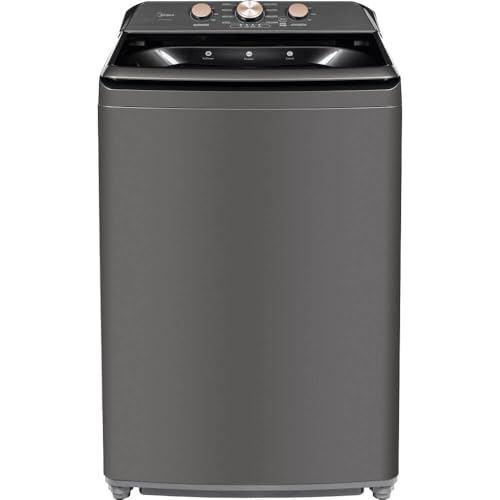
A 4.1 cu. ft. gray top-loader with auto sensing, eight presets, a high-water option and a tub clean cycle. It stands 46 inches tall, 28 deep and 29 wide, and weighs 128 pounds, which makes it one of the easier full-size machines to move. The height is the trade: at 46 inches, check the shelf or cabinet above before you assume it fits under a standard counter.
What stands out
- Auto sensing plus eight preset cycles cover daily loads
- A tub clean cycle keeps the drum fresh between washes
- At 128 pounds, it is manageable for two people
Watch out for
- At 46 inches tall, overhead clearance is essential
- The 29-inch width needs an opening wider than average
BLACK+DECKER 4.1 Cu. Ft. Top Load Washing Machine with Agitator, BTLW41MW

BLACK+DECKER's 4.1 cu. ft. top-loader uses an agitator for heavy soils, a stainless tub and a glass lid, with 10 cycles and a 24-hour delay. It measures 42.13 inches tall, 26.93 deep and 25.75 wide, and weighs 116.83 pounds, the lightest full-size machine in this group. That narrow width is the reason to pick it: it slips into openings that reject a 27-inch cabinet.
What stands out
- At 25.75 inches wide, the narrowest full-size model here
- Under 120 pounds, easy to move and level
- The agitator suits heavy soils, work clothes and shop towels
Watch out for
- The agitator is rough on delicates and fine knits
- 10 cycles is a short list next to rivals
LG WT8400CW 5.5 Cu. Ft. White Mega Capacity Smart Top Load Washer w/EasyUnload
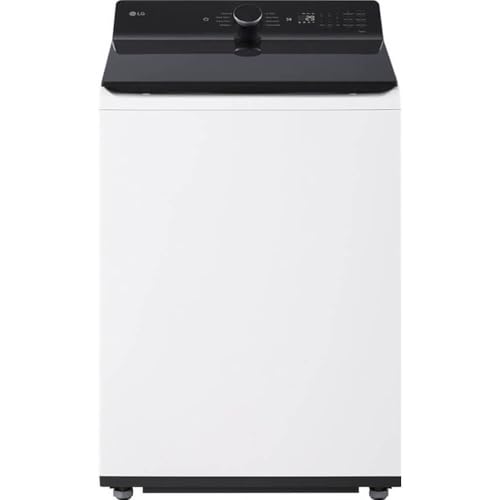
LG's 5.5 cu. ft. Mega Capacity top-loader uses an EasyUnload design that lifts the drum opening toward you and AI settings that pick a cycle from the load. It is a large machine at 130 pounds, and the listing reports 10 inches for height, width and depth, which is clearly a placeholder. Treat the capacity as real and the dimensions as unavailable until LG publishes them.
What stands out
- 5.5 cu. ft., the largest drum in this guide
- The EasyUnload design raises the drum opening toward you
- AI cycle selection on a large top-load design
Watch out for
- The listing reports 10 inches for height, width and depth
- The large drum needs a wide, deep and tall opening
GE GTW500ASNWS Top Loading Washer with Stainless Steel Basket, 4.6 Cu. Ft. Capacity, 13 Cycles, White
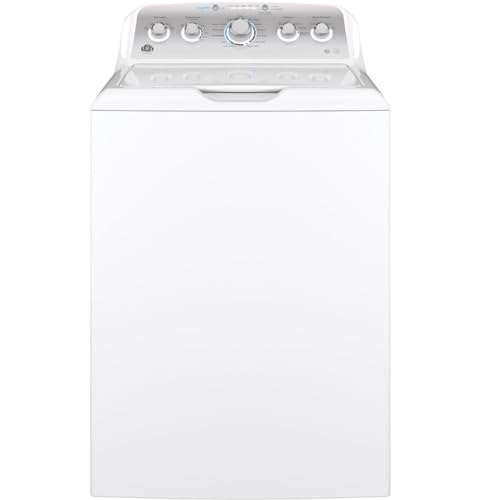
GE's 4.6 cu. ft. top-loader has a stainless basket, 13 cycles, a dual-action agitator and an optional second rinse for detergent sensitivity. It measures 44 inches tall, 27 deep and 27 wide, a consistent set of numbers that fits a standard 27-inch opening with an inch to spare on each side. No weight is published, so plan for roughly the usual 140 to 150 pounds with a hand truck.
What stands out
- The 27-inch cabinet fits standard laundry openings easily
- An optional second rinse helps with sensitive skin
- 13 cycles on a straightforward, easy-to-read control panel
Watch out for
- The dual-action agitator can tangle long sleeves and sheets
- No weight is published, which complicates delivery planning
LG WM4000HBA 4.5 Cu. Ft. Smart Front-Load Washer, High-Efficiency Laundry Machine with Wi-Fi Connectivity, Bla

LG's WM4000HBA is a 4.5 cu. ft. front-loader in black steel with TurboWash 360, the Allergiene cycle and ThinQ app control. It weighs 198.4 pounds and lists 29 inches of height, which is close to the real figure, but the 42-inch width field is impossible for a residential washer. Confirm the true cabinet width before you cut anything; expect something near 27 inches.
What stands out
- TurboWash 360 shortens full-size wash cycles without cutting load size
- The Allergiene cycle targets pet dander and dust
- ThinQ app control plus remote diagnostics and alerts
Watch out for
- Width figure in the listing is clearly wrong
- Height is quoted oddly for a front-loading washer
Buying guide
Measure the Space, Not the Old Machine
Start with width at the narrowest point, which is rarely the wall. Baseboard, door casing, a utility sink, a shelf bracket or a dryer sitting beside the opening can all steal an inch. Measure width at the floor, at mid-height and near the top, because cabinet sides bow and a machine that fits low can bind high. Then measure height to the first obstruction overhead, not to the ceiling, and remember that a top-load lid needs clearance to open. Write the three widths down separately rather than picking the smallest, because a machine has to pass the narrowest point and still sit level on the floor.
Depth is the measurement people get wrong. Appliance specs quote the cabinet, usually 25 to 34 inches, but the hoses and the vent add three to six inches behind it. Measure from the wall to the front of the opening and subtract the hose allowance. Then stand in the room and open the door: a front-loader needs roughly 20 inches of swing, and a top-loader needs a lid that clears the shelf above. Leave the clearance the manual asks for, typically an inch on each side and several behind. A useful trick: tape a cardboard outline of the machine's footprint to the floor and stand back. If it looks absurdly large, you have measured someone else's appliance.
The Hookups Decide Before the Tape Does
Look at the wall before you look at the machines. A standard setup has two shutoff valves with hose threads, a drain standpipe or a laundry sink, and a grounded outlet. Most manuals want the standpipe opening between roughly 30 and 39 inches above the floor, high enough to prevent siphoning and low enough that the pump is not lifting against gravity all cycle. A standpipe that is too low will drain the drum mid-wash; one that is too high can leave the machine unable to empty. Older homes often have a standpipe lower than that, which is a plumbing job rather than an appliance problem, and worth fixing before delivery day.
Electrical is the other gate. A washer normally runs on a dedicated 120-volt circuit, and so does a gas dryer, which also needs a gas line and a shutoff. An electric dryer needs 240 volts at 30 amps, which is why so many pair bundles assume a four-prong outlet. Compact all-in-one combos usually run on 120 volts, and the commercial units in this group run on 220. Check the breaker panel before you fall in love with a machine, and count the outlets you actually have. Confirm at the panel that the circuit is dedicated. Sharing one with a microwave or a space heater is how a washer ends up tripping a breaker mid-spin.
The Path In: Doors, Stairs and Corners
The opening is only half the measurement. A 27-inch washer will not pass a 26-inch door frame with the trim on, and a 32-inch-deep cabinet will not turn a 90-degree corner in a 36-inch hallway. Measure every doorway on the route, the width between stair rails, and the depth of any landing. Remove interior doors and closet doors before delivery day rather than during it, and check that the delivery crew is insured for the stairwell. The tightest spot is usually the turn at the top of a basement stair, where a machine has to pivot while two people hold it.
Weight matters as much as width. The machines here run from about 117 pounds for a 4.1 cu. ft. top-loader to 330 pounds for a Samsung laundry center. Two people can move the light end of that range with a strap and a hand truck. The heavy end needs a professional crew, floor protection and a clear path. If the laundry is in a basement, measure the stair width and the headroom at the turn before ordering anything. Deliveries usually stop at the threshold unless you pay for placement, so decide in advance who carries it the last twenty feet.
Floors, Vibration and the Spin Cycle
A front-load washer spins at up to 1,300 RPM, and an unbalanced load at that speed will find every weakness in a floor. Check that the machine will sit on a solid, level surface rather than carpet or a suspended wood floor with spring in it. A drip pan is worth having under an upstairs install, but it adds height, so include it in the vertical measurement. Adjustable feet need a half-inch of travel to level the cabinet, and the floor should be flat within a quarter inch over the machine's footprint. A washer that rocks will walk during the spin, and the vibration travels into the joists and the rooms below.
On an upper floor, the machine should sit across the joists rather than parallel to them, near a load-bearing wall if possible. That is structural advice worth a contractor's opinion if the house is old or the span is long. A vibration mat helps with noise and does nothing for a floor that flexes. If the floor moves when someone walks past, fix the floor before blaming the appliance. Concrete in a basement is the easy case. A suspended wood floor in an older house is the one that needs a second look before a 1,300 RPM spin starts.
Reading the Spec Table Without Getting Fooled
Dimension order is not standardized across listings. Some quote height by width by depth, some width by depth by height, and some convert from millimeters and lose an inch. The LG front-loader here lists 42 inches in the width field, which would make it wider than any residential laundry opening; the real figure is closer to 27. The 5.5 cu. ft. LG reports 10 inches on all three sides, an obvious placeholder. The Samsung laundry center reports zeroes, which means nobody measured it. None of those are typos introduced here; they are the listings as published, which is exactly why a buyer needs a fallback source.
Use arithmetic as a filter. A full-size top-load washer is 27 to 29 inches wide and 42 to 46 inches tall. A front-loader is 27 inches wide and 39 inches tall, or 24 inches wide in the compact class. A 4.1 cu. ft. drum cannot live in a cabinet 20 inches wide. When a number fails that test, ask the seller for the cutout sheet, then measure the actual machine yourself if you can see one on a showroom floor. The tape wins every argument. Measure twice, write the numbers on the wall in pencil, and keep the receipt until the machine is level and has run through its first spin.
Frequently asked questions
What is the standard width of a washing machine?
Most full-size washers are 27 inches wide, with top-loaders sometimes reaching 29. Compact and apartment models run 24 inches, and the smallest portable units are around 20. Add the clearance the manual specifies, usually an inch on each side, when you compare that to your opening.
How much clearance does a washer need?
Plan on about an inch on each side, several inches behind for hoses, and room in front for the door swing. Top-loaders need clear space above the lid. Manufacturers publish exact figures, and those figures assume the machine is level, so a floor that slopes eats clearance fast.
How high should the drain standpipe be?
Most manuals specify a standpipe opening roughly 30 to 39 inches above the floor. Too low and the machine can siphon water out mid-cycle; too high and the pump struggles to lift it. Check your model's manual, because compact and portable machines often use a different range.
Can a washing machine go on a second floor?
Usually yes, in a house built for it. The machine should sit across the joists, on a solid level floor, ideally near a bearing wall. A drip pan is cheap insurance. If the floor bounces when someone walks past, get the structure checked before adding 200 pounds of vibrating steel.
Why do the dimensions in listings look wrong?
Because they often are. Sellers copy fields from a template, mix height, width and depth, or leave zeroes. Check that the numbers describe a plausible box, compare them with the manufacturer's own spec sheet, and measure your opening before ordering rather than after delivery.
Verdict
The Kenmore 4.5 cu. ft. front-loader is the pick if your opening is a true 27 inches and your tape agrees with the listing: steam treatment, a 25-minute express wash and published dimensions that pass a sanity check. The BLACK+DECKER 4.1 cu. ft. top-loader is the value choice for a narrow slot, at 25.75 inches wide and under 120 pounds, with an agitator that suits heavy soils.
The LG WM4000HBA is the upgrade for a household that wants TurboWash 360, the Allergiene cycle and app control, but confirm its width with the seller first, because the listing reports 42 inches. If you are measuring for a laundry center, the Samsung Bespoke is the roomiest option here, though its dimension fields are blank.