Dryer balls are usually sold as a way to soften clothes without chemicals. For towels, they solve a narrower problem: the film left by fabric softener and dryer sheets is exactly what makes a towel stop drying. A towel that feels soft in the closet but pushes water around in the bathroom has a buildup problem, not a softness problem.
The mechanics are simple. Balls bounce through the drum, lift the load apart and keep hot air moving between layers. Wool also takes up some moisture and releases it slowly, which keeps the drum humid and helps relax fibers. That can trim drying time and leave towels fluffier without leaving a coating. It will not make a thin towel feel plush, and it will not match a dryer sheet for static in a dry January.
We compared ten sets: eight wool, one plastic, one TPR, ranging from four balls to eight. The useful differences are material, ball size, count and whether a storage bag comes with the set. For towels, count and size matter most, because a dense load needs enough balls to keep the layers moving.
Top picks at a glance
Wool Dryer Balls 6-Pack L
Check price on AmazonChemical Free & Baby Safe! Reusable Wool Dryer Balls XL 6-Pack
Check price on AmazonBienstylife Reusable Laundry Dryer Balls
Check price on AmazonCompare the shortlist
| Model | Type | Capacity | Key feature | Amazon |
|---|---|---|---|---|
| 1. Wool Dryer Balls 6-Pack L | Wool | — | Softening | Check price |
| 2. Bienstylife Reusable Laundry Dryer Balls | Fabric Care | — | Wrinkle care | Check price |
| 3. Molly's Suds Wool Dryer Balls | Wool | — | Delay start | Check price |
| 4. Premium New Zealand Wool Dryer Balls | Wool | — | Wrinkle care | Check price |
| 5. Chemical Free & Baby Safe! Reusable Wool Dryer Balls XL 6-Pack | Wool | — | Wrinkle care | Check price |
| 6. 6 Pcs Dryer Balls Laundry Reusable, Soften Fabrics, Reduce Stati | Fabric Care | — | Wrinkle care | Check price |
| 7. Wool Dryer Balls | Dryer sheets | — | Connected controls | Check price |
| 8. WoollyPals Dryer Balls (6-Pack, XL Size) | Dryer sheets | — | Connected controls | Check price |
| 9. Bziia Wool Dryer Balls 8-Pack Reusable Natural Fabric Softener f | Wool | — | Softening | Check price |
| 10. Natural Wool Dryer Balls | Liquid | — | Quick cycle | Check price |
Detailed reviews
Wool Dryer Balls 6-Pack L

A six-pack of large New Zealand wool balls with a linen storage bag, which is more useful than it sounds when the set lives in a closet. The label claims 10 to 25 percent shorter drying time and says the balls also cut lint and hair. The set is reusable for hundreds of loads. The linen bag is the main convenience here.
What stands out
- Large balls separate a dense towel load quite well
- Storage bag keeps the set together in a closet
- Pure New Zealand wool with no synthetic filler added
Watch out for
- Only claims hundreds of loads, not a thousand
- Wool may shed a little lint on the first loads
Bienstylife Reusable Laundry Dryer Balls

The odd one out: four plastic balls rather than six wool ones. The maker says they soften without the noise wool can make and pull hair and lint off the load, which matters in a pet household. Four balls is a small set for a big towel load, so expect to add more or use them on smaller washes. They are a reasonable start for a pet household.
What stands out
- Plastic shell wipes clean and never absorbs odor
- Pulls pet hair and lint off the towel load
- Keeps towel absorbency because it adds no coating
Watch out for
- Four balls is thin for a large towel load
- Plastic does not absorb moisture or soften much
Molly's Suds Wool Dryer Balls
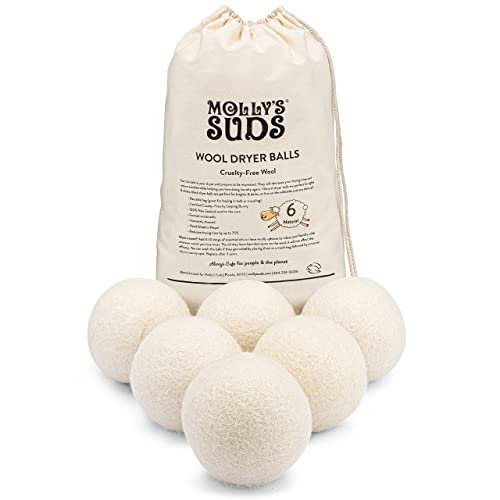
Molly's Suds is the best-documented set here: hand-felted XL balls, a muslin storage bag and a claim of up to 30 percent less drying time, or about 18 minutes out of every hour. Each ball is rated for roughly 1,000 loads, which the company frames as about three years of average use. It is Leaping Bunny certified. The balls are white and plain.
What stands out
- Hand-felted XL balls hold their shape over years
- Up to 30 percent shorter cycles, per the label
- Leaping Bunny certified and sourced from small farms
Watch out for
- Natural wool color varies from ball to ball
- Only one color and one size in this listing
Premium New Zealand Wool Dryer Balls

Another six-pack of hand-felted New Zealand wool, sold on the same promises: softer laundry, less static, less pet hair and no fragrance. GroundLuxe leans on the gift angle and mentions mesh bags, produce bags and washing machine cleaners in the listing, though the set itself is the six balls. No size or weight is listed, so judge it by the count.
What stands out
- Six balls cover a normal family towel load
- Hand-felted New Zealand wool with no added fillers
- Unscented, which makes it a good fit for fragrance-free homes
Watch out for
- The listing gives no dimensions or ball size
- Gift extras are unclear beyond the six balls
Chemical Free & Baby Safe! Reusable Wool Dryer Balls XL 6-Pack

Wooly Heroes sells six XL balls and leans hard on the baby-safe angle: organic New Zealand wool, no chemicals, 1,000-plus loads. The balls are handmade by women artisans, according to the listing. For a towel load, the XL size is the relevant part; the baby claims matter more if the same dryer handles crib sheets. The set arrives without a bag.
What stands out
- XL balls handle heavy towels without flattening out
- Rated for more than 1,000 dryer loads per set
- Handmade by women artisans, according to the listing
Watch out for
- No storage bag is mentioned in the listing
- Static control is modest in very dry air
6 Pcs Dryer Balls Laundry Reusable, Soften Fabrics, Reduce Static & Wrinkle

Six TPR balls, 2.4 inches across, which is smaller than the XL wool balls most of this lineup uses. The smaller size suits small and medium loads and gets into the gaps between folded towels. TPR is a rubbery plastic, so the balls flick moisture and lift the load without absorbing water. They also help remove hair and lint. The set is small enough for a stacked unit.
What stands out
- Small size reaches gaps in a packed drum
- The rubber-like TPR wipes clean after each load
- Keeps towels absorbent because it adds no coating
Watch out for
- 2.4 inches is small for a king-size towel load
- TPR does not absorb water, so softening is modest
Wool Dryer Balls

An award-winning set, and still one of the easiest to recommend because the label is specific. Six XL balls, each about nine inches around, rated for a thousand-plus loads. The label gives a real dose: three balls for a small or medium load, five or six for a large one. That is more specific than most competitors. It is the safest default if you are unsure.
What stands out
- Clear dosing advice for small and large loads
- A nine-inch circumference gives solid coverage in the drum
- Thousand-plus load rating, like the best sets here
Watch out for
- Light colors show lint and dye transfer over time
- No storage bag is included with the six-pack
WoollyPals Dryer Balls (6-Pack, XL Size)

Six extra-large three-inch balls, a drawstring cotton bag and an instruction card. The listing says 1,000 loads and describes the balls as odorless, which is the right expectation: clean wool has a faint lanolin smell when new, and it fades. Three inches is a solid size for towels, and the bag keeps the set from scattering. The instruction card covers dosing.
What stands out
- Three-inch balls are sized for bulky towel loads
- Drawstring cotton bag keeps the set paired together
- The set is rated for up to 1,000 loads
Watch out for
- Plain white balls show every stray dark fiber
- Wool may need a few loads to felt fully
Bziia Wool Dryer Balls 8-Pack Reusable Natural Fabric Softener for Laundry

The eight-ball set, which is the right buy for a household that regularly dries two loads of towels back to back. Bziia also sells four- and six-packs, so the eight-pack is the family size. The balls are New Zealand wool with no synthetic filler, and the listing promises softer laundry, less static and shorter cycles. The extra balls are the whole point.
What stands out
- Eight balls keep a second towel load covered
- Also sold in smaller four- and six-ball packs
- Made from New Zealand wool with no synthetic fillers
Watch out for
- Eight balls take up drawer space between loads
- No ball diameter is listed for the set
Natural Wool Dryer Balls

Six large New Zealand wool balls, rolled tight and felted, with a listing that mentions essential oils for scent and biodegradability at the end of their life. The package is about five inches square, so the balls arrive compressed and fluff up with use. It is a straightforward set with no storage bag. The balls are white and plain, and it is a no-frills buy.
What stands out
- Tightly felted balls resist flattening in hot cycles
- Can be scented with a drop of essential oil
- The wool is biodegradable once the balls wear out
Watch out for
- The six-pack does not include a storage bag
- The compressed packing gives them a short break-in period
Buying guide
Why towels and fabric softener do not get along
Fabric softener and dryer sheets work by leaving a film on fibers. That film is why a towel feels soft and why it stops absorbing water. After months of weekly softener, the loops are coated enough that water sits on the surface instead of wicking into the cotton. The towel feels thick because the coating fills the loops, but the cotton underneath is starving for water. The fix is not a stronger detergent; it is a strip wash and a different drying habit. Dryer balls do the second part without adding anything to the fabric. If towels smell musty even after washing, the same coating is holding odor in the fibers, especially in a front loader with a rubber gasket.
Stripping is simple: wash the towels on the hottest setting the care label allows with detergent and a cup of white vinegar in the rinse, then dry them fully. Check the label before you go hot, because some colored towels bleed. Skip softener and sheets from then on. Do not put vinegar and detergent in the same compartment, because they neutralize each other. The first load will feel rougher than you expect. After two or three cycles with balls, the loops relax and the towel starts to feel like terry cloth again rather than a sheet of felt. If a towel still repels water after a strip wash, the buildup is old and the towel may be ready for the rag bin.
Wool, plastic, or TPR: what each material does
Wool balls are the default for a reason. Wool takes up some moisture from the load and gives it back slowly, which keeps the drum humid and helps relax fibers. Tightly felted balls hold their shape; loosely wound ones flatten and shed. Sizes in this lineup run from about 2.4 inches to 3 inches across, and the larger ones displace more laundry. Wool is soft against fabric, though any ball can thump in a small machine. It can be scented with a drop of essential oil, and at the end of its life the wool breaks down. The catch is care: wool holds odor if it gets musty, so let the balls dry between loads. A set with a storage bag is easier to keep dry.
Plastic and TPR balls work differently. They do not absorb water; they bounce, separate the load and flick moisture off the fabric. That makes them good at lifting pet hair and lint, and they wipe clean. The Bienstylife set is plastic and marketed as quiet, a claim that runs against the usual assumption that plastic balls are noisy. What plastic does not do is absorb moisture, so it softens less. The PEASUG set is TPR, a rubbery material. Both keep towel absorbency intact, which is the main job. Wool is the better choice for cotton towels; plastic is the better choice for pet bedding. A plastic set is also easier to rinse clean after a muddy load. If the dryer sits against a bedroom wall, noise is a real buying criterion rather than a footnote.
How many balls a towel load actually needs
The common advice is three balls for a small or medium load and five or six for a large one, which Smart Sheep and several other labels repeat. A towel load is dense and heavy, so treat it as large even when the drum is not full. Six balls is the practical minimum for a family towel wash. An eight-pack is useful if you routinely dry towels and bedding on the same day and do not want to move balls between loads. Ball size matters too: three-inch XL balls displace more laundry than 2.4-inch ones, so a set of small balls needs a higher count to do the same work. If you dry one towel at a time, three balls are enough.
Overloading defeats the balls. A drum packed tight cannot tumble, so the balls sit against the door and the hot air bypasses the middle of the load. Towels need room to unfold. Dry four bath towels at a time in a full-size drum, or fewer in a compact one, and let the balls do their job. Shake each towel once before tossing it in; it opens the folds. If the towels are still damp at the end, add ten minutes rather than a seventh ball. If towels come out in a tight ball, the load was too big or the cycle was too short. The same rule applies to a duvet cover: add a couple of dry towels to keep it moving, and the balls will find their way into the folds.
Drying time, static, and the life of a towel
Drying-time claims in this category run from 10 to 40 percent. Molly's Suds says up to 30 percent, which it translates to about 18 minutes per hour; Qiseec says 10 to 25 percent. Treat all of them as best-case numbers from a friendly test load. Real savings depend on how fast your washer spins, how big the load is, how clean the vent is and whether the dryer's sensor is calibrated. A ball set cannot fix a clogged vent or a washer that leaves towels dripping. Fix those first, then judge the balls on a normal week of laundry rather than one dramatic cycle. If you want a number, time two identical loads, one with balls and one without. Use the same towels and the same spin setting.
Static is where wool balls are weakest. They reduce friction and add a little moisture, but they do not leave the conductive film a dryer sheet does. In a dry winter house, a synthetic blanket may still crackle. If static is the only problem, a sheet or a humidifier is the better tool. If the goal is softer, more absorbent towels, balls win. Lint is the other trade-off: wool can shed a little at first, and dark towels will show it. Rinse the balls every few months, let them dry completely, and keep them out of a damp closet. Store them loose or in a mesh bag on a hook, never in a sealed bin. Expect to replace them when the surface mats and they stop bouncing.
Frequently asked questions
Do dryer balls make towels softer?
They fluff the loops and reduce the stiffness that comes from overdrying, but they cannot add softness to a worn towel. The bigger gain is absorbency: without a softener film, the towel soaks up water again. Expect a rougher feel for the first few loads after you stop using sheets.
How many dryer balls should I use for towels?
Five or six large balls for a family towel load, three for a small load. Towels are dense, so err on the high side. If the drum looks more than two-thirds full, split the load before adding another ball. Overcrowding hurts drying more than a low ball count.
Do wool dryer balls leave lint on towels?
New wool balls can shed a little fuzz for the first few loads, and white balls show dark fibers from previous loads. Check the lint screen and pick off any loose wool. Tightly felted balls shed less than loosely wound ones, and the shedding stops once the surface mats down.
Can I use dryer balls with dryer sheets?
You can, but the sheet coats the balls along with the towels, which defeats the point of using wool. Pick one. If you need static control on a synthetic load, use a sheet there and keep the balls for towels, bedding and cotton clothing.
Do dryer balls work in a sensor dryer?
Yes. The balls tumble with the load and the sensor reads moisture from the drum, so the cycle ends when the towels are dry. Clean the lint screen and wipe the moisture sensor bars, because a coated sensor can stop a cycle early or run it long.
Verdict
Molly's Suds is the top pick: six hand-felted XL balls, a muslin bag, a 1,000-load rating and the most specific drying-time claim in the lineup. Smart Sheep is the value choice, with the same six-ball count, a nine-inch circumference and clear dosing advice that makes it hard to misuse. Bziia's eight-pack is the upgrade for a family that dries towels in back-to-back loads.
Choose the Bienstylife plastic set if pet hair is the main problem and you want something you can wipe clean. Choose PEASUG if your dryer is compact and 2.4-inch balls fit the drum better. Anyone still using softener on towels should stop before buying anything; the balls only work when the coating is gone.