Walk around the outside of a house with a dryer and you can usually spot the vent cover before you find the meter. It is the small hood on the siding, often painted over, sometimes hanging by two screws with a flap that stopped closing years ago. That flap is the only thing standing between the laundry room and whatever the weather is doing outside.
Replacing one is a twenty-minute job with a screwdriver and a tube of exterior caulk, which is why it is strange how often it goes wrong. Most of the covers in this batch have to be mounted vertically, with the outlet facing down. Put one on a soffit or a roof discharge and the flap hangs open, rain blows in and lint packs into the hinge. The manufacturer note is not fine print; it is the whole installation.
The second decision is the damper. A gravity louver, a spring flap, a magnetic door and a plastic cap that rides on the exhaust stream all close differently, and they behave differently in a cold wind. A cover that seals tightly saves a little energy, but one that seals too tightly can stall a short duct with a weak blower.
Below are ten covers we compared on fit, damper design, material and hardware, with notes on which wall each one suits.
Top picks at a glance
Dryer Vent Cover 4 inch UV Resistant, Dryer Vent Seal for Home Exterior
Check price on AmazonDeflecto Outdoor Dryer Vent Cover 4-Inch with Louvered Gravity Damper White
Check price on AmazonElaraBerry 4 Inch Magnetic Dryer Vent Cover Outside with Screen, White
Check price on AmazonCompare the shortlist
| Model | Type | Capacity | Key feature | Amazon |
|---|---|---|---|---|
| 1. Dryer Vent Cover 4 inch UV Resistant, Dryer Vent Seal for Home E | Vent | — | Connected controls | Check price |
| 2. Heartland Natural Energy Saving Dryer Vent Closure | Vent | — | — | Check price |
| 3. Hon&Guan 4 Inch Dryer Vent Cover Outside with Removable Mesh, Wa | Vent | — | — | Check price |
| 4. Houseluxe Dryer Vent Cover Outside 4 inch, Magnetic Door Design, | Vent | — | Quick cycle | Check price |
| 5. ElaraBerry 4 Inch Magnetic Dryer Vent Cover Outside with Screen, | Vent | — | Low noise | Check price |
| 6. Hydencamm 4" Metal Dryer Vent Cover for Exterior Wall, Stainless | Gas | — | Manual operation | Check price |
| 7. 4 Inch Magnetic Dryer Vent Cover Outside, Exterior Dryer Vent Co | Vent | — | — | Check price |
| 8. HG Power 4 Inch Dryer Vent Cover Outside with Removable Screen, | Vent | — | Efficiency | Check price |
| 9. 4 Inch Dryer Vent Cover Outside Hooded Wall Vent with Screen and | Vent | — | Low noise | Check price |
| 10. Deflecto Outdoor Dryer Vent Cover 4-Inch with Louvered Gravity D | Vent | — | — | Check price |
Detailed reviews
Dryer Vent Cover 4 inch UV Resistant, Dryer Vent Seal for Home Exterior

A square-base replacement for a standard 4-inch hood. The inner plastic cap lifts on exhaust airflow and drops back when the dryer stops, so there is no spring or magnet to wear out. Screws and washers are included and the base is pre-drilled. The listing specifies vertical mounting outdoors, and the cap will not seat correctly on a soffit or roof discharge.
What stands out
- Cap rides on airflow with no spring or magnet to fail
- Screws and washers come in the box, ready to fit
- Square base covers old screw holes in siding
Watch out for
- Must be mounted vertically; a horizontal install leaks
- Plastic cap can stick once lint builds on the seat
Heartland Natural Energy Saving Dryer Vent Closure

The Heartland closure is the oldest design here: a square base, a self-sealing cap and a stated 30-minute install. It is built to sit over an existing 4-inch opening and cover the siding around it, and the listing says it mounts to brick, masonite and press board. Vertical mounting is required. Its footprint is larger than most, which helps hide a ragged cutout.
What stands out
- Large footprint hides old caulk lines and cutouts
- Self-sealing cap closes on its own without a spring
- Pre-drilled square base suits brick and press board
Watch out for
- Bulky profile stands out on a clean wall
- Large body can look oversized on narrow trim
Hon&Guan 4 Inch Dryer Vent Cover Outside with Removable Mesh, Wall Mount Extractor Vent with Rubber Cushioned

A metal wall vent with a magnet-held damper, a removable mesh screen and a rubber gasket around the frame. The 6x6 body suits a standard 4-inch pipe and the four included screws go through the flange. The removable grid can be left out when a dryer throws heavy lint. It is a general-purpose vent rather than a dryer-specific hood, so check the opening before you buy.
What stands out
- Magnet holds the damper flat against the frame
- Removable mesh pulls out easily for rinsing under a tap
- Rubber gasket quiets the flap every time it closes
Watch out for
- Mesh clogs quickly on a dryer that throws heavy lint
- No extension tube, so wall depth is on you
Houseluxe Dryer Vent Cover Outside 4 inch, Magnetic Door Design, Durable Airflow Vent with Lint Trap Screen, T
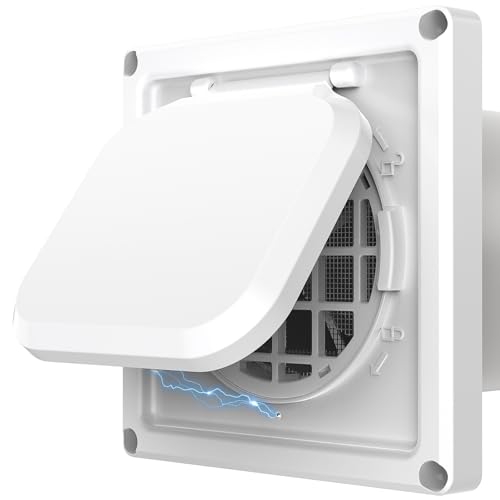
A 6x6 poly-plastic cover with a magnetic door and a detachable lint screen. It is sized for 4-inch duct only, and the listing warns against 3-inch and 6-inch openings. Four pre-drilled holes make the swap quick. The screen comes out without tools, which matters more than the magnet on a dryer that produces a lot of lint. Measure the opening first.
What stands out
- Detachable lint screen pulls out without any tools
- Magnetic door opens under low airflow and shuts flat
- Four pre-drilled holes line up with old hoods
Watch out for
- Plastic body is the least durable option here
- Screen adds airflow resistance when cleaning is skipped
ElaraBerry 4 Inch Magnetic Dryer Vent Cover Outside with Screen, White

A galvanized steel cover with a nylon insect screen, a tilted damper and a built-in magnet. The kit adds a detachable extension tube and mounting hardware, so it reaches through thicker wall assemblies than a flat faceplate. At roughly 9-1/4 inches long it has the largest footprint in the batch. It is also sold for bathroom, kitchen and range-hood exhaust.
What stands out
- Extension tube handles thick siding and brick veneer
- Galvanized steel resists rust far better than plastic hoods
- Tilted damper sheds rain away from the opening
Watch out for
- Footprint is larger than a standard 6x6 faceplate
- Insect screen needs frequent cleaning in lint season
Hydencamm 4" Metal Dryer Vent Cover for Exterior Wall, Stainless Steel

A stainless steel louvered cover with no screen, sold with five screws, a rubber gasket and foam tape. The interlocking body is designed to reduce rattle, and stainless is the right material for a coastal wall. Because there is no mesh, lint passes straight through. The listing warns about sharp edges and recommends gloves during installation. It is the only stainless body here.
What stands out
- No screen means nothing to clog with lint
- Stainless body will not rust or crack like plastic
- Rubber gasket and foam tape cut vibration rattle
Watch out for
- Open louvers will not keep small insects out
- Sharp edges, so wear gloves while installing it
4 Inch Magnetic Dryer Vent Cover Outside, Exterior Dryer Vent Cover, White

A low-profile white cover in galvanized steel with a magnetic damper. At about 7-7/8 by 6-11/16 inches it sits close to the siding rather than projecting like a hood. The magnetic plate opens with exhaust flow and closes when the dryer stops. No screen is fitted, and the listing stresses measuring the duct opening before ordering. Check the collar size first.
What stands out
- Low-profile face sits tight against the house siding
- Magnetic damper shuts itself without a spring or lever
- Galvanized steel body with a clean white finish
Watch out for
- No screen, so insects can enter while it is open
- White finish may not match dark or colored siding
HG Power 4 Inch Dryer Vent Cover Outside with Removable Screen, Black

A metal cover with a removable screen, a rubber ring and a cushioned one-way flap. The published opening is 3.81 inches, which is worth checking against your pipe collar. The flap is designed to block backdraft and the rubber cushion is there to stop rattling. It is sold for dryer, range-hood, AC and general wall exhaust, in a black finish.
What stands out
- Removable mesh pulls out for rinsing and reinstall
- Cushioned flap cuts rattle and backdraft noise at the wall
- Metal body holds up better than plastic hoods
Watch out for
- Black finish shows lint and dust very quickly
- 3.81-inch opening is snug on some duct collars
4 Inch Dryer Vent Cover Outside Hooded Wall Vent with Screen and Damper, Exhaust Vent Wall Mount Exterior Wall
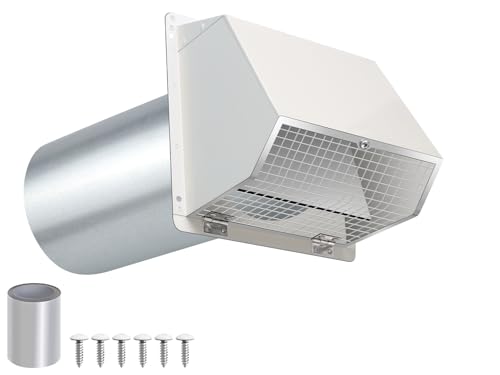
A hooded wall vent in 28-gauge galvanized steel with an openable screen, a spring-loaded backdraft damper and an 8-1/4 inch pipe. It ships with six screws, four pre-drilled flange holes and a roll of foil tape for the duct joint. The long pipe is the reason to choose it: it clears brick veneer and deep siding that a flat cover cannot reach.
What stands out
- Long 8-1/4 inch pipe clears thick wall assemblies
- Spring damper closes hard against cold winter backdraft
- Foil tape included for sealing the duct joint
Watch out for
- Hooded shape is more visible than a flat cover
- Spring tension can keep the flap from opening fully
Deflecto Outdoor Dryer Vent Cover 4-Inch with Louvered Gravity Damper White

A UV-resistant plastic cover with a 6x6 louvered faceplate and a gravity damper. The louvers open when the dryer runs and fall closed when it stops, with no spring or magnet involved. It mounts over a standard 4-inch pipe using pre-drilled holes, though mounting screws are not included. The flush face gives a neater finish than a projecting hood. It is the plainest cover here.
What stands out
- Gravity louvers need no spring, magnet or adjuster
- UV-resistant plastic resists cracking, fading and going brittle
- Flush 6x6 faceplate looks tidy against the siding
Watch out for
- Mounting screws are not included in the box
- Louvers can stick after a season of pollen and lint
Buying guide
The Damper Is the Whole Product
Four damper designs show up in this batch, and they fail in different ways. A gravity louver is a set of angled blades that fall shut when airflow stops; it has no spring, no magnet and nothing to adjust. A magnetic door uses a small magnet to pull a flat plate against the frame, so it opens at very low pressure and closes with a soft click. A spring-loaded flap closes harder and resists wind better, at the cost of some airflow. The plastic cap used by Mogseek, Heartland and RAEFLOW is the simplest of all: the exhaust stream lifts a cap, and gravity drops it back. None of these designs is best in every climate, but each has a failure mode you can predict.
The difference matters most in winter. A cover that seals loosely lets cold air pour back through the duct and into the laundry room, and the dryer has to push against that leak on every cycle. A cover that seals too aggressively can stall a short duct with a weak blower. Magnets sit in the middle: strong enough to hold the plate flat, light enough to open at the first push of air. Check the seat, not just the flap. Lint collects on the lip where the plate lands, and one hardened strand is enough to keep the door ajar. That is a two-minute cleaning job, not a reason to replace the cover. A cover that rattles usually has a worn seat, not a weak magnet.
Vertical Mounting, Wall Depth and Fit
Nearly every cover here carries the same instruction: mount it vertically. That means the faceplate sits flat against a vertical wall and the outlet points down, so gravity helps the flap close and rain runs off the hood instead of into the duct. A cover bolted to a soffit or a roof has the outlet facing sideways or up, and the flap will hang open. If your discharge is horizontal, choose a hooded model with a spring damper or a louvered faceplate; do not force a cap-style cover into a position it was never designed for. Before removing the old cover, note which way its hood pointed. That is usually the right orientation for the replacement, especially on a wall that takes the wind.
The opening is nominally 4 inches, but the actual collar can measure closer to 3.8, which is why HG Power publishes 3.81 inches for its opening. Measure the pipe, the wall thickness and the old screw holes before ordering. A cover with an 8-1/4 inch pipe, like the JYINCPED, clears brick veneer and thick siding; a flat 6x6 faceplate will not. Pre-drilled holes are only useful if they line up with something solid behind the siding. If they do not, drill new ones and seal the old ones with exterior caulk. Photograph the opening with a tape measure across it; that one image answers most fit questions later, including the depth you need.
Metal, Plastic and a Decade of Weather
Plastic covers are cheap, light and easy to cut, and UV-resistant formulations hold up for years on a shaded wall. On a south or west wall they fade, chalk and eventually crack at the screw holes. Galvanized steel and stainless steel cost more and last longer; stainless is the better choice near salt water, and Hydencamm uses it for the body and the screws. Paint adhesion is the weak point on any metal cover. Scratches during installation rust first, so touch them up before the first rain. A painted plastic cover can look fine for a decade and still snap when you lean on it in cold weather, which is why old hoods so often come off in pieces.
Hardware tells you a lot about the design. A rubber gasket between the cover and the wall reduces vibration and closes the gap that wind whistles through. Foam tape does the same job on the flap and is common on metal models. Screws are sometimes included and sometimes not: Deflecto expects you to supply them, while Hon&Guan, Hydencamm and JYINCPED include a set. Use stainless screws regardless. A zinc screw in cedar or treated siding will leave a rust streak within a season. Gaskets compress over time, so do not overtighten and distort the frame. Seal the top and both sides with caulk, and leave the bottom edge open so water can drain. A flush cover needs less caulk and looks better from the yard.
Screens, Lint and the Case for Leaving One Out
A screen keeps birds, insects and mice out of the duct, and it also catches lint. On a dryer that runs four loads a week, a fine mesh can load up in a month and cut airflow enough to lengthen cycles. Removable screens on the Hon&Guan, Houseluxe, HG Power and JYINCPED models are the practical compromise: pull the screen, rinse it, put it back. Rinse under a tap rather than picking at it dry, because brushing wet lint only pushes it deeper into the mesh. Fixed screens are a maintenance trap, especially on a vent you cannot reach from the ground. A screen torn at the frame is no longer doing its job; replace it or take it out.
The alternative is no screen at all, which is the argument Hydencamm and Vondura make. A closed damper already blocks most animals, and a wide-open throat gives lint nothing to grab. That works if the flap seals well and you check the duct once a season. On a ground-level vent near a garden, keep a screen. On a second-story wall with a long run, the screen is more likely to cost you airflow than save you from a bird. Either way, look at the outside cover when you clean the lint screen, before you blame the dryer. With the dryer running, the flap should open wide and fall shut within a second of stopping. If it hangs halfway, clean the seat before buying anything.
Frequently asked questions
Can I replace a dryer vent cover myself?
Yes, if the old cover is screwed to siding and the duct pipe is sound. Remove the screws, pull the cover, scrape the old caulk, then test-fit the new one before sealing. The job needs a screwdriver, exterior caulk and perhaps a drill. Stop and call someone if the pipe crumbles or the wall is soft around the opening.
Should a dryer vent cover have a screen?
Only if you will clean it. A screen keeps insects and birds out, but lint blocks the mesh and strangles airflow, which lengthens drying time. A removable screen is the best compromise. On a long duct or a second-story wall, a well-sealed damper with no screen often performs better.
Why does my vent flap stay open?
Usually lint on the hinge or a bent flap. Clean the seat and check that the cover is mounted vertically with the outlet down. If the flap is warped or the magnet has lost grip, replace the cover; a permanently open flap lets cold air and pests into the duct all winter.
Does a magnetic vent cover really save energy?
It saves a little by stopping backdraft when the dryer is off. The bigger savings come from a short, clean duct and a sealed connection at the dryer. Do not expect a magnet alone to change your bill. The cover's real job is keeping weather and animals out while opening freely during a cycle.
What size cover fits a 4-inch dryer duct?
A cover listed for 4-inch duct, which usually means a 6x6 inch faceplate and a collar near 3.8 inches across. Measure the pipe and the old screw spacing before ordering. Covers for 3-inch and 6-inch ducts look similar in photos and will not seal on a 4-inch wall opening.
Verdict
Top pick: the Hydencamm stainless cover. It has no screen to clog, a louvered face that sheds rain, and a rubber gasket and foam tape to stop rattle. Choose it for a long duct or a wall that gets weather from every direction. Value pick: the Deflecto, a plain gravity-louver cover that does the basic job and costs little; buy stainless screws, because none are included.
Upgrade: the ElaraBerry if your wall is thick. The extension tube reaches through brick veneer and deep siding, and the galvanized body and insect screen suit a vent close to the ground. For a magnetic door on a standard wall, the Houseluxe is the simplest swap in the batch.