The first sign is usually the towels. They come out of the dryer stiff enough to stand on their own, and the white wash has drifted from white to a flat grey that no amount of bleach corrects. The detergent has not stopped working. The minerals in the water have used it up before it reached the fabric, and what is left over plates the drum, the hoses and the heating element.
Hard water is measured in grains per gallon, and above roughly seven the laundry starts to suffer. Calcium and magnesium bind to the surfactants in detergent, so a dose that cleans well in soft water leaves soil suspended in the drum in hard water. The same minerals precipitate as scale when the water is heated, which is why the element is often the first part to fail.
No washing machine on this list softens water. That is a job for a softener, either whole-house or a small cartridge unit on the cold inlet. What a washer can do is dose accurately, rinse thoroughly and hold a hot cycle long enough for detergent to work, and those three things separate the machines below.
We compared specifications, features and owner reports from households on wells and municipal supplies, and flagged the listings where a number looks wrong.
Top picks at a glance
Kenmore 4.5 cu. ft. Front Load Washer
Check price on AmazonElectrolux 27 in. W 4.5 cu. ft. Front Load Washer with SmartBoost, LuxCare Plu
Check price on AmazonSamsung 5.0 cu. ft. Extra Large Capacity Smart Front Load Washer with Super Sp
Check price on AmazonCompare the shortlist
| Model | Type | Capacity | Key feature | Amazon |
|---|---|---|---|---|
| 1. Kenmore 4.5 cu. ft. Front Load Washer | Front-load | 4.5 cu ft | Steam | Check price |
| 2. Electrolux 27 in. W 4.5 cu. ft. Front Load Washer with SmartBoos | Front-load | 4.5 cu ft | Steam | Check price |
| 3. Samsung 5.0 cu. ft. Extra Large Capacity Smart Front Load Washer | Front-load | 5.0 cu ft | Steam | Check price |
| 4. Samsung WF90F53ADS 5.3 Cu. Ft. Bespoke AI Dark Steel Front Load | Front-load | 5.3 cu ft | Auto-dispense | Check price |
| 5. GE Profile 5.3 cu. ft. Smart Front Load Washer in Sapphire Blue | Front-load | 5.3 cu ft | Steam | Check price |
| 6. LG WM3400CW 4.5 cu ft Front-Load Washer | Front-load | 4.5 cu ft | Low noise | Check price |
| 7. Electrolux 27 Inch Front Load Washer with 4.5 cu ft Capacity, Lu | Front-load | 4.5 cu ft | Steam | Check price |
| 8. Samsung 4.5 cu. ft. High Efficiency Front Load Washer with Vibra | Front-load | 4.5 cu ft | Low noise | Check price |
Detailed reviews
Kenmore 4.5 cu. ft. Front Load Washer

The metallic silver version of Kenmore's 4.5 cubic foot front loader, with the same 12 cycles and five wash temperatures as the white model. Extra Rinse is the setting that matters in hard water, and Steam Treat helps with stained loads that need heat. Cold Clean is included for energy savings, and the machine is ENERGY STAR certified. The cabinet is a standard 27 inches wide and just under 40 inches tall.
What stands out
- Extra Rinse clears mineral-heavy water out of fabric
- Steam Treat adds heat without a long soak cycle
- Twelve cycles including kids wear, whites and delicates
Watch out for
- No bulk detergent tank to simplify daily dosing
- Touch console responds slowly when your hands are wet
Electrolux 27 in. W 4.5 cu. ft. Front Load Washer with SmartBoost, LuxCare Plus Wash System, Perfect Steam in

Electrolux's 4.5 cubic foot washer with SmartBoost, which mixes detergent and water before the wash begins. That premixing is useful with powder in hard water, since it dissolves the granules rather than leaving them in the drawer. Perfect Steam handles stains, the Adaptive Dispenser takes pods, liquid or powder, and there are more than eleven cycles. At 38 inches tall it slides under a low counter.
What stands out
- SmartBoost dissolves powder before the wash actually starts
- Adaptive dispenser suits pods, liquid or powder detergent
- Perfect Steam helps lift soil bound by minerals
Watch out for
- No dedicated second-rinse button on the control panel
- Steam lengthens an already long cotton wash cycle
Samsung 5.0 cu. ft. Extra Large Capacity Smart Front Load Washer with Super Speed Wash and Steam, Brushed Blac

A 5.0 cubic foot Samsung in brushed black with Super Speed Wash, which the listing says cleans a full load in about 28 minutes, plus steam and Wi-Fi through SmartThings. ENERGY STAR certified, and it can be stacked with a matching dryer to save floor space. The 27-inch cabinet fits a standard alcove, and the 216-pound weight keeps it planted. A sensible large machine with fewer dispensers to clog.
What stands out
- Five cubic feet means fewer loads every single week
- Steam cycle helps with stained towels and bedding
- Stackable with a matching Samsung dryer to save space
Watch out for
- No auto-dispense tank for consistent dosing on everyday loads
- Brushed black finish shows water marks and dust
Samsung WF90F53ADS 5.3 Cu. Ft. Bespoke AI Dark Steel Front Load Smart Washer

Samsung's Bespoke 5.3 cubic foot washer in dark steel, built around the Flex Auto Dispense system and a 7-inch AI Home touchscreen. SmartThings adds remote control and cycle downloads. The auto-dispense tank is the headline for hard-water households, since it removes the guesswork that causes scum. The listed width of 43 inches is not plausible for a front loader, so measure the machine or confirm the spec before ordering.
What stands out
- Flex Auto Dispense meters detergent on every single load
- Large 7-inch screen simplifies cycle selection and settings
- Five cubic feet with SmartThings app control included
Watch out for
- Listed 43-inch width looks wrong for this machine class
- Touchscreen is one more expensive part that can fail
GE Profile 5.3 cu. ft. Smart Front Load Washer in Sapphire Blue w/OdorBlock UltraFresh Vent System, Microban,
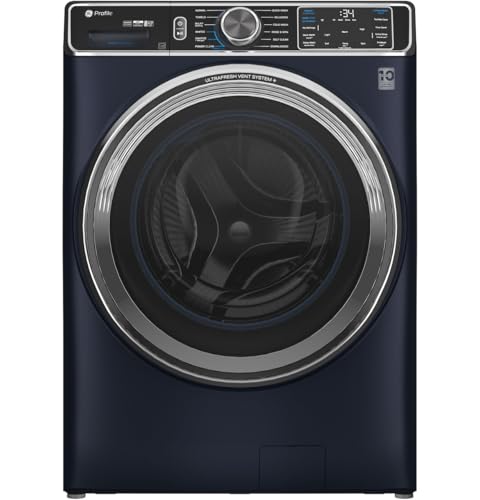
The GE Profile 5.3 in sapphire blue is the most complete package here for hard water. SmartDispense holds detergent for roughly 32 loads and dispenses per cycle, steam and a sanitize plus allergen cycle provide the heat that mineral soils need, and UltraFresh venting dries the drum afterward. Microban is listed as well. At 28 inches wide it needs a slightly wider alcove than a standard 27-inch machine.
What stands out
- SmartDispense removes daily detergent guesswork from the routine
- Steam, sanitize and allergen cycles live in one unit
- UltraFresh venting limits gasket odor and mold growth
Watch out for
- Bulk tank prefers liquid, so powder builders are lost
- Twenty-eight inches wide needs extra clearance in the alcove
LG WM3400CW 4.5 cu ft Front-Load Washer

LG's WM3400CW is a 4.5 cubic foot machine built for quiet operation, with LoDecibel hardware, TrueBalance anti-vibration and 6Motion drum movement. It is ENERGY STAR certified and keeps the control set simple, which means fewer dispensers to clog with scale. The listing's dimensions read 10 by 10 by 10 inches, which is clearly a placeholder rather than a measurement. Confirm the cabinet size before you buy.
What stands out
- Simple controls leave little to clog or wear out
- TrueBalance keeps spin vibration under control on wood floors
- ENERGY STAR certified for water and power consumption
Watch out for
- Listed dimensions are placeholders rather than real measurements
- No steam cycle and no allergen option on the dial
Electrolux 27 Inch Front Load Washer with 4.5 cu ft Capacity, LuxCare® Plus Wash, Perfect Steam™, SmartBoost®,
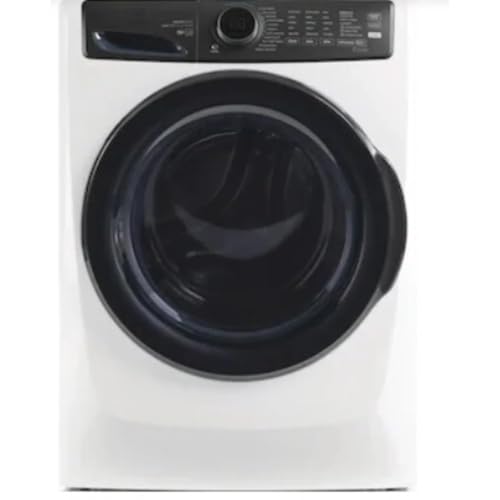
The second Electrolux 4.5 adds Pure Rinse and Stain Soak to the SmartBoost and Perfect Steam formula, with a 1,300 rpm spin and a 15-minute fast wash. Pure Rinse is the useful one in hard water, since it flushes more of the mineral-laden wash water before the spin. ENERGY STAR certified and described as quiet in the listing. Same 27-inch footprint as the other Electrolux.
What stands out
- Pure Rinse flushes minerals before the final spin
- 1,300 rpm spin leaves less water in the fabric
- Stain Soak gives detergent time to work on soil
Watch out for
- Pure Rinse adds time and water to every load
- No descale program and no water hardness setting
Samsung 4.5 cu. ft. High Efficiency Front Load Washer with Vibration Reduction Technology+, White, WF45T6000AW
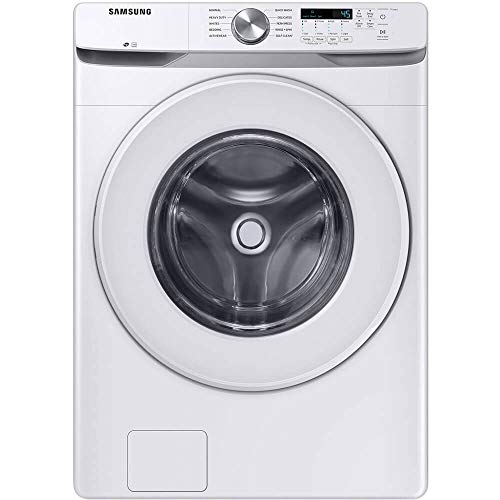
Samsung's 4.5 cubic foot WF45T6000AW is the plain option: Vibration Reduction Technology+, a Swirl+ drum that is meant to extract more water, and ENERGY STAR certification. No steam, no app, no dispenser tanks. That simplicity is an advantage in hard water, because there is less plumbing inside the cabinet to scale up. The 27-inch cabinet and 200-pound weight are easy to place and easy to level.
What stands out
- Few internal parts to scale up or clog with scum
- Swirl+ drum extracts more water at the final spin
- Vibration Reduction Technology+ keeps the cabinet steady and quiet
Watch out for
- No steam or soak cycle for stubborn stained loads
- Basic console offers no rinse customization at all
Buying guide
What Hard Water Does Inside the Drum
Scale is the visible half of the problem. Calcium carbonate comes out of solution when water is heated and deposits on the hottest surface, which is the heating element. A coating a fraction of a millimeter thick forces the element to run longer to reach temperature, and a thick one can trip the thermal cutout. The same film forms on the outer drum and in the hoses, where it traps lint and detergent and turns into a grey sludge that eventually flakes onto dark clothes.
The invisible half is chemical. Hard water minerals attach to detergent molecules and neutralize them, so less surfactant is available to lift soil from fabric. You notice it as grey whites, dull colors and towels that feel rough against the skin. Iron, common in well water, adds orange staining on top of that. None of this is dramatic in a single wash. It accumulates over a year of loads and shows up as a machine that cleans worse than it did when it was new.
Detergent Choice Beats Machine Choice
Powder detergent usually handles hard water better than liquid because many powders include builders such as sodium carbonate, which sequester calcium before it can bind to the surfactants. Liquids often rely on the detergent alone. That does not mean liquid cannot work, only that you may need more of it, or a separate water conditioner, to get the same result. A fragrance-free powder is also easier on sensitive skin, which is a useful bonus in a household already fighting residue.
Do not simply double the dose and hope. Excess detergent in hard water produces more scum, not more cleaning, and the residue ends up in the gasket. Start at the recommended dose, add a water conditioner if the results are poor, and use test strips to learn what your supply actually contains. A small softening cartridge plumbed into the cold inlet is cheaper than a whole-house system and removes most of the calcium before it ever reaches the machine.
Temperature, Rinsing and Spin Speed
Detergent dissolves and works faster in warm water, and powders in particular need heat to fully dissolve. Washing everything cold saves energy, but in hard water it often leaves powder granules in the dispenser and a dull film on the fabric. A warm wash for everyday loads and a hot cycle for towels and bedding once a week is a sensible compromise. Stain Soak and steam options earn their place here, because heat plus time is what shifts mineral-bound soil.
Rinsing matters more than usual, since the water you drain still carries calcium and detergent. A second rinse or a dedicated pure rinse cycle clears more of it before the spin. Spin speed does the rest: a 1,300 rpm final spin leaves less water in the fabric, and less water means less mineral residue drying into the fibers. On a machine limited to 1,000 rpm, expect towels to need a longer dryer cycle and to feel rougher.
Why Dosing Accuracy Matters More Here
When detergent is being neutralized by minerals, the difference between the right dose and a guess is visible on the clothes. Three machines in this group automate part of that decision. The GE Profile 5.3 uses SmartDispense, a bulk tank that holds enough detergent for roughly 32 loads and meters it per cycle. The Samsung Bespoke 5.3 has the Flex Auto Dispense system, and the Electrolux pair use an Adaptive Dispenser that accepts pods, liquid or powder.
Auto-dispense is not a cure for hard water, and it has limits. Bulk tanks generally want liquid detergent, so the powder advantage disappears, and the machine cannot know your water hardness unless you tell it. What it does remove is the tendency to overfill the cap, which is the most common cause of scum in a front loader. If you use powder deliberately for the builders, a manual drawer is still the better tool.
Maintenance That Delays the Damage
Once scale is in the drum, the only fix is dissolving it. Run a hot maintenance cycle with a washing machine descaler or citric acid every month or two in very hard water, and every three months in moderately hard water. Follow the label rather than inventing a dose, and do not add clothes. Wipe the gasket fold and clean the pump filter at the same time, because scale and lint collect together and the combination is what starts the musty smell.
Check the inlet screens twice a year. They catch grit and sediment, and a partly blocked screen lowers fill pressure, which makes the machine take longer to fill and can trigger a fault code. If you are on well water, a sediment filter ahead of the washer is worth more than any cycle feature. And if hardness is above about ten grains, a softener will do more for your laundry, your water heater and your dishwasher than any washer you can buy.
Frequently asked questions
Can a front-load washer soften hard water?
No. A washer can heat, agitate and rinse, but it cannot remove calcium or magnesium. Only an ion-exchange softener does that, whether whole-house or a cartridge on the cold inlet. Some machines have a water hardness setting that adjusts cycle behavior, which helps detergent work but does not change the water.
Does hard water ruin clothes permanently?
It dulls them gradually rather than destroying them in one wash. Whites go grey, colors lose depth, and towels stiffen as minerals dry into the fibers. Most of that reverses with a descaling wash and a switch to a detergent with builders. Fabric that has been washed in hard water for years may never come fully white again.
How often should I descale the washer?
Every one to two months if your water is above roughly ten grains per gallon, and every three months below that. Use a dedicated descaler or citric acid on a hot, empty cycle. Vinegar works but is harsher on rubber seals over time, so keep it for the dispenser drawer rather than the drum.
Is powder detergent better than liquid in hard water?
Often, yes, because many powders contain builders that lock up calcium before it reaches the surfactant. Liquids can work with a higher dose or a separate conditioner. The bigger factor is using the right amount, since overdosing creates scum that traps soil and feeds odor in the gasket.
Will a water softener damage my washing machine?
No. Softened water is easier on the machine because it leaves less scale, and you will need noticeably less detergent. Reduce the dose when you install one, or the extra suds will not rinse out. Keep a small amount of hardness in the water if the softener allows it, since completely soft water can feel slippery.
Verdict
Hard water punishes guesswork, and the GE Profile 5.3 is built to remove it. SmartDispense meters detergent from a bulk tank, the steam and sanitize cycles give powder and detergent time to work, and the 5.3 cubic foot drum means fewer loads of mineral-heavy water through the machine. The Electrolux 4.5 with SmartBoost is the value pick, since premixing detergent with water before it hits the drum is exactly what a hard-water household needs.
The upgrade is the Samsung Bespoke 5.3, where Flex Auto Dispense and the 7-inch control screen put both detergent and rinse aid on automatic. If you want a straightforward machine with no tank to clean, the Samsung 4.5 with Vibration Reduction Technology+ is the simple choice. Whatever you buy, budget for a softener or a descaling routine, because the machine alone will not fix the water.