Five machines is a short list, and that is the honest headline. The budget end of the gas dryer market is thin. A gas dryer carries a burner, a safety system, and a second fuel connection, so manufacturers tend to reserve their cheapest builds for 120-volt electric compacts and push gas models upmarket.
What remains in this band is still useful: five full-size dryers between 6.7 and 7.4 cubic feet, all vented, all with sensor drying, and none with steam. Two are GE Profiles, one is a GE with an unusually long vent rating, one is a Kenmore with wrinkle care, and one is a Midea with a knob and twelve cycles.
We compared the specifications, cycle lists, dimensions, and owner reports. The differences that matter here are not exotic. They are vent length, cabinet height, whether the machine can be stacked, and whether you want a sanitize cycle. Everything else is fairly even, which makes this an easier decision than the longer electric list. One caveat before the models: none of the five includes a gas connector, and some do not include a power cord. Treat those as part of the purchase.
Top picks at a glance
GE GTD48GASWWB 7.2 cu. ft. Gas Dryer with Up to 120 ft. Venting and Extended T
Check price on AmazonKenmore 7.0 cu. ft. Front Load Gas Dryer
Check price on AmazonGE Profile PTD60GBPRDG 7.4 cu. ft. Smart Gas Dryer with Sensor Dry in Diamond
Check price on AmazonCompare the shortlist
| Model | Type | Capacity | Key feature | Amazon |
|---|---|---|---|---|
| 1. GE GTD48GASWWB 7.2 cu. ft. Gas Dryer with Up to 120 ft. Venting | Gas | 7.2 cu ft | Capacity | Check price |
| 2. GE Profile PTD60GBPRDG 7.4 cu. ft. Smart Gas Dryer with Sensor D | Gas | 7.4 cu ft | Sensor drying | Check price |
| 3. Kenmore 7.0 cu. ft. Front Load Gas Dryer | Front-load | 7.0 cu ft | Sensor drying | Check price |
| 4. Midea MLTG37N1BWW Gas Dryer Auto Sensor Dry 12 Total Cycles 6.7 | Gas | 6.7 cu ft | Sensor drying | Check price |
| 5. GE Profile PTD60GBSRWS 7.4 Cu. Ft. White Front Load Gas Dryer | Front-load | 7.4 cu ft | Sensor drying | Check price |
Detailed reviews
GE GTD48GASWWB 7.2 cu. ft. Gas Dryer with Up to 120 ft. Venting and Extended Tumble

The GE GTD48GASWWB is the practical specialist of this group. Its 7.2 cubic foot drum is ordinary, but the 120-foot vent rating is not, and Extended Tumble keeps clothes moving after the cycle to limit wrinkles. Cycles cover heavy, normal, delicate, and timed dry. It measures 44 by 27 by 29.5 inches and weighs 107 pounds. For a basement laundry, that vent allowance can be the difference between having a dryer and not having one.
What stands out
- Vent runs of up to 120 feet are supported
- Extended Tumble reduces wrinkling after the cycle ends
- The lightest full-size model here at 107 pounds
Watch out for
- This model skips both steam and sanitize entirely
- Forty-four-inch height needs vertical clearance above the cabinet
GE Profile PTD60GBPRDG 7.4 cu. ft. Smart Gas Dryer with Sensor Dry in Diamond Gray
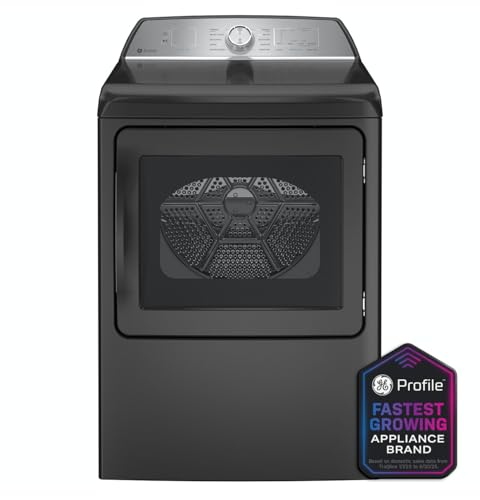
The GE Profile PTD60GBPRDG brings 7.4 cubic feet and sensor dry in a Diamond Gray finish that looks better than most utility-room appliances. It is 27 inches wide and explicitly non-stackable, so it needs its own floor space. Power, gas, and vent connections are at the rear for service access, and the cabinet weighs 122.47 pounds. The trade is stacking: this one will not go over a washer.
What stands out
- Diamond Gray finish suits a laundry room on display
- Sensor drying and smart controls come as standard
- Rear connections simplify both installation and later service access
Watch out for
- Non-stackable design, so it consumes valuable floor space
- No steam or sanitize cycle in the listed features
Kenmore 7.0 cu. ft. Front Load Gas Dryer
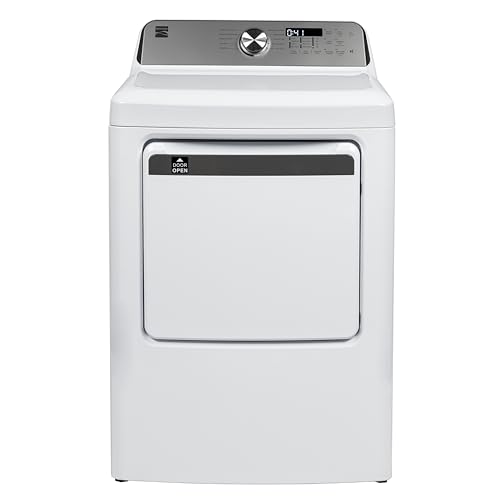
Kenmore's 7.0 cubic foot gas dryer offers ten cycles, six options, sensor drying, and Wrinkle Guard behind touch controls. It is the only model here that leans on post-cycle tumbling as its main fabric-care feature, and it does so without steam. The listing's dimension block is unreliable, so confirm the cabinet size with the seller before ordering. Weight is not published either, so plan the delivery with the retailer.
What stands out
- Wrinkle Guard tumbles clothes after the cycle ends
- Ten cycles handle everyday fabrics and household items
- Touch controls are easy to wipe clean between loads
Watch out for
- No steam refresh or sanitize cycle at all
- Dimensions in the product listing cannot be trusted
Midea MLTG37N1BWW Gas Dryer Auto Sensor Dry 12 Total Cycles 6.7 Cu.ft White

Midea's 6.7 cubic foot gas dryer is the smallest model here and the easiest to operate. Twelve cycles split into six sensor and six manual programs, with Wrinkle Care and Air Fluff for freshening. A knob selects cycles, and the LED indicators show status. It measures 43 by 30 by 27 inches, weighs 127.8 pounds, and uses an aluminized alloy steel drum. For a single person or a couple, 6.7 cubic feet is enough capacity.
What stands out
- Twelve cycles split between sensor and manual programs
- Air Fluff freshens clothes without adding any heat
- Simple knob is easy to use and clean
Watch out for
- The smallest drum here, at 6.7 cubic feet
- There is no steam, sanitize, or app control
GE Profile PTD60GBSRWS 7.4 Cu. Ft. White Front Load Gas Dryer

The white GE Profile PTD60GBSRWS is the most complete machine in this band: 7.4 cubic feet, sensor drying, a sanitize cycle, and ENERGY STAR certification. The feature list is short but still covers the essentials, and white matches most washer pairs. It weighs 122.47 pounds, and it is the least complicated way to get a sanitize cycle in this band.
What stands out
- Sanitize cycle sets it apart from the rest of this band
- Sensor dry and ENERGY STAR certification are included
- White finish matches most common washer pairs and finishes
Watch out for
- No steam refresh and no app control offered
- Detailed cabinet dimensions are missing from the listing
Buying guide
Why the list is short
Gas dryers are a smaller market than electric ones, and the budget segment is smaller still. Builders and landlords usually install electric because it avoids running a gas line to the laundry, so the volume sits with 240-volt machines. Manufacturers respond by putting their value engineering into those models and treating gas as a step up. The result is a band with fewer models, fewer finishes, and less discounting.
That is not a reason to avoid gas. If the laundry room already has a gas stub and a vent, a gas dryer is usually the faster and cheaper machine to run. It is a reason to shop differently: compare the five options on fit and venting rather than hunting for a feature that does not exist at this level. Steam, in particular, is absent from every model here.
The five that follow clear the same bars: a full-size drum, a standard four-inch vent connection, and sensor drying. There is no compact 120-volt model in the group, no ventless design, and no steam. If you need any of those, the electric guides cover them. If you have a gas stub and a family-sized pile of laundry, this is the shortlist that matters.
The gas connection is the real cost center
Every machine here needs a shutoff valve, a flexible connector rated for a dryer, and a 120-volt outlet for the controls and ignition. The connector is almost never in the box, and neither is the power cord on some models. A licensed installer should make the connection and leak-test it. Ask whether the existing shutoff is the right type and easy to reach, since some older valves no longer turn freely. If the laundry has never had a gas appliance, get a quote for running the line before you fall in love with a dryer.
Venting is the second fixed cost. All five models need a four-inch duct to the outdoors, and the run has to be short enough for the machine's rating. The GE GTD48GASWWB stands out because it is rated for runs up to 120 feet, which is the answer for a basement or an interior closet with no direct outside wall. For everyone else, a straight run under the length in the manual is the goal. A carbon monoxide alarm on the same floor is a small expense with a large payoff.
The connector and the duct are two different parts, and both matter. The gas connector is the short flex line between the shutoff and the dryer; the duct is the four-inch pipe that carries moist air outside. Use a listed connector, not a length of whatever is on the shelf, and keep the duct as straight as the room allows. An installer who checks both is worth the call.
Sizing: 6.7 to 7.4 cubic feet
The spread here is narrow. The Midea is 6.7 cubic feet, the Kenmore is 7.0, the GE GTD48GASWWB is 7.2, and both GE Profiles are 7.4. In practice, 7.0 and up handles a family's everyday laundry without splitting loads. The 6.7 cubic foot Midea is the one to think about if king bedding is part of the weekly routine, because a king comforter needs room to turn over. A drum that is too small lets the comforter ball up, and the center stays damp no matter how long the cycle runs.
Cabinet dimensions vary more than capacity. The GE GTD48GASWWB is 44 inches tall, the Midea is 43, and the Profiles are shorter but not published in the listing. Depths run about 29.5 to 30 inches on the models that state them. Measure the opening, the doorway, and the clearance behind the machine for the gas connector and vent. Height is the dimension people forget, especially under a shelf. A recessed vent box and a recessed gas valve can recover two or three inches if the wall allows.
Features worth having in this band
Sensor drying is standard across all five, and it is the feature that matters most. The dryer ends the cycle when moisture drops instead of running a timer, which protects fabrics and saves energy. Beyond that, the useful extras are specific: the white GE Profile adds a sanitize cycle, the GE GTD48GASWWB adds Extended Tumble and a long vent rating, and the Kenmore and Midea add post-cycle wrinkle care.
What you will not find is steam. If refreshing wrinkled shirts without a wash matters to you, this is the wrong band, and the main gas dryer guide covers models that do it. The other trade is control sophistication. The Midea uses a knob, the Kenmore uses touch controls, and the GE Profiles lean on electronic panels with sensor cycles. Pick the interface you will actually use at 7 a.m. None of these panels is hard to learn, but the GE Profiles ask you to set dryness levels through a menu, while the Midea's knob does one thing per turn.
Stacking, doors, and tight rooms
Stacking is not a given. The GE Profile PTD60GBPRDG is explicitly non-stackable, and the rest need a manufacturer kit matched to a specific washer. If floor space is tight, verify the pairing before you buy, because a generic bracket is not a substitute and can void a warranty. A side-by-side pair needs about five feet of width once the machines and a gap between them are counted. Measure the delivery path too, because a 27-inch dryer will not pass through a 24-inch door frame.
Door swing and connection access matter just as much. The GE Profile PTD60GBPRDG routes power, gas, and vent connections at the rear, which means you need clearance behind the cabinet for the connector and duct. Every dryer needs some rear clearance, so measure from the wall rather than the cabinet front. A recessed box in the wall buys back a few inches. Measure with the connector installed, not with the machine alone, and confirm the depth rating accounts for the plug and hose.
What you give up for the lower sticker
Compared with a premium gas dryer, these five give up steam, fancy finishes, and some cycle variety. The GE Profiles offer Diamond Gray or white, the others are white. None has app control listed, and none offers a heat pump or ventless design, which is an electric-only idea anyway. What you keep is full-size capacity, sensor drying, and a gas burner that heats quickly.
That is a reasonable trade for a laundry room that already has the hookup. The money you do not spend on steam is better spent on a proper install, a short rigid vent run, and a carbon monoxide alarm nearby. Those three things affect safety and drying performance every day. A steam refresh affects one shirt on a Thursday. A machine that fits, vents properly, and dries a full basket beats a fancier one that does none of those.
Frequently asked questions
Are there budget gas dryers available?
Yes, but the selection is thin. This list has five, all full-size and all with sensor drying. Most sit between 7.0 and 7.4 cubic feet, and none includes steam. Expect white or gray finishes and simpler control panels than the premium gas models.
Do all gas dryers need to be vented?
Yes. Gas combustion produces moisture and carbon monoxide, so every model here vents through a four-inch duct to the outdoors. Never vent into a wall cavity, attic, or room. Keep the run short, use rigid metal duct, and check the exterior damper once a year.
Can I convert an electric dryer to gas?
It is rarely practical. Manufacturers generally do not support field conversion, and the burner, gas valve, and safety controls are not present on an electric model. Buy a dryer built for the fuel you have. Converting the other way, gas to electric, is equally discouraged. The safer path is to buy the fuel type the laundry room already supports.
What parts do I need to buy with a gas dryer?
Plan on a flexible gas connector rated for the appliance, a power cord if the listing says it is not included, and a four-inch vent kit or duct. Some installations also need a new shutoff valve or a recessed outlet box. An installer can confirm the list before delivery day.
Is a 6.7 cubic foot gas dryer big enough for a family?
For everyday clothes, yes. For king comforters and large bedding loads, it is tight. A 7.0 to 7.4 cubic foot drum gives bedding room to tumble. If your household washes comforters often, choose one of the larger models and check the drum depth before ordering, since the listed capacity alone will not tell you how a comforter will sit.
Verdict
The white GE Profile PTD60GBSRWS is the top pick here: 7.4 cubic feet, sensor drying, a sanitize cycle, and ENERGY STAR certification in a straightforward cabinet. The GE GTD48GASWWB is the value pick, with a 7.2 cubic foot drum, Extended Tumble, a 107-pound cabinet, and the 120-foot vent rating that solves awkward installations.
The Diamond Gray GE Profile is the upgrade if you want the same capacity in a darker finish with smart controls. The Kenmore 7.0 is the choice for wrinkle care on a simpler panel, and the Midea 6.7 is best for a small household that wants a knob and does not wash king bedding.