Every gas dryer sold today can stop when a timer runs out. Fewer can stop when the clothes are dry, and the difference between those two behaviors is the biggest factor in how a dryer feels to live with. A machine that guesses wrong every third load turns laundry into a supervision job.
Moisture sensing is not new, and it is not reserved for expensive machines. What varies is how many cycles use it, whether you can adjust the target dryness, and how the logic handles a mixed load. A dryer with good sensors and a badly sorted load will still leave a towel damp in the middle, and no control board can fix that.
We compared specifications, features and owner reports on eight gas dryers. Five listings name or describe a sensing system; three do not, which is not proof those machines lack one. We describe what each listing actually claims rather than filling the gaps ourselves.
One practical note before the list. Sensor performance depends on a clean drum and a reasonable load. A sensor bar coated with fabric softener residue reads damp fabric as dry, and no amount of engineering fixes a dirty drum.
Top picks at a glance
GE Profile PTD60GBSRWS 7.4 Cu. Ft. White Front Load Gas Dryer
Check price on AmazonGE GTD48GASWWB 7.2 cu. ft. Gas Dryer with Up to 120 ft. Venting and Extended T
Check price on AmazonElectrolux ELFG7637AW 8 cu. ft. White Front Load Perfect Steam Gas Dryer with
Check price on AmazonCompare the shortlist
| Model | Type | Capacity | Key feature | Amazon |
|---|---|---|---|---|
| 1. GE Profile PTD60GBSRWS 7.4 Cu. Ft. White Front Load Gas Dryer | Front-load | 7.4 cu ft | Sensor drying | Check price |
| 2. Electrolux ELFG7637AW 8 cu. ft. White Front Load Perfect Steam G | Front-load | 8 cu ft | Steam | Check price |
| 3. Kenmore 7.4 Cubic Feet Front Load Gas Dryer with Steam Technolog | Front-load | 7.4 cu ft | Steam | Check price |
| 4. Speed Queen ADA 7 Cu. Ft. Sanitizing Gas Dryer with Pet Plus in | Gas | 7 cu ft | Sanitize cycle | Check price |
| 5. GE GTD48GASWWB 7.2 cu. ft. Gas Dryer with Up to 120 ft. Venting | Gas | 7.2 cu ft | Capacity | Check price |
| 6. GE 7.8 cu.ft. Smart Front Load Gas Dryer in Carbon Graphite with | Front-load | 7.8 cu ft | Steam | Check price |
| 7. Kenmore 29" Front Load Gas Dryer with Wrinkle Guard and 7.0 Cubi | Front-load | — | Quick cycle | Check price |
| 8. 7.4 cu. ft. Ultra Large Capacity Smart wi-fi Enabled Front Load | Front-load | 7.4 cu ft | Connected controls | Check price |
Detailed reviews
GE Profile PTD60GBSRWS 7.4 Cu. Ft. White Front Load Gas Dryer

The GE Profile PTD60GBSRWS is the most straightforward sensor-dry machine here: 7.4 cu ft, Sensor Dry on the main cycles, a sanitize option and ENERGY STAR certification. There is no steam and no app, which keeps the control panel short and the failure points few. It suits a household that wants the dryer to make one decision well, and it is the easiest machine in this guide to explain to a housesitter.
What stands out
- Sensor Dry named and central to the cycle set
- Sanitize cycle plus ENERGY STAR certification for efficiency
- Drum size lines up with a standard 4.5 cu ft washer
Watch out for
- No steam refresh for wrinkled shirts or knits
- Weight is the only published dimension for this model
Electrolux ELFG7637AW 8 cu. ft. White Front Load Perfect Steam Gas Dryer with LuxCare Dry and Instant Refresh

The Electrolux pairs Predictive Dry with LuxCare, using moisture readings to stop short of over-drying rather than following a timer. The 8.0 cu ft drum is the largest here, Perfect Steam and Instant Refresh handle wrinkles, and eleven programs cover Activewear, Allergen, Delicates, Towels and a 15-minute fast dry. It is ENERGY STAR certified and built with a quiet-running design.
What stands out
- Predictive Dry reads moisture instead of counting elapsed time
- 8.0 cu ft drum with steam and refresh cycles
- Fifteen-minute fast dry for uniforms and single shirts
Watch out for
- More cycles and settings to learn than most need
- 126-pound cabinet needs two people to move safely
Kenmore 7.4 Cubic Feet Front Load Gas Dryer with Steam Technology, White
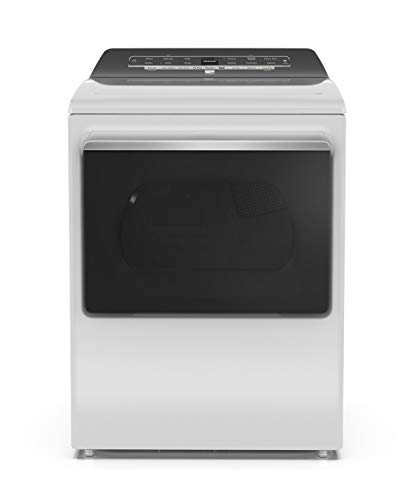
Kenmore's 7.4 cu ft model does not name its sensing system in the listing, but it does pair steam with a drop-down door that doubles as a sorting surface. It is ENERGY STAR certified and measures 27 inches wide by 29.88 deep. Treat the sensing claim as unconfirmed and check the manual, then judge the machine on the steam cycle and the door, which are the parts that set it apart.
What stands out
- Steam cycle that targets wrinkles and lingering odors
- Drop-down door doubles as a resting spot for baskets
- ENERGY STAR certified in a cabinet only 27 inches wide
Watch out for
- Sensing system is not named in the listing
- Power cord and vent kit are not included in the box
Speed Queen ADA 7 Cu. Ft. Sanitizing Gas Dryer with Pet Plus in Matte Black

Speed Queen's 7.0 cu ft machine uses over-dry protection rather than a sensor-dry badge, which amounts to the same goal: stop before the load is cooked. A sanitizing cycle and Pet Plus setting suit animal households, anti-static treatment handles the cling, and the 42.75-inch cabinet is listed as ADA compliant. It is the machine for someone who values a long service life over a long cycle list.
What stands out
- Over-dry protection stops the cycle before fabric suffers
- Pet Plus setting and a sanitizing cycle for pet bedding
- ADA-compliant height with a sturdy, long-life build
Watch out for
- 7.0 cu ft drum is the smallest in this group
- Sensing is not marketed under the sensor dry name
GE GTD48GASWWB 7.2 cu. ft. Gas Dryer with Up to 120 ft. Venting and Extended Tumble

The GE GTD48GASWWB is the venting specialist: rated for duct runs up to 120 feet, with extended tumble and a cycle list covering heavy, normal, delicate and timed drying. Its listing does not name a moisture sensor, so confirm that detail before buying if automatic stopping is a priority. What it does offer is the easiest installation in this group, at 107 pounds and 44 inches tall.
What stands out
- Vent runs up to 120 feet solve difficult rooms
- At 107 pounds it is the easiest to carry downstairs
- Extended tumble limits wrinkles after the cycle ends
Watch out for
- No moisture sensor is named in the listing
- 44 inches tall, which rules out low shelves
GE 7.8 cu.ft. Smart Front Load Gas Dryer in Carbon Graphite with Steam and Sanitize GFD65GSPVDS

GE's 7.8 cu ft model puts steam and sanitize ahead of sensing in its marketing, with an aluminized steel drum and ENERGY STAR certification backed by an estimated 687 kWh of annual electrical use. The drum is the largest steam-equipped size here at 7.8 cu ft, and the cabinet measures 28 inches wide by 32 deep. Its sensor behavior is not spelled out, so ask before assuming.
What stands out
- 7.8 cu ft drum with both steam and sanitize cycles
- Drum lining resists rust, which matters in a damp basement
- ENERGY STAR listed with an annual kWh estimate
Watch out for
- Sensing is not named in the feature list
- Steam cycles need a water line or a reservoir nearby
Kenmore 29" Front Load Gas Dryer with Wrinkle Guard and 7.0 Cubic Ft. Total Capacity, White
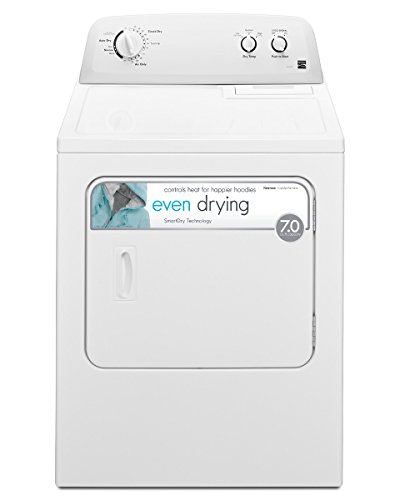
The 7.0 cu ft Kenmore is the clearest budget example of sensing done simply. SmartDry sensors adjust time and temperature as the load dries, an integrated thermostat watches for heat damage, and four temperatures plus an air-dry option cover the rest. Wrinkle Guard tumbles for up to 40 minutes after the cycle, and the 36-inch cabinet fits under a shelf.
What stands out
- SmartDry sensors adjust time and temperature as the load dries
- Wrinkle Guard tumbles for up to 40 minutes after drying
- Low 36-inch cabinet slides under a workbench shelf
Watch out for
- 7.0 cu ft is small for bedding plus towels
- 29-inch width is wider than most machines here
7.4 cu. ft. Ultra Large Capacity Smart wi-fi Enabled Front Load Gas Dryer with Built-In Intelligence

LG's 7.4 cu ft dryer describes its sensing as built-in intelligence, which reads load size and fabric mix and then picks settings rather than making you choose. Wi-Fi adds cycle alerts and remote monitoring through the LG app. At 27 inches wide and 31 deep, the cabinet is easier to fit than the deeper alternatives, and the drum matches a full-size washer.
What stands out
- Built-in intelligence adjusts settings to the load automatically
- App-based alerts let you track a load from upstairs
- 31-inch depth leaves more clearance behind the cabinet
Watch out for
- Sensing is branded but not described in any detail
- Smart features depend on app setup and an account
Buying guide
How moisture sensing actually works
Most dryers use a pair of metal strips inside the drum, usually near the lint filter. Wet fabric bridges the strips and completes a small circuit. As the load dries, resistance rises until the board decides the fabric has stopped giving up water, and the cycle ends. Some machines also watch exhaust temperature, which climbs sharply once evaporation stops. Two methods are better than one, and the better machines combine them rather than trusting a single reading.
That is why sensing rewards a sorted load. A drum holding a bath mat and a silk blouse gives the sensor two different answers at once. It waits for the slowest item, which is the mat, and the blouse spends the wait getting hot and dry. Sorting by weight is not a housekeeping ritual; it is how you help the sensor do its job. Ambient humidity matters too, which is why a basement dryer often needs a higher dryness setting than the same model upstairs.
Sensor dry versus timed dry: what changes in the drum
Over-drying is the quiet cause of most laundry complaints. Cotton shrinks, elastic loses its snap, synthetics build static, and lint multiplies, all because a timer kept applying heat after the water was gone. A sensor ends the cycle at the point where the load is dry rather than the point where a dial says zero, which is why fabric comes out softer, shirts need less ironing and clothes last through more washes.
The energy saving is real but secondary. The bigger gain is time, because a sensed load of towels can finish well before a fixed timer would allow. The setting to look for is a dryness level, usually offered as more dry, normal and less dry. Sheets and lightweight synthetics do better on less dry, heavy towels on normal, and denim on more dry. A machine without that adjustment gives you the factory's opinion of dry and nothing else, which is fine until the factory is wrong.
Reading the labels: Sensor Dry, SmartDry, Predictive Dry
Brands name the same idea differently. GE calls it Sensor Dry. Kenmore uses SmartDry. Electrolux pairs LuxCare with Predictive Dry, and Speed Queen describes over-dry protection. LG talks about built-in intelligence that reads load size and fabric mix, while other brands use moisture sensing, auto dry and a dozen other phrases. None of these names is regulated, so the label alone tells you very little about how well the system works.
What you can check is coverage and control. Ask whether sensing works on the main cycles or only on one, whether the dryness level is adjustable, and whether quick cycles quietly fall back to a timer. Those three answers separate a system that helps daily from one that exists mainly for the spec sheet. The manual is more reliable than the showroom card, and the cycle chart usually takes two minutes to find once you know the model number.
Keeping the sensor honest
Dryer sheets are the usual suspect when sensing drifts. The coating that makes fabric feel soft also leaves a film on the sensor bars, and a filmed sensor reads wet fabric as dry. Wiping the bars with a little rubbing alcohol every few months restores most of the accuracy, and it takes less time than folding a load. Cleaning the lint filter every load matters too, since a restricted filter holds humidity in the drum and confuses the reading.
Load habits finish the job. Shake items out before they go in, keep the drum to about two-thirds, and avoid mixing a heavy towel load with light synthetics. If the machine offers a humidity or dryness offset in its settings, leave it alone for the first month and learn the baseline before adjusting. Most complaints about sensor dry that are not caused by a dirty sensor are caused by a load the sensor was never going to read correctly.
Where sensor dry fits in the whole purchase
Sensing is one part of a dryer, and it cannot compensate for a machine that is the wrong size or badly installed. Capacity comes first: a 7.4 to 8.0 cu ft drum handles bedding, and a 7.0 handles everything else with one extra pass. Venting comes second, because a long or crushed duct stretches every cycle and makes even a good sensor look unreliable. Both matter more than the badge on the panel.
Then comes the gas connection, which is a licensed job in most states and should include a leak test. Budget for the vent kit, the connector and the labor alongside the machine. A dryer with excellent sensing and a restricted vent will still take seventy minutes on towels, and the owner will blame the sensor. Installation quality decides more of the daily experience than the brand name, which is an inconvenient fact for anyone shopping by features alone.
Frequently asked questions
Does sensor dry actually save energy?
Yes, because it stops the cycle when the load is dry instead of running a fixed timer past that point. The saving depends on how often you would otherwise over-dry. A household that runs full loads on a normal cycle sees a modest gain; one that routinely adds twenty minutes to be safe sees more.
Why does my sensor dryer still leave clothes damp?
Start with the load. An overloaded drum, or one mixing towels with light synthetics, defeats the sensor. Next check the sensor bars for fabric softener film and clean the lint filter. If neither helps, the dryness level may be set to less dry, which is a setting rather than a fault.
Can I switch sensor dry off?
On most machines, yes. Timed cycles remain available and are useful for touch-ups, damp towels or a load you want to run for a set period before bed. Some models let you add time to a sensed cycle, which is the more useful option because it keeps the automatic stop.
Do dryer sheets affect the moisture sensor?
They can. The softening coating leaves a film on the metal sensor bars, and the film insulates them from damp fabric, so the dryer thinks the load is drier than it is. Wipe the bars with rubbing alcohol every few months, and consider using wool dryer balls if the problem keeps returning.
Is sensor dry the same as auto dry?
Usually, yes. Auto dry, sensor dry, smart dry and moisture sensing all describe a cycle that ends when the load reaches a target dryness. The names vary by brand and are not standardized. Check the manual for which cycles use the sensor and whether the dryness level can be changed.
Verdict
The Electrolux ELFG7637AW is the top pick for anyone who cares about sensing: Predictive Dry reads moisture rather than time, the 8.0 cu ft drum gives a comforter room to tumble, and the dryness logic is paired with steam for the loads that need reviving. The Kenmore 7.0 is the value choice, with SmartDry sensors, four heat settings and Wrinkle Guard for loads that sit.
The GE Profile 7.4 is the upgrade for a simpler household: sensor dry, a sanitize cycle and ENERGY STAR certification without steam or an app. If the vent run is long, the GE 7.2 and its 120-foot allowance matter more than any sensor badge, and the Speed Queen is the one to consider if pet hair and sanitizing drive the decision.