An ironing board is the least considered purchase in the laundry room and the one most often replaced for the wrong reason. A wobble, a scorched cover or a top that feels too short all get blamed on the board, when a tightened bolt or a new pad would have solved it for a fraction of the effort.
This list is deliberately mixed. Four entries are covers and pads, two are specialty shapes for sleeves and tailoring, three mount to a wall and one is a full-size folding board. That mix reflects how people actually shop: sometimes the board is fine and the surface is not, and sometimes there is no floor space left for a board at all.
The measurements that matter are surface size, height range and weight. A standard board runs about 13 inches wide by 43 to 54 inches long. The Jakeefud lists 13 by 43 with seven height positions from 29 to 35 inches, while the Xabitat wall board measures 36.2 by 12.2 and holds 25 pounds. Those numbers tell you more than any padding claim.
We compared specifications, features and owner reports. Where a listing contradicts itself, we say so rather than pick the friendlier number.
Top picks at a glance
Newhouse Specialty Padded Sleeve Ironing Board
Check price on AmazonWhitmor Ironing Board Cover, Machine Washable, No Pad, Fits 15 x 54 in
Check price on AmazonFacilehome 180° Swivel Wall Mount Ironing Board Cabinet with Storage,White
Check price on AmazonCompare the shortlist
| Model | Type | Capacity | Key feature | Amazon |
|---|---|---|---|---|
| 1. Newhouse Specialty Padded Sleeve Ironing Board | Ironing board | — | — | Check price |
| 2. Seiritex Wall Mounted Ironing Board with Iron Holder, 42x14 Comp | Compact | — | Compact footprint | Check price |
| 3. Xabitat Ironing Board 36.2" x 12.2" Wall Mounted Compact Fold Do | Compact | — | Steam | Check price |
| 4. Jakeefud Deluxe Ironing Board with Heat Resistant Cover and Thic | Ironing board | — | Compact footprint | Check price |
| 5. Facilehome 180° Swivel Wall Mount Ironing Board Cabinet with Sto | Ironing board | — | Compact footprint | Check price |
| 6. SAVUK Ironing Board Cover and Pad Standard Size 15x54 inch Extra | Ironing board | — | — | Check price |
| 7. Ironing Board Cover and Pad, 15x54 Standard Size, Scorch Resista | Ironing board | — | Steam | Check price |
| 8. GORILLA GRIP Padded Ironing Board Cover, 15x54 Linen | Ironing board | — | Wrinkle care | Check price |
| 9. Whitmor Ironing Board Cover, Machine Washable, No Pad, Fits 15 x | Ironing board | — | — | Check price |
| 10. Jacobson Products Padded Chest & Sleeve Ironing Boards | Portable | — | Compact footprint | Check price |
Detailed reviews
Newhouse Specialty Padded Sleeve Ironing Board
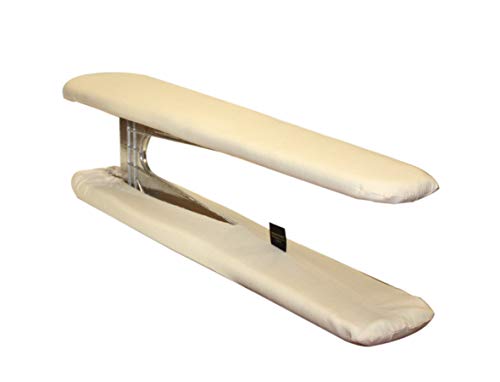
A dedicated sleeve board rather than a full ironing surface. One side is standard width and the other narrows, so you can press a sleeve seam or a small garment without creasing the part you just finished. The cover is flannel, which tolerates high heat, and the frame is heavy-duty aluminum. At 23 inches long it stores on a shelf or hangs from a hook.
What stands out
- Narrow side fits inside sleeves and small seams
- Flannel cover stands up to direct heat well
- Heavy-duty aluminum frame keeps the board rigid under pressure
Watch out for
- Not a substitute for a full-size ironing board
- No height adjustment or folding legs for storage
Seiritex Wall Mounted Ironing Board with Iron Holder, 42x14 Compact Mount Foldable Ironing Board for Small Spa
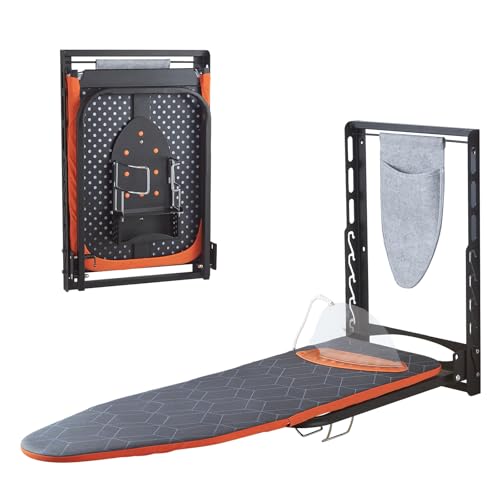
A 14-inch-deep wall board that folds to 3.5 inches and offers five height positions in two-inch steps. The frame uses a breathable metal mesh panel, and the package includes a heat-resistant iron cradle and a silicone rest mat. Six expansion bolts hold it to the wall. The title says 42 by 14 while the feature copy describes a 13 by 36 mesh surface, so confirm the working area before you buy.
What stands out
- Folds to just 3.5 inches against the wall
- Offers five separate height positions in two-inch steps
- Iron holder and silicone rest mat are included
Watch out for
- Listing gives two different board dimensions to compare
- Not suitable for drywall, so find a stud first
Xabitat Ironing Board 36.2" x 12.2" Wall Mounted Compact Fold Down, Gray

A compact wall board with a 36.2 by 12.2 surface, a perforated steel top and a cotton cover over a pad. The frame is rated for 25 pounds, folds flush against the wall and locks with a one-click release. Installation uses four bolts, and the brand advises against mounting it in drywall without professional help. At 41 inches long when folded, it needs a clear wall.
What stands out
- The perforated steel top lets steam escape quickly
- Frame is rated for 25 pounds of pressure
- Folds flush to the wall and locks with one click
Watch out for
- Drywall mounting needs professional help or a backing board
- The narrow surface is too tight for bedding
Jakeefud Deluxe Ironing Board with Heat Resistant Cover and Thicken Felt Pad, Heavy Sturdy Legs,Full Size Hang

The full-size board in this group, with a 13 by 43 mesh top, seven height positions from 29 to 35 inches and a folding frame that weighs 9.5 pounds. A silicone-padded iron rest sits at the end, the feet are non-skid, and the height lock is designed to stop the board collapsing mid-press. The feature copy says 10.5 pounds while the specification says 9.5, a small discrepancy worth knowing if you carry it up stairs.
What stands out
- Seven height positions from 29 to 35 inches
- Mesh top and a heat-resistant pad are included
- Light enough to fold and move on your own
Watch out for
- Weight is listed as both 9.5 and 10.5 pounds
- A 43-inch top is short for curtain panels
Facilehome 180° Swivel Wall Mount Ironing Board Cabinet with Storage,White

A wall cabinet rather than a bare board. The mirrored doors open to reveal three tiers of storage and a board that swivels almost 180 degrees, so left-handed and right-handed users can both work comfortably. Two hooks hold finished garments, and the whole unit arrives assembled. It weighs 30.8 pounds and stands 37.6 inches tall, so the wall needs solid anchoring.
What stands out
- Board swivels almost 180 degrees for either hand
- Three tiers of storage hide behind mirrored doors
- Two hooks hold pressed garments ready for the closet
Watch out for
- At 30.8 pounds it needs serious wall anchoring
- Cabinet depth eats into an already narrow room
SAVUK Ironing Board Cover and Pad Standard Size 15x54 inch Extra Heavy Duty Thick Padding, Heat Reflective, No

A four-layer cover and pad with a cotton top, a silicone coating, foam and a felt base, fastened by a drawstring rather than elastic. The brand quotes heat resistance to 240 degrees without naming the scale, so treat the figure as approximate. The nose pocket and two underside straps are designed to keep the surface taut on a standard board.
What stands out
- Four layers topped with a reflective silicone coating
- The drawstring pulls tauter than tired elastic edges
- Cotton top glides smoothly under a hot iron
Watch out for
- Heat rating is quoted without a temperature unit
- Drawstring takes longer to fit than elastic edges
Ironing Board Cover and Pad, 15x54 Standard Size, Scorch Resistant

A 15 by 54 cover with up to 6 millimeters of synthetic fiber and foam padding, a cotton top and a nose pocket. Four adjustable clips pull it tight from underneath, and the brand includes a mesh pressing cloth for delicate fabric. It fits boards from 13 to 15 inches wide and 52 to 54 inches long, and the whole thing weighs half a pound.
What stands out
- Six millimeters of padding hides the board's mesh marks
- Four adjustable clips hold the cover tight underneath
- Fits the common 13 to 15 inch width
Watch out for
- A thick pad slows heat transfer a little
- It is not sized for compact wall-mounted boards
GORILLA GRIP Padded Ironing Board Cover, 15x54 Linen

A silicone-coated cover rated to 400 degrees Fahrenheit, with extra-thick padding and a nose pocket. Elastic around the edge does most of the holding, and two hook-and-loop straps underneath add tension. It measures 15 by 54 inches and fits standard boards. The reflective surface is the selling point: it sends heat back into the garment instead of absorbing it.
What stands out
- Silicone coating is rated to 400 degrees Fahrenheit
- Reflective silicone sends heat back into the fabric
- Elastic edges plus two straps keep it flat
Watch out for
- Fits only standard 15 by 54 inch boards
- The silicone surface can feel slick with starch
Whitmor Ironing Board Cover, Machine Washable, No Pad, Fits 15 x 54 in

A simple replacement cover with no pad, made from 88gsm fabric and secured by a stitched-in string. It fits boards from 13 to 15 inches wide and 52 to 54 inches long, and it is machine washable. This is the right buy when the padding underneath is still good and only the top cloth is scorched or stained, and it is the least expensive way to refresh a tired board.
What stands out
- Machine washable, which makes refreshing it easy enough
- String fit adjusts to fit most standard boards
- Thin fabric lets heat pass through to the pad quickly
Watch out for
- No pad included, so it adds no cushioning
- Thin 88gsm fabric wears faster than padded covers
Jacobson Products Padded Chest & Sleeve Ironing Boards
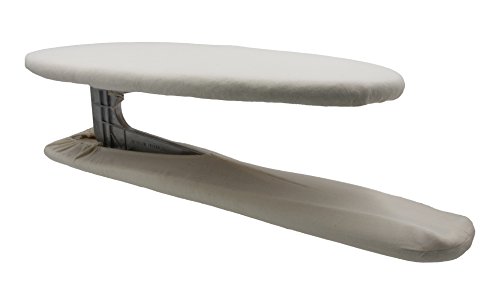
A chest and sleeve board for tailoring rather than general laundry. The narrow shape slides inside a sleeve or across a shoulder seam, and the padded surface doubles as a pressing and pin board. The frame is heavy-duty aluminum and the board measures 10 by 5 inches, so it stores in a drawer. It is also useful under a garment steamer.
What stands out
- The narrow shape reaches shoulders and sleeve seams
- Doubles as a pin board for tailoring work
- Small enough to store in a drawer or bin
Watch out for
- Far too small for shirts, sheets or bedding
- The padded surface cannot be replaced when it wears
Buying guide
Size and shape: full-size, compact and specialty boards
A full-size board is the only shape that handles a duvet cover or a curtain panel without bunching. The Jakeefud offers 13 by 43 inches of mesh surface, which is enough for a shirt laid flat and just short of what a king sheet wants. Wall boards like the Xabitat and the Seiritex run 36 by 12 or 42 by 14, fine for shirts and trousers but cramped for bedding. Neither is a defect; they are different tools for different laundry. If most of your ironing is shirts, the compact surface is quicker to set up and easier to store. A 43-inch top also leaves room for a stack of hangers at one end without crowding the pressing area.
Specialty boards exist because a flat surface cannot get inside a sleeve. The Newhouse is 23 inches long with a standard side and a narrow side, so you can press a sleeve seam without creasing the rest of the sleeve. The Jacobson chest board is smaller still at 10 by 5 inches and shaped for shoulders and tailoring. Buy one as an addition to a main board, not as a replacement, unless you only ever press shirts. They store on a hook or in a drawer, which is why they are easy to keep. Hang the specialty board on the same hook as the main iron, so it stays within reach instead of in another room.
Height adjustment and stability where it counts
Working height is the specification people ignore until their back aches. The Jakeefud adjusts through seven positions from 29 to 35 inches, the Seiritex offers five positions in two-inch steps, and most wall boards fix at one height. A board that tops out at 35 inches is roughly counter height, which suits most standing adults. If you are taller, you will stoop; if you iron sitting down, you want the low end of the range instead. Measure your elbow height before you choose. A quick check: stand at the board and rest your hands flat on the surface. If your elbows are bent much past a right angle, the board is low. Adjust before you blame the board.
Stability comes from the frame, the lock and the feet. A mesh top distributes pressure better than a solid panel, a locking collar stops the board dropping mid-press, and non-skid feet keep the whole thing from walking across tile. The wall boards here are rated for 25 to 30 pounds of downward pressure, which is more than an iron and a garment will ever apply. If a board wobbles, check the rivets and the leg splay before you replace it. A five-minute tighten is cheaper than a new board. Look for a locking collar with a metal pin rather than a plastic cam, because the cam is usually the part that fails first. That is also the part that decides whether the board drops under pressure.
Wall-mounted and cabinet boards: installation decides everything
Every wall board in this group carries the same warning in different words: do not trust drywall. The Xabitat and Seiritex both advise against it, and they are right. The wall has to carry the board, the iron and the pressure you lean into it, and that load belongs on studs or a proper backing board. The Xabitat uses four bolts, the Seiritex six expansion bolts, and both take under half an hour with a drill and a level. If you rent, find the studs first and ask before drilling. A stud finder and a spirit level cost less than a repair, and a board mounted off level will annoy you every time. Mark both holes before drilling.
Cabinet versions add storage and weight. The Facilehome is a 30.8-pound unit with mirrored doors, three shelves and a board that swivels almost 180 degrees, so left-handed users can work from the other side. Before you mount anything that heavy, open the door through its full swing and check what it hits. A cabinet that fouls a door frame is worse than no cabinet, because you will stop folding it away. Measure the folded depth too, since these units sit proud of the wall. The mirrored doors also work as a full-length mirror, which is why these cabinets appear in bedrooms as often as laundry rooms. Check there is room to stand back from the glass.
Covers and pads: the cheapest fix for a bad board
Most boards are let down by their surface. A thin cover lets the mesh pattern print onto a shirt, and a scorched one leaves marks on anything light. The Dalykate uses up to 6 millimeters of synthetic fiber and foam, the Gorilla Grip rates its silicone coating to 400 degrees Fahrenheit, and the SAVUK layers cotton, silicone, foam and felt. The SAVUK quotes heat resistance to 240 degrees without naming the scale, so treat that figure as approximate. Layers matter, but so does the condition of the pad underneath. If the pad is lumpy or compressed, no cover will fix the surface, and you will still feel the mesh through the cloth. Replace both at once.
Fastening matters as much as the layers. Elastic edges are quick but go slack; a drawstring pulls tighter and stays there; clips and hook-and-loop straps add tension from underneath. The Whitmor is the exception in this group because it has no pad at all: 88gsm fabric on a string, meant for a board whose padding is still sound. Measure your board before ordering, because 15 by 54 is a standard, not a universal. A cover that is two inches short will pull off at the nose every time. A cover that is too large will wrinkle under the iron, and one that is too small will not reach the nose pocket. The tape measure matters more than the color.
Frequently asked questions
What size ironing board do I need?
For shirts and trousers, a 36 by 12 inch wall board is workable. For bedding, curtains and family laundry, choose a full-size board around 13 by 43 inches or larger. Standard covers are 15 by 54 and fit boards 13 to 15 inches wide, so measure the surface before buying a replacement.
Can I mount an ironing board on drywall?
Not safely on its own. The board, the iron and the pressure of pressing all hang on the fasteners, and drywall crumbles under that load. Mount into studs, a plywood backing board or masonry. Several manufacturers say the same in their instructions, and a wall board that pulls out mid-press is a genuine injury risk.
How often should I replace an ironing board cover?
When the surface stops being smooth, when scorch marks transfer to fabric, or when the padding compresses to the point where you can feel the mesh through it. A cover is inexpensive and takes minutes to fit, so there is no reason to press on a tired one. Wash cotton covers occasionally and avoid dry cleaning.
Are wall-mounted ironing boards worth it?
In a small apartment or a laundry closet, yes. They fold to a few inches, free the floor and cost less than a cabinet. The catch is installation: you need a solid wall and a clear swing. If you iron bedding every week, a full-size folding board is still more comfortable.
Do I need a separate sleeve board?
Only if you press dress shirts, suits or garments with narrow seams. A sleeve board slides inside the sleeve so you can press the seam without putting a crease down the front. The Newhouse doubles as a small general board. For T-shirts and linens, a full-size board is enough.
Verdict
The Jakeefud is the board to buy if you want one full-size surface that folds away. Seven height positions, a 13 by 43 mesh top, a silicone iron rest and 9.5 pounds make it easy to live with. The Seiritex is the value pick for a small room: it folds to 3.5 inches, offers five heights and includes an iron holder, provided you have a solid wall.
The Facilehome cabinet is the upgrade when the laundry room has no floor left. It swivels, stores three shelves of supplies behind mirrored doors and holds finished garments on two hooks. If your existing board is structurally fine, skip all three and buy the Gorilla Grip cover; a new surface is the cheapest improvement in this article.