Most people buy an ironing mat for the same reason: the board is a nuisance. It lives behind a door, it takes a minute to set up, and it is still standing in the kitchen when dinner is ready. A mat rolls out on the dryer, takes a shirt's worth of creases, and disappears into a drawer. That is a real improvement in a small home, and it costs a fraction of the floor space.
The catch is that a mat is not a board. It has no frame and no tension, so the surface beneath it does most of the work. Put one on a firm countertop and it behaves; put one on a bed or a glass table and you are asking for trouble. The four mats here also use different constructions, and those differences decide whether the mat is meant for quilt seams, a washer top, or a travel bag.
Wool felt, quilted cotton with corner magnets, silicone-coated canvas and a four-layer pad with a silicone rest are four distinct answers to the same question. None of them will press a linen sheet as crisply as a full-size board, and the notes below say so. What they do well is handle the daily touch-up without the setup ritual.
We compared specifications, features and owner reports rather than running a lab, and we left out thickness claims that no listing supports. Where a mat has a hard limitation, such as a surface it cannot safely sit on, it is stated plainly.
Top picks at a glance
ZOMONETI 17" x 13.5" Wool Pressing Mat 100% New Zealand Felted Wool Ironing Ma
Check price on AmazonSAVUK Portable Ironing Mat Standard Size Silicone Coated Extra Heavy Duty Thic
Check price on AmazonRuibo Magnetic Ironing Mat Blanket,Iron Board Alternative Cover/Quilted Washer
Check price on AmazonCompare the shortlist
| Model | Type | Capacity | Key feature | Amazon |
|---|---|---|---|---|
| 1. ZOMONETI 17" x 13.5" Wool Pressing Mat 100% New Zealand Felted W | Wool | — | Compact footprint | Check price |
| 2. Ruibo Magnetic Ironing Mat Blanket,Iron Board Alternative Cover/ | Portable | — | Delay start | Check price |
| 3. SAVUK Portable Ironing Mat Standard Size Silicone Coated Extra H | Portable | — | Compact footprint | Check price |
| 4. Ironing Mat for Table Top & Countertop, Magnetic Edges, 39.8x18. | Ironing | — | Steam | Check price |
Detailed reviews
ZOMONETI 17" x 13.5" Wool Pressing Mat 100% New Zealand Felted Wool Ironing Mat Pad Blanket for Quilter, Sewin

A half-inch felted wool pressing mat, 17 by 13.5 inches, made with New Zealand wool and other fibers. The dense felt holds heat and radiates it back into the fabric, and the textured surface grips bias strips and quilt blocks so they do not stretch. A silicone iron rest pad is included, and the mat weighs about a pound, so it moves between a sewing table and a class without fuss.
What stands out
- Half-inch felted wool holds heat for one-pass pressing
- Textured wool surface grips seams and accepts pins
- Silicone iron rest pad included for hot soleplates
Watch out for
- At 17 by 13.5 inches it is too small for garment bodies
- Wool felt needs airing after heavy steam use
Ruibo Magnetic Ironing Mat Blanket,Iron Board Alternative Cover/Quilted Washer Dryer Heat Resistant Pad/Portab
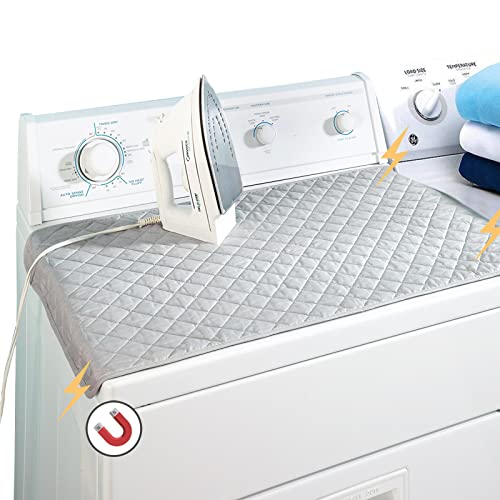
A quilted polyester and cotton pad, 33 by 18.5 inches, with a heavy-duty magnet in each corner. It rolls or folds for storage and is light enough to hang, and the maker suggests leaving it on a front-loading machine between uses. The listing is explicit that it should not be used on wood or plastic, which tells you the magnets and heat are meant for appliance tops.
What stands out
- Corner magnets hold the pad on steel appliance tops
- 33 by 18.5 inches covers a shirt or a pair of trousers
- Rolls up small and weighs about half a pound
Watch out for
- Magnets are useless on wood or plastic tables
- Quilted cotton offers little padding on hard edges
SAVUK Portable Ironing Mat Standard Size Silicone Coated Extra Heavy Duty Thick Padding, Heat Reflective, Non

A 21 by 28 inch portable mat with a silicone-coated face and a non-slip silicone backing. A built-in silicone rest gives the iron somewhere to sit, and the mat folds for travel or drawer storage. The maker does not publish a thickness or a temperature rating, so it is best treated as a touch-up surface rather than a heavy pressing pad. It is the simplest of the four to wipe clean.
What stands out
- Non-slip silicone backing grips smooth table and counter tops
- Built-in iron rest keeps the hot soleplate off fabric
- Folds flat for travel, dorms and small apartments
Watch out for
- The maker publishes no thickness or heat rating
- Thin padding transmits hard table edges and seams
Ironing Mat for Table Top & Countertop, Magnetic Edges, 39.8x18.3" Overall
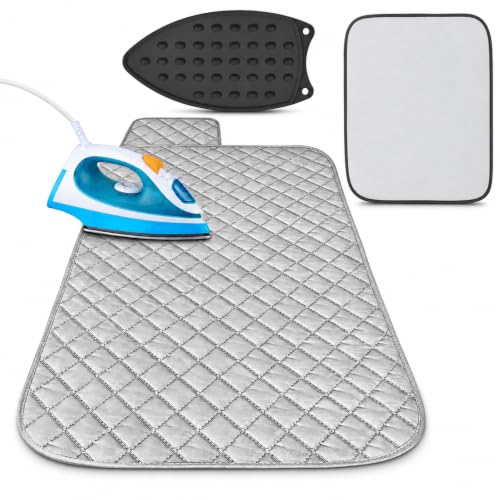
A four-layer pad with a 33.5 by 18 inch press area and a side section that holds a silicone iron rest, 39.8 by 18.3 inches overall. Magnetic edges grip steel appliance tops, the maker rates it to 374 degrees Fahrenheit, and the set includes a mesh for delicates and a 0.07-inch pad for seams. It folds flat and weighs about 0.7 pounds. Hand wash only, no tumble drying.
What stands out
- Four layers limit heat and steam reaching the surface
- Magnetic edges hold it steady on steel washer tops
- Includes a thin seam pad and a mesh for delicates
Watch out for
- Hand wash only, and it must air dry
- Press area is short for long sleeves and drapes
Buying guide
A mat is a heat barrier, not a board
An ironing mat replaces the setup, not the board itself. You unfold nothing, you clear nothing, and you press a shirt on a surface that is already in the room. What the mat supplies is a heat barrier and a little padding, not rigidity. That is enough for a collar, a pair of trousers or a dress you are touching up before dinner. It is not enough for a tablecloth, a pleated skirt or anything that needs the fabric pulled tight against a firm edge, because the surface underneath decides the result. A full board has a mesh top and a cover under tension; a mat has neither, which is exactly why it packs flat. The quickest way to judge one is to ask what it will sit on and what you plan to press, because those answers eliminate most of the market before thickness matters.
The surface under the mat matters more than the mat itself. Lagarto's instructions are unusually explicit: wood, laminate or stone tables, dressers and washer tops are fine, while glass, sofas, soft surfaces and thin plastic are not. Ruibo comes at it from the opposite direction, warning against wood and plastic because its magnets and quilting are designed for appliance tops. Those two pieces of advice are not contradictory; they reflect different constructions. Read the maker's surface list before you iron on the dining table, and never press on a surface that cannot take heat or cannot stay flat. When the surface is unknown, a silicone-backed mat and a folded cotton towel underneath are the forgiving combination. A towel also absorbs the steam that would otherwise condense on the table.
Wool pressing mats: the quilter's tool
A wool pressing mat is dense felt, and its trick is that it holds heat rather than reflecting it. The ZOMONETI is half an inch of felted New Zealand wool, 17 by 13.5 inches, and the maker says it radiates heat back into the fabric so you can press a seam once instead of flipping the piece. The felted texture also grips, which keeps bias strips and small quilt blocks from stretching as the iron moves across them. Quilters pin straight into the wool, which is why the mat has become a standard item in sewing rooms. At about a pound it moves easily between a table and a class, but it still needs a hard, flat base to work.
The limitation is size and purpose. Seventeen by thirteen inches is a pressing station for seams, blocks and collars, not a surface for a shirt body or a pair of trousers. You also need a hard table underneath, because the wool is soft and a mattress or an ironing board pad will let the mat sink. Wool felt can hold moisture after a long steam session, so air it out before you fold it away. If your ironing is mostly garments rather than sewing, a larger synthetic pad will serve you better. For garment work, look for at least 30 inches of length, which is where the wool format stops being useful and a flat pad starts. A cutting mat underneath is a good substitute for a dedicated pressing table.
Magnetic mats and the appliance-top trick
The magnetic mat is the cleverest idea in the category. Four heavy-duty magnets sit in the corners of the Ruibo's quilted polyester and cotton pad, which is 33 by 18.5 inches and weighs about half a pound. Drop it on a steel-topped washer or dryer and it stays put while you work, then rolls up for storage. The maker even suggests leaving it in place on a front-loading machine between sessions. That is a practical solution in a laundry closet where a board would block the door, and it costs no floor space at all. The pad is thin, though, so do not expect it to level a textured or slightly crowned appliance top. On a top-loader, you will be lifting the mat every single load.
It only works on a metal top. The same magnets do nothing for a wooden table, and the maker warns against using the mat on wood or plastic because heat and hardware can mark the finish. Appliance tops also vary: a painted top can dull under repeated heat, and a top with a control panel at the rear leaves less usable depth than the mat's 33 inches. Check that the lid or door clearance lets the mat lie flat, and wipe the top before you set the mat down, since grit under a quilted pad scratches paint. If your machine has a plastic lid or a strongly curved top, this format is not for you. A magnetic mat on a plastic lid is an accident waiting to slide.
Silicone-backed mats for tables and travel
The SAVUK takes the opposite approach to the magnetic pad. It is 21 by 28 inches, coated in silicone on the face, and backed with a non-slip silicone layer that grips a table instead of relying on magnets. A built-in silicone iron rest means you can set the iron down without hunting for a trivet, and the whole thing folds for a suitcase. The maker does not list a thickness, so treat it as a light-duty surface for touch-ups rather than a pad for heavy pressing. It is the mat to take to a rental, a hotel room or a relative's house, where you cannot count on a metal top or a spare table. Check that the folded size fits the bag you actually travel with.
This is the format that makes most sense for renters and travelers. It sits on a kitchen counter, a hotel desk or a dresser, and it does not care whether the surface is magnetic. The silicone face is easy to wipe, and the smooth coating helps the iron glide. What it lacks is padding: on a hard table, the press feels firm, which is good for creases but unforgiving on buttons and seams. Use short strokes, keep the iron moving, and put a folded towel under the mat if the table has a delicate finish. Avoid pressing on a surface that flexes, even with the silicone back holding on. Silicone can leave a faint sheen on waxed wood, so try a corner first.
Layers, thickness and the mesh-mark problem
The Lagarto is the most engineered mat here: four layers, a press area of roughly 33.5 by 18 inches, magnetic edges, a silicone iron rest and a separate thin pad for seams. The maker rates the assembly to 374 degrees Fahrenheit and says the layers reduce heat and steam transfer to the surface below. That matters if you are working on a laminate counter that cannot take direct heat. The magnetic edges hold it on a washer or dryer, and the whole set folds flat for travel. It is the only mat in this group that arrives as a three-piece kit, which is useful if you sew as well as iron. The thin seam pad is the piece that makes the kit worth carrying.
Thickness is a trade-off rather than a score. A thick pad cushions the surface and hides the mesh pattern of an ironing board, but it also absorbs pressure, so creases need more passes. A thin pad transmits heat and pressure more directly, which is why Lagarto includes a 0.07-inch pad for sewing seams. For garment touch-ups, a medium layer is the better compromise. If you can feel the table through the mat with your palm, the pad is too thin for anything beyond a quick refresh. If the mat feels like a mattress, the iron will sink and you will fight the same crease three times. Match the pad to the task and the table, not to the marketing photos.
Care, storage and the surfaces to avoid
None of these mats is machine-washable in the ordinary sense, and the listings are not generous with care instructions. Lagarto specifies hand wash only and no tumble drying; the wool mat should be aired and spot cleaned rather than soaked, because wet felt takes a long time to dry and can lose its flat shape. Silicone-coated surfaces wipe clean with a damp cloth. Whatever the mat, let it cool completely before folding, since creasing a warm pad can set a permanent ridge in the padding. Never iron directly on a stained mat, because heat can drive the stain into the coating. Wipe the face every few sessions, since sizing from fabric builds up and scorches. A cover that has gone tacky is usually one wash away from clean.
Storage is the other half of the purchase. Wool mats should lie flat or hang; folding a half-inch felt pad along the same line every time weakens it. Magnetic and silicone mats roll or fold, which is the point, but store them away from sharp edges and hot appliances. Keep the iron in its rest rather than face-down on the mat, even for a minute, and never leave a hot iron unattended on any of these surfaces. A mat is a heat barrier, not a fireproof shelf. Replace one when the face is scorched through or the padding has flattened into hard spots. A mat that has lost its grip is a slip hazard on a smooth counter, and no amount of padding fixes that.
Frequently asked questions
Can I iron on any table with an ironing mat?
Only on a firm, heat-tolerant surface. Wood, laminate and stone are usually fine if the mat has enough padding and you keep the iron moving. Glass, soft furniture, thin plastic and finished veneer are risky because trapped heat and steam can crack, warp or cloud them. When in doubt, put a folded cotton towel under the mat and work in short passes.
Will a magnetic ironing mat stay on my washer or dryer?
It will if the top is steel and the mat's magnets line up with a flat area. Most top-loading and front-loading appliances have steel tops, but controls, raised edges and plastic trim reduce the usable surface. Test the magnets before you trust them, and never let the mat overhang a control panel where steam can reach the electronics.
Can I use an ironing mat on a bed?
It is possible for a quick touch-up, and at least one maker mentions it, but a mattress gives no support. The iron sinks into the padding, creases take longer, and there is a real risk of scorching the bedding underneath. If you have no other surface, use a firm board under the mat, keep the iron on low, and do not leave it unattended.
Is a wool pressing mat good for regular shirts?
For collars, cuffs and seams, yes. For a whole shirt, no. A 17 by 13.5-inch wool mat is too small to lay a body panel flat, and the felt grips the fabric, which makes it harder to smooth a large piece. Use wool for detail work and a larger mat or a board for the body and sleeves.
How thick should an ironing mat be?
Enough to block heat and soften the surface, but not so much that the iron sinks. Half an inch of wool is right for sewing, while a quarter inch or less suits garment touch-ups on a firm table. If the mat feels spongy under your palm, expect to press each area twice. If you can feel the table, add a towel underneath.
Verdict
The Lagarto is the best all-round choice. It has the largest pressing area, magnetic edges for appliance tops, a rated four-layer build and a separate silicone rest, so it covers garment touch-ups and sewing without needing a board. The SAVUK is the value pick for travelers and renters: 21 by 28 inches, a non-slip silicone back and a built-in iron rest, with no magnets to limit where it works.
The ZOMONETI is the upgrade for anyone who quilts or sews regularly; half an inch of wool holds heat and grips seams in a way no synthetic pad does. Choose the Ruibo instead if your only free surface is the top of a front-loading washer and you want a pad that can stay there between loads.