Hard water announces itself in the shower long before it reaches the washing machine. The glass doors spot, the bar soap refuses to lather, and a towel dried in the sun comes out stiff enough to stand on its own. Inside the washer, the same minerals are working on your clothes, just out of sight and much more slowly.
The chemistry is not complicated. Calcium and magnesium bind to the surfactants in detergent and to the surface of fabric. Some of the detergent is used up before it can clean anything, and what is left behind traps soil and soap in the fibers. Over months, whites go gray, colors go dull, and the heating element collects scale.
Sheets are a difficult format for this problem. A liquid hard-water detergent can carry builders and chelating agents in solution, while a thin film has limited room for them. Not one of the eight products here is sold as a hard-water formula. That is not a reason to avoid sheets, but it changes what you should expect from them.
We compared specifications, dose guidance and owner reports for eight boxes, and ranked them on what they can realistically do in hard water: dissolve fully, rinse clean, and avoid adding to the buildup.
Top picks at a glance
Poesie Laundry Detergent Sheets Fresh Scent 160 Count Fast Dissolve
Check price on AmazonThe Clean People Laundry Detergent Sheets
Check price on AmazonKind Laundry Detergent Sheets, Fragrance Free, Travel Size, 18 Loads
Check price on AmazonCompare the shortlist
| Model | Type | Capacity | Key feature | Amazon |
|---|---|---|---|---|
| 1. Poesie Laundry Detergent Sheets Fresh Scent 160 Count Fast Disso | Front-load | — | High efficiency | Check price |
| 2. Kind Laundry Detergent Sheets, Fragrance Free, Travel Size, 18 L | Detergent sheets | — | High efficiency | Check price |
| 3. ARM & HAMMER Power Sheets Laundry Detergent, Fresh Breeze, 35 Co | Detergent | — | High efficiency | Check price |
| 4. ARM & HAMMER Plus OxiClean Power Sheets Laundry Detergent, 52 Co | Stain remover | — | — | Check price |
| 5. ARM & HAMMER 5in1 Power Sheets Laundry Detergent, Free & Clear, | Detergent | — | High efficiency | Check price |
| 6. BLUELAND 100% Plastic-Free Laundry Detergent Tablets, 36ct, Free | Pods | — | High efficiency | Check price |
| 7. The Clean People Laundry Detergent Sheets | Detergent sheets | — | High efficiency | Check price |
| 8. Earth Breeze Laundry Detergent Sheets Fragrance Free 180 Loads | Detergent sheets | — | Compact footprint | Check price |
Detailed reviews
Poesie Laundry Detergent Sheets Fresh Scent 160 Count Fast Dissolve

A 160-sheet box advertised at up to 320 small loads, with perforations so you can dose a half. Poesie's listing is unusually candid about dissolution, suggesting you put the sheet in the empty drum if it does not break down with the clothes. Fresh scent, and compatible with top load, front load and HE machines. It is a practical box for a busy shelf.
What stands out
- Perforated halves make the dose easy to adjust
- Up to 320 small loads from just 160 sheets
- Unusually honest dissolve instructions printed on the listing
Watch out for
- Scented only, with no unscented version on offer
- The thin cardboard box dents easily in transit
Kind Laundry Detergent Sheets, Fragrance Free, Travel Size, 18 Loads

Eighteen fragrance-free sheets in a package smaller than a phone, with EWG Verified, Leaping Bunny and USDA BioPreferred credentials. The formula is built around seven enzymes and the listing claims full dissolution at any temperature. In hard water the enzyme load helps with soil, but 18 loads is a short supply for testing a routine. It is a sample, not a solution.
What stands out
- EWG Verified, fragrance-free and shipped without any plastic
- A seven-enzyme formula aimed at soil and odor
- Packs smaller than a phone in a bag
Watch out for
- Only 18 loads in each package, so it runs out fast
- No hard-water claim anywhere on the product listing
ARM & HAMMER Power Sheets Laundry Detergent, Fresh Breeze, 35 Count

Thirty-five sheets in a Fresh Breeze scent, advertised at up to 70 small loads when you use half a sheet. The Quick Dissolve technology is the relevant feature in hard water, because a sheet that never fully breaks down adds to the film instead of removing it. HE compatible and made with no plastic bottle waste. The box is small enough for a cabinet shelf.
What stands out
- Quick Dissolve technology that works at all wash temperatures
- Up to 70 small loads from only 35 sheets
- Half-sheet dosing for lighter or smaller wash loads
Watch out for
- Scented only, in a Fresh Breeze fragrance that lingers
- No hard-water specific claim printed on the package
ARM & HAMMER Plus OxiClean Power Sheets Laundry Detergent, 52 Count
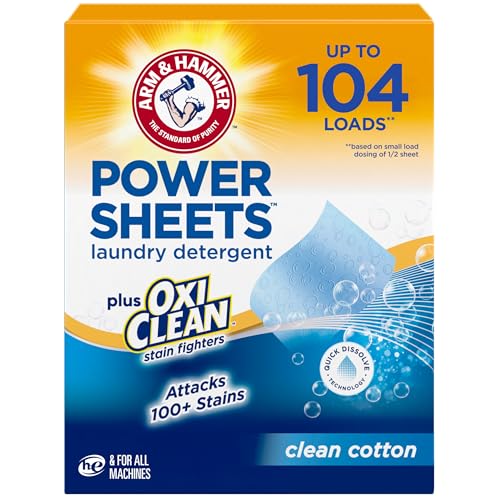
The strongest stain-fighting sheet in this group, with OxiClean built into a 52-sheet box advertised at 104 medium loads. In hard water the oxygen-based stain fighters help with the dulling that minerals cause, and the sheets use the same cleaning ingredients as the brand's liquid. No certification, but wide availability and simple dosing. It is the mainstream choice for a reason.
What stands out
- OxiClean stain fighters are built into every sheet
- 104 medium loads out of only 52 sheets
- Attacks more than 100 stains per the box
Watch out for
- Scented, with a clean cotton fragrance that lingers
- No certification and no full ingredient list online
ARM & HAMMER 5in1 Power Sheets Laundry Detergent, Free & Clear, 50 Count
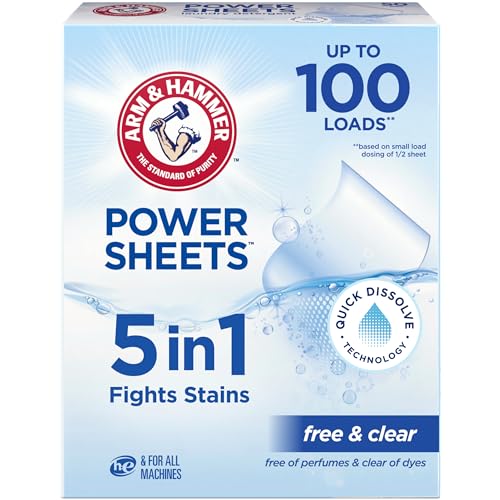
Fifty dye-free, perfume-free sheets with Quick Dissolve technology and up to 100 small loads. Dermatologist tested, HE compatible, and built on the same cleaning ingredients as the brand's liquid detergent. In hard water the absence of dye matters less than the dissolve behavior, but a fragrance-free box is easier on skin already irritated by mineral residue. It is the box to buy for a household with both problems.
What stands out
- Free of dyes and free of any added perfume
- Quick Dissolve works at every wash temperature setting
- Up to 100 small loads from just 50 sheets
Watch out for
- No hard-water claim and no third-party certification at all
- The sheets are larger than some travel formats
BLUELAND 100% Plastic-Free Laundry Detergent Tablets, 36ct, Free & Clear

A compressed tablet rather than a sheet, included because the format handles hard water differently. The formula is plant and mineral based, free of dyes and fragrance, and carries EPA Safer Choice, Leaping Bunny, B Corp, Climate Neutral and USDA Bio-Preferred credentials. Drop one in the drum for a normal load and two for a large one. It is the strongest certification set here.
What stands out
- A mineral-based formula pressed into a compact tablet
- EPA Safer Choice and Climate Neutral certified as well
- Fragrance-free and safe for septic systems at home
Watch out for
- Not a sheet, so it cannot be torn in half
- 36 tablets is a short supply for a family
The Clean People Laundry Detergent Sheets

The biggest box here at 192 sheets, with a fresh scent and a hypoallergenic pitch. It is free of dyes, optical brighteners, phosphates and parabens, and works in any machine at any cycle temperature. A large count matters in hard water because you will likely dose higher than the chart suggests. The cube is compact for its capacity. It is a heavy box for a shelf.
What stands out
- 192 sheets, enough to absorb a higher dose
- Free of dyes, optical brighteners and added phosphates
- Works in any machine at any wash temperature
Watch out for
- Scented, and some sensitive skin will dislike that
- The five-inch cube takes up valuable shelf space
Earth Breeze Laundry Detergent Sheets Fragrance Free 180 Loads
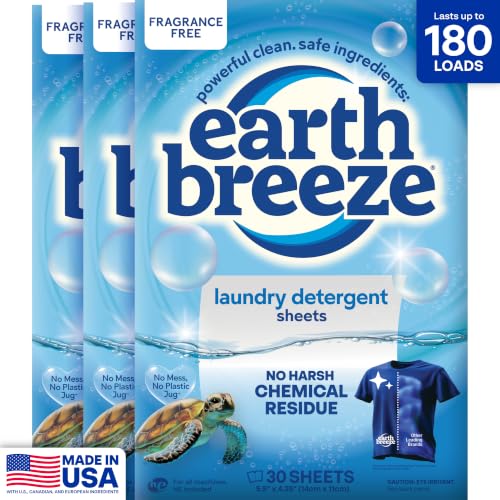
A 180-load fragrance-free box from the brand that popularized the format. The listing says it works in hot or cold cycles and any machine, with no optical brighteners, dyes, parabens or phthalates. In hard water its advantage is a thin sheet that dissolves quickly rather than a special formula, and the count leaves room to dose up. The box is plain cardboard and easy to store.
What stands out
- 180 loads leaves room for a higher dose
- Fragrance-free, with no optical brighteners in the film
- The thin sheet dissolves quickly in any cycle
Watch out for
- No hard-water claim anywhere on the product listing
- No third-party certification is named on the box
Buying guide
What hard water actually does to a wash
Hard water is water with dissolved calcium and magnesium, usually measured in grains per gallon. Below about 3.5 grains it behaves much like soft water. Above 7 grains you notice it in the soap dish, the kettle and the shower head. The minerals do two things in laundry: they consume detergent by binding to it, and they precipitate onto fabric as an insoluble film. That film is what makes towels scratchy, sheets stiff and whites look tired even after a clean cycle. It also builds up inside the machine, which is a separate bill. A test strip from a hardware store costs a few dollars and tells you which band you are in. Test once a year, since supply blends change.
The film also traps soil. A shirt washed in hard water can come out with detergent residue that attracts body oil, which attracts more dirt, which is why hard-water laundry looks dingy even when the cycle was fine. Chlorine in municipal water makes it worse by reacting with organic soil. If your whites turn yellow rather than gray, suspect the water before the detergent, and check whether the yellowing is worse at the collar and underarms. Those are the places where sebum meets residue. In soft water a wash would lift both; in hard water the two combine into something the machine cannot rinse away. A towel is the easiest test: if it crunches when folded, the rinse is not doing its job.
Sheets are not water softeners
A detergent sheet is mostly surfactant and binder, with enzymes and fragrance in smaller amounts. It has little room for the bulky builders that liquid hard-water formulas use to sequester minerals. That does not make sheets useless in hard water, but it means they cannot compensate for the water the way a dedicated liquid can. Expect to dose higher and rinse longer, or expect the film to stay on the fabric. A sheet is a delivery system, not a treatment plant, and no amount of marketing changes that. The makers know it, which is why almost none of them make a hard-water claim. If a box advertises hard-water performance, check whether it means dissolving or softening, because those are different promises that need different products.
The honest framing is that sheets handle the cleaning and the water handles the rest. If your supply is very hard, a sheet alone will underperform no matter which brand you pick. That is why the ranking below weights full dissolution and clean rinsing over stain-fighting claims. In hard water the residue is the bigger problem, and a sheet that leaves a patch has made the situation worse rather than better. Judge a box by how completely it disappears, then by how the rinse water looks. Fill a clear glass from the wash and let it stand for an hour; sediment tells you the detergent is not being carried away. Cloudy water after the rinse means the dose or the water is the issue. That test costs nothing.
Dose, rinse and the residue trap
The instinct in hard water is to add more detergent. Up to a point that helps, because extra surfactant replaces what the minerals consumed. Past that point it backfires: undissolved sheet and unrinsed soap become part of the film. The practical approach is one extra half sheet for a heavily soiled load, plus an extra rinse, then check the result. If clothes feel stiff, the dose is too high, not too low, and the machine is telling you so. Trust the fabric over the chart. The chart was written for average water, and yours is not average. Write the dose on the box in marker so the next person does not guess, and revisit it when the season changes and the supply shifts.
Rinsing is the lever most people ignore. A second rinse uses a few gallons and removes a surprising amount of residue. On a machine with a light soil setting, choose a longer cycle instead, since hard water needs more mechanical action and more dilution. Cold water is fine for rinsing, because the goal is carrying minerals away rather than dissolving them. Warm water helps with the wash itself, so split the difference: warm wash, cold extra rinse. If the machine has a rinse and spin cycle, use it. It skips the agitation and goes straight to dilution, which is exactly what hard water needs. A rinse-only cycle takes about ten minutes and costs far less than a second full wash.
Treat the water, not just the detergent
A water softener is the only real fix. Ion exchange removes calcium and magnesium before they reach the machine, and it changes laundry more than any detergent swap. If a whole-house system is out of reach, a small softener installed on the washer line costs less and treats only the cold feed. Renting limits what you can install, which is why so many apartment dwellers end up compensating with dose and rinse instead. A pitcher filter does nothing for laundry, and a shower filter does even less. Ask a plumber what your options are before you buy another detergent. The installation is usually simpler than people expect, and it pays back in detergent over a few years. Ask for a quote.
Descaling the machine matters too. Scale builds on the heating element and inside the drum, and a scaled element runs hotter for the same result, which is bad for fabric and for the electricity bill. A monthly hot maintenance cycle with a washer cleaner, plus a descaler every few months in very hard water, keeps the machine from adding to the problem. Vinegar handles light scale, but it is not a substitute for a proper descaler. Clean the filter and the detergent drawer too, because both collect the same minerals. Run the maintenance cycle with an empty drum, never with a load inside. A machine that smells musty is often a machine with scale and residue in the wrong places.
Whites, darks and mineral dulling
White cotton is where hard water shows up first, because there is no dye to hide the film. Oxygen bleach, the color-safe kind, helps more than chlorine in a wash that also contains detergent, and it is gentler on fabric over time. Use it warm rather than hot if the care label allows. Chlorine bleach is a last resort for specific stains, not a routine brightener, and it reacts badly with the minerals and organics already in hard water. A scoop of oxygen bleach in the drum before the clothes works better than pouring it over the fabric, and it keeps the dose even. Sort whites by fabric weight so heavy items get the longer cycle they need. It does make a difference.
Dark clothes have the opposite problem: mineral residue reads as a chalky haze, especially on black jeans and navy T-shirts. An extra rinse and a lower dose do more than any optical brightener, and optical brighteners are exactly what you do not want on darks, because they fluoresce under light. If darks look faded after a few months, the fix may be the water rather than the dye, and an extra rinse costs less than replacing the shirt. Turn dark loads inside out to cut surface abrasion, and wash them less often. Fading on darks is mechanical as well as chemical, and every extra cycle takes a little more dye with it. Fewer washes and cooler water help as well.
Frequently asked questions
What is the best detergent sheet for hard water?
None of the eight here is sold as a hard-water formula, so pick on dissolution and rinsing rather than marketing. ARM & HAMMER Plus OxiClean has the strongest stain chemistry, and Poesie has the most adjustable dose. If your water is very hard, a softener will do more than any sheet.
Do detergent sheets work in hard water?
They clean, but they cannot soften. Expect to use slightly more than the chart suggests and to run an extra rinse. A sheet that fails to dissolve is worse than useless in hard water because it adds to the film on the fabric rather than removing it.
How much detergent should I use in hard water?
Start with the chart and add half a sheet for a heavily soiled load, then check for stiffness after drying. If clothes feel rough or show white streaks, you are overdoing it. Hard water needs more surfactant, but unrinsed detergent makes fabric feel worse rather than better.
Will hard water ruin my washing machine?
It shortens the life of the heating element and can clog valves and the detergent drawer over years. Scale also gives bacteria a surface to cling to. A monthly hot maintenance cycle and a descaler every few months will slow the damage, and a softener stops it.
Does vinegar soften water in the wash?
Vinegar lowers pH and helps rinse away some residue, but it does not remove calcium or magnesium the way an ion exchange softener does. A cup in the rinse is a reasonable maintenance habit. It will not turn hard water soft, and it should not be used with chlorine bleach.
Verdict
ARM & HAMMER Plus OxiClean is the pick for hard water because the OxiClean stain fighters address the dulling minerals leave behind, and 52 sheets cover 104 medium loads with simple dosing. Poesie's 160-sheet box is the value choice, with perforations that make a half-sheet adjustment easy and up to 320 small loads.
The upgrade is BlueLand if you will accept a tablet instead of a sheet: a mineral-based, fragrance-free formula with EPA Safer Choice and Climate Neutral certification. Whatever you buy, test your water and put a softener on the line before you spend more on detergent. Dose by the chart, add a rinse, and give the change a month.