The first sign is usually the detergent drawer. A chalky white ring forms around the siphon, the cap develops a crust, and the inside of the machine starts to feel like a shower door in a neglected hotel. That is calcium and magnesium coming out of solution, and it is the same material that makes white shirts look tired after a year and turns bath towels into sandpaper. Hard water is not a detergent defect, and nothing on this page will soften it. What a good liquid can do is keep working while the water fights back.
Hardness is measured in grains per gallon. Below about 3.5 the water is soft, 3.5 to 7 is moderately hard, 7 to 10.5 is hard, and above that it is very hard. Much of the Midwest, the Southwest and large parts of Florida and Texas sit in the last two bands. Your water district publishes the number, and a strip test from a hardware store confirms it in a minute. It is worth knowing, because moderately hard water needs a small dose adjustment while very hard water usually needs a softener.
The ten liquids here cover several strategies: concentrated mainstream formulas, dye-free sensitive-skin options, baby detergents and two large-format value bottles. None of them carries a hardness claim, which is normal. We compared specifications, features and owner reports, then worked out what each bottle's dose means in a household where the label dose is only a starting point.
Top picks at a glance
ARM & HAMMER Sensitive Skin Free & Clear, 105 Fl Oz, 105 Loads
Check price on AmazonTide Liquid Laundry Detergent, Original Scent, 126 Loads, 158 fl oz, Boosted C
Check price on AmazonTide Simply Liquid Laundry Detergent, Refreshing Breeze Scent, 138 Loads, 173
Check price on AmazonCompare the shortlist
| Model | Type | Capacity | Key feature | Amazon |
|---|---|---|---|---|
| 1. ARM & HAMMER Sensitive Skin Free & Clear, 105 Fl Oz, 105 Loads | Liquid | — | High efficiency | Check price |
| 2. Tide Simply Liquid Laundry Detergent, Refreshing Breeze Scent, 1 | All-in-one | — | — | Check price |
| 3. Tide Free & Gentle Liquid Laundry Detergent, 80 Loads, 105 fl oz | Liquid | — | — | Check price |
| 4. all Baby Concentrated Liquid Laundry Detergent, 75oz, 100 Loads | Liquid | — | High efficiency | Check price |
| 5. Gain Liquid Laundry Detergent, Original Scent, 88 fl oz, 61 Load | Liquid | — | High efficiency | Check price |
| 6. ARM & HAMMER Liquid Laundry Detergent | Liquid | — | High efficiency | Check price |
| 7. Tide Liquid Laundry Detergent, Original Scent, 126 Loads, 158 fl | Liquid | — | Quick cycle | Check price |
| 8. Dreft Newborn Baby Liquid Laundry Detergent, Gentle on Sensitive | Liquid | — | High efficiency | Check price |
| 9. Gain Liquid Laundry Detergent, Now with Odor Defense, Original S | Liquid | — | Softening | Check price |
| 10. ARM & HAMMER Plus OxiClean with Odor Blasters Liquid Laundry Det | Liquid | — | — | Check price |
Detailed reviews
ARM & HAMMER Sensitive Skin Free & Clear, 105 Fl Oz, 105 Loads

ARM & HAMMER's dye-free, perfume-free liquid at 105 ounces for 105 loads, about one ounce per wash. It is SkinSAFE certified, which means it excludes the allergens that certification body tracks, and it carries a two-times stain-fighter claim against a leading value detergent. The dose is easy to scale up in hard water, and it works in cold cycles. A sensible default for a sensitive household that still wants cleaning power.
What stands out
- SkinSAFE certified and free of dyes, perfumes and preservatives
- One ounce per load, simple to increase for hard water
- Two-times stain fighters and works in cold water
Watch out for
- Free-and-clear formulas need a dose bump in hard water
- Not as strong on grease as a mainstream liquid
Tide Simply Liquid Laundry Detergent, Refreshing Breeze Scent, 138 Loads, 173 fl oz, All-In-One Detergent

Tide Simply in Refreshing Breeze, 173 ounces for 138 loads, about 1.25 ounces per wash. It is positioned as an all-in-one detergent that handles stains and odors without the premium positioning of the main Tide line, and the label says it works in all machines and water conditions, including cold. In hard water, the large bottle gives you room to dose up without running out in a month.
What stands out
- 138 loads in a large bottle, about 1.25 ounces each
- Rated for all machine types and water conditions
- Handles common stains and odors without extra boosters
Watch out for
- The scent is stronger than a free-and-clear formula
- Less grease power than the main Tide concentrate
Tide Free & Gentle Liquid Laundry Detergent, 80 Loads, 105 fl oz, Tide Laundry Detergent, Clean Laundry Deterg

Tide Free & Gentle at 105 ounces for 80 loads, roughly 1.3 ounces per wash. It has no added dyes or perfumes, is dermatologist tested, and carries a three-in-one claim covering stains, odors and dinginess. The dose is on the generous side, which leaves room to push higher in hard water, but also means the bottle empties faster than a concentrated value brand.
What stands out
- No added dyes or perfumes, and dermatologist tested
- Its three-in-one claim covers stains, odors and dinginess
- Safe on all washable fabrics, including dark colors
Watch out for
- 1.3 ounces per load is a fairly large dose
- The scent-free formula still needs a hard-water boost
all Baby Concentrated Liquid Laundry Detergent, 75oz, 100 Loads

all Baby is a 75-ounce bottle dosed at 100 loads, about 0.75 ounces per wash, which makes it one of the more concentrated baby formulas available. It is pediatrician tested, dye-free and hypoallergenic, carries EPA Safer Choice recognition, and is safe for septic systems. It handles everyday baby soil well and is gentle enough for daily washing of bedding and soft toys.
What stands out
- 0.75 ounces per load, concentrated for a baby formula
- Pediatrician tested, dye-free and EPA Safer Choice certified
- Septic safe and works well in cold water
Watch out for
- Light scent may still bother highly sensitive skin
- Needs a softener boost in very hard water
Gain Liquid Laundry Detergent, Original Scent, 88 fl oz, 61 Loads, Freshness + Odor Fighting, High Efficiency

Gain Original Scent at 88 ounces for 61 loads, about 1.4 ounces per wash. The label is explicit that it works in cold water and HE machines, and the fragrance capsules keep releasing scent for weeks. Cleaning is competent on everyday soil, and the formula is easy to find. In hard water the already-generous dose climbs higher, so the bottle does not last long.
What stands out
- Works in cold water and in high-efficiency machines
- Long-lasting scent from capsules that keep releasing all day
- Reliable everyday cleaning at a familiar, simple dose
Watch out for
- 1.4 ounces per load is high before any adjustment
- Strong scent is not suitable for sensitive skin
ARM & HAMMER Liquid Laundry Detergent
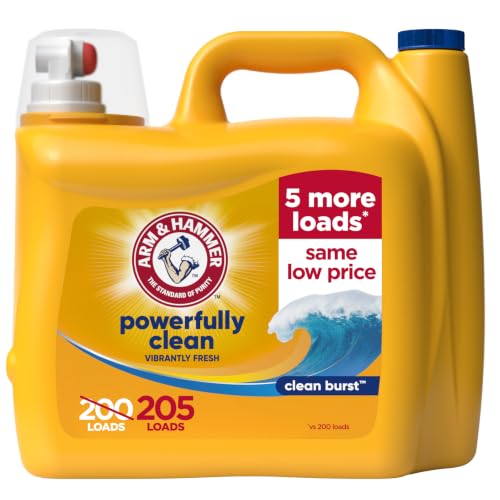
A 205-ounce jug of ARM & HAMMER Clean Burst dosed at 205 loads, one ounce per wash. It is the value anchor of this group: a big bottle, a simple dose and a two-times stain-fighter claim against a leading value detergent. The baking soda base helps with odor, and the formula is rated for all washers and temperatures. It is the easiest bottle here to stretch in hard water without feeling wasteful.
What stands out
- 205 loads at one ounce each, easy dose math
- Works in all machine types and at all temperatures
- The baking soda base helps control odor in towels
Watch out for
- The Clean Burst scent is noticeable on towels
- The large jug takes up a lot of shelf space
Tide Liquid Laundry Detergent, Original Scent, 126 Loads, 158 fl oz, Boosted Clean even in cold water, laundry

Tide Original in the 158-ounce, 126-load size, about 1.25 ounces per wash. It is the most cleaning-focused liquid here, with strong grease performance and a formula that works in cold and quick cycles. The concentration is good without being extreme, which makes it a reasonable base for a hard-water dose bump. The scent is the classic Tide smell and it does linger.
What stands out
- Strong grease and stain performance in every measured ounce
- 126 loads from 158 ounces at 1.25 ounces each
- Works in cold water and in short quick cycles
Watch out for
- The fragrance lingers on bedding and bath towels
- Not marketed for sensitive skin or fragrance allergies
Dreft Newborn Baby Liquid Laundry Detergent, Gentle on Sensitive Skin, HE Compatible, 2 Pack, 32 Loads Each

A two-pack of Dreft Newborn liquid, 32 loads per bottle. It is hypoallergenic, free of added chlorine, dyes and phosphates, and built around milk and spit-up stains. The newborn formula is gentle enough for the first months, and buying two bottles means one stays in the nursery. The dose is not especially concentrated, so a hard-water household will go through it faster than the load count suggests.
What stands out
- Two bottles, 32 loads each, convenient for a nursery
- No added chlorine, dyes or phosphates in the formula
- Targets milk and spit-up stains much more directly
Watch out for
- Modest load count for the volume in each bottle
- Gentle formula needs help in very hard water
Gain Liquid Laundry Detergent, Now with Odor Defense, Original Scent, 177 fl oz, 134 Loads

Gain Odor Defense in Original Scent, 177 ounces for 134 loads, about 1.3 ounces per wash. The Odor Defense side is aimed at musty, set-in smells, which is useful in hard water because mineral film traps odor in towels. The jug is large, the fragrance is strong, and the formula works in all machines and water conditions. It is a practical choice for a busy family that does not want to rebuy often.
What stands out
- 134 loads at about 1.3 ounces per wash
- Odor Defense targets musty towel and gym smells
- Works in every machine type and all water conditions
Watch out for
- The heavy fragrance is not for sensitive households
- Large jug is awkward to store and pour
ARM & HAMMER Plus OxiClean with Odor Blasters Liquid Laundry Detergent

ARM & HAMMER Plus OxiClean with Odor Blasters, 158.6 ounces for 122 loads, about 1.3 ounces per wash. It combines an oxygen source with a three-times odor-fighter claim, which suits towels, workout clothes and anything that has picked up a musty edge from mineral residue. The Fresh Burst scent is noticeable but not heavy, and the formula is dermatologist tested.
What stands out
- OxiClean plus Odor Blasters combined in a single bottle
- 122 loads at roughly 1.3 ounces per wash
- Dermatologist tested and works well in cold water
Watch out for
- Scent may be too much for fragrance-sensitive users
- Oxygen power is reduced in cold and quick cycles
Buying guide
Hard water is a chemistry problem, not a detergent problem
Detergent molecules have a water-loving end and an oil-loving end. The oil-loving end grabs soil, and the water-loving end keeps the assembly suspended so it can drain away. Calcium and magnesium compete for that water-loving end and pair off with the detergent before it reaches your clothes. The result is less surfactant available for cleaning, more scum in the drum, and a grey film that settles into fabric over months. In a top-loader full of water you notice it as weak suds and dull whites. In a high-efficiency machine, where the water is only a thin film, the same hardness does proportionally more damage, because there is no surplus water to dilute the minerals or carry the scum away.
The visible symptoms follow a pattern. Whites go from bright to bone grey, colors lose depth, towels stiffen even without fabric softener, and dark jeans pick up a pale haze that looks like lint. Inside the machine, scale builds on the heater, the drum spider and the door seal. That scale insulates the heating element, so cycles run longer and the appliance works harder for the same result. If you have replaced a washer at eight years old in a hard-water town while a neighbor in a soft-water town got fifteen, this is part of the reason. The damage is slow, which is why it is easy to blame the detergent instead of the water.
Testing is cheap and worth doing before you change products. A strip test gives you a number in under a minute, and the annual water quality report gives you a range plus the source. Test the cold and hot taps separately if you can, because a softener that serves only the hot line changes how you should wash. Below 3.5 grains the water is soft, 3.5 to 7 is moderate, 7 to 10.5 is hard, and above that it is very hard. If you come back at 8 grains or higher, treat a detergent change as a partial fix and budget for a softener. At 4 or 5, dose adjustment will probably be enough.
The first move is dose, not a new bottle
The label dose assumes water somewhere in the middle of the range. In hard water, the practical adjustment is 25 to 50 percent more detergent, not double. Go up one line on the cap, run a normal cycle, and read the result. If whites are still grey and the drum smells flat, add a little more. If towels come out stiff or the door glass is coated, you have overshot and are now adding residue rather than cleaning power. A kitchen measuring cup is more accurate than a cap, and it removes the temptation to eyeball a concentrated formula that only needs a couple of tablespoons per load. Write the dose you settle on inside the cabinet door, because the number drifts when two people share the laundry.
How you add it matters as much as how much. Liquid poured onto dry clothes in a hard-water area can leave concentrated spots, because the minerals locally overwhelm the surfactant before the water arrives. Dose into the dispenser drawer, or start the fill and pour into the water before loading. If the machine has a prewash compartment, use it for heavily soiled loads: the first flush does the dirty work and the main wash starts cleaner. There is a ceiling, though. Past roughly one and a half times the label dose, extra detergent stops buying cleaning and starts leaving residue, which traps minerals and holds odor. At that point a booster or a softener is the better tool, not another half cap.
What the label can and cannot tell you
Almost no liquid detergent states how it handles hardness, so you have to read between the claims. A formula that works in all water conditions is making a general promise, not a measurement. Concentration helps, because more surfactant per ounce means more cleaning before the minerals take their cut. A baking soda base raises pH and helps with odor, but baking soda does not remove calcium. Claims of two or three times the stain fighters are comparisons against a leading value detergent, not against hard water. They are still useful, just not for this problem. The claims worth trusting are specific certifications, and even those address skin or the environment rather than water chemistry. One practical check is to look for a builder or chelating agent in the ingredient list.
The ingredients that genuinely help are chelating agents and builders, which lock onto calcium and magnesium so the surfactant can do its job. Powders can carry them in useful amounts; liquids usually carry less, because the chemistry is harder to keep stable in solution. That is one reason a liquid-plus-booster routine often beats a liquid alone in hard water. Chlorine bleach works differently and is unaffected by hardness, but it is harsh on colors and should stay out of a dark load whatever the water is doing. If you use it on whites, dose it in the dispenser, keep it away from anything with elastic, and never pour it directly onto fabric. A chlorine load also needs a second rinse before the next wash, or the residue can bleach whatever follows.
Oxygen bleach is the more useful additive for a hard-water household, with one caveat: it needs warm water and time to activate. A cold quick wash with oxygen bleach does very little. If your whites are dull, a monthly warm or hot load with oxygen bleach and a normal dose of liquid will do more than switching brands. Read the booster label for the dose, and never mix oxygen and chlorine bleach, because the two release gas when combined. Keep the tub dry and sealed between uses, since a caked scoop measures badly and wastes product on every load. Warm rather than hot water is the safer choice for colored items, because heat plus oxygen can dull a dark dye.
Boosters, softeners and the limit of liquids
A dedicated laundry water softener is the cheapest way to test whether hardness is really your problem. These products are dosed by the cap into the wash and bind minerals before the detergent does. Add one to a load of white towels and compare it with a load washed without. If the towels come out softer and brighter, you have your answer, and the fix is a routine rather than a new detergent. Washing soda works on the same principle and is sold in the laundry aisle, though it raises pH and is not the right choice for wool or anything with a delicate dye. It also cuts the amount of detergent you need, which is the opposite of what most people expect.
A whole-house softener is the real fix, and it is an appliance purchase rather than a grocery one. It removes hardness at the source, protects the water heater and the washer, and cuts detergent use across the house. Renters rarely have the option, which is why the booster approach matters. For apartment dwellers, the routine is three steps: dose the detergent a little high, add a softener or washing soda to loads that look grey, and run a hot cleaning cycle monthly to keep scale from setting. That will not turn hard water soft, but it keeps whites presentable and the heater efficient, which is the part that fails first. Start with the cheapest fix and work upward before you buy anything else.
Free and clear formulas in hard water
Dye-free and fragrance-free detergents are the right choice for a lot of households, but they are not automatically strong in hard water. Many free-and-clear formulas trim the ingredient list, which can mean fewer enzymes and less surfactant per dose. That does not make them weak, but it does mean the dose adjustment matters more. ARM & HAMMER Free & Clear is dosed at one ounce per load with a two-times stain-fighter claim, and Tide Free & Gentle carries a three-in-one claim and a dermatologist testing statement. Both are reasonable starting points in water up to about 7 grains, and both need help beyond that. Buy the largest size you can store, because sensitive-skin households tend to run through free-and-clear bottles faster than they expect.
The trap is adding a scented booster to compensate. If someone in the house reacts to fragrance, a scent bead or a scented softener undoes the reason you bought a free-and-clear detergent in the first place. Use oxygen bleach for brightness, a fragrance-free softener for hand feel, and an extra rinse for residue. Hard water already leaves a film on fabric, and a second rinse is the cheapest way to reduce what stays against the skin. Baby laundry deserves its own note, because infant clothes are thin, washed often and worn against skin that reacts easily. all Baby is dosed at 75 ounces for 100 loads, and Dreft's newborn liquid is free of added chlorine, dyes and phosphates. Add a softener to the baby load before you add more detergent.
Load counts and the real cost of dosing heavy
Hard water changes the value calculation, because you are not using the label dose. A bottle dosed at one ounce per load and claiming 205 loads gives you roughly 137 washes once you dose at 1.5 ounces. That is still a lot, but it reframes the comparison between a big value jug and a concentrated bottle. Work out the ounces per load first, then divide by your adjusted dose. The number that matters is how many washes you actually get, not how many the label promises. A bottle that looks cheaper on the shelf can cost more per load once the water gets a vote. That is why the largest jug is not automatically the best value in hard water.
For reference, the bottles here run from 0.75 ounces per load for all Baby to about 1.45 for Gain Original. ARM & HAMMER Clean Burst and Free & Clear sit at roughly 1.0, Tide Original and Tide Simply at about 1.25, and the Tide Free & Gentle and OxiClean bottles just above 1.3. A household dosing 1.5 times higher in hard water should expect 30 to 40 percent fewer washes than the label suggests. That is worth knowing before you buy the largest jug on the shelf, and it is worth rechecking after you install a softener, because your dose should come back down. Write your adjusted dose on the cap with a marker so the next person does not guess.
Buy the size you will finish within a season. Detergent that sits in a hot garage for a year separates and loses enzyme activity, and a five-gallon jug is a lot of surface area to keep stable. If storage is tight, a concentrated bottle that gives 80 to 110 loads at the label dose is easier to manage than a 205-load jug that has to be decanted. Either way, keep the cap clean and the bottle upright, because dried detergent around the threads makes every pour messier than the last. A funnel and a labeled smaller bottle turn a bulk jug into something you will actually use. Heat is the enemy here, so a cool closet beats a shelf above the dryer.
Frequently asked questions
Does hard water make detergent less effective?
Yes. Calcium and magnesium bind the surfactant before it reaches soil, so the same dose cleans less and leaves more mineral film. The effect is modest at 4 grains and severe above 10. You cannot fix it with detergent alone, but a higher dose plus a softener or booster recovers most of the lost performance.
How much extra detergent should I use in hard water?
Start with 25 percent more than the label dose, then adjust. At 7 to 10 grains, most households land between 25 and 50 percent more. Stop increasing once towels come out stiff or the door glass is coated, because past that point you are adding residue rather than cleaning power.
Does vinegar soften water in the wash?
Not in any meaningful way. A cup of white vinegar in the rinse can help strip detergent residue and reduce stiffness, but it does not remove calcium from the wash water. It is also acidic enough to damage elastic and some dyes if used regularly. A dedicated laundry softener or washing soda is the better tool.
What is the best detergent for hard water and sensitive skin?
A dye-free, fragrance-free liquid dosed a little higher than the label suggests, with a softener added rather than more detergent. ARM & HAMMER Free & Clear and Tide Free & Gentle are the two most straightforward options here. Add an extra rinse, and treat baby loads separately so residue stays low.
Will hard water damage my washing machine?
Over time, yes. Scale builds on the heating element, the drum and the seal, which makes cycles longer and can shorten the machine's life. A monthly hot cleaning cycle slows it, and a whole-house softener prevents it. If the machine already runs long cycles and the heater feels slow, descale before replacing it.
Verdict
Tide Original is the pick for hard water because it gives you the most cleaning per ounce in this group: 126 loads from 158 ounces, a concentrated formula, and enough grease-fighting power to compensate for minerals stealing surfactant. Dose it a line high and add a softener to the worst loads. ARM & HAMMER Clean Burst is the value choice, with 205 loads from 205 ounces and a straightforward one-ounce dose that is easy to adjust upward.
For sensitive skin, Tide Free & Gentle and ARM & HAMMER Free & Clear are the two to shortlist, and both need the same dose bump rather than a switch to a harsher formula. If your water tests above 10 grains, spend the money on a softener before you spend it on a premium detergent. No liquid on this page will do the job a softener does.