There are two kinds of small laundry space and they are not interchangeable. One is a 27-inch alcove built for a full-size washer, where the dryer goes on top and the pair has to clear a shelf or a bulkhead. The other is a 24-inch slot, the width European appliances are built to, where a compact cabinet slides in beside or above a matching washer. A machine from one group will not fit the other, and no amount of measuring afterward fixes that.
This guide sorts six stackable dryers by which slot they fit, then by the numbers that decide the rest: depth at the cabinet, height with the door closed, door swing, and how far the machine has to stand off the wall for a duct, a cord or a drain. Those numbers matter more than the drum size on the box, because a dryer that does not fit never dries anything.
The 27-inch group is vented and holds 8 cubic feet. The 24-inch group is ventless heat pump and holds 4.0 to 4.4. Neither is better in the abstract. One takes a family's towels in a single load and needs a duct; the other fits a closet and needs a drain or a tank. This article is about the fit, not the format, so the ranking changes with the room.
We compared specifications, features and owner reports. Contradictory dimensions are the most common fault in these listings, so they are flagged here rather than smoothed over.
Top picks at a glance
LG DLHC1455W 24 in. W 4.2 Cu. Ft. Ventless Stackable Compact Smart Electric Dr
Check price on AmazonElectric Dryer 8 cu.ft, 27" Front Load Clothes Dryer Machine with 10 Cycles, S
Check price on Amazon800 Series 24 in. 4 cu. ft. Stackable Ventless Compact Front Load Smart Electr
Check price on AmazonCompare the shortlist
| Model | Type | Capacity | Key feature | Amazon |
|---|---|---|---|---|
| 1. LG DLHC1455W 24 in. W 4.2 Cu. Ft. Ventless Stackable Compact Sma | Ventless | 4.2 cu ft | Sensor drying | Check price |
| 2. Midea Heat Pump Ventless Front Load Dryer Stackable 4.4 Cu.ft Wh | Heat pump | 4.4 cu ft | Sensor drying | Check price |
| 3. Electric Dryer 8 cu.ft, 27" Front Load Clothes Dryer Machine wit | Front-load | 8 cu ft | Steam | Check price |
| 4. 800 Series 24 in. 4 cu. ft. Stackable Ventless Compact Front Loa | Ventless | 4 cu ft | Connected controls | Check price |
| 5. Smad 8.0 Cu.ft Electric Dryer, 27" Full Size Clothes Dryer Machi | Front-load | 8.0 cu ft | Steam | Check price |
| 6. Techomey 4.4 Cu.Ft Ventless Heat Pump Clothes Dryer, 24" Compact | Heat pump | 4.4 cu ft | Sensor drying | Check price |
Detailed reviews
LG DLHC1455W 24 in. W 4.2 Cu. Ft. Ventless Stackable Compact Smart Electric Dryer in White with Dual Inverter

Measured against a 24-inch slot, LG's machine carries the most features per inch: 4.2 cubic feet, fourteen programs, sensor drying and app control. The drum is small, but the feature set is not. It also has the least reliable published dimensions, because the size block repeats a 10-inch figure for every side. Get the numbers from LG before you build a cabinet around it.
What stands out
- Fourteen programs is a lot for a compact cabinet
- Sensor Dry and ThinQ remote control both included
- Dual inverter heat pump with no duct needed
Watch out for
- Cabinet dimensions are not published in usable form
- Drum is smaller than a full-size vented machine
Midea Heat Pump Ventless Front Load Dryer Stackable 4.4 Cu.ft White

Of the compact machines, this is the one whose paperwork matches its cabinet: 23.4 inches wide, 25.7 deep and 33.5 tall. It holds 4.4 cubic feet, uses a humidity sensor, and is ENERGY STAR certified. Wrinkle care runs about 90 minutes after the load dries. The 240-volt cord is extra, so add it to the order.
What stands out
- Published dimensions match a true 24-inch slot exactly
- ENERGY STAR certified, with humidity-sensing control built in
- No duct, so it fits an interior closet
Watch out for
- Cord is sold separately, and it needs 240 volts
- Ninety-minute wrinkle cycle adds a lot of time
Electric Dryer 8 cu.ft, 27" Front Load Clothes Dryer Machine with 10 Cycles, Steam, Wrinkle Care,Stackable, Wh

A 27-inch cabinet with an 8-cubic-foot drum, which makes it a fit for the alcove and not the slot. Steam, wrinkle care, a reversible door and an ECO cycle that senses humidity all come on this model, along with three exhaust routes. If the room has the width and a duct, this is twice the dryer that any compact machine here can offer.
What stands out
- Twice the drum volume of the compact machines
- Three exhaust directions help in the most awkward alcoves
- Steam plus humidity-sensed ECO drying on one machine
Watch out for
- Twenty-seven inches wide will not fit a 24-inch slot
- Needs a duct route to the outside wall
800 Series 24 in. 4 cu. ft. Stackable Ventless Compact Front Load Smart Electric Dryer in Pearl Steel, Energy

Listed as a 24-inch ventless dryer with 4 cubic feet and ENERGY STAR certification, the Bosch reads well until the measurements: 23 inches high, 35 deep, 27 wide. That is not a 24-inch cabinet. Until the spec sheet is corrected, this is a machine to see in a showroom with a tape measure. Ask the seller for a current sheet before you order.
What stands out
- Ventless by design and ENERGY STAR certified too
- Pearl steel finish suits a highly visible location
- Stackable, and it fits inside a truly compact footprint
Watch out for
- Dimensions conflict with the product description on the page
- Almost no cycle or feature information is listed
Smad 8.0 Cu.ft Electric Dryer, 27" Full Size Clothes Dryer Machine, 120V 240V Stackable Large Capacity Front L
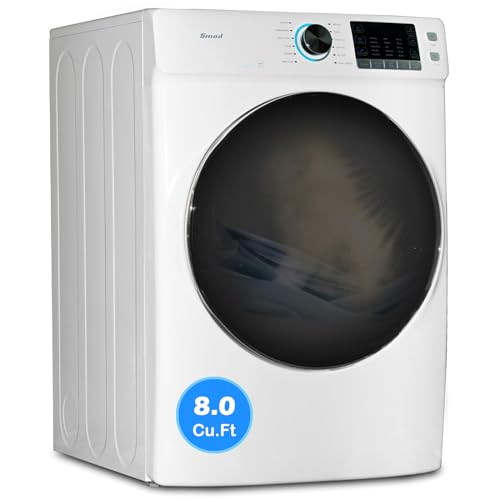
The full-size alternative: 27 inches wide, 8 cubic feet, moisture sensing and steam. Its three exhaust directions are the practical feature in a small room, since the rear wall is often blocked by hoses and the only route out is sideways or down. It needs a three-wire or four-wire 240-volt outlet, and the supplied cord fits the four-wire type. Nothing about the cabinet is subtle, which is the point.
What stands out
- Rear, left and bottom exhaust choices are all offered
- Moisture sensor and steam cycle at full size
- Fits a standard 27-inch laundry alcove with room
Watch out for
- Stated dimensions contradict each other on the page
- Cord does not suit a three-hole socket at all
Techomey 4.4 Cu.Ft Ventless Heat Pump Clothes Dryer, 24" Compact 120/240V Electric Front Load Drying Machine,

A 24-inch heat pump with 4.4 cubic feet and sixteen cycles, and the closest rival to the Midea on paper. Drum air stays below 50 degrees Celsius according to the brand, which suits wool and anything prone to shrinking. It ships with a four-prong cable, and the tank needs emptying after every load, a chore worth weighing before you stack it high.
What stands out
- Sixteen cycles is generous for a compact cabinet
- Low drum temperature protects delicate and wool fabrics
- Sensor dry stops at exactly the chosen level
Watch out for
- Tank emptying after every load is a chore
- Four-prong cable needs an adapter on old outlets
Buying guide
The 24-Inch Slot: What Actually Fits
Four machines here are built for the 24-inch slot. Midea, Techomey and LG put their cabinets at roughly 23.4 inches wide and 33.5 inches tall, which is the compact standard, and all three are designed to sit under a counter or on top of a matching washer. Bosch calls its unit a 24-inch dryer and rates it at 4 cubic feet, but the dimension block on the listing reads 23 inches high, 35 deep and 27 wide, which describes something else entirely. Until that is resolved, treat the Bosch as a machine you must measure in person before you buy it. The three published cabinets sit within a fraction of an inch of each other on width, which is why depth and weight end up separating them.
Capacity inside that slot runs 4.0 to 4.4 cubic feet, roughly half a full-size drum, and that changes what a load means. A set of queen sheets and a few towels will fill it. A comforter will not, and neither will a full set of bath sheets. Owners who move from a 27-inch dryer to a 24-inch heat pump usually report two things at once: the laundry room feels twice as large, and they run one more load a week. Both are true, and neither is a reason to avoid the format if the room only has 24 inches to give. Sort your laundry by load size for a week and you will know whether four cubic feet is enough before you commit.
The 27-Inch Alcove: Stacked and Tall
The two Smad dryers are 27 inches wide and hold 8 cubic feet, the standard full-size format sold alongside 27-inch front-load washers. Stacked, the pair is tall enough that the dryer controls sit near eye level for most adults and the top of the machine clears a typical interior door frame. Check the ceiling height and any light fixture before you commit to that layout. A pair that fits the floor plan but not the vertical space is a common and expensive mistake, and the fix usually means moving a shelf or returning a dryer. Smad's own feature text lists 39.8 inches of height for the dryer alone, so the stacked pair lands near six and a half feet.
The reward for the height is capacity and speed. Eight cubic feet swallows a duvet cover and a set of towels in one go, and a vented drum dries faster than a heat pump because it pushes heated air through the load instead of recycling it. The cost is a duct. If the alcove has no route to the outside, this entire group is out, no matter how neatly the cabinet fits the opening or how sensible the machine looks on paper. A duct that exits into a garage or an attic void simply moves the lint and moisture somewhere you will have to deal with later. Speed is the everyday benefit, and it is the part people notice after the first week.
Depth Is the Dimension That Fails
Depth is where small installations go wrong, because the cabinet number is measured at the body and not at the plug. A 25.7-inch cabinet needs room behind it for the cord, and a vented machine needs room for a duct that has to bend without kinking. Add two inches for the hose and another inch for the plug, then compare the total with the interior depth of the closet. If the closet has a door frame, measure at the frame rather than at the drywall, because the frame is what the cabinet actually has to pass through. Baseboards, quarter round and a door saddle all eat small fractions of an inch that the spec sheet never mentions at all.
Counter depth catches people out as well. A standard counter is 24 to 25 inches deep, and a compact dryer is deeper than that once the cord or vent is attached, so the machine can stand proud of the counter unless the cabinet is set forward. That is not a failure, but it is a look some people cannot live with. Sketch the section from the side: wall, gap, machine, door. If the door cannot close, the depth is wrong even when every individual measurement on the spec sheet looked fine. The same logic applies to height, since a cabinet listed at 33.5 inches can need more once the feet are raised and the top panel clears a counter rail.
Doors, Aisles and the Basket Problem
A dryer door that opens 180 degrees needs a clear wall in front of it. Most compact machines open to about 90 degrees or a little past it, enough to load a drum but not enough to stand beside it with a basket. In a hallway installation the open door can block the only walking route in the apartment, which is a daily irritation rather than a one-time problem. A reversible door solves half of it, and Smad lists one on its 10-cycle model, but no hinge arrangement fixes a corridor that is 30 inches wide. If the room is a pass-through, consider changing the door direction before changing the dryer, because the door is the cheaper of the two.
Bifold and sliding closet doors are their own complication. Bifolds need clearance to fold, and a stacked pair usually sits deep enough that the panels bind against the dryer door as it opens. Sliding doors need a track that stays clear of the machine's feet, or the bottom rail gets bent the first time someone shoves the stack back into place, and the rail is the part that fails first. The cheapest fix is often to take the closet door off and fit a curtain or a louvered panel, which also gives a vented machine the air it needs. Measure the folded panel depth rather than the opening, and check that the track screws do not land where the machine's feet need to sit.
Vent or No Vent in a Tight Room
A tight room makes the vent decision for you more often than the budget does. If there is no exterior wall within a reasonable duct run, a vented dryer is not an option, and the compact heat pumps here are the only path forward. If there is an exterior wall, a vented 27-inch machine gives you twice the drum for the same floor space, at the cost of a hole, a duct and a yearly cleaning. The room decides this, not the feature list, and it is the first thing to settle. A duct that runs long with several elbows will underperform a short, straight one, so the presence of an exterior wall is not the same as a workable route.
The middle case is a room with a vent left by an older machine. That is the best case, because the hard work is already done and the opening exists. Check the duct size and condition before you assume it is usable, since a crushed flex line behind the old dryer will strangle a new one. A heat pump avoids the whole question, dries more slowly and releases its warmth into the room, which is welcome in a cold basement and unpleasant in a sealed closet with no airflow at all. Whichever route you take, leave the closet door open during a cycle or fit a vent into the door itself, because a closed door turns a small room into a damp box.
Frequently asked questions
What is the smallest stackable dryer?
The compact heat pumps here are the smallest, with cabinets around 23.4 inches wide and 33.5 inches tall. Depth is the number that varies, so compare it against your opening rather than trusting the width alone. One listing in this group publishes dimensions that do not match its own description, so verify before ordering.
Will a 24-inch dryer fit in a 27-inch closet?
Usually yes, and you get a few inches of clearance for the door and for air. The question is depth and height, not width. Check the closet door frame, any shelf above the machine and the route behind it for the cord or drain. A 27-inch opening is generous for a compact dryer but not for a full-size one.
How much space do I need behind a stackable dryer?
Enough for the cord and, on a vented model, for the duct to bend without crushing. Two inches is a reasonable planning figure for a cord and three for a duct, but the manual states the real minimum. Leave the gap even when the machine looks flush, because airflow behind a dryer is part of how it works.
Can a stackable dryer go under a counter?
Yes, if the counter is tall enough and deep enough, and if the door opens without hitting a cabinet run. Compact heat pumps suit this best because they need no duct. Measure the counter opening at the front edge and at the back, and remember that the machine still needs clearance behind it for the cord.
Is a ventless dryer slower?
Yes. A heat pump dries at a lower temperature and recycles the air instead of exhausting it, so a heavy load takes longer than it would in a vented drum. Sensor drying stops the cycle at the right moment, which helps, but it cannot make the physics faster. Plan for longer cycles and start loads earlier.
Verdict
If the opening is 24 inches, the Midea heat pump is the pick. It is the only machine here that combines a published compact footprint with 4.4 cubic feet, ENERGY STAR certification and humidity-sensing cycles, and it needs no duct at all. Techomey is the value choice: the same footprint and drum, sixteen cycles and a lower drying temperature, with a tank you must empty after every load.
The LG DLHC1455W is the upgrade if you want fourteen programs, sensor drying and app control, though its missing cabinet dimensions mean a phone call before you order. If the alcove is 27 inches and has a duct, skip all three and take the Smad 8-cubic-foot model instead. Twice the drum beats every feature on this list.