A moisture sensor is two metal strips inside the drum, and it works by measuring how easily current passes between them. Wet fabric conducts; dry fabric does not. The control board watches that change and ends the cycle when the load reaches the dryness level you chose. That is the whole mechanism, and everything else, from the cycle count to the phone app, sits on top of that one measurement.
It matters because the alternative is a timer. A timed dry runs for the minutes you dial in, whether the load is a single sheet or a full drum of denim. Anyone who has pulled damp jeans out of a dryer that had just finished a sixty-minute cycle has met the limits of timed drying. A sensor is not perfect either, but it responds to the load rather than to the clock on the wall.
Every machine here senses moisture in some form, and they are not equals. Smad pairs a moisture sensor with steam on its 8-cubic-foot model and adds humidity-sensed ECO drying on the other. Midea and LG use humidity readings to set cycle length. Techomey pauses when the load reaches the selected level. Bosch publishes almost nothing about how its cycles decide anything.
We compared specifications, features and owner reports. Sensor systems are hard to judge from a spec sheet, so the useful signals are what owners say about damp loads and how easy each machine makes the sensor strip to reach.
Top picks at a glance
Smad 8.0 Cu.ft Electric Dryer, 27" Full Size Clothes Dryer Machine, 120V 240V
Check price on AmazonElectric Dryer 8 cu.ft, 27" Front Load Clothes Dryer Machine with 10 Cycles, S
Check price on AmazonMidea Heat Pump Ventless Front Load Dryer Stackable 4.4 Cu.ft White
Check price on AmazonCompare the shortlist
| Model | Type | Capacity | Key feature | Amazon |
|---|---|---|---|---|
| 1. Smad 8.0 Cu.ft Electric Dryer, 27" Full Size Clothes Dryer Machi | Front-load | 8.0 cu ft | Steam | Check price |
| 2. Electric Dryer 8 cu.ft, 27" Front Load Clothes Dryer Machine wit | Front-load | 8 cu ft | Steam | Check price |
| 3. Midea Heat Pump Ventless Front Load Dryer Stackable 4.4 Cu.ft Wh | Heat pump | 4.4 cu ft | Sensor drying | Check price |
| 4. LG DLHC1455W 24 in. W 4.2 Cu. Ft. Ventless Stackable Compact Sma | Ventless | 4.2 cu ft | Sensor drying | Check price |
| 5. Techomey 4.4 Cu.Ft Ventless Heat Pump Clothes Dryer, 24" Compact | Heat pump | 4.4 cu ft | Sensor drying | Check price |
| 6. 800 Series 24 in. 4 cu. ft. Stackable Ventless Compact Front Loa | Ventless | 4 cu ft | Connected controls | Check price |
Detailed reviews
Smad 8.0 Cu.ft Electric Dryer, 27" Full Size Clothes Dryer Machine, 120V 240V Stackable Large Capacity Front L
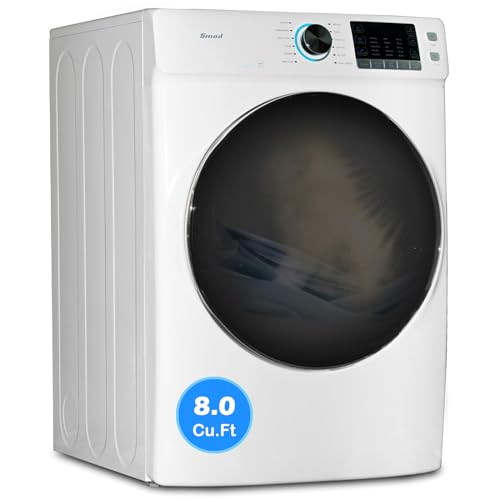
The sensor here reads the load and ends the cycle, which is the behavior that matters on a full-size drum. Steam follows the dry cycle to relax wrinkles, and the machine offers rear, left or bottom exhaust. It needs a three-wire or four-wire 240-volt outlet. The listing states its dimensions twice in two different orders, so trust the manual rather than the page.
What stands out
- Moisture sensor fitted to a full-size eight-cubic-foot drum
- Steam cycle handles wrinkles after the drying ends
- Three exhaust directions simplify the most difficult installation
Watch out for
- Conflicting dimensions appear across the same product listing
- Cord suits the four-wire outlet only, not the older type
Electric Dryer 8 cu.ft, 27" Front Load Clothes Dryer Machine with 10 Cycles, Steam, Wrinkle Care,Stackable, Wh

Smad's second 8-cubic-foot dryer adds an ECO mode that senses humidity and stops at the right point, plus steam and wrinkle care. The reversible door and child lock are useful around small children. A four-hole cord is included and a three-hole socket needs another. The cycle count is listed as ten in the title and twelve in the features, which is worth settling before you buy.
What stands out
- ECO dry senses humidity and stops at the right point
- Steam and wrinkle care on a large drum
- Reversible door and a child lock both included
Watch out for
- Cycle count is inconsistent within the same listing
- Needs a separate cord for older three-hole homes
Midea Heat Pump Ventless Front Load Dryer Stackable 4.4 Cu.ft White

This is a humidity-sensing heat pump rather than a timer with a low temperature setting, and that distinction is the reason to pick it. It is the simplest sensing story in this group. The board watches moisture and adjusts cycle length, then runs a 90-minute unheated tumble to loosen wrinkles. ENERGY STAR certification backs the efficiency claim, though the cord is extra and the unit needs 240 volts.
What stands out
- Humidity sensor adjusts the cycle to the load
- ENERGY STAR certified, which lowers the running cost
- Ventless, so it works in an interior closet
Watch out for
- Power cord is not included at 240 volts
- Smaller drum fills quickly with bedding and towels
LG DLHC1455W 24 in. W 4.2 Cu. Ft. Ventless Stackable Compact Smart Electric Dryer in White with Dual Inverter

Sensor Dry is the centerpiece rather than a footnote: the cycle follows the moisture left in the fabric, and the app tells you when it ends. Fourteen programs cover the usual fabric types, and the dual inverter compressor keeps the drum cool. What the listing does not tell you is the cabinet size, which is a problem if the machine has to fit an opening.
What stands out
- Sensor Dry is central to the cycle design
- Fourteen programs cover a wide range of fabric types
- Wi-Fi alerts and remote start through the ThinQ app
Watch out for
- Cabinet dimensions are missing from the product listing
- Small drum compared with a full-size vented model
Techomey 4.4 Cu.Ft Ventless Heat Pump Clothes Dryer, 24" Compact 120/240V Electric Front Load Drying Machine,

Sixteen cycles, sensor-based stopping and a drum the brand says stays below 50 degrees Celsius. That combination suits wool, silk and anything that shrinks in a hot drum. The trade is maintenance: the condensate tank must be emptied after every load or the program pauses, and the four-prong cable needs an adapter on older outlets with three slots. The low temperature is the reason it appears here.
What stands out
- Sixteen cycles, with sensor-based stopping on each one
- Drum temperature is held below 50 degrees Celsius
- Compact cabinet suits a standard 24-inch closet opening
Watch out for
- Water tank needs emptying after every single load
- Four-prong cable requires an adapter on old outlets
800 Series 24 in. 4 cu. ft. Stackable Ventless Compact Front Load Smart Electric Dryer in Pearl Steel, Energy

For a guide about sensing, the Bosch is the awkward entry, because the listing says nothing about how its cycles decide when to stop. It is a 24-inch ventless dryer with 4 cubic feet and ENERGY STAR certification, and the pearl steel finish is genuinely nice. The dimensions contradict the product name, so verify both before you rely on either.
What stands out
- ENERGY STAR certified and completely ventless by design
- Compact 24-inch format with a premium steel finish
- Stackable in a closet or under a counter
Watch out for
- No sensor or cycle detail in the listing
- Dimensions do not match a 24-inch cabinet at all
Buying guide
How a Dryness Sensor Reads a Load
The strips sit inside the drum, usually near the lint filter or on the back wall, and they only get a reading when damp fabric touches both at once. That is why the first few minutes of a sensor cycle are spent tumbling rather than deciding. Once the load is warm and the moisture starts to drop, the board can watch the resistance climb and estimate how much water is left. The estimate improves as the cycle runs, which is why a sensor dry often overshoots at the start and corrects later. Most boards average the reading over several minutes rather than reacting to a single contact, and in practice that software layer matters as much as the strips themselves.
The practical result is a cycle that ends when the load is dry instead of when the dial says so. On a mixed load of towels and shirts, the towels hold water long after the shirts are ready, so the sensor keeps running until the heaviest item stops conducting. That is the right call for a family that wants everything dry, and the wrong call for someone who wanted to pull the shirts out early. Sorting by fabric weight solves more drying problems than any setting. It also shortens cycles, because the drum is not waiting on one heavy item to catch up with the rest. Keep towels in one basket and shirts in another, and the sensor's job gets easier every week.
The Strip Needs Cleaning
A sensor that reads wet clothes when the load is dry has usually been coated. Dryer sheets leave a waxy film, fabric softener leaves another, and hard water leaves mineral scale behind when the moisture evaporates. The film insulates the strips, so the board never sees the resistance rise and keeps the drum turning. Wipe the bars with a cloth dampened in white vinegar every few months, and skip the dryer sheets if you can live without them. It is a two-minute job that fixes a complaint people often blame on the machine. A cloth is enough; a scouring pad will scratch the bars and make the problem worse. Check the strips when a familiar load starts taking noticeably longer than it used to.
Reach matters as much as cleaning. On a stacked pair, the sensor sits deep in the drum at chest height, and reaching it means leaning into a hot cabinet. That is one more reason to check the drum layout before you buy rather than after. A machine with a filter and sensor at the front lip is easier to keep clean than one that puts both at the back, and a clean sensor is the difference between sensor dry working and sensor dry being a feature you stop using. On a compact machine the drum opening is small, so a tall owner kneels rather than leans, which is a design difference worth noticing on a showroom floor while the drum is still empty.
Dry Levels and What They Change
Most sensor dryers offer a range from damp dry to extra dry, and the setting changes when the cycle stops rather than how hot it gets. Damp dry is for clothes you plan to iron or hang, extra dry is for towels and heavy cotton, and the middle setting covers most everyday loads. The label wording differs by brand, so read the manual once and write the setting you like on a note inside the door. Families tend to settle on one level within a month and never touch it again. If the manual lists a dryness offset or a calibration setting, leave it alone until you have run a dozen loads at the default, since the factory setting is tuned for average conditions rather than your towels.
The setting also decides how much energy the cycle uses, because a dryer that stops ten minutes early saves that ten minutes on every load. Extra dry is the most expensive habit in a laundry room, and it is usually chosen to compensate for an overloaded drum rather than because the load needed it. Try one level lower than you think you need, run a full load, and check the heaviest item in the middle rather than the thin ones at the edge. Adjust from there. The other lever is the washer: water left in the fabric is what the dryer has to remove, so a faster final spin does more for drying time than any setting on the dryer itself.
Where Sensors Get Fooled
Bulky items are the classic failure. A comforter rolls into a bundle, the outside dries, and the sensor reads dry while the center stays damp. The same happens with a heavy bath mat wrapped around lighter items. Shake bedding out before it goes in, and dry it alone rather than with a mixed load. If the machine has a bedding or bulky cycle, that cycle usually runs longer and tumbles more gently, which helps the sensor see the whole load rather than the outer layer. A duvet cover is worse than a comforter in this respect, because the fabric wraps around itself and traps damp air in pockets the strips never touch, so shake it out and zip it fully shut before it goes in.
Very small loads fool sensors in the other direction. Two shirts may never touch the bars often enough for a reliable reading, so the machine runs long or stops early depending on the model. Timed dry is the better choice for a handful of items. Cold rooms slow the process as well, especially for heat pumps, because the condenser has less heat to work with. A sensor is a good estimator, not a lab instrument, and it does best with an ordinary full load. A single bath mat has the same problem in reverse: it wraps the drum and presents one wet face, so split the load or use timed dry and check the middle of the load rather than the edge.
Sensor Dry, Steam and ECO in One Machine
Steam and sensing work together more often than the marketing suggests. A steam refresh runs after the load is already dry, adding moisture back and tumbling it out to relax fibers, so the sensor's job is finished before steam begins. That is why a steam cycle on a dry load can feel counterintuitive and still work. On the Smad models the steam function is a wrinkle treatment, not a cleaning cycle, and it does nothing for stains that have already set. Steam also adds water to the drum, so the sensor reading stops being useful at that point and the machine switches to a fixed program with its own timing, set by the manufacturer rather than by the size of the load.
ECO modes change the temperature rather than the stopping point. On a heat pump, ECO holds the drum cooler for longer, and the sensor still decides when to stop. The trade is time for energy, which is a reasonable one for a load you are not waiting on. If a machine offers both ECO and a quick cycle, they usually pull in opposite directions, and the quick cycle is the one that gives up on sensor accuracy by running a fixed program. That is fine for two shirts and poor for a full drum. The cycle chart in the manual usually shows which programs sense and which simply count down, so neither behavior is a defect once you know which is which.
Frequently asked questions
Does sensor dry actually save energy?
It can, because the cycle ends when the load is dry rather than at a fixed time, and most loads finish before the timer would have. The saving depends on how well the load is sorted and how clean the sensor is. A coated sensor, or an overloaded drum, gives much of the benefit back.
Why does my sensor dryer stop while clothes are still damp?
Usually because the sensor read the outside of a bundle rather than the middle. A comforter, a heavy mat or an overloaded drum can all produce that result. Shake items out, dry bulky things separately, and clean the sensor bars with vinegar before assuming the machine is faulty.
Can I just use timed dry instead?
Yes, and for very small loads it is often the better choice. Timed dry is predictable and does not depend on contact between fabric and the sensor strips. The trade is that you have to know your load, and a timer cannot tell when a heavy towel is done.
Do dryer sheets affect the sensor?
They can. The coating that makes sheets feel soft leaves a film on the sensor bars, and that film insulates them from the damp fabric. The machine then reads the load as drier than it is, or keeps running because it cannot get a reading. Wipe the bars and use sheets sparingly.
Is sensor dry worth having on a compact heat pump?
It matters more there than on a vented dryer, because heat pump cycles are long and a fixed timer wastes more time. A humidity sensor trims the tail of the cycle and stops the drum when the load is ready. Every compact machine here offers some form of it.
Verdict
The LG DLHC1455W is the pick for anyone who cares about sensing, because Sensor Dry is the centerpiece rather than a bullet point. It has fourteen programs, a dual inverter heat pump and ThinQ alerts for the moment the load finishes. The missing cabinet dimensions remain the one real annoyance, so confirm them before you plan around the machine.
The Smad 8.0-cubic-foot model is the value choice: a moisture sensor, steam and a full-size drum that gives the sensor a proper load to read. Step up to the Midea if running cost matters more than capacity. Its humidity-sensing heat pump carries ENERGY STAR certification and dries at a lower temperature, which is gentler on everything that goes through it.