The basement is the one room where a vented dryer's duct run usually exceeds what the manual allows. The machine sits against an interior wall, the duct climbs through a joist bay, turns twice, and exits through a rim joist that may be below grade. Every foot and every elbow cuts airflow, lint collects at the low point, and the dryer starts taking two cycles to do one load's work.
Ventless drying sidesteps all of it. A heat pump condenses moisture out of the air inside the drum, sends the water to a tank or a drain, and returns the dried air to the clothes. No duct, no exterior penetration, no backdraft flap whistling on a windy night. In a finished basement where the laundry sits behind a door, that is usually the difference between a workable laundry and a remodeling project.
The catch is that basements are cool and sometimes damp, and heat pumps do their best work in a warm room. They also need a drain or a tank, a dedicated circuit, and enough clearance to pull a lint filter. We compared specifications, features and owner reports on seven machines and ranked them for basement conditions rather than showroom conditions.
Top picks at a glance
Midea Heat Pump Ventless Front Load Dryer Stackable 4.4 Cu.ft White
Check price on Amazon800 Series 24 in. 4 cu. ft. Stackable Ventless Compact Front Load Smart Electr
Check price on AmazonLG DLHC1455W 24 in. W 4.2 Cu. Ft. Ventless Stackable Compact Smart Electric Dr
Check price on AmazonCompare the shortlist
| Model | Type | Capacity | Key feature | Amazon |
|---|---|---|---|---|
| 1. Midea Heat Pump Ventless Front Load Dryer Stackable 4.4 Cu.ft Wh | Heat pump | 4.4 cu ft | Sensor drying | Check price |
| 2. LG DLHC1455W 24 in. W 4.2 Cu. Ft. Ventless Stackable Compact Sma | Ventless | 4.2 cu ft | Sensor drying | Check price |
| 3. Samsung 4.0 cu. ft. Compact Ventless Heat Pump Dryer with AI Sma | Heat pump | 4.0 cu ft | Sensor drying | Check price |
| 4. Techomey 4.4 Cu.Ft Ventless Heat Pump Clothes Dryer, 24" Compact | Heat pump | 4.4 cu ft | Sensor drying | Check price |
| 5. Electrolux 24 in. 4.0 cu. ft. Compact Stackable Electric Ventles | Ventless | 4.0 cu ft | Stackable | Check price |
| 6. Smad 23.4" Ventless Heat Pump Dryer, 4.4 Cu.Ft Front Load Clothe | Heat pump | 4.4 cu ft | Sanitize cycle | Check price |
| 7. 800 Series 24 in. 4 cu. ft. Stackable Ventless Compact Front Loa | Ventless | 4 cu ft | Connected controls | Check price |
Detailed reviews
Midea Heat Pump Ventless Front Load Dryer Stackable 4.4 Cu.ft White

Midea's 24-inch heat pump holds 4.4 cu. ft., the largest drum in this basement group, and stacks over a matching washer. It needs a 240-volt circuit and the cord is sold separately. A humidity sensor sets the cycle length from the load, Wrinkle Care adds about 90 minutes of unheated tumbling, and the machine is ENERGY STAR qualified. Cabinet dimensions are published at 23.4 inches wide, 25.7 inches deep and 33.5 inches tall.
What stands out
- Largest drum in this basement group at 4.4 cubic feet
- Published dimensions make closet planning far more reliable
- ENERGY STAR qualified, with humidity-sensing cycle control built in
Watch out for
- Power cord is sold separately from the dryer
- The 90-minute wrinkle cycle adds noticeable running time
LG DLHC1455W 24 in. W 4.2 Cu. Ft. Ventless Stackable Compact Smart Electric Dryer in White with Dual Inverter

LG's DLHC1455W is a 24-inch ventless dryer with dual inverter heat-pump technology, a 4.2 cu. ft. drum and 14 programs. Sensor Dry adjusts cycle length to the moisture left in the load, and ThinQ Wi-Fi covers remote start, monitoring and end-of-cycle alerts. It weighs about 128 pounds, which is light for the category. The dimensions printed in the listing read 10 inches on every side, which is clearly an error, so request the real cut sheet before ordering.
What stands out
- Dual inverter heat pump and a 4.2 cubic foot drum
- Fourteen drying programs, all with sensor-based dryness control
- ThinQ Wi-Fi covers remote start and cycle alerts
Watch out for
- Listed dimensions are obviously wrong on the page
- Cord type and voltage details are not stated anywhere
Samsung 4.0 cu. ft. Compact Ventless Heat Pump Dryer with AI Smart Dial, Wi-Fi Connected, Smart Dry Technology
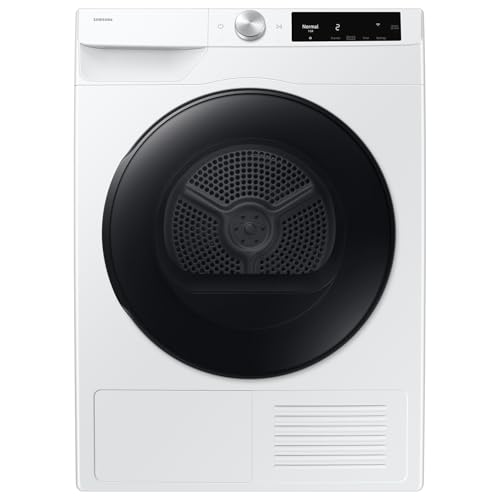
Samsung's 4.0 cu. ft. compact ventless heat pump brings an AI Smart Dial, SmartThings Wi-Fi and Sensor Dry, and it is ENERGY STAR certified. The dial rearranges around the cycles you use most, and the app handles alerts, remote start and delay. Weight is listed at 110 pounds, making it the easiest machine here to move down a basement stair. Samsung omits cabinet dimensions, so measure the stair turn and the alcove before delivery day.
What stands out
- The AI dial adapts to your regular laundry cycles
- SmartThings app handles cycle alerts and remote start
- Lightest machine in this group at 110 pounds
Watch out for
- No cabinet dimensions are published for this model
- Four cubic feet limits bedding and towel loads
Techomey 4.4 Cu.Ft Ventless Heat Pump Clothes Dryer, 24" Compact 120/240V Electric Front Load Drying Machine,

Techomey's 4.4 cu. ft. ventless heat pump includes a four-prong power cable and runs 16 cycles with sensor drying. The maker says drum air stays below 50 degrees Celsius, which suits wool and synthetics, and the cabinet measures 33.5 by 25.6 by 23.5 inches. The tank must be emptied after every load or the program pauses, which is workable beside a utility sink and tedious without one. A three-prong outlet needs a conversion adapter.
What stands out
- A four-prong power cord is included in the box
- The low drying temperature protects wool and synthetics
- Offers 16 drying cycles with automatic sensor control
Watch out for
- Tank has to be emptied after every single load
- A three-prong outlet needs a separate conversion adapter
Electrolux 24 in. 4.0 cu. ft. Compact Stackable Electric Ventless Dryer in White with Instant Refresh ELFE4222

Electrolux's 24-inch ELFE4222AW offers 4.0 cu. ft., 12 drying cycles and an Instant Refresh setting in a compact cabinet measuring 32.12 inches tall, 23.1 inches wide and 24.53 inches deep. It weighs about 179 pounds. The listing describes it as a ventless compact electric dryer and never claims heat-pump technology, so confirm how it dries before assuming heat-pump efficiency. Cycle names cover towels, delicates, jeans and heavy duty.
What stands out
- Twelve drying cycles, including an Instant Refresh setting
- Publishes cabinet dimensions, including a 24.53-inch depth
- A compact 23.1-inch width fits the tightest alcoves
Watch out for
- Heat-pump technology is not stated in the listing
- About 179 pounds, the heaviest machine in this group
Smad 23.4" Ventless Heat Pump Dryer, 4.4 Cu.Ft Front Load Clothes Dryer with Wrinkle Care,10KG Load, 120/240V,

Smad's 4.4 cu. ft. heat pump adds sanitize and wrinkle care to 16 programs, with an LED display and a stackable 23.4-inch cabinet. The listing shows 120/240V without saying which configuration ships, and the dimension fields contradict each other between the bullets and the spec block, so treat both with suspicion. Wrinkle care and sanitize are useful in a basement where loads sit before folding. Confirm voltage and footprint in writing.
What stands out
- Sanitize and wrinkle care across 16 drying programs
- 4.4 cubic feet fits inside a narrow 23.4-inch cabinet
- Stackable with a matching washer from the same brand
Watch out for
- Voltage configuration is not stated in the listing
- Published dimensions contradict each other on the page
800 Series 24 in. 4 cu. ft. Stackable Ventless Compact Front Load Smart Electric Dryer in Pearl Steel, Energy

Bosch's 800 Series is a 24-inch stackable ventless compact front-load dryer in Pearl Steel, rated 4 cu. ft. and ENERGY STAR listed. Beyond that, the listing is nearly empty: one marketing line, no cycle list, no cord or voltage details, and dimension fields that look scrambled. Bosch builds serious laundry appliances, but this page gives a buyer almost nothing to verify. Ask the seller for the full spec sheet and confirm the drying technology before ordering.
What stands out
- ENERGY STAR listed with a four cubic foot drum
- Pearl Steel finish suits a finished basement laundry
- A stackable 24-inch footprint saves valuable floor space
Watch out for
- The listing has almost no usable product specifications
- Drying technology is not described anywhere in the listing
Buying guide
Why the Duct Fails Down Here
A vented dryer moves a lot of air, and it needs a short, smooth path to do it. Most manuals cap the equivalent length around 25 feet, counting each elbow as several feet and each transition as more. A basement run that climbs eight feet, turns twice and exits through a wall cap can hit that limit without looking long. The symptom is not a dramatic failure. It is a dryer that runs 90 minutes, leaves towels damp and overheats its own cabinet, and a homeowner who blames the machine. Flexible foil duct makes it worse, because the wire helix traps lint on every ridge within a season.
Cold weather adds another failure mode. Moist air passing through a duct in an unheated rim space condenses inside the pipe, and lint sticks to the wet walls. The flap on the exterior cap freezes open or shut, and on a windy night the exhaust can blow back into the room. None of that happens with a sealed heat-pump loop, which is the strongest argument for this category in a basement. If your current dryer needs a second cycle to finish a load, the duct is the first thing to inspect and the reason to consider switching before you spend money on a repair.
Send the Water Somewhere Useful
Every heat pump here produces condensate, and most basements already have the right place for it: a floor drain, a laundry sink or a standpipe. A gravity hose to a floor drain is the simplest plumbing in the house, and it removes the one chore owners complain about most. Route the hose with a continuous fall, secure it so it cannot be kicked out of the drain, and check it after the first week for kinks. The drain also has to sit lower than the machine's outlet; if the only floor drain is uphill, the tank is the honest option and the hose is decoration.
If there is no drain, the machine needs a tank, and then the schedule matters. Techomey's listing is the most explicit of this group: empty the tank after every load, or the program pauses. That pause protects the compressor, but it also means a forgotten tank ends a cycle with wet clothes sitting inside overnight. In a basement the tank sits in a cool, still room, so rinse it and let it dry rather than sealing it damp. A tank that is emptied weekly instead of daily will smell, and the smell gets blamed on the basement rather than the machine.
Cold Rooms and Heat-Pump Behavior
A heat pump moves heat rather than making it, so a 55-degree basement gives the compressor less to work with than a 70-degree laundry room. Cycles stretch by a noticeable margin in winter, and the first load of the day is the slowest because the cabinet is cold. That is normal behavior, not a fault. Check the manual for the ambient range the maker supports, and keep the machine above freezing even when the basement is not in daily use. A basement at 60 degrees is workable. One at 45 is not, and a machine that sits idle all winter may need a warm-up cycle before it behaves normally.
Placement helps more than settings. Keep the dryer away from an exterior door that opens to the yard, and off a concrete slab that stays cold all year if you can put it on a platform or a rubber mat. Leave the clearance the manual asks for around the cabinet so the loop can shed heat. If the basement has a dehumidifier, run it; dry air accepts moisture faster, and the dryer rewards you with shorter cycles and a room that smells less like a laundry. Sealing the rim joist and insulating the band board do more for that room than any dryer feature.
Wiring a Basement Laundry
Most machines in this list want 208 to 240 volts on a dedicated circuit, and a basement panel is usually close enough to make that affordable. Midea sells its power cord separately. Techomey includes a four-prong cable but needs an adapter for a three-prong outlet. Samsung publishes neither a cord nor a voltage in its bullet points, so ask. Have an electrician check the panel for capacity before you buy, especially if the basement also carries a sump pump, a freezer and a dehumidifier. If the panel is an old fuse box, the answer may include a subpanel, and that quote should arrive before the dryer does.
Do not run a dryer from an extension cord, a power strip or a circuit shared with a freezer. In an unfinished basement, use a GFCI-protected receptacle as local code requires, keep the cord out of standing water, and mount the receptacle clear of the floor if the slab gets damp. If the only available outlet is 120 volts, none of these dryers will run on it, and no adapter changes that. The electrical work is a one-time cost and a boring line on the invoice. A burned-out compressor from a bodge-job connection is neither.
Fit, Stack and Reach the Filter
Basement ceilings are low, and a stacked pair adds up fast. Each cabinet here is roughly 32 to 34 inches tall, so a stack lands near 67 inches before the kit, which clears most joists but not a duct soffit or a stair landing. If the pair goes under a bulkhead, measure the clearance under it rather than at the floor. Stack only on a front-load washer with a flat, load-bearing top, using the bracket the dryer maker sells for that washer. A 24-inch cabinet passes most basement stair doors; a 90-degree turn at the bottom of the stairs is where the delivery stops.
Service access matters as much as fit. The lint filter is usually at the bottom of the door opening, and the condenser panel may be behind a kick plate, so leave enough room to kneel. LG lists 4.2 cu. ft., Electrolux 4.0 and Samsung 4.0, all in a 24-inch width, enough for everyday loads and short of a king comforter. Keep a path to the back panel for the hose and cord, and do not box the machine in behind a sealed cabinet. A machine on a rubber mat or a low platform also stays drier if the slab sweats in summer.
Humidity, Lint and the Smell Test
A ventless dryer does not vent moisture into the room, but it does release warmth, and a basement with no air movement will feel close after a long cycle. Leave the laundry door open, run a dehumidifier in summer, and check the wall behind the machine for condensation after the first month. If the basement already has a damp corner, fix that before adding an appliance that adds heat to it. A dehumidifier with a hose to the same floor drain solves both problems at once, and it costs less to run than the damage from a musty laundry.
Lint is the other maintenance task. Clean the primary filter every load and the secondary filter or condenser grille monthly, because a heat pump has two places for lint to collect and only one of them is obvious. A clogged condenser raises cycle times and can trip a thermal cutout. Write the cleaning schedule on the wall behind the machine. It sounds excessive until the first winter, when the dryer starts taking two hours and nobody remembers when the coil was last vacuumed. Keep a spare mesh filter if the model uses one, and check the drain hose for kinks while you are back there.
Frequently asked questions
Can a ventless dryer work in a basement with no drain?
Yes, if the model has a condensate tank, but you will be carrying water. Techomey asks for the tank to be emptied after every load, and the program pauses if you forget. If a floor drain or standpipe is within hose reach, plumb it instead. That single change removes the most common complaint about ventless drying.
Will a heat pump dry clothes in a cold basement?
It will, more slowly. Heat pumps move existing heat, so a 55-degree room gives the compressor less to work with and cycles stretch out. Keep the machine above freezing, check the manual for the supported ambient range, and expect the first load of a winter morning to be the slowest of the day.
Do I need a 240-volt circuit for a basement heat pump?
Most models here want 208 to 240 volts on a dedicated circuit. Midea sells the cord separately; Techomey includes a four-prong cable. Have an electrician confirm panel capacity alongside a sump pump, freezer and dehumidifier. A 120-volt outlet will not run these machines, and an adapter does not change that.
Do ventless dryers make a basement damp?
They should not. Moisture condenses inside the machine and leaves as liquid, not as steam. What escapes is warmth, which a cool basement absorbs. If walls bead up, the tank is overflowing or the condenser is clogged. Run a dehumidifier in summer and leave the laundry door open during cycles.
Can I stack a heat pump on my basement washer?
Only on a front-load washer with a flat, load-bearing top, using the stacking kit sold for that pair. A top-loader cannot carry a dryer. Check the total height against joists, ducts and any soffit, and anchor the pair with the anti-tip strap. A stack that fits the floor but not the ceiling is a common and expensive mistake.
Verdict
The LG DLHC1455W is the top pick for a basement. Dual inverter heat-pump drying, 4.2 cu. ft. in a 24-inch cabinet, 14 programs, sensor drying and ThinQ Wi-Fi make it the most complete machine here. LG's published dimensions in the listing look wrong, so get the cut sheet before you build a platform around it.
The Midea is the value pick, with 4.4 cu. ft., a published 23.4-inch width, humidity sensing and ENERGY STAR qualification; add the cord to the budget. Step up to the Samsung for the AI dial and app alerts. The Electrolux and Bosch are worth a look for finish and cycle selection, but confirm the drying technology in writing, because neither listing states it clearly.