A heat-pump dryer does not blast hot air at a wet towel. It runs a sealed refrigerant loop that pulls moisture out of the drum air and returns warmed, dry air to the clothes, which is why the drum stays closer to body temperature than to oven temperature. The result is slow, gentle drying with no duct and no large heating element.
That difference shows up in three places: the plug, the clock and the lint filter. Most of these machines want a 240-volt circuit, a load that used to take 45 minutes can take 90, and the condenser coil behind the lint screen needs cleaning far more often than the filter on a vented dryer. Skip any one of those and the machine underperforms in a way that feels like a defect but is really maintenance.
The four dryers here all use the same basic technology and land in the same 24-inch, 4.0 to 4.4 cu. ft. class. Two advertise 120/240V, one states 240 volts plainly, and one says nothing about voltage at all. That single line of a spec sheet decides whether the dryer can go where you want it.
We compared specifications, features and owner reports, then set the marketing claims beside the practical questions: how the load gets dry, where the water goes and what the install really requires.
Top picks at a glance
Midea Heat Pump Ventless Front Load Dryer Stackable 4.4 Cu.ft White
Check price on AmazonSamsung 4.0 cu. ft. Compact Ventless Heat Pump Dryer with AI Smart Dial, Wi-Fi
Check price on AmazonTechomey 4.4 Cu.Ft Ventless Heat Pump Clothes Dryer, 24" Compact 120/240V Elec
Check price on AmazonCompare the shortlist
| Model | Type | Capacity | Key feature | Amazon |
|---|---|---|---|---|
| 1. Midea Heat Pump Ventless Front Load Dryer Stackable 4.4 Cu.ft Wh | Heat pump | 4.4 cu ft | Sensor drying | Check price |
| 2. Samsung 4.0 cu. ft. Compact Ventless Heat Pump Dryer with AI Sma | Heat pump | 4.0 cu ft | Sensor drying | Check price |
| 3. Techomey 4.4 Cu.Ft Ventless Heat Pump Clothes Dryer, 24" Compact | Heat pump | 4.4 cu ft | Sensor drying | Check price |
| 4. Smad 23.4" Ventless Heat Pump Dryer, 4.4 Cu.Ft Front Load Clothe | Heat pump | 4.4 cu ft | Sanitize cycle | Check price |
Detailed reviews
Midea Heat Pump Ventless Front Load Dryer Stackable 4.4 Cu.ft White

Midea's 4.4 cu. ft. heat pump is the most transparent listing in this group. It states 240 volts, notes that the cord is sold separately, and claims at least 28 percent lower energy use than a standard dryer. A humidity sensor sets the cycle, Wrinkle Care tumbles intermittently for about 90 minutes after the load is dry, and the machine is ENERGY STAR qualified. The cabinet measures 23.4 inches wide, 25.7 deep and 33.5 tall, which fits a standard 24-inch stack.
What stands out
- 240-volt requirement stated plainly in the product listing
- ENERGY STAR qualified with a humidity sensor onboard
- Wrinkle Care tumbles for about 90 minutes after drying
Watch out for
- Power cord is sold separately from the machine
- No cabinet weight published for floor or stack planning
Samsung 4.0 cu. ft. Compact Ventless Heat Pump Dryer with AI Smart Dial, Wi-Fi Connected, Smart Dry Technology
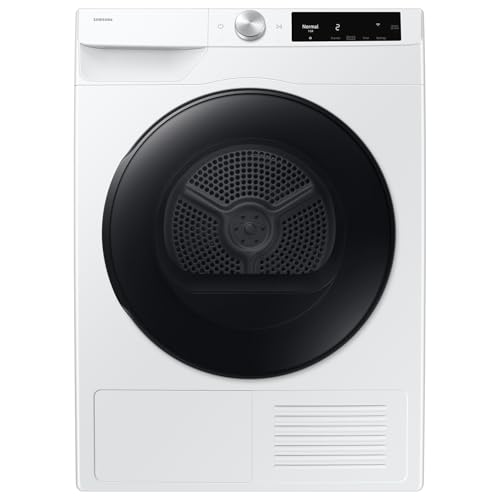
Samsung's 4.0 cu. ft. compact heat pump centers on an AI Smart Dial that learns your cycle habits and moves them to the top of the list. SmartThings adds end-of-cycle notifications and remote start, stop or delay, and Sensor Dry adjusts time and temperature as moisture drops. It is ENERGY STAR certified and weighs 110.2 pounds, the lightest machine here. The listing does not publish cabinet dimensions or voltage, so both need confirming before you plan the install.
What stands out
- Lightest cabinet in this group at 110.2 pounds
- SmartThings adds remote control plus end-of-cycle notifications on your phone
- AI dial adapts the cycle list to your habits
Watch out for
- No cabinet dimensions anywhere in the product listing
- Voltage requirement is not stated in the bullets
Techomey 4.4 Cu.Ft Ventless Heat Pump Clothes Dryer, 24" Compact 120/240V Electric Front Load Drying Machine,

Techomey's 4.4 cu. ft. heat pump lists sixteen cycles and a sensor that stops the program when the load reaches the selected dryness. The brand says the loop keeps process air below 50 degrees Celsius, which is gentle for wool and delicates, and the cabinet is sized to stack on a matching washer. Two details from the listing matter: empty the water tank after every use or the program pauses, and the dryer arrives with a four-prong cable that needs an adapter on a three-prong outlet.
What stands out
- Sixteen cycles with moisture sensing and auto stop
- Low process temperature protects wool and delicate fabrics
- Stackable 23.4 by 25.7 by 33.5 inch cabinet
Watch out for
- Tank must be emptied after every load or it pauses
- Four-prong cable may need an adapter on three-prong outlets
Smad 23.4" Ventless Heat Pump Dryer, 4.4 Cu.Ft Front Load Clothes Dryer with Wrinkle Care,10KG Load, 120/240V,

Smad's 4.4 cu. ft. heat pump carries a 10 kg load rating, sixteen programs, wrinkle care and a sanitize function for bedding and towels. The LED display shows cycle status, and the cabinet measures 25.7 inches deep, 23.4 wide and 33.5 tall, matching the footprint of the Midea and Techomey. The title claims 120/240V but the listing never explains how the lower voltage is configured, so treat that as a question for the seller rather than a settled feature.
What stands out
- Sixteen programs including a sanitize cycle for bedding
- 4.4 cu. ft. drum rated to a 10 kg load
- Clear LED status display shows where the cycle stands
Watch out for
- 120/240V claim lacks any explanation in the listing
- No cabinet weight or cycle time figures published
Buying guide
How a Heat Pump Dries at Low Temperature
Inside the cabinet, two air paths meet at a heat exchanger. The process air leaving the drum passes over a cold evaporator coil, where moisture condenses out and drips into a tank or drain. The same air then crosses a hot condenser coil, picks the heat back up, and returns to the drum. Nothing vents outside and nothing burns. A compressor circulates refrigerant between the two coils, which is why the machine hums like a refrigerator and why the cabinet warms slowly instead of glowing hot. It is a closed loop, and the only thing leaving the machine is water you carry away. The drum stays sealed while it runs, so the only real air exchange happens when you open the door at the end.
The practical payoff is temperature. Techomey states that its loop holds process air below 50 degrees Celsius, roughly 122 Fahrenheit, which is cool by dryer standards. Wool, elastane, printed shirts and anything with a care label warning about heat come out closer to how they went in. The trade is time: low-temperature air carries less moisture per pass, so the drum turns longer. Owners who expect a one-hour cycle often decide the machine is broken when it is doing exactly what the technology allows. A moisture sensor ends the cycle when the load is dry, not when the timer says so. Give the load ten minutes to settle after the sensor stops the drum; clothes come out warm rather than hot, and a little steam escapes when the door opens.
The Energy Math and What It Saves
Midea claims at least 28 percent lower energy use than a standard dryer, and Techomey goes further with a 66.7 percent reduction claim. Treat both as manufacturer figures rather than measured results. What is not in dispute is the shape of the savings. A vented dryer heats air with a resistive element and throws most of that heat, plus the moisture, out the duct; it also pulls conditioned air out of the house, which the furnace or air conditioner then has to replace. A heat pump recycles heat it has already paid for. Midea and Samsung both carry ENERGY STAR certification, a third-party number you can compare. The gap between 28 and 66.7 percent is mostly a difference in test conditions and baseline machines, not evidence that one dryer is twice as efficient as the other.
Savings shrink when the machine is used badly. A clogged lint screen, a dusty condenser coil, an overloaded drum or a cold garage all push the compressor into longer runs, and a long run erases the advantage. Heat pumps also lose efficiency in a cold space, because there is less ambient warmth to move into the loop. If the dryer lives in an unheated mudroom, expect longer cycles in January than in July. The purchase price is higher than a basic vented dryer, so the payback comes from years of steady use. Running two loads a week will take a long time to repay the difference. Time-of-use pricing can undercut the savings further if the long cycle lands in a peak window, so run laundry overnight or early if your rate plan rewards it.
240 Volts, the Cord and the Circuit
This is the specification that decides the installation, and the listings are uneven about it. Midea says 240 volts and notes the power cord ships separately. Techomey and Smad both put 120/240V in the title, but neither explains how the 120-volt configuration is wired, and Techomey adds that the dryer arrives with a four-prong cable, so a three-prong setup needs an adapter. Samsung's bullets never mention voltage. One email to the seller, asking for the nameplate photo, is worth more than an hour of reading reviews. The receptacle in the wall has a shape, and the cord has to match it. Photograph the receptacle and the breaker label before you call anyone; those two pictures answer most of the questions an electrician will ask.
Assume a dedicated circuit until the manual says otherwise. A dryer sharing a circuit with a microwave or a window air conditioner will trip the breaker at the worst moment, and an extension cord is not a solution for a machine that runs for ninety minutes. Have an electrician look at the panel before delivery, especially in an older house where the service may already be full. Adding a circuit may need a permit, and the cost of that work belongs in the budget before you compare models. If the only available spot is a standard 120-volt outlet, confirm in writing that the specific model can run on it. A 240-volt dryer circuit is not a do-it-yourself job for most homeowners, and a permit keeps the installation insurable if something goes wrong later.
Where the Water Goes
A heat-pump dryer removes water as liquid, not as vapor, so every load leaves a puddle somewhere. Most models give you a tank, and some can be plumbed to a drain. Emptying the tank is the chore owners underestimate: Techomey's listing warns that the program pauses if the tank fills, which means a load can sit damp overnight because nobody checked. A tank holds one load, sometimes less if the clothes went in wet. If the dryer sits near a standpipe or a laundry sink, use the drain hose and forget the tank entirely. If it does not, empty the tank after every cycle and rinse it now and then. A tank with a lid is easier to carry than an open tray, and a clear tank shows the water level before you lift it out of the cabinet.
Water is only half the exhaust story. The machine also releases heat into the room, and a small closet with the door shut will get warm and slightly humid. Leave the door open during the cycle, or fit louvered doors, and run a fan if the space is tight. Clean the lint screen before every load and check the condenser area as the manual directs, because a mat of lint on the coil is the most common reason a heat-pump dryer starts taking two hours to finish. A soft brush and five minutes a month will keep the cycle times where they started. Owners who ignore the coil for a year often blame the machine, then find a felt-like mat of lint packed behind the filter housing.
Capacity, Cycles and Stacking
The four machines split into two capacity groups: Samsung at 4.0 cu. ft., and Midea, Techomey and Smad at 4.4. That difference is roughly a couple of bath towels per load, which matters more in a household of four than in a couple's apartment. Program counts run from fourteen on the Samsung to sixteen on the Techomey and Smad, though the number of cycles says less than the sensor does. All four use moisture sensing to end the cycle, and that sensor is what keeps a small load from running the full timer. Fabric settings matter more than the total count on the dial. A queen comforter will fit in the drum but will ball up and dry unevenly, which is the usual reason a large load comes out damp in the middle.
Stacking is the other practical question. Midea, Techomey and Smad publish cabinets around 23.4 inches wide by 25.7 deep by 33.5 tall, a footprint that stacks on a matching 24-inch washer with the right kit. Samsung publishes only a weight, 110.2 pounds, with no cabinet dimensions at all, so measure before you plan a stack around it. Leave room for the door to swing and the tank to come out. None of these drums will take a king comforter comfortably. Bedding goes to a laundromat or a larger machine, and pretending otherwise leads to a strained compressor and a long afternoon. Measure the stacked height with the kit installed rather than adding the two cabinets together, because the kit itself adds an inch or two.
Frequently asked questions
Is a heat-pump dryer better than a condenser dryer?
For running cost, usually yes. A condenser dryer heats air with an element and then cools it to condense the moisture, while a heat pump moves existing heat between two coils. The heat pump dries at a lower temperature and uses less energy per load. It also costs more to buy and takes longer, so the choice depends on how often you run it.
Do heat-pump dryers need a drain?
No, most can run on a collection tank that you empty by hand. A drain hose is optional and worth using if the machine sits near a standpipe or sink. Techomey's listing notes that the program pauses when the tank fills, so a full tank can leave a load sitting damp until someone notices.
Why does a heat-pump dryer take so long?
Low temperature means each pass of air carries less moisture, so the drum has to turn longer to remove the same water. Techomey says its process air stays below 50 degrees Celsius. That is the trade for gentler fabric care and lower energy use. Expect 80 to 100 minutes for a normal load, longer for towels.
Can a heat-pump dryer be installed in a closet?
Yes, and that is the main reason people buy one, since there is no duct. The closet still needs a dedicated circuit, clearance behind the cabinet for the cord and hose, and a way for heat to escape. Louvered doors or an open door during the cycle keep the space from turning into a hot box.
Do all heat-pump dryers require 240 volts?
Not all, but the listings here are inconsistent. Midea states 240 volts. Techomey and Smad advertise 120/240V without explaining the 120-volt setup, and Techomey ships with a four-prong cable. Samsung does not state voltage at all. Confirm the requirement in writing before you buy or book an electrician.
Verdict
The Midea is the top pick because it does the least guessing for you: 4.4 cu. ft., a stated 240-volt requirement, a humidity sensor, a wrinkle cycle and ENERGY STAR qualification, with the cord sold separately. The Smad is the value choice for the same 4.4 cu. ft. drum, sixteen programs and a sanitize cycle, provided you can confirm the 120/240V wiring before delivery.
The Samsung is the upgrade if you want the lightest cabinet here, an AI dial that learns your routine, and SmartThings alerts, though its listing omits dimensions and voltage. The Techomey is the one to ask about if a 120-volt option is essential; its four-prong cord and unexplained dual-voltage title are exactly the details a seller should confirm in writing.