The shut-off valve behind a washer is usually installed once and touched twice a year, which is why it is easy to forget how badly some of them are designed. Then a hose bulges, the machine goes out for repair, and you find out whether the handle still turns, whether the outlet box is buried behind drywall, and whether the fitting on the wall matches anything sold today.
This guide sorts ten listings by type rather than by brand: single-fixture manual valves, recessed outlet boxes, push-fit retrofit valves, motorized leak-detection kits, and two replacement parts that appear in the same search but do a completely different job. That last group causes more wasted orders than any other.
The differences that decide a purchase are unglamorous. Inlet style, outlet count, handle color, and whether the body is a full-port ball valve. A quarter-turn ball valve is the standard for a reason: a quarter turn is all it takes, and the port stays open and unobstructed while water flows.
Below, each valve is described by what it connects to and what it cannot do. If you already know your pipe type, skip to the notes; the buying sections explain the tradeoffs first.
Top picks at a glance
Eastman Brass Outlet Box Blue Handle Washing Machine Valve, 1/2 Inch MIP x 3/4
Check price on AmazonFloodStop Washing Machine Leak Detector Kit, 3/4" Straight
Check price on AmazonKingston Brass 1/2' Sweat Inlet x 3/4' Hose Thread, Dual Outlet Washing Machin
Check price on AmazonCompare the shortlist
| Model | Type | Capacity | Key feature | Amazon |
|---|---|---|---|---|
| 1. Eastman Brass Outlet Box Blue Handle Washing Machine Valve, 1/2 | Valve | — | Quick cycle | Check price |
| 2. Kingston Brass 1/2' Sweat Inlet x 3/4' Hose Thread, Dual Outlet | Hose | — | — | Check price |
| 3. Drain Valve 9379-177-005 | Valve | — | Efficiency | Check price |
| 4. FloodStop Washing Machine Leak Detector Kit, 3/4" Straight | Valve | — | — | Check price |
| 5. SUNGATOR Push-Fit Laundry Washer Valve Box, Washing Machine Outl | Valve | — | Child lock | Check price |
| 6. Highcraft 541D Washing Machine Replacement Valve 1/2’’ CPVC Inle | Valve | — | — | Check price |
| 7. Supplying Demand 203741 Top Load Clothes Washer Water Inlet Mix | Top-load | — | Top-load | Check price |
| 8. SharkBite 1/2 Inch x 3/4 Inch MHT Washing Machine Angle Valve, P | Valve | — | Quick cycle | Check price |
| 9. Highcraft 540D Washing Machine Replacement Valve 1/2’’ CPVC Inle | Valve | — | — | Check price |
| 10. YoLink Water Shutoff Kit: 0.75" Brass Ball Valve + Valve Control | Valve | — | Connected controls | Check price |
Detailed reviews
Eastman Brass Outlet Box Blue Handle Washing Machine Valve, 1/2 Inch MIP x 3/4 Inch MHT, Quarter Turn Ball Val

A single cold-water quarter-turn valve with a blue handle and a brass body, sized 1/2-inch MIP inlet by 3/4-inch hose thread. The threaded inlet suits a stub coming out of a wall or a drop ear elbow, not a copper sweat connection. It is the cold half of a pair, and the blue handle makes that obvious at a glance.
What stands out
- Blue handle marks the cold line at a glance
- Quarter-turn ball valve opens in a single 90-degree sweep
- Brass body with a standard 3/4-inch hose outlet
Watch out for
- Cold water only, so a pair needs another valve
- Threaded inlet will not fit sweat or CPVC pipe
Kingston Brass 1/2' Sweat Inlet x 3/4' Hose Thread, Dual Outlet Washing Machine Shut off Valve, Brass

One 1/2-inch sweat inlet feeding two 3/4-inch hose outlets, rated to 150 PSI. This suits installations where a single copper line has to serve both washer hoses, which turns up in older buildings with one tempered supply. The body is brass, and no handle color coding is stated, so label the lines yourself.
What stands out
- Two hose outlets fed from a single inlet
- Solid brass body rated to 150 PSI working pressure
- Compact body fits into a shallow wall cavity
Watch out for
- Sweat joint requires soldering and a drained line
- One inlet cannot supply separate hot and cold lines
Drain Valve 9379-177-005

A replacement drain solenoid for Dexter commercial washers that use part 9379-177-005. It controls water leaving the drum, not water entering the machine, so it is not a supply shut-off despite how it reads in search results. Built for laundromats and on-premise laundry rooms where the machine runs all day and downtime costs money.
What stands out
- Direct replacement for a known Dexter part number
- Built for the duty cycle of commercial laundry equipment
- Drop-in swap that keeps technician time short
Watch out for
- Not a supply shut-off despite the search match
- Fits only Dexter machines using that part number
FloodStop Washing Machine Leak Detector Kit, 3/4" Straight

A pair of 3/4-inch straight motorized ball valves with a floor sensor, audible alarm and visual indicator. When the sensor gets wet, both valves close and the alarm sounds. Rated to 140 PSI working pressure and listed to ICC-ES PMG-1511, with lead-free brass that meets NSF 61. Installation is quoted at about 15 minutes, which assumes an outlet nearby.
What stands out
- Closes both hot and cold lines without anyone home
- Alarm sounds at the machine, not across the house
- Lead-free brass body that carries plumbing-code listings
Watch out for
- Needs a live power outlet close to the washer
- Only reacts where the sensor puck is actually sitting
SUNGATOR Push-Fit Laundry Washer Valve Box, Washing Machine Outlet Box

A recessed washing machine outlet box with push-fit inlets for 1/2-inch PEX, copper, CPVC or PE-RT, two 3/4-inch hose outlets and a center drain. Two disconnect clips are included, and the box separates from its frame so it can be inverted for an awkward cavity. The shut-off valves are forged brass, and the assembly opens for service.
What stands out
- No soldering, crimping or glue on the supply side
- Center drain keeps the discharge hose out of the way
- Box and frame separate to fit tight retrofits
Watch out for
- Push-fit fittings need clean, squarely cut pipe ends
- Box depth has to match the wall cavity
Highcraft 541D Washing Machine Replacement Valve 1/2’’ CPVC Inlet x 3/4’’ MHT Outlet Brass Blue-for Cold Water

A blue-handled cold-water valve with a 1/2-inch CPVC inlet and a 3/4-inch hose outlet, built around a full-port quarter-turn ball valve. Rated 20 to 125 PSI and 40 to 160 degrees Fahrenheit, certified to NSF 61 and ANSI A112.18.1. The CPVC inlet is solvent-welded to a CPVC stub, so this is not the part for copper or PEX.
What stands out
- Full-port ball valve that keeps the flow unrestricted
- Certified to NSF 61 and ANSI A112.18.1 standards
- Blue handle and body identify the cold side
Watch out for
- CPVC inlet requires solvent welding rather than a thread
- Rated for cold water service only, not hot
Supplying Demand 203741 Top Load Clothes Washer Water Inlet Mix Valve

A water inlet mixing valve for model-specific top-load commercial washers, not a shut-off. It controls fill temperature rather than isolating the supply. The alternate part number is AP6873906, and the listing is clear that fitment depends on the model, so check the plate on the machine before ordering. Expect to open the cabinet and move a hose or two.
What stands out
- Replaces a known inlet valve part number directly
- Designed for a specific list of commercial top-load washers
- Straightforward swap once the cabinet is open
Watch out for
- Does not shut off the water supply at all
- Fitment is limited to the listed commercial models
SharkBite 1/2 Inch x 3/4 Inch MHT Washing Machine Angle Valve, Push To Connect Brass Plumbing Fitting, PEX Pip
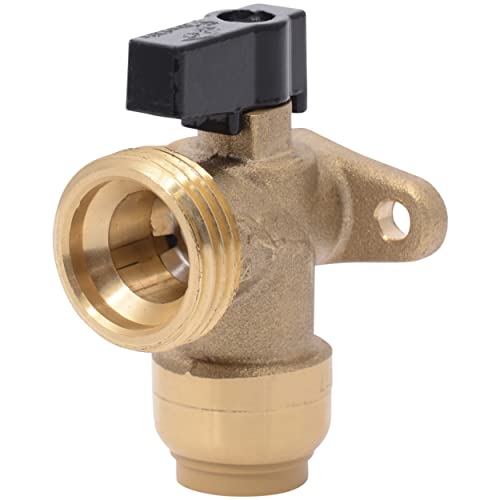
A push-to-connect angle valve built for washers installed without an outlet box. The 1/2-inch inlet accepts PEX, copper, CPVC, PE-RT and SDR-9 HDPE; the outlet is 3/4-inch hose thread. Quarter-turn handle, mounting brackets included, and removal takes a disconnect clip or tongs. Manufactured and tested in the USA, and suited to behind-the-wall work with no access panel.
What stands out
- Installs on wet lines without soldering or tools
- Mounting bracket holds the valve on a stud
- Works with five common types of pipe material
Watch out for
- Costs noticeably more than a basic sweat valve
- Removal needs a disconnect clip or a pair of tongs
Highcraft 540D Washing Machine Replacement Valve 1/2’’ CPVC Inlet x 3/4’’ MHT Outlet Brass Red-for Hot Water S

The red-handled twin of the 541D: 1/2-inch CPVC inlet, 3/4-inch hose outlet, full-port quarter-turn ball valve, and the same NSF 61 and ANSI A112.18.1 certifications with a 20 to 125 PSI rating. Buy it with the blue version to replace a matched pair in one order. The red body makes the hot line unmistakable during service.
What stands out
- Red handle and body mark the hot line
- Same body and rating as the cold version
- Full-port ball valve that preserves the flow rate
Watch out for
- Hose washers are still sold as a separate purchase
- CPVC inlet only, with no threaded version offered
YoLink Water Shutoff Kit: 0.75" Brass Ball Valve + Valve Controller
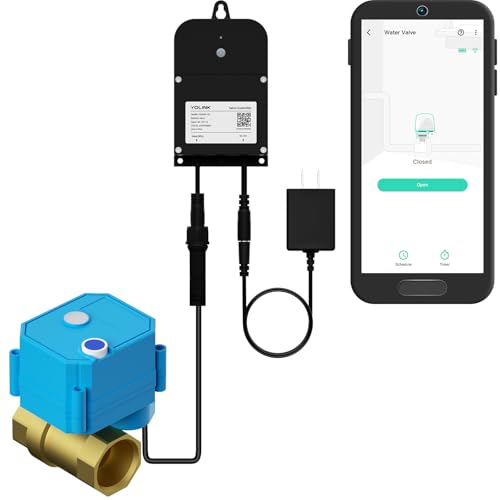
A 3/4-inch brass motorized ball valve with a controller, 12V adapter and four AA batteries for backup. It reaches a YoLink hub over LoRa at up to 2,034 feet and can close itself when paired with YoLink leak sensors, even without internet. The hub is required and sold separately; Alexa, IFTTT and Home Assistant are supported. Battery-only runtime is listed at up to about two years.
What stands out
- Closes remotely or on a leak sensor trigger
- Battery backup keeps it working in an outage
- LoRa range reaches basements, meter pits and outbuildings
Watch out for
- Hub is required and sold as a separate item
- One valve size, so check your line diameter
Buying guide
Manual Valves, Outlet Boxes and Motorized Kits
A manual valve is the simplest thing that works: a brass body, a handle, an inlet that connects to the supply pipe and a 3/4-inch hose thread on the outlet. It costs little, needs no power and lasts decades if the water is not aggressive. The catch is access. A valve buried in a wall cavity without an access panel is a valve you cannot reach, and an outlet box exists to solve that. It recesses the valves and hose connections into the wall so the machine can sit closer to the studs, and it gives you a frame to open when something starts to drip. That frame matters as much as the valves inside it.
Motorized kits sit at the other end of the scale. Instead of turning a handle, a small motor closes a ball valve when a sensor detects water on the floor. The FloodStop kit here includes both hot and cold valves plus a sensor; the YoLink kit is a single valve with a controller that talks to a hub. Neither replaces the manual valve. Both install downstream of it, so you still need a working shut-off to service the automatic one. Budget for the valve you can turn by hand before you budget for the one that turns itself, and plan where the sensor puck will sit.
Match the Inlet to the Pipe You Actually Have
The inlet is where most returns begin. A 1/2-inch MIP inlet is male iron pipe thread and screws into a female fitting such as a drop ear elbow. It will not solder onto copper and it will not slip onto PEX. A 1/2-inch sweat inlet is meant for soldering to copper, which means the line has to be drained and open, and a torch in a stud bay needs care. A CPVC inlet is solvent-welded, so the pipe must be CPVC rather than copper. Push-fit accepts several materials at once, which is why it dominates retrofit work. The safest choice is the one that needs no adapter, because every adapter is another joint that can leak behind a machine you cannot easily move.
Measure the outlet box opening before ordering a box, not after. A recessed box has to fit the depth of the wall cavity and leave room for the hoses to bend without kinking. On a finished wall, a box may mean cutting drywall and adding framing; a surface-mounted angle valve on a stud is often the more honest solution. The SharkBite valve here is built for exactly that case. Mount it to a stud or joist, push the pipe in, and skip the box entirely. Push-fit is not magic, though: the pipe end has to be cut square, deburred and pushed fully home, or the O-ring will weep.
Handle Color, Outlet Count and Hose Thread
Red is hot, blue is cold, and a single blue valve on a cold line is not a pair. Several listings here are single-fixture valves, which is fine when you are replacing one side after a leak, but a full replacement usually needs two. The Kingston valve takes a different approach: one 1/2-inch sweat inlet feeds two 3/4-inch hose outlets, so a single supply line can serve both hoses. That suits older buildings with one tempered line, and it is not a substitute for separate hot and cold supplies. If you are replacing both sides, buy the same model twice so the handles and service parts match.
The outlet is almost always 3/4-inch male hose thread, which is what a washer hose coupling expects. Check that the valve includes hose washers or that you have spares, because a missing washer is the most common cause of a drip at a brand-new valve. Also check the handle type. A quarter-turn ball valve opens fully in 90 degrees and is easy to work with wet hands. A gate or globe valve takes several turns, and the stem packing can weep over time. Hose thread is not pipe thread, and the two are easy to confuse in a hardware store aisle. Read the outlet size twice, because a 3/4-inch hose coupling and a 1/2-inch pipe fitting look similar in a product photo.
Automatic Shutoff and the Parts That Are Not Valves
An automatic system is only as good as its sensor placement. The FloodStop sensor has to sit where water will actually collect, usually in the pan or at the low corner behind the machine, and the valves need a live outlet. The YoLink valve needs its hub for app control, though its device-to-device mode can close the valve on a sensor trigger without the internet. Both are useful, and neither is a substitute for replacing old rubber hoses with braided ones. Water from a burst hose runs down the wall and pools at the lowest point, which is rarely directly under the valve. Mount the sensor on the floor, not on the wall, because a puck fixed to drywall will never see the puddle it is meant to detect.
Two listings here are not supply shut-offs at all. The Supplying Demand 203741 is a water inlet mix valve that controls fill temperature on specific top-load commercial washers, and the Dexter 9379-177-005 is a drain solenoid for commercial machines. They appear in shut-off valve searches because the words overlap. If no water enters the drum, think inlet valve. If the drum will not empty, think drain pump or drain valve. Buying the wrong one is easy to avoid by reading the description twice and matching the part number on the machine. Start with the model plate rather than the search bar and the odds improve immediately.
Frequently asked questions
Do I need a separate shut-off valve for hot and cold?
Usually yes. Most washers have two supply lines and two valves, one red and one blue, so either line can be isolated without killing water to the whole house. A dual-outlet valve can feed both hoses from one line, but that only works if your plumbing supplies a single tempered line. If you have separate hot and cold stubs, buy a matched pair.
Can I replace a washing machine shut-off valve myself?
It depends on the connection. A threaded MIP or push-fit valve is a reasonable DIY job once the house water is off and the line is drained. Sweat and CPVC joints need soldering or solvent welding, and a failed joint inside a wall is expensive to fix. If the valve sits behind drywall with no access panel, hire a plumber.
What do MIP, MHT and sweat mean on a valve listing?
MIP is male iron pipe thread, the tapered thread that screws into a female fitting. MHT is male hose thread, the 3/4-inch thread a washer hose coupling screws onto. Sweat means the fitting is soldered to copper pipe. A valve listed as 1/2-inch MIP by 3/4-inch MHT has a threaded pipe inlet and a hose outlet.
Are automatic leak shut-off systems worth the money?
They help most in an upstairs or finished-basement laundry room, where a burst hose does expensive damage. A motorized valve with a floor sensor can stop flow while no one is home. It will not catch a slow drip that never reaches the sensor, and it needs power. Treat it as one layer alongside braided hoses and a drain pan.
Why does a new valve drip where the hose connects?
Most often the hose washer is missing, folded or hardened. The coupling should be hand tight plus a quarter turn; over-tightening distorts the washer and causes the leak it is meant to prevent. Confirm that the hose has a 3/4-inch female coupling and that the valve outlet is clean. A drip from the handle points to stem packing or the ball seat.
Verdict
The SharkBite 1/2-inch push-to-connect angle valve is the pick for most retrofits. It mounts to a stud, accepts PEX, copper, CPVC, PE-RT or HDPE, and needs no soldering, which makes it the least risky way to add a real shut-off where none exists. For a straight replacement on CPVC stubs, the Highcraft pair is the value choice: buy the blue 541D and the red 540D together and you have matching full-port valves for both lines.
The upgrade is the FloodStop kit if the washer sits upstairs or over finished space. It closes both lines on its own and carries plumbing-code listings. Choose the Kingston dual-outlet only if one tempered line feeds both hoses, and skip the mix valve and the drain solenoid unless their part numbers match your machine.