A stack of gym towels straight from the wash should smell like nothing. When it does not, the machine usually ran a short, cool cycle that rinsed away some sweat and left the oils behind. Terry holds body oil deep in the loop, and microfiber holds it even tighter.
Gym laundry is a hygiene problem before it is a volume problem. A 300-member gym might produce 100 to 200 towels a day, which is 60 to 120 pounds of wet terry, but the hard part is not the weight. It is getting hot water, detergent and mechanical action into a dense pile of towels that has been sitting in a hamper for six hours.
We compared specifications, features and owner reports on eight washers. Five are 220V commercial units rated by dry weight; three are 120V machines that suit a studio, a small box gym or a backup laundry. The right answer depends on how many towels you generate and whether the building can support commercial power.
One thing to settle early: a gym that sells towel service needs a dryer that can keep up with the washer, and often a second set of towels. The washer is only one third of the loop.
Top picks at a glance
Banfluxion Automatic Laundry Washing Machine Commercial/Industrial Wash+Spin W
Check price on AmazonMidea MLTW41A1BMG 4.1 Cu. Ft. Gray Top Load Washer
Check price on AmazonWYDDDARY Commercial Washer Extractor 66LBS Heavy-Duty Laundry 220V 1PH
Check price on AmazonCompare the shortlist
| Model | Type | Capacity | Key feature | Amazon |
|---|---|---|---|---|
| 1. Banfluxion Automatic Laundry Washing Machine Commercial/Industri | Stain remover | — | Auto-dispense | Check price |
| 2. LGXEnzhuo 220V 2.2KW Industrial Front Load Washer 44LBS | Front-load | — | Inverter motor | Check price |
| 3. INTSUPERMAI 44LBS Commercial Washing Machine, 3-in-1 Wash Spin D | Top-load | — | Quick cycle | Check price |
| 4. IntXanth 220V 3Ph 60Hz Washer Industrial Automatic Laundry Washi | Stain remover | — | Quick cycle | Check price |
| 5. WYDDDARY Commercial Washer Extractor 66LBS Heavy-Duty Laundry 22 | Washers | — | Connected controls | Check price |
| 6. Kenmore 4.5 cu. ft. Front Load Washer | Front-load | 4.5 cu ft | Steam | Check price |
| 7. BLACK+DECKER 4.1 Cu. Ft. Top Load Washing Machine with Agitator, | Top-load | 4.1 cu ft | Delay start | Check price |
| 8. Midea MLTW41A1BMG 4.1 Cu. Ft. Gray Top Load Washer | Top-load | 4.1 cu ft | Top-load | Check price |
Detailed reviews
Banfluxion Automatic Laundry Washing Machine Commercial/Industrial Wash+Spin Washer with 33lbs Dry Clothes Cap

Banfluxion's 33-pound washer is the smallest true commercial unit here and the easiest to justify for a studio or small box gym. It handles wash and spin, uses 304 stainless throughout, and runs on 220V single-phase. The control panel allows stepless speed changes, and the spring-and-damper suspension means no concrete pad. If your daily load is 30 to 40 pounds, this is the size that makes sense.
What stands out
- 33-pound batches suit studios and small box gyms
- 304 stainless resists sweat, bleach and humid laundry air
- It runs on 220V single-phase rather than three-phase
Watch out for
- There is no dryer function, so the loop needs one
- It still requires a dedicated 220V circuit and plumbing
LGXEnzhuo 220V 2.2KW Industrial Front Load Washer 44LBS

The 44-pound LGXEnzhuo integrates wash, spin and dry in one drum with 6kW of heating and a 304 stainless interior. The dual inverter system lets staff set wash and extraction speeds, and the safety door lock and emergency stop suit a commercial laundry room. It weighs 1,361 pounds, so placement needs planning. It is the closest thing here to a complete laundry in one box.
What stands out
- Wash, spin and dry all happen in a single machine
- Adjustable speeds handle both heavy terry and microfiber
- The emergency stop and door lock protect staff
Watch out for
- Over 1,300 pounds empty, so the floor must be checked
- The 220V install and ventilation add real cost
INTSUPERMAI 44LBS Commercial Washing Machine, 3-in-1 Wash Spin Dry, SUS304 Stainless Steel, Top Load Industria

A 44-pound, 20kg industrial washer with a 2.2kW motor and 6kW heater, wired for 220V three-phase. The 304 stainless drum is 29.5 inches across, the door has a safety lock and tempered glass, and the suspension is designed for a normal floor. The listing notes it ships without a cord because plugs vary by region. Budget for an electrician and a plumber, not just the machine.
What stands out
- 44-pound batches match a mid-size gym's daily towels
- The 304 stainless drum handles bleach and sweat
- The large door simplifies loading wet, heavy terry
Watch out for
- Three-phase power is a hard requirement for this unit
- No cord is in the box, so plan the wiring
IntXanth 220V 3Ph 60Hz Washer Industrial Automatic Laundry Washing Machine Commercial Washer WASH SPIN DRY 44L

A 44-pound industrial washer with a frequency-converter drive, a 6kW heater and a belt-driven drum. The belt drive is quieter than a direct drive at this scale, and the lower suspension uses hydraulic and spring damping so it can sit on a standard floor. The drum measures 29.5 inches by 17.7 inches. The 6kW heater means it can run a hot wash without relying on the building's tank.
What stands out
- A variable-frequency drive allows adjustable wash and spin speeds
- The belt drive is quieter under heavy loads
- 304 stainless covers both the shell and drum
Watch out for
- Three-phase wiring is required before this machine can run
- There is no drying function in this model
WYDDDARY Commercial Washer Extractor 66LBS Heavy-Duty Laundry 220V 1PH

The largest machine here at 66 pounds, with 620 RPM extraction and 12kW of heating. It runs on 220V single-phase, which is easier to provision than three-phase, and the programmable LCD supports manual or automatic control with self-diagnosis. The full suspension system means no foundation, though the footprint is substantial. The 620 RPM spin is the specification that pays for itself in dryer time.
What stands out
- 66 pounds absorbs a busy club's daily towel volume
- The 12kW heater supports genuinely hot wash cycles
- Single-phase 220V avoids the cost of three-phase wiring
Watch out for
- The large footprint and 64-inch height need planning
- A 12kW draw may require a service upgrade
Kenmore 4.5 cu. ft. Front Load Washer

The Kenmore 4.5 cu. ft. front loader is the sensible 120V option for a studio. Twelve cycles, five temperatures and an Extra Rinse give you a hot towel wash and a thorough rinse, and Steam Treat handles stains. The metallic silver finish is the only difference from the white model. It is not commercial equipment, but it is a lot of machine for the money.
What stands out
- A 120V installation keeps the whole project simple
- Five temperatures allow a genuine hot towel wash
- Extra Rinse helps clear detergent from dense terry
Watch out for
- It is not built for all-day commercial duty
- 4.5 cu. ft. is small beyond studio towel volume
BLACK+DECKER 4.1 Cu. Ft. Top Load Washing Machine with Agitator, BTLW41MW

BLACK+DECKER's 4.1 cu. ft. top loader with a single agitator is the budget route for a small gym. It has a stainless tub, ten cycles and a 24-hour delay, and the agitator is effective on stained terry. At under 117 pounds it is easy to install, and the low price makes a second unit for backup realistic. It is the machine you buy when the budget is the project.
What stands out
- The agitator handles heavy terry and set-in stains
- The low cost makes a backup machine realistic
- At under 117 pounds it is easy to install
Watch out for
- It is rough on microfiber and elastic waistbands
- There is no heater, so hot washes depend on your tank
Midea MLTW41A1BMG 4.1 Cu. Ft. Gray Top Load Washer
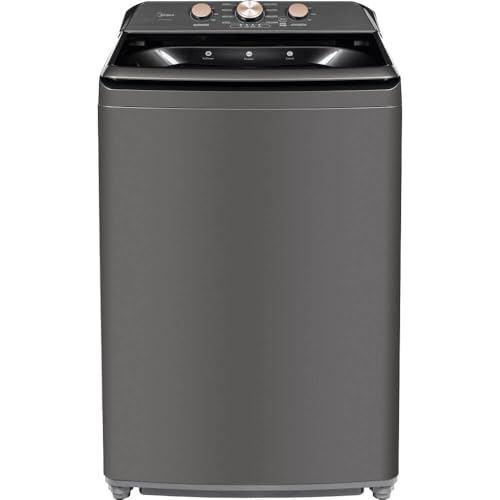
The Midea 4.1 cu. ft. top loader has a High Water setting, a Tub Clean cycle and eight presets. High Water is the relevant feature for gym towels, since a deep fill helps rinse dense terry, and Tub Clean keeps odor from settling into the drum. At 128 pounds it is manageable, and the price is low enough to keep a spare. It is the least intimidating machine on this list.
What stands out
- High Water helps rinse dense loads of gym towels
- The Tub Clean cycle controls odor between wash days
- It is affordable enough to keep a spare
Watch out for
- Auto sensing can choose a shallow fill for towels
- There is no steam or sanitize cycle on this model
Buying guide
What gym laundry is really made of
Terry towels are dense and absorbent, which is the point in the gym and a nuisance in the wash. A dry gym towel weighs well under a pound; soaked, it can weigh two or three. That water has to be replaced with detergent solution, agitated through the loop and then spun out, and a machine that fills shallow will leave the core of the pile dry and unwashed. This is why a gym towel load needs more water than the same weight of T-shirts. It also needs more detergent, because the soil is oil and salt rather than dust. A towel that comes out of the drum still smelling of chlorine or sweat was never fully wetted. Wet weight is the real load.
Microfiber is a different problem. It picks up oils and holds them, and fabric softener or dryer sheets coat the fibers so they stop absorbing. Wash microfiber separately, skip softener entirely and use a detergent with enzymes. If towels still smell after a hot wash, the dryer or the hamper is leaving moisture in the fabric, not the detergent. Microfiber also sheds lint into the drum and trap, so clean the filter more often if your gym uses it. Cool water is fine for microfiber as long as the detergent is right, but hot water is better for the cotton terry that makes up most gym towels. Never wash microfiber with terry; the lint transfer is permanent. Separate loads protect both fabrics.
Sizing the machine to the towel count
Count towels per day, not members. A gym that issues one towel per visit and sees 200 people a day generates 200 towels, roughly 60 to 80 pounds dry. A 33-pound commercial unit handles that in two or three loads; a 66-pound unit in one or two. A 4.5 cu. ft. front loader holds 15 to 20 pounds, which is fine for a studio with 40 daily visitors and wrong for a busy club. If your gym sells towel service to non-members, add that volume; it is often the difference between one machine and two. A club that runs classes back to back generates towels in bursts, not evenly, so plan for the peak hour rather than the daily average.
Then count hours, not just pounds. If the laundry room runs from 6 a.m. to 10 p.m., a 66-pound machine with a 45-minute cycle can process several hundred pounds in a day. If housekeeping leaves at 3 p.m., the same machine has half the window. Capacity per hour, not capacity per load, decides whether you need one unit or two. Staffing matters as much as machinery: someone has to move towels from the dryer to the shelf, and that person is usually the same one cleaning the locker room. A second machine is often cheaper than a second shift, and measuring a real week beats guessing from a busy Monday. Write the daily number on the laundry room wall where staff can see it.
Spin speed and the drying bill
Extraction speed decides how much water the dryer has to evaporate, and in a gym the dryer runs as much as the washer. The largest commercial unit here spins at 620 RPM, which is modest on paper but sustained over a much heavier drum. The 120V machines spin faster in relative terms and leave a 15-pound load damp rather than wet, so the dryer finishes sooner. Drying is where the utility bill hides: a towel that goes into the dryer at 60 percent moisture takes roughly twice as long as one at 40 percent. Over a year, that difference runs into hundreds of dryer hours. The spin cycle is also the loudest part of the wash, which matters if the laundry shares a wall with the weight room. A dryer that runs two hours longer every day is a machine that fails a year early.
That trade has a limit. Very high spin speeds can crease terry and stress the machine, and the commercial units compensate with a longer spin and a heavier suspension. If you are choosing between a 44-pound unit at 620 RPM and a 4.5 cu. ft. machine, pick based on volume first. Drying cost follows volume and moisture, not the other way around. A high-efficiency dryer with a moisture sensor will save more than a faster spin on a machine that is already maxed out. Keep the lint trap clean and the dryer vent short; a restricted vent can add 20 minutes to every load. Measure the vent run and the lint trap access before you place the dryer, not after.
Power, floor loading and placement
The commercial machines here need 220V, and two of them need three-phase. Heating power ranges from 6kW to 12kW, which means a dedicated circuit and often a service upgrade. The largest unit here weighs over 1,300 pounds empty. That load passes through four feet onto a floor designed for people, not machinery, so a structural check is not optional. A second-floor laundry in a converted office building is the usual problem case. Vibration isolation pads help, but they do not fix a floor that flexes. If the machine sits over a parking garage, have an engineer confirm the slab before delivery. Walk and photograph the delivery route, including door widths, thresholds and tight turns, before the truck arrives at all.
Drainage is the other installation trap. These units specify 2- to 2.5-inch drain ports and dump a drum of water in a hurry, so a floor drain or a large waste line is required. Ventilation matters too. A hot laundry room with several dryers needs makeup air, or the dryers run long and the room stays damp. In a gym, that damp air finds its way into the locker room, and members notice before the staff does. A humidity sensor on the exhaust fan is a small upgrade that pays for itself. Keep the water heater close to the laundry; long runs waste both water and heat. A dryer that cannot exhaust properly will cook towels and shorten their life.
Odor, hygiene and microfiber
Odor in gym towels is usually biofilm, not sweat. Detergent residue and moisture feed it, and a cold quick wash leaves both behind. Wash towels hot with an enzyme detergent, skip fabric softener, and dry them completely before they go back on the shelf. A monthly drum clean on hot keeps the machine from becoming the source. If the smell survives a hot wash, strip the towels with a hot wash and a cup of white vinegar, then rewash normally. Vinegar in the rinse is fine occasionally; in every load it can degrade elastic over time. A hot wash with a detergent built for synthetic fabrics works better than a cold wash with extra fragrance, every single time you try it.
Steam is useful for pads, mats and anything that cannot take a hot wash, but it will not sterilize a towel. Chlorine bleach works on white terry and damages elastane, so keep it away from straps and microfiber. If members complain about a mildew smell, check the dryer vent and the hamper before you blame the washer. A lidded, vented hamper and a daily pickup do more for odor than any sanitize cycle. Wash hands after handling used towels, and keep clean and dirty towels on separate carts. The goal is a routine that works when the gym is busy, not a perfect protocol for a quiet day. Clean towels should smell like clean cotton, not like a fragrance. That is the whole trick.
Frequently asked questions
How many towels can a commercial washer handle per day?
A 33-pound unit can process roughly 100 to 150 pounds of towels across a working day, which is about 250 to 400 gym towels. A 66-pound unit can double that. Real output depends on cycle length, staffing and drying capacity, so measure the whole loop rather than the washer alone.
Can a home washer handle gym towels?
For a studio or home gym with 30 to 50 towels a day, yes. A 4.5 cu. ft. front loader will run several loads without strain, though the duty cycle is the limiting factor. For a club with hundreds of daily towels, a residential machine will fail early. Match the machine to hours of operation, not just pounds.
Do I need three-phase power for a gym laundry?
Not necessarily. Several of these units run on 220V single-phase, which most commercial buildings can supply. Three-phase is more efficient for large motors but expensive to add. Have an electrician confirm the panel and service capacity before buying; the installation can exceed the machine cost.
How do I get sweat smell out of microfiber towels?
Wash them separately on hot with an enzyme detergent and no fabric softener. Add a second rinse, and dry them completely, because residual moisture is what feeds the smell. If odor persists, strip them with a hot wash and a half cup of baking soda, then rewash. Never use dryer sheets on microfiber.
What spin speed do I need for towels?
620 RPM on a commercial drum extracts well because the drum is large and the spin runs long. On a home-style front loader, anything above 1,000 RPM leaves towels ready for a short dryer cycle. Below 800 RPM, expect longer drying and higher energy use, especially with dense terry.
Verdict
The LGXEnzhuo 44-pound unit is the best fit for a working gym. It washes, spins and dries in one drum, heats its own water to 6kW, and has the safety lock and emergency stop that staff need. The 44-pound capacity matches a mid-size club's daily towel volume without forcing a second machine.
For a studio or home gym, the Kenmore 4.5 cu. ft. front loader is the value pick: 120V, five temperatures and an Extra Rinse that clears detergent from terry. The upgrade is the WYDDDARY 66-pound unit for clubs that generate more than 100 pounds a day. Confirm the 12kW circuit, the floor loading and the drain before delivery.