A laundry energy monitor is almost never sold as a laundry product. The hardware is a set of clamp sensors that live inside the breaker panel, and the laundry room gets one channel among sixteen. That is not a limitation so much as a design: the panel is where the current actually passes, and a clamp around the right conductor will measure a washer or dryer more honestly than any app that estimates from cycle counts.
Laundry is a good test case for these systems because it is bursty. A washer pulls hard for a few minutes, idles, then spins; a dryer runs a steady high load for an hour. A monitor with two-second sampling shows that shape, while a one-minute average turns it into a flat line. If you want to know whether it is cheaper to run a load at night or whether the dryer is the reason your bill jumped, the sampling rate matters as much as the accuracy figure.
We compared specifications, features and owner reports across ten monitors, from three-phase clamp meters that need a Tuya gateway to local-first units that never touch a cloud. The shortlist favors systems that can isolate a washer and dryer without pretending to be a utility-grade meter.
Top picks at a glance
3 Phase Clamp Meter Real Time Monitoring Home Energy Meter with 3 X 300A Circu
Check price on AmazonEmporia Vue 3 Home Energy Monitor
Check price on Amazon3 Phase 4 Wire Energy Meter Real Time Monitoring
Check price on AmazonCompare the shortlist
| Model | Type | Capacity | Key feature | Amazon |
|---|---|---|---|---|
| 1. 3 Phase Clamp Meter Real Time Monitoring Home Energy Meter with | Smart Energy | — | Sensor drying | Check price |
| 2. Meross Smart Home Energy Monitor with 18 Circuit Monitoring, Hom | Smart Energy | — | Connected controls | Check price |
| 3. 3 Phase 4 Wire Energy Meter Real Time Monitoring | Electric | — | Connected controls | Check price |
| 4. 3 Phase 4 Wire Energy Meter Real Time Monitoring 3 X 300A Circui | Smart Energy | — | Sensor drying | Check price |
| 5. 3 Phase Clamp Meter Real Time Monitoring Home Energy Meter with | Smart Energy | — | Sensor drying | Check price |
| 6. Meross Smart Home Energy Monitor, Real-Time Power & Cost Trackin | Electric | — | Connected controls | Check price |
| 7. Emporia Vue 3 Home Energy Monitor | Electric | — | Sensor drying | Check price |
| 8. Refoss Smart Home Energy Monitor with Open API, Home Assistant, | Electric | — | Sensor drying | Check price |
| 9. Refoss Smart Home Energy Monitor with 16 60A Circuit Sensor, Loc | Electric | — | Sensor drying | Check price |
| 10. Smart Home Energy Monitor with 16 50A Circuit Level Sensors, Rea | Electric | — | Connected controls | Check price |
Detailed reviews
3 Phase Clamp Meter Real Time Monitoring Home Energy Meter with 3 X 300A Circuit Level Sensor for ZigBee

Zqmvik's clamp meter uses three 300A sensors and a ZigBee radio to report voltage, current and power factor through a Tuya-compatible gateway. It is built for three-phase panels and for appliance-level branches, including a washer and dryer. Data arrives roughly every two seconds at about two percent accuracy. A gateway is required and is not included, and the listing says installation should be done by qualified personnel.
What stands out
- Three 300A sensors cover heavy three-phase service loads
- Updates every two seconds at roughly two percent accuracy
- Works with Tuya for appliance-level automation and rules
Watch out for
- Requires a separate ZigBee gateway to function at all
- No local-only mode or a documented open API
Meross Smart Home Energy Monitor with 18 Circuit Monitoring, Home Assistant Support, Real-Time Energy Usage Tr

Meross monitors two 200A mains plus sixteen 60A branch circuits, which is enough to put a dedicated sensor on the washer and another on the dryer. It supports Home Assistant, solar surplus detection and custom usage alerts, and the listing promises no subscription. ETL certification and UL 61010 compliance cover the safety side, with a two-year warranty. The unit is compact at 4.5 by 3.48 by 1.1 inches.
What stands out
- Eighteen channels cover mains plus individual appliance loads
- Home Assistant support with local data and no subscription
- ETL certified and tested to the UL 61010 standard
Watch out for
- No expandable branch count beyond the sixteen included
- Clamp-on installation still requires opening the breaker panel
3 Phase 4 Wire Energy Meter Real Time Monitoring
This is a three-phase, four-wire energy meter with three 300A clamp sensors and Tuya integration. It reports voltage, current and power factor every two seconds with about two percent accuracy, which is enough to see when a washer or dryer is running and roughly what it draws. The listing repeats the safety warning: installation and repair belong to qualified personnel, and power must be off before the clamps go on.
What stands out
- Three-phase four-wire support for larger commercial service panels
- Three 300A clamps handle air conditioning and dryers
- Two-second reporting is fast enough for load tracking
Watch out for
- Requires a Tuya gateway that is sold separately
- Per-circuit history export is not described in the listing
3 Phase 4 Wire Energy Meter Real Time Monitoring 3 X 300A Circuit Level Sensor
Gucagle's meter is the same three-phase formula: three 300A sensors, Tuya linkage and two-second updates at plus or minus two percent. It measures voltage, current and power factor, and the clamp design is meant to install around existing conductors without cutting them. The gateway is separate, and the listing is explicit that a qualified electrician should do the work. For a laundry room on a three-phase service, it is a way to watch both machines from one app.
What stands out
- Clamps around existing conductors without cutting or rewiring
- Three 300A sensors cover dryer and air conditioning
- Reports every two seconds at roughly two percent accuracy
Watch out for
- Needs a separate Tuya gateway and a Tuya account
- Not a substitute for a revenue-grade utility meter
3 Phase Clamp Meter Real Time Monitoring Home Energy Meter with 3 X 300A Circuit Level Sensor for ZigBee
Pvbylo's three-phase clamp meter follows the same Tuya template: three 300A sensors, a ZigBee radio, two-second reporting and about two percent accuracy. It measures voltage, current and power factor and links to other Tuya devices for automation. The listing stresses that the clamp is lightweight and easy to install around a power cord, but also that a qualified person should do the work. No gateway is included.
What stands out
- Three 300A clamps suit three-phase residential service panels
- Two-second data supports real-time load checks and alerts
- Tuya linkage enables simple automation and scheduling rules
Watch out for
- Gateway and account are separate purchases from the meter
- Documentation is limited compared with established mainstream brands
Meross Smart Home Energy Monitor, Real-Time Power & Cost Tracking
This Meross unit concentrates on branch circuits: sixteen 60A sensors plus two 200A mains, with Home Assistant support and solar surplus detection. The app tracks power, voltage, current and power factor to about two percent, stores up to five years of data and exports hourly reports. ETL certification, UL 61010 compliance and a two-year warranty round out the listing. It is the version to choose if your panel is full and you mainly want appliance-level detail.
What stands out
- Sixteen branch clamps provide real appliance-level energy detail
- Five years of stored data with hourly export
- No subscription and local Home Assistant data access
Watch out for
- Mains and branch clamps share one compact enclosure
- Installation requires panel access and careful breaker labeling
Emporia Vue 3 Home Energy Monitor

Emporia's Vue 3 is the best-known name in this category, and the listing is clear about the fine print: the base unit supports single-phase, split-phase and some three-phase systems, but a 200A sensor for three-phase Wye is sold separately. Branch sensors are also extra, up to sixteen at 50A. Data is plus or minus two percent, with one-second readings in the app, minute data kept seven days and hourly data kept indefinitely. It is UL Listed and carries a one-year warranty.
What stands out
- UL Listed with a mature app and clear data retention
- Supports both solar production and net metering monitoring
- Screw terminals make CT wiring easier to manage
Watch out for
- Branch sensors and the three-phase mains sensor are sold separately
- One-second data is only retained for three hours
Refoss Smart Home Energy Monitor with Open API, Home Assistant, No Cloud

Refoss builds the EM16P around local control: a built-in web interface, an open API and MQTT, with native Home Assistant integration and no cloud requirement. It reads two 200A mains and sixteen 60A branches at plus or minus one percent, stores daily data for five years and exports it. ETL certification and a two-year warranty cover the hardware. The listing also mentions OpenClaw support for AI-driven automation, which is unusual in this category.
What stands out
- Local web UI, Open API and MQTT without a cloud
- Plus or minus one percent accuracy on branch circuits
- Five years of daily data with CSV export
Watch out for
- Setup assumes comfort with IP addresses and MQTT
- The local-first setup is not aimed at casual users
Refoss Smart Home Energy Monitor with 16 60A Circuit Sensor, Local Control
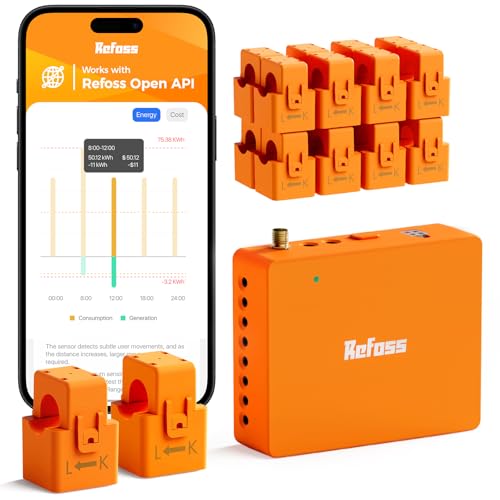
The second Refoss unit targets the same local-first buyer but adds an external antenna and an eighteen-circuit layout: two 200A mains and sixteen 60A branches. Accuracy is plus or minus one percent, daily data is kept for five years, and the app lets you flip a reversed CT reading instead of reopening the panel. It supports single-phase, split-phase and three-phase four-wire Wye systems. ETL certification and a two-year warranty apply.
What stands out
- Eighteen circuits with an external antenna for range
- Flip a reversed sensor reading in the app
- Local control with no subscription or cloud dependency
Watch out for
- Still needs panel space for sixteen branch clamps
- The documentation assumes a fair amount of networking knowledge
Smart Home Energy Monitor with 16 50A Circuit Level Sensors, Real-Time Power Usage & Electricity Cost Tracking

Fusion Energy's SEM-Meter is a sixteen-sensor branch monitor with a privacy mode: it can run on a local MQTT server without the vendor's cloud or app. The clamps are 50A, the reported accuracy is one percent, and it supports single-phase, split-phase and three-phase systems up to 415Y/240. Hourly exports last 90 days, while daily, monthly and yearly data is kept permanently. A one-year warranty applies.
What stands out
- Runs fully local on MQTT without vendor cloud
- Sixteen 50A clamps cover the usual appliance loads
- Supports three-phase systems up to 415Y/240 volts AC
Watch out for
- Fifty-amp clamps limit use on larger branch circuits
- Local mode requires a Home Assistant and MQTT setup
Buying guide
Whole-home or circuit-level: the laundry question
A whole-home monitor clamps around the two main service conductors and reports total consumption. That is useful for a bill, and useless for Laundry Day, because the washer disappears into the total. A circuit-level system adds branch sensors, usually 50A or 60A clamps, that go around individual breaker feeds. Put one on the washer circuit and one on the dryer circuit, and the app can show each machine separately. Sixteen branch channels is the common ceiling, which is enough for laundry plus the big loads that dominate a bill. The limitation is physical: every branch sensor needs a conductor to clamp around.
The dryer needs care because it is a 240-volt load. A single clamp around one leg reads only half the current, so a monitor that claims to cover a dryer with one 50A sensor is either using a double-pole sensor or reporting an approximation. Check how the system handles two-pole circuits before trusting its dryer numbers. The washer is simpler: a 120-volt branch with one hot leg, a neutral and a ground, and a clamp on the hot leg captures the whole load. If the washer shares a circuit with a utility sink pump, the reading will include both.
What has to fit in the panel
The typical layout is two 200A main clamps plus sixteen 60A branch clamps, all wired back to a controller that sits inside or beside the panel. That means physical space, not just electrical capacity. A panel already crowded with tandem breakers may not have room for sixteen CTs and their leads. Panels with access only to the busbars can need flexible sensors, and three-phase systems need a Wye configuration with an earthed neutral; delta service is usually excluded. Measure the panel and photograph the label before ordering. A panel with no spare knockout for the controller's cable is a non-starter.
The safety story is the same for every unit here: the cover comes off, the power is off, and someone who knows what a service conductor looks like does the work. Several listings say installation must be done by qualified personnel, and that is not boilerplate. ETL certification or UL 61010 compliance speaks to the device, not to your wiring. If your panel is old, full, or has aluminum branch wiring, get an electrician to scope the job before you buy a monitor. The same visit can confirm whether the panel has a neutral bar available for the controller.
Gateways, protocols and the cloud question
The three-phase clamp meters in this group use ZigBee and Tuya, which means they need a gateway that is often sold separately. The gateway is a small extra box and one more thing that can lose its pairing, but it also lets the sensors run on a low-power radio instead of Wi-Fi inside a metal panel. Wi-Fi units connect directly, which is simpler until the panel is in a basement corner where the signal is weak. An external antenna, as one Refoss model offers, is a practical answer to that problem. ZigBee also keeps the radio out of your Wi-Fi spectrum, which matters in a crowded house.
Then there is the cloud. Meross, Refoss and Fusion Energy all advertise local operation or no subscription, but the details differ: some keep data on a local server, some expose an open API, and some still need the vendor's app for setup. If Home Assistant is your hub, look for native integration or MQTT rather than a cloud API that can be switched off. If you just want a monthly chart, a cloud app is fine. Read the retention terms either way, because a five-year history is only useful if you can export it. Local access is the safer bet for long-term use; cloud services change terms.
Accuracy, sampling and solar automation
One percent versus two percent accuracy sounds like a marginal difference, and for a whole-home total it is. For a single wash cycle it matters more: at two percent, a 1.5 kWh cycle carries an uncertainty of about 30 watt-hours, which is small next to the error in guessing your utility's rate. Sampling rate is the bigger practical split. One-second data captures the heating and spin phases; two-second data is close enough; one-minute averages blur them into a single bar. For laundry, two-second sampling is enough to separate the wash, heat and spin phases.
Solar is where these monitors earn their keep beyond curiosity. A unit that detects surplus production can tell you to run the washer and dryer at midday instead of after dinner, and some can trigger a smart plug or a Home Assistant automation. Peak-demand and time-of-use alerts work the same way: set a threshold, get a notification, move the load. None of that requires a laundry-specific feature. It requires a monitor that exposes the data and a house willing to change its schedule. Start with one appliance and a week of data before automating anything.
Frequently asked questions
Can an energy monitor tell me what one wash cycle costs?
Yes, if you have a branch sensor on the washer circuit and your utility rate is entered correctly. The monitor measures watt-hours, and the app multiplies by the rate. Treat the result as a close estimate rather than a billing figure, since taxes, tiers and time-of-use periods can change the effective rate.
Do I need a smart panel or special breakers?
No. These systems use clamp-on current sensors around existing conductors, plus a small controller. You need physical space in the panel and a qualified installer. A smart panel replaces the panel itself; a monitor adds sensors to the one you have.
Is a 60A sensor enough for a dryer circuit?
For most homes, yes. A typical electric dryer runs on a 30A double-pole breaker, and a 60A clamp covers that with headroom. The important detail is whether the monitor reads both legs of the 240-volt circuit; a single clamp on one leg will undercount.
Will a monitor work with rooftop solar?
Most of these units support solar production and net metering monitoring, and some can detect surplus power for load shifting. Check the listing for your service type, because three-phase systems may need an extra sensor and delta service is often unsupported.
Can I install an energy monitor myself?
Only if you are comfortable working inside a breaker panel with the main off, and your local rules allow it. Several listings specify qualified personnel, and insurance may care after a fault. An electrician can usually install the controller and clamps in an hour or two.
Verdict
The Refoss EM16P is the top pick for a laundry-focused installation: two 200A mains and sixteen 60A branches, plus or minus one percent accuracy, five years of daily data, local web access, MQTT and native Home Assistant support. It costs more thought to set up than a cloud plug, and it rewards that effort with data you actually own. The Meross sixteen-channel unit is the value choice if you want ETL certification, Home Assistant support and no subscription with a simpler app.
The Emporia Vue 3 is the upgrade for homeowners who want a mature app, UL listing and expandable branch monitoring, provided you budget for the extra sensors. Choose the three-phase Tuya meters only if your panel is three-phase and you already run a Tuya gateway. For a single-family home with a washer and dryer, the Refoss or the Meross will answer the question that matters: which machine is moving the meter.