The appliance people most want to put on a smart plug is the washing machine, and it is the one that gains the least. A plug can cut power and restore it, but it cannot press Start. Most modern washers hold their cycle in an electronic control board, so an interrupted wash stays interrupted, full of water, until somebody walks over and presses a button.
The laundry room still has plenty of work for a plug. A dehumidifier that runs all afternoon and should stop before the room turns clammy is a natural fit. So is a box fan pointed at a drying rack, a lamp over the folding table, or a pedestal fan meant to keep air moving through a damp basement corner.
The other surprise is physical. Laundry rooms tend to have two outlets, one behind each machine, and a plug with a rounded body can cover the second socket or stop a cord from seating against the wall. That is why the ultra-mini format dominates this list: about 2.4 inches deep is the limit before a plug starts to interfere.
Ten plugs are compared here, though several are the same model in different pack sizes. Only one measures energy, one is Matter-native, and one speaks only to Alexa. The rest are competent on/off switches with timers, which is all most laundry rooms actually need.
Top picks at a glance
Kasa Smart Plug Ultra Mini 15A, EP10, Smart Home Wi-Fi Outlet
Check price on AmazonKasa Smart Plug Mini 15A, EP25P4, Apple HomeKit Supported
Check price on AmazonKasa Smart Plug HS103P4, Smart Wi-Fi Outlet, Touch Actuator, Works with Alexa,
Check price on AmazonCompare the shortlist
| Model | Type | Capacity | Key feature | Amazon |
|---|---|---|---|---|
| 1. Kasa Smart Plug Ultra Mini 15A, EP10, Smart Home Wi-Fi Outlet | Smart Energy | — | Connected controls | Check price |
| 2. Kasa Smart Plug Mini 15A, EP25P4, Apple HomeKit Supported | Smart Energy | — | Connected controls | Check price |
| 3. Kasa Smart Plug HS103P4, Smart Wi-Fi Outlet, Touch Actuator, Wor | Smart Energy | — | Connected controls | Check price |
| 4. Amazon Smart Plug, Works with Alexa, Simple Setup, Endless Possi | Smart Energy | — | Connected controls | Check price |
| 5. Kasa Smart Plug Ultra Mini 15A, EP10P4, Smart Home Wi-Fi Outlet | Smart Energy | — | Connected controls | Check price |
| 6. Kasa Smart Plug Ultra Mini 15A, EP10P2, Smart Home Wi-Fi Outlet | Smart Energy | — | Connected controls | Check price |
| 7. Linkind Matter Smart Plug, Work with Apple Home, Alexa, Siri, Go | Smart Energy | — | Connected controls | Check price |
| 8. Govee Smart Plug, WiFi Outlet Compatible with Alexa & Google Ass | Smart Energy | — | Connected controls | Check price |
| 9. GHome Smart Plug, WiFi Smart Plugs that Work with Alexa and Goog | Smart Energy | — | Connected controls | Check price |
| 10. EIGHTREE Smart Plug WiFi Outlet Works with Alexa & Google Home, | Smart Energy | — | Connected controls | Check price |
Detailed reviews
Kasa Smart Plug Ultra Mini 15A, EP10, Smart Home Wi-Fi Outlet

The single-pack version of Kasa's ultra-mini plug, 2.36 inches deep and 1.5 inches tall, with a 15-amp rating and 2.4 GHz Wi-Fi. It does on/off, schedules and countdowns through the Kasa app and works with Alexa and Google. No energy monitoring and no HomeKit, but it is the simplest way to put one laundry-room outlet on a timer. A physical button on the face still works when the network does not.
What stands out
- Small body leaves the second outlet free for another plug
- Fifteen amps handles a dehumidifier without any strain
- Two-year warranty and UL certification for daily use
Watch out for
- No energy monitoring, so you cannot see the running cost
- One plug only, and a second outlet costs again
Kasa Smart Plug Mini 15A, EP25P4, Apple HomeKit Supported

The EP25 four-pack is the only plug in this batch that measures power, and it adds Apple HomeKit alongside Alexa, Google and SmartThings. Kasa's app shows live watts and a running history, which is how you find out what the dehumidifier really costs to run. The body is 2.62 inches long and 1.57 inches wide, so it stays out of the way.
What stands out
- Real-time and historical energy monitoring in the Kasa app
- Works with HomeKit, Alexa, Google and SmartThings apps
- Four plugs cover both machines and two extras
Watch out for
- HomeKit remote control needs a home hub present
- Costs noticeably more than the plain EP10 four-pack
Kasa Smart Plug HS103P4, Smart Wi-Fi Outlet, Touch Actuator, Works with Alexa, Echo, Google Home, No Hub Requi

An older Kasa design sold in a four-pack, with a touch actuator on the face and a 15-amp rating. It handles schedules, countdowns and voice control through Alexa or Google, and it is UL certified. What it lacks is the smaller body and the energy metering of the EP25, so it suits a bulk buy for lamps, fans and a dehumidifier rather than a metered setup.
What stands out
- Four 15-amp plugs for the price of one metered unit
- Touch button is easy to find behind a machine
- Works with Alexa and Google without any hub
Watch out for
- No energy monitoring, so it cannot show running cost
- Bulkiest Kasa body in this batch of plugs
Amazon Smart Plug, Works with Alexa, Simple Setup, Endless Possibilities
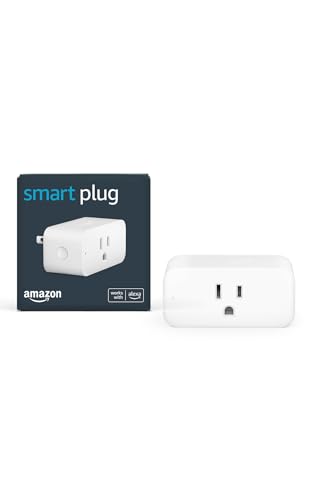
Amazon's own plug is the least complicated device here: plug it in, open the Alexa app, and it appears. It does routines, schedules and voice control, and the compact body is designed to keep the second socket free. There is no Google support, no HomeKit and no watt meter, so it only makes sense if Alexa already runs the house.
What stands out
- Setup takes only minutes inside the Alexa app
- Compact shape leaves the second outlet fully usable
- Routines can tie the fan to other Alexa devices
Watch out for
- Alexa only, with no Google or HomeKit option
- No energy monitoring and no detailed usage history
Kasa Smart Plug Ultra Mini 15A, EP10P4, Smart Home Wi-Fi Outlet

Four of the EP10 ultra-mini plugs in one box, each 2.36 by 2.03 by 1.5 inches and rated 15 amps. They are the same plug as the single pack, so the four-pack is simply the sensible way to cover a washer, a dryer outlet and two accessory sockets. Schedules, countdowns, Alexa and Google all work; metering does not. Each plug pairs separately, so the app lists four devices rather than one group.
What stands out
- Four compact plugs arrive in a single purchase
- Same 15-amp rating as the more expensive metered model
- Fits a duplex outlet without blocking the second
Watch out for
- No watt reading on any of the four plugs
- A Kasa app account is required for every plug
Kasa Smart Plug Ultra Mini 15A, EP10P2, Smart Home Wi-Fi Outlet

The two-pack of the EP10, aimed at a washer and dryer pair or a dehumidifier and a fan. Each unit is the 1.5-inch-tall ultra-mini body with a 15-amp rating, UL certification and a two-year warranty. It is the sensible middle size if four plugs would sit in a drawer and one would leave you short. Both units pair separately, so each can carry its own name in the app.
What stands out
- Two plugs suit a washer and dryer outlet pair
- Ultra-mini body keeps both sockets clear and usable
- Alexa and Google control without a hub or bridge
Watch out for
- No energy monitoring here, just on and off
- Costs more per plug than the four-pack option
Linkind Matter Smart Plug, Work with Apple Home, Alexa, Siri, Google Home

Linkind's four-pack is the Matter option, which means Apple Home, Alexa, Google Home or SmartThings can control it without a separate manufacturer app. Each plug handles 15 amps and 1,800 watts, is ETL certified and keeps working over the local network if the internet drops. A Matter controller is required for the big platforms, and the AiDot app works without one.
What stands out
- Matter support across all four major smart-home platforms
- Local control keeps working through an internet outage
- Fifteen amps plus overload and short-circuit protection built in
Watch out for
- Needs a Matter hub or controller for voice platforms
- No energy monitoring in the app or elsewhere
Govee Smart Plug, WiFi Outlet Compatible with Alexa & Google Assts, 4 pcs

A four-pack from Govee that pairs over Bluetooth and then runs on 2.4 GHz Wi-Fi, with group control so one tap can switch several plugs. The catch is the rating: 10 amps and 1,200 watts, well below the 15-amp ceiling of the Kasa and Linkind models. Good for lamps, fans and holiday lights, less suited to a compressor appliance. ETL and FCC certification covers the safety side.
What stands out
- Bluetooth pairing is quicker than the usual Wi-Fi setup
- Group control switches several plugs with one tap
- ETL and FCC certified with a compact body
Watch out for
- Only 10 amps and 1,200 watts of capacity
- No 5 GHz Wi-Fi support, like every plug here
GHome Smart Plug, WiFi Smart Plugs that Work with Alexa and Google Home

A single GHome plug that works with the GHome, Smart Life and Tuya apps, so it can slot into an existing smart-home account rather than adding another. It is 1.1 inches tall and 2.1 inches square, one of the flattest bodies in the batch. Voice control needs the app first; Alexa and Google cannot talk to it directly out of the box.
What stands out
- Works with three common smart-home apps out of the box
- Very flat body slips behind a machine easily
- Schedules, countdowns and group sharing are all included
Watch out for
- Must be set up in the app before voice control
- Single plug only, with no multi-pack option here
EIGHTREE Smart Plug WiFi Outlet Works with Alexa & Google Home, 15A, 4-Pack

EIGHTREE's four-pack uses the Smart Life app and Bluetooth for first-time pairing, then 2.4 GHz Wi-Fi for control. Each plug is rated 15 amps, and the set includes timer, countdown and random schedule options. The listing's 4-inch dimensions describe the pack rather than one plug, so measure the outlet before assuming the body is that wide. Bluetooth handles setup even when the phone is on a 5 GHz network.
What stands out
- Four 15-amp plugs with app and voice control
- Bluetooth pairing avoids the usual Wi-Fi setup dance
- Random scheduling is genuinely useful when you travel
Watch out for
- Alexa and Google need the Smart Life app first
- No energy monitoring on any of the four plugs
Buying guide
Most washers will not pick up where the plug left off
A smart plug is a switch, not a remote control for the machine's own panel. When it cuts power, the washer's board loses its place in the cycle. On a front-loader that can mean a locked door, a tub of water and a fault code when power returns. Some machines resume, many do not, and the difference is rarely spelled out in the manual. Test it once with a load you do not care about before you trust a schedule. If what you really want is a wash that finishes when you get home, the machine's own delay-start setting is the better tool.
Dryers are a harder stop. An electric dryer runs on a 240-volt circuit and cannot be plugged into any 120-volt smart plug here. A gas dryer uses a standard cord but has the same memory problem, and interrupting a cycle with a drum full of hot clothes is a good way to set wrinkles. Use a plug on a machine only if its manual says the cycle resumes after a power interruption. Otherwise the plug is a remote kill switch, and a kill switch you cannot restart remotely is not much of a convenience.
Fifteen amps is the ceiling, and one of these plugs stops at ten
A 15-amp plug on a 120-volt circuit is rated for 1,800 watts. That covers a dehumidifier, a fan, a lamp and most small laundry-room loads with room to spare. It does not leave room for a washer's spin-up surge and a dehumidifier on the same circuit, which is why the breaker, not the plug, is usually what trips. Treat the plug rating as a ceiling rather than a target, and remember that watts add up across a circuit even when they are spread over several outlets and several plugs.
The Govee four-pack is rated 10 amps and 1,200 watts, and that is a real difference rather than a rounding error. Ten amps is fine for lamps and fans and marginal for a compressor-driven dehumidifier. Check the amp figure on the appliance label before assuming any plug will do; a plug running at its limit every time a compressor starts is not where you want to save money. If the label is hidden behind the machine, look up the model number instead of guessing from the size of the unit.
2.4 GHz only, and Matter changes who runs the show
Every plug here connects on the 2.4 GHz band. That is fine for a laundry room at the back of the house and better through a concrete wall than 5 GHz, but it means the plug will not see a router that publishes only a 5 GHz network. If your phone is on the faster band during setup, the app may never find the device. Join the 2.4 GHz network for the two minutes of pairing, then forget about it.
Matter is the other fork in the road. The Linkind plugs hand control to Apple Home, Alexa, Google Home or SmartThings without a manufacturer app, but they need a Matter controller such as a HomePod, Echo, Nest or SmartThings hub to do it. The Kasa EP25 also needs a home hub for HomeKit, because Siri control of a Wi-Fi plug runs through an iPad, HomePod or Apple TV. Pick the ecosystem first, then the plug.
The one feature worth paying extra for is a watt reading
Energy monitoring sounds like a gimmick until you point it at a dehumidifier. The Kasa EP25P4 reports real-time watts and keeps a history in the app, so you can see how long the compressor actually ran overnight against how long you assumed it ran. That number is what tells you whether a 30-minute schedule is enough or whether the room needs a different fix entirely.
What it will not do is measure a dryer or any 240-volt circuit, and it will not split a washer's cycle into wash, rinse and spin. For that detail you need a panel monitor with clamp sensors, which is a different purchase and often a different installer. A plug meter is a single-appliance tool, and it is honest about that limit; so is every plug-in watt meter on the market.
Fit, buttons and the outlet behind the machine
The ultra-mini plugs here are about 2.4 inches deep and 2 inches wide, small enough to leave a duplex outlet usable. The Amazon plug is closer to 3.15 inches long, and the EIGHTREE set lists a package footprint around 4 inches square, so check the space before committing to a strip. Laundry outlets are often GFCI receptacles with a test and reset button, and a fat plug can make that button hard to reach.
A physical button still matters. Every plug here has one, and it is what you use when the Wi-Fi is down or a guest needs the fan. Look for a button on the face rather than the side if the outlet sits behind the machine, and check the plug's orientation: a body that hangs below the outlet can foul a hose or a leveling foot. Depth is easy to measure and easy to forget, and the mistake only shows up when you push the machine back and hear plastic crack.
Frequently asked questions
Can I put my washing machine on a smart plug?
You can plug it in, but the plug can only cut and restore power. It cannot start a cycle, and many washers lose their place when power drops, leaving a full tub and a locked door. If you want a schedule, test one interrupted cycle first and check whether your manual says the machine resumes.
Can a smart plug run an electric dryer?
No. An electric dryer needs a 240-volt circuit, and every plug on this list is a 120-volt device rated for 15 amps or less. A gas dryer can physically plug in, but cutting power mid-cycle is bad for the clothes and the machine, so it is not a useful automation.
Do these smart plugs work with 5 GHz Wi-Fi?
No. All of them are 2.4 GHz only, which is normal for this class of device. If your router uses one network name for both bands, the plug will usually still connect, but a phone locked to 5 GHz during setup can stop the app from finding it.
How many watts can a 15-amp smart plug handle?
About 1,800 watts at 120 volts, which is the practical limit for a dehumidifier, fan or lamp. The Govee plugs are rated 10 amps and 1,200 watts. Add up everything on the circuit, not just the one appliance, because the breaker protects the wire and does not care which plug is rated for what.
Will a smart plug fit behind a washer in a tight outlet?
An ultra-mini body around 2.4 inches deep usually will. Measure the gap between the outlet face and the back of the machine, including the plug body and the cord's bend. If the outlet is a GFCI, leave room for the test button; a plug that covers it is a nuisance every time the circuit trips.
Verdict
The Kasa EP25P4 is the pick for a laundry room because it is the only plug here that reports watts, and a laundry room is where that number earns its keep. Fifteen amps, HomeKit support and a body small enough for a duplex outlet round it out. If you just want the dehumidifier on a timer, the Kasa EP10 four-pack is the value buy at the same 15-amp rating without the meter. The Linkind Matter four-pack is the upgrade for a house that already runs on Apple Home, Alexa or SmartThings and wants one app for everything.
The Amazon plug makes sense only in an all-Alexa household; it is the simplest setup here and the least flexible. Skip the Govee set for a compressor appliance and keep it for lamps and fans, where 10 amps is plenty.