Laundry is the household chore people most often try to cost out, and the arithmetic is less obvious than it looks. The washer has a motor, a pump, a control board and a display. The dryer has a heating element or a gas burner and a blower. The hot water comes from a tank in the basement or a coil in a closet. Four different loads, and a single plug-in meter can only see one of them.
That is the split this guide is built around. A plug-in watt meter sits between the wall and one 120-volt appliance, which makes it perfect for a washer, a dehumidifier or a drying fan. A whole-panel monitor clamps onto the service conductors and the branch circuits, which is the only way to catch a 240-volt dryer and the water heater that feeds the hot wash.
The products here range from a two-pack of plug meters with an adjustable overload alarm to a panel unit with sixteen branch sensors and a local API. They are not competitors so much as different levels of the same investigation, and the right one depends on whether you want to know what the washer draws or what the laundry routine costs.
Top picks at a glance
2 Pack Upgraded Watt Meter, Power Meter Plug Electricity Usage Monitor
Check price on AmazonUpgraded Watt Meter Power Meter Plug Home Energy Monitor 8 Display Modes
Check price on AmazonRefoss Smart Home Energy Monitor with 16 60A Circuit Sensor, Local Control
Check price on AmazonCompare the shortlist
| Model | Type | Capacity | Key feature | Amazon |
|---|---|---|---|---|
| 1. 2 Pack Upgraded Watt Meter, Power Meter Plug Electricity Usage M | Electric | — | Connected controls | Check price |
| 2. Upgraded Watt Meter Power Meter Plug Home Energy Monitor 8 Displ | Electric | — | Connected controls | Check price |
| 3. HBN Watt Meter Plug with Backlight, Plug-in Socket Power Meter E | Electric | — | — | Check price |
| 4. Emporia Vue 3 Home Energy Monitor | Electric | — | Sensor drying | Check price |
| 5. Smart Home Energy Monitor with 16 50A Circuit Level Sensors, Rea | Electric | — | Connected controls | Check price |
| 6. Refoss Smart Home Energy Monitor with 16 60A Circuit Sensor, Loc | Electric | — | Sensor drying | Check price |
| 7. Watt Meter Power Meter Plug Home Electricity Usage Monitor 7 Mod | Electric | — | — | Check price |
Detailed reviews
2 Pack Upgraded Watt Meter, Power Meter Plug Electricity Usage Monitor

Two identical plug meters with an eight-mode backlit display, covering watts, kilowatt-hours, volts, amps, hertz, power factor, cost and elapsed time. The overload threshold is adjustable up to 3,680 watts, and the factory setting is high enough that you should lower it before measuring a 15-amp appliance. A kilowatt-hour alarm and data memory make it useful for a week-long washer test.
What stands out
- Two meters, so washer and dehumidifier can run at once
- Adjustable overload alarm down to a sensible level
- Keeps accumulated data when you unplug the meter
Watch out for
- Overload default is too high for a 15-amp load
- Backlight dims after ten minutes without a button press
Upgraded Watt Meter Power Meter Plug Home Energy Monitor 8 Display Modes

A single MECHEER meter with the same eight display modes, a 2.5 by 3.5 inch body and a default overload warning at 1,800 watts. Reset is a five-second press with no tool, which matters if you plan to measure one cycle at a time. It stores accumulated electricity and cost across unplugging, and the ABS housing is rated for standard US sockets.
What stands out
- Overload warning set at a realistic 1,800 watts
- Five-second reset with no pin or tool needed
- Large backlit screen stays readable at an angle
Watch out for
- Only one meter in the box, not two
- Cost mode needs the tariff entered by hand
HBN Watt Meter Plug with Backlight, Plug-in Socket Power Meter Electricity Usage Monitor Consumption Home Elec

The HBN meter adds apparent power in volt-amps to the usual list, for nine modes in total. It is rated 125 volts AC, 15 amps and 1,875 watts, with a 160-degree viewing angle and a backlight that shuts off after fifteen seconds to save power. It stores non-real-time data through an outage, and a three-second press clears the accumulated totals.
What stands out
- Nine modes, including apparent power measured in volt-amps
- Wide viewing angle suits a low, floor-level outlet
- Stores accumulated totals through a sudden power outage
Watch out for
- Backlight cuts out after only fifteen short seconds
- No two-pack option for a paired appliance test
Emporia Vue 3 Home Energy Monitor

Emporia's panel monitor clamps inside the breaker panel and reports to an app over 2.4 GHz Wi-Fi, with one-second data while the app is open, one-minute data kept for a week and hourly data kept indefinitely. It is UL and CE listed, handles single-phase, split-phase and two-wire systems, and tracks solar and net metering. Accuracy is quoted at plus or minus two percent.
What stands out
- Sees the dryer and water heater, not just 120-volt loads
- One-second data helps spot a sudden power surge
- Solar and net metering support are built in
Watch out for
- Needs panel access and a 2.4 GHz Wi-Fi signal
- Three-phase systems need an extra sensor, sold separately
Smart Home Energy Monitor with 16 50A Circuit Level Sensors, Real-Time Power Usage & Electricity Cost Tracking

Fusion's monitor ships with sixteen 50-amp branch sensors plus mains, which is enough to give the washer, dryer and water heater their own channels. It quotes one percent accuracy, runs on 2.4 GHz Wi-Fi, and can operate entirely on a local MQTT server with no cloud account, which makes it a natural fit for Home Assistant. The one-year warranty is shorter than Refoss offers.
What stands out
- Sixteen branch sensors cover every big household load
- Local MQTT mode works without any cloud account
- One percent accuracy claim beats most plug meters
Watch out for
- One-year warranty only, which is shorter than Refoss offers
- Local mode assumes you already run a broker
Refoss Smart Home Energy Monitor with 16 60A Circuit Sensor, Local Control
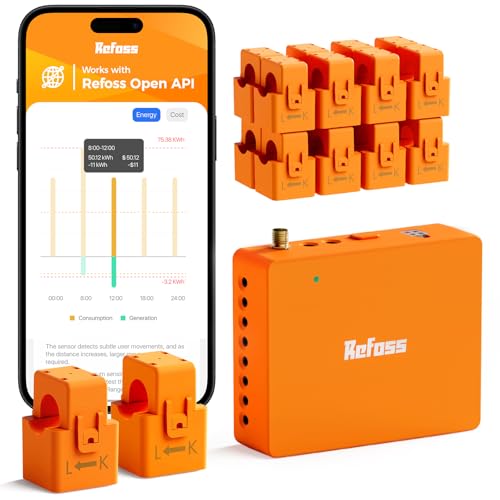
Refoss monitors eighteen circuits with two main sensors rated to 200 amps and sixteen branch sensors rated to 60 amps, at a quoted plus or minus one percent. It offers a local web interface, an open API, MQTT and WebSocket, keeps daily data for five years and exports CSV without a subscription. It is ETL certified, and a reversed sensor can be flipped in the app instead of rewired.
What stands out
- Eighteen circuits in total, with high-capacity main clamps
- Local web UI, API and MQTT with no subscription
- Five years of daily history, exportable to CSV
Watch out for
- Panel installation is not a job for beginners
- More monitor than a single laundry room needs
Watt Meter Power Meter Plug Home Electricity Usage Monitor 7 Modes Display
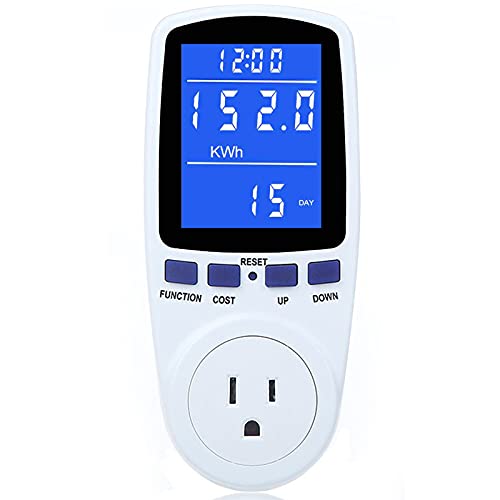
The older MECHEER design has seven modes and a 2.36 by 1.85 inch LCD with five backlight durations, from ten minutes to always on. Overload is adjustable up to 3,680 watts, and accumulated electricity, cost and time survive an unplug or a power cut. It lacks the hertz and power-factor modes of the newer eight-mode units, so it is the budget way into a single-appliance measurement.
What stands out
- Backlight can be set to stay on permanently
- Large screen is easy to read standing up
- Keeps accumulated totals through a sudden power failure
Watch out for
- Only seven modes, with no hertz or power factor
- No dimensions published for fitting a tight outlet
Buying guide
Two kinds of tracker, and only one can see the dryer
A plug-in meter is a pass-through device: the appliance plugs into it, it plugs into the wall, and it measures volts, amps, watts and accumulated kilowatt-hours. It is limited to 120-volt, 15-amp loads, which covers the washer, the dehumidifier, the iron and the drying fan. It cannot be used on a 240-volt dryer circuit, and no adapter makes that safe.
A panel monitor uses clamp-on current sensors around the service conductors and individual branch wires. It sees everything downstream, including the dryer and the water heater, and it reports to an app or a local server. The trade-off is installation: you are working inside the breaker panel, and the unit has to be mounted where the sensors can reach the wires. That is a different project from plugging a meter into a wall.
There is a third option that gets overlooked: a smart plug with metering. It is a plug meter with an app and a schedule attached, and for a washer it does both jobs at once. The catch is the same 15-amp ceiling, plus the fact that the plug's own electronics sit in a humid room. If you already want the dehumidifier on a timer, a metered plug is the more useful purchase than a bare meter.
A washer meter misses most of a hot wash
This is the part that surprises people. A plug meter on the washer measures the motor, the pump, the control board and the display. It does not measure the energy used to heat the water, because that happens at the water heater, on a different circuit, often in a different room. A hot wash can look modest on the meter while the gas or electric water heater quietly does the expensive part.
So read the number for what it is: the machine's own draw. If you want the full cost of a hot cycle, you need the water heater on a monitored circuit, which means a panel monitor or a separate meter at the tank. A practical compromise is to run the same load on cold and on hot, compare the washer's numbers, then add the water-heating difference from your utility bill.
Water heating is also where the fuel matters. An electric tank can add a large load for every hot wash; a gas tank adds gas, which no plug meter can measure at all. That does not make the washer's own reading useless. It tells you what the machine costs to run, and it separates a washer that is behaving normally from one with a failing pump or a heater circuit stuck on.
Panel monitors need space, phases and a plan
Before buying a panel monitor, open the panel and look at two things: whether there is a spare knockout for the unit's own breaker, and whether the main conductors are accessible for the clamps. The Emporia Vue 3 supports single-phase, split-phase and two-wire systems; three-phase and four-wire Wye systems need an extra sensor on some models. The Fusion unit covers single, split-phase and three-phase up to 415Y/240, while Refoss covers single, split and three-phase four-wire Wye.
If the panel is full, old, or has no room for the sensor leads, the job stops there until an electrician makes room. A monitor that clamps the mains only will give you a whole-house total, which is useful for spotting a bad week but useless for separating the dryer from the oven. Branch sensors are what turn a total into a diagnosis.
Placement of the unit itself is the other practical detail. Most of these boxes are designed to sit inside or beside the panel, and the Refoss includes an external antenna because a panel in a basement corner is a poor place for Wi-Fi. Check the cable length on the sensors before you plan the layout: a 50-amp clamp with a short lead will not reach the far side of a crowded panel, and extending it is not a hardware-store job.
The numbers worth writing down
A plug meter's display cycles through modes: watts now, kilowatt-hours accumulated, volts, amps, hertz, power factor and cost. The two that matter for laundry are the running watts and the accumulated kilowatt-hours over a full cycle. Reset the accumulated value before the load, run the cycle, and read the total afterward. That single number, divided by the load size, is your cost per wash. Some meters also hold minimum and maximum watts, which is how you catch a spin-up surge or prove that a machine really did fall back to a low-power standby between cycles.
Cost mode needs a unit price before it means anything, and most of these meters let you enter one. Check whether the figure is cents per kilowatt-hour or the full amount; a decimal in the wrong place makes the result nonsense. If the meter has a data-memory function, it will keep the accumulated total when you unplug it, which is the difference between a week-long test and one you have to restart every time somebody needs the outlet.
Accuracy, sampling and where the data lives
Plug meters are generally accurate enough for appliance-level decisions, and the panel units here quote plus or minus one or two percent. That is finer than the difference between one wash cycle and the next, so do not chase small variations. What matters more is sampling: the Emporia Vue 3 keeps one-second data only while the app is open and retains it for three hours, then drops to one-minute data for seven days and hourly data indefinitely. A plug meter samples fast enough to show a pump pulsing, but that one-second view is what shows a dryer element switching on and off through a cycle.
Where the data lives is the other question. Cloud-based monitors are easier to set up and harder to keep private; the Refoss and Fusion units offer local options, including MQTT, an open API and a local web interface, and the Refoss can run without its cloud at all. If you already run Home Assistant, that local path is worth more than a slightly prettier app.
Frequently asked questions
Can a plug-in power meter measure my dryer?
No. An electric dryer runs on a 240-volt circuit at far more than the 15 amps a plug meter is built for. Only a panel monitor with clamp sensors can measure it. A gas dryer plugs into 120 volts, but the meter would still only see the motor, controls and igniter, not the gas.
How accurate are these energy monitors?
The plug meters are fine for comparing one cycle to another. The panel units here claim plus or minus one to two percent. Neither is a revenue-grade meter, and neither will match your utility bill exactly, because the bill includes delivery charges, taxes and fees that the device never sees.
How much electricity does a washing machine use per load?
It depends on the machine, the cycle and the water temperature, which is exactly why a meter is useful. The washer's motor and controls are a modest load; the big variable is hot water, and that energy is consumed at the water heater rather than at the outlet behind the machine.
Do I need an electrician to install a whole-home energy monitor?
Often, yes. The unit installs inside the breaker panel, and the sensors must clamp around conductors that may be live. Some homeowners with an accessible panel and a spare knockout do it themselves, but if the panel is full, the labelling is unclear or you are not comfortable working near the main lugs, hire someone.
Is a smart plug enough to track laundry energy?
For the washer, a dehumidifier or a fan, yes, provided the plug reports watts rather than just on and off. For the dryer and the water heater, no. A smart plug with metering is the simplest start, and it will tell you quickly whether a panel monitor is worth the extra trouble.
Verdict
The Refoss monitor is the top pick because it covers the whole picture: two main sensors up to 200 amps, sixteen branch sensors at 60 amps, eighteen circuits, plus one percent accuracy and a local API that keeps working without a cloud account. It is the one here that can separate the dryer, the washer and the water heater in a single view. For a simpler question, the MECHEER two-pack of plug meters is the value buy: put one on the washer and one on the dehumidifier and you will learn most of what a laundry room can tell you. The Emporia Vue 3 is the upgrade for a household with solar or net metering, where the one-second view and the UL listing matter more than branch count.
If you are not ready to open the panel, start with a plug meter. It is honest about its limits.