The best pretreater is the one you actually reach for at ten at night, with the shirt already in the basket and the wash about to start. That sounds like a low bar until you compare formats. A gel stick lives in a drawer and takes four seconds. A refill bottle needs a sprayer you have to find. A bar of soap needs wet hands and a scrub. Chemistry matters, but format decides whether treatment happens.
Pretreating is also the step most people skip, then blame the detergent for. A wash cycle gives a stain remover roughly fifteen minutes of contact at a dilution the machine chose. Applying concentrate directly to the mark and leaving it there changes both variables at once. That is the entire principle, and it works with ordinary products.
The ten entries here cover the formats that matter: a gel stick, several trigger sprays, an oxygen spray, an enzyme spray for scent-sensitive homes, a refill for people who treat often, a detergent that doubles as a pretreater, and the bar soap that handles ground-in grime better than most liquids.
We compared specifications, features and owner reports rather than running a lab. Where a product is really a compromise, such as a detergent standing in for a dedicated pretreater, the note says so.
Top picks at a glance
OxiClean Max Force Laundry Stain Remover Gel Stick, 6.2 fl oz
Check price on AmazonSpray 'n Wash Max Laundry Stain Remover Spray for Clothes, 16oz
Check price on AmazonMiss Mouth's Messy Eater Stain Treater Spray, Laundry Stain Remover, 16 Oz
Check price on AmazonCompare the shortlist
| Model | Type | Capacity | Key feature | Amazon |
|---|---|---|---|---|
| 1. OxiClean Max Force Laundry Stain Remover Gel Stick, 6.2 fl oz | Stain remover | — | Oxygen bleach | Check price |
| 2. Spray 'n Wash Max Laundry Stain Remover Spray for Clothes, 16oz | Stain remover | — | — | Check price |
| 3. OxiClean Max Force 5 in 1 Power Laundry Stain Remover Spray, 12 | Stain remover | — | — | Check price |
| 4. Miss Mouth's Messy Eater Stain Treater Spray, Laundry Stain Remo | Stain remover | — | — | Check price |
| 5. Grandma's Secret Spot Remover Laundry Spray | Stain remover | — | — | Check price |
| 6. Stardrops The Pink Stuff Miracle Laundry Stain Remover Spray, 16 | Stain remover | — | — | Check price |
| 7. Shout Triple Acting Laundry Stain Remover Spray Refill, 60oz, (1 | Stain remover | — | High efficiency | Check price |
| 8. Clorox Fraganzia | Top-load | — | High efficiency | Check price |
| 9. Puracy Enzyme Stain Remover Spray Bottle for Laundry, Free & Cle | Stain remover | — | High efficiency | Check price |
| 10. Fels Naptha Laundry Soap & Stain Remover Bar, Pack of 3 | Stain remover | — | — | Check price |
Detailed reviews
OxiClean Max Force Laundry Stain Remover Gel Stick, 6.2 fl oz

A 6.2-ounce gel stick that applies concentrate directly to the mark with no overspray. The label allows treating now and washing up to seven days later, and the formula is color safe, dye free and chlorine free. It covers oil, grease, makeup, blood, grass, ink and food, which makes it the most versatile single item here, It is small enough to keep in a drawer between uses.
What stands out
- Pinpoint application that puts gel only on the mark
- Can wait up to seven days before washing
- Color safe on both whites and colored fabrics
Watch out for
- Slow to cover a large stained area evenly
- Stick can drag on stiff or heavy fabric
Spray 'n Wash Max Laundry Stain Remover Spray for Clothes, 16oz

A 16-ounce maximum-strength spray that claims removal of stains dried in for up to a week, including wine, coffee, blood and food. Spray, rub and wait five minutes before washing is the whole routine. It works in cold, warm or hot water, which makes it a safe first move on blood. The trigger is comfortable for repeated use, and the bottle is small enough to keep under the sink.
What stands out
- Handles stains that have already dried into fabric
- Effective across cold, warm and hot wash temperatures
- Simple spray, rub and wash routine to follow
Watch out for
- Five-minute dwell is too short for old marks
- Overspray can dampen the fabric around the mark
OxiClean Max Force 5 in 1 Power Laundry Stain Remover Spray, 12 oz
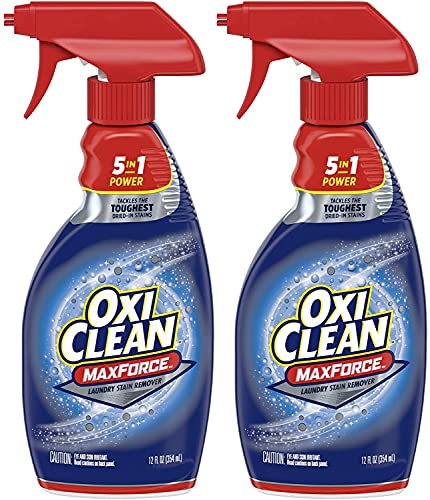
A two-pack of OxiClean's Max Force five-in-one spray, twelve ounces per bottle, built around four stain-fighting ingredients and aimed at grass, grease and oil. It is labeled safe for colorfast, washable fabrics. The twin pack suits a household that treats often, though the bottles are small for large spills, so keep one upstairs and one near the machine. The spray is thin, soaks in quickly and suits mud and grass.
What stands out
- Formulated to target grease, oil and grass stains
- Two bottles, one for upstairs and one down
- Safe on colorfast, washable fabrics around the home
Watch out for
- Twelve ounces empties quickly with heavy daily use
- Less effective on tannin stains than oxygen products
Miss Mouth's Messy Eater Stain Treater Spray, Laundry Stain Remover, 16 Oz
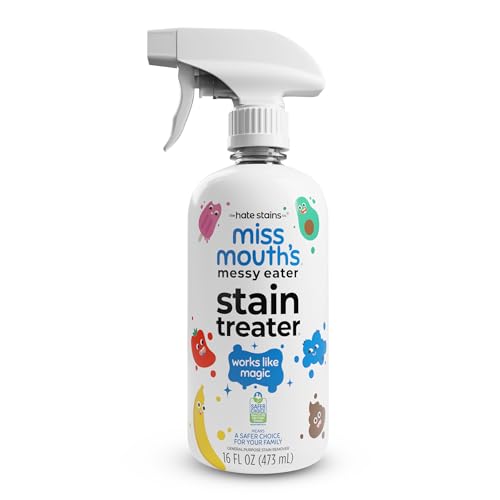
A 16-ounce spray sold for baby and toddler messes, carrying EPA Safer Choice certification. It handles fruit juice, baby food, formula, ketchup, blowouts and blood, on fresh or set-in stains. The bottle is large for a nursery product, which is useful because diaper-bag duty usually falls to a smaller pen or travel size. For dried stains, the label suggests a splash of water before spraying.
What stands out
- EPA Safer Choice certified formula for family laundry
- Works on both fresh and already set-in stains
- Large bottle suits a busy household with toddlers
Watch out for
- Bottle is too big to carry in a diaper bag
- Mild formula struggles with heavy grease and ink
Grandma's Secret Spot Remover Laundry Spray

A 16-ounce spray plus a 2-ounce travel bottle, chlorine- and bleach-free, with a citrus scent. It is specifically formulated for rust, and it also handles paint, oil, blood, iodine, coffee and pet stains. The concentrate works at any water temperature, and the small bottle is genuinely useful for travel. The label says it leaves no dirt-attracting residue behind on the fabric.
What stands out
- One of few products aimed at rust stains
- Formula contains no chlorine, bleach or added phosphates
- Includes a small travel-size bottle for bags and cars
Watch out for
- Citrus scent remains noticeable on the treated fabric
- Not a heavy-duty formula for thick kitchen grease
Stardrops The Pink Stuff Miracle Laundry Stain Remover Spray, 16.9 Fl Oz
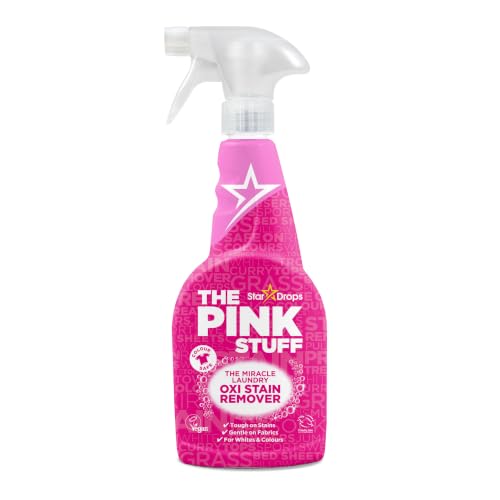
A 16.9-ounce oxygen spray sold for whites and colors, aimed at grease, oil and dirt. The routine is spray, wait a few minutes, wash. It is a reasonable all-rounder for a small household and easier to aim than a pump bottle, but the volume is modest and there is no refill option in this pack. The bottle is slim enough to stand in a caddy.
What stands out
- Oxygen action that stays safe on whites and colors
- Quick spray, wait and wash routine with no scrubbing
- Compact enough for a shelf or laundry caddy
Watch out for
- Small bottle for the number of stains it treats
- The short dwell time suits fresh marks only
Shout Triple Acting Laundry Stain Remover Spray Refill, 60oz, (1-Pack)

Sixty ounces of enzyme prewash refill without a sprayer, intended to top up a Shout bottle. The label claims a concentration advantage over in-wash powder when applied directly, and treated items can wait up to a week. It works at any temperature and in HE or standard machines, which makes it a sensible bulk buy for heavy users. Plan on decanting, because the jug is heavy when full.
What stands out
- Bulk refill stretches much further than small bottles
- Enzyme formula covers food, grass, makeup and wine
- Works in any water temperature or machine type
Watch out for
- No spray trigger or empty bottle is included
- Requires an empty bottle you may not own
Clorox Fraganzia
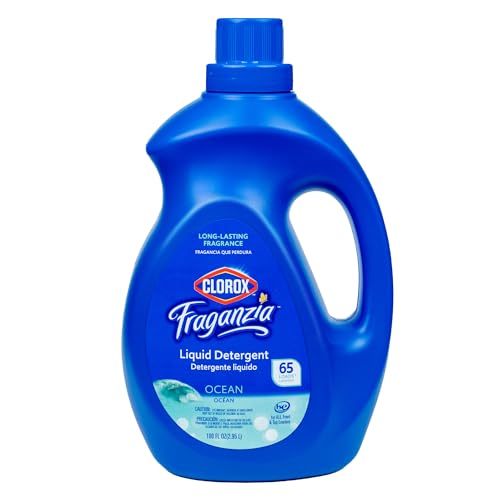
A 100-fluid-ounce liquid detergent in an ocean scent, labeled for all front and top loaders with up to sixty-five loads at the small-load line. The cap doubles as a measure, and the label describes applying a little undiluted to a stain for five minutes before washing. It is a detergent doing pretreater duty, not a dedicated stain product, so treat it as convenience rather than specialist chemistry.
What stands out
- One bottle covers both washing and light pretreating
- HE compatible with both front and top loaders
- Built-in measuring cap with two visible fill lines
Watch out for
- The ocean fragrance is strong for scent-sensitive households
- Weaker on set-in stains than a dedicated spray
Puracy Enzyme Stain Remover Spray Bottle for Laundry, Free & Clear, 12oz

A twelve-ounce enzyme spray with a six-enzyme formula, free and clear, aimed at protein, starch and oil stains. Fresh marks need fifteen minutes, older ones up to eight hours after a gentle rub. It is made without chlorine bleach, dyes or fragrance, and it carries USDA biobased certification. Test on a hidden area first, especially on delicate fabrics, as the label advises.
What stands out
- Six-enzyme formula handles several stain types at once
- Free and clear, with no added fragrance at all
- Long dwell time allowed on older set-in stains
Watch out for
- Small bottle for the volume used per stain
- Enzyme action is noticeably slower on heavy grease
Fels Naptha Laundry Soap & Stain Remover Bar, Pack of 3

A three-pack of 5.5-ounce Fels Naptha bars, the old-fashioned laundry soap still sold for pretreating and general cleaning. It contains no naphthalene despite the name, and each bar is roughly four and three-quarter inches long. Best used wet, rubbed into the fabric and worked in by hand before washing, and the bars last a long time if kept dry between uses.
What stands out
- Excellent on ground-in dirt and stubborn collar grime
- Three bars last a very long time in storage
- The current formula contains no naphthalene at all
Watch out for
- Alkaline formula can dull dark colors over time
- Requires hand scrubbing and some patience to work
Buying guide
A pretreater is a dwell-time product, not a detergent
Detergent is formulated to work in a drum full of water, surrounded by other garments, for the length of a cycle. A pretreater is formulated to sit on one spot at close to full strength for minutes or hours. Those are different jobs, which is why pouring detergent on a stain and washing immediately rarely matches a dedicated product applied and left alone.
The practical consequence is that dwell time matters more than the brand. Five minutes is the minimum most labels allow, and it is enough for a fresh food stain. An hour is better for anything that has dried. Overnight is where oxygen and enzyme products earn their keep. What you cannot do is apply, wait thirty seconds and expect the mark to be gone.
Gel sticks, sprays, bars and detergent: matching the format
A gel stick is the most controlled option. You rub it directly on the mark until the area is saturated, and nothing oversprays onto the surrounding fabric. For a collar, a cuff or a single spot on a school shirt, it is faster and neater than a spray. The trade is coverage: a stick is slow across a large area such as a tablecloth or the front of a hoodie.
Trigger sprays cover area quickly and get into fabric better than a gel, which makes them the right choice for food spills, wine and anything that has spread. Their weakness is drift. Spray too close and the product puddles; too far and half of it lands beside the stain. Hold the bottle a few inches away and spray until the area is visibly wet, not soaked.
Bar soap is the oldest format and still the best on ground-in dirt, ring-around-the-collar and garden grime. You wet the bar, rub it into the fabric, and work the lather in with your fingers. Fels Naptha has been used this way for generations. The compromise is that bars are alkaline and can dull dark colors over time, so keep them for workwear and whites.
Liquid detergent as a pretreater is a legitimate fallback, not a gimmick. Clorox Fraganzia's label explicitly describes applying a small amount undiluted, rubbing it in for five minutes and washing. If you already have the bottle, that saves shelf space. It will not out-clean a dedicated product on a set-in stain, but for a fresh spill it is often enough.
Match the chemistry to the stain in front of you
Protein stains, which means blood, dairy, egg, vomit and many baby messes, respond to cool water and enzymes. Heat sets them, so the instinct to use the hottest water available is exactly wrong. An enzyme spray left for fifteen minutes on a blood spot will do more than a hot wash ever will, and it will not bake the stain into the fiber.
Tannin stains from tea, coffee, wine and fruit respond to oxygen. That is why an oxygen spray or a percarbonate-based powder works better on a coffee spill than a straight enzyme product. Grease and oil need surfactant and time, and benefit from a slightly warm wash afterward. Pigment stains such as mud, clay and makeup are mostly mechanical: lift the solids first, then treat what is left.
Rust needs an acid, which is where Grandma's Secret earns its place. Dye transfer is another matter, and none of the pretreaters here reverse it. Sorting is easier than treating.
Color safety, delicates and flame-resistant sleepwear
Most sprays here are labeled safe on colorfast washable fabrics, which is a narrower promise than it sounds. Colorfast means the dye does not run when wet. Test anything new, dark or valuable at an inside seam, and never spray a whole garment without checking. Oxygen products are generally gentler on dye than chlorine, but concentration still matters.
Delicates need a gentler approach regardless of the product. Silk, wool and rayon should be treated with the smallest amount of product, blotted rather than rubbed, and rinsed by hand before they go anywhere near a machine. Agitation does as much damage as chemistry on those fibers.
For baby sleepwear, check the care label before treating. A few dedicated baby brands state plainly that their stain remover does not harm the flame-resistant capability of sleepwear, and that is the claim to look for, because a general-purpose spray may not carry it. A stripped flame retardant is a safety issue rather than a cosmetic one.
Concentrates, refills and how far a bottle really goes
A sixteen-ounce spray treats perhaps forty to sixty individual spots, depending on how generously you apply it. A gel stick lasts longer per stain because you are depositing product only where the fabric is marked. A sixty-ounce refill gives you far more product per bottle, but only if you already own a sprayer and will actually refill it rather than letting the jug sit in the cabinet.
Concentration is not the same as strength. Shout's refill label claims a concentration advantage over in-wash powder when applied directly, which is a statement about how the product is used rather than a magic formula. Diluting a concentrate defeats the point; so does spraying so much that the fabric is saturated and the excess runs into the drum.
When a pretreater will not save the garment
Some stains are finishes rather than soils. Bleach spots, scorch marks, and color loss from a hair product are damage to the fiber or dye, and no pretreater reverses them. The same goes for a stain that has been through a hot dryer: heat sets most proteins and many dyes, and the mark is now part of the fabric.
Age matters too. A stain that has been washed and dried repeatedly has had multiple chances to bond with the fiber. Re-treating can still improve it, but expectations should be modest, and repeated aggressive treatment will thin the fabric before it lifts the mark.
Frequently asked questions
Do pretreaters work on old, already-washed stains?
Sometimes, partly. A stain that has been through the wash and the dryer has had heat applied, which sets protein and many dyes permanently. Enzyme and oxygen products can still lift some of the residue if you give them hours rather than minutes, but expect improvement rather than removal. Repeated treatment on the same spot weakens the fabric.
Can I pretreat clothes and wash them a week later?
Several labels allow up to seven days, including the OxiClean gel stick and the Shout refill. It works, but treated damp fabric sitting in a hamper is a good place for mildew. If you need the delay, hang the garment to dry after treating rather than balling it up, and wash as soon as you reasonably can.
Should I pretreat with hot or cold water?
Start cool for anything protein-based, including blood, dairy, egg and baby formula, because heat sets those stains. Oxygen products need warmth to activate, so a warm wash after treatment is fine once the stain is lifted. When in doubt, treat cool, check the result, then wash at the warmest temperature the care label allows.
Are enzyme pretreaters safe on baby clothes?
Generally yes, and enzyme sprays are among the better choices for formula, spit-up and diaper leaks. Choose a free-and-clear formula if your baby has sensitive skin, rinse thoroughly, and check the sleepwear label. Flame-resistant sleepwear is the one category where you should confirm the product explicitly says it will not affect the treatment.
What is the difference between a pretreater and a stain remover?
In practice, very little. Both are concentrated products applied before washing. Pretreater usually implies a spray or gel left on for minutes to days, while stain remover can also mean an in-wash booster or a laundry bar. Read the directions rather than the front label: the dwell time tells you what the product is designed to do.
Verdict
The OxiClean Max Force gel stick is the pick for most households. It goes exactly where the stain is, stays color safe and chlorine free, and tolerates washing up to a week later, which suits people who treat on Monday and wash on Saturday. The Spray 'n Wash Max bottle is the value buy: a small outlay, a five-minute dwell and reliable results in any water temperature.
If fragrance is a problem, the upgrade is Puracy's enzyme spray, free and clear and able to sit up to eight hours on older marks. Families with babies should look at Miss Mouth's, and workwear owners should keep a Fels Naptha bar. Clorox Fraganzia is the compromise: a detergent that pretreats adequately rather than a pretreater that washes.