A sleeve board looks like a toy ironing board, and that is the point. A shirt sleeve is a tube roughly four inches across, so a full-size board cannot enter it; you end up pressing a crease down the middle and calling it done. The narrow board slides inside, lets you rotate the sleeve, and presses the seam allowance flat without printing a line through to the outside.
Most of these boards are 20 to 23 inches long and stand four to six inches high on a table, with a tapered nose for cuffs and collars. Some are single boards; some are two-sided, with a wider surface for chest panels and a narrow one for sleeves. The Newhouse chest-and-sleeve model pairs an oval bosom board with a 24-inch sleeve board in one unit.
Two entries here are not sleeve boards at all. The ZOES is a replacement cover for a full-size board, and the Kikihouse is a wall-mounted ironing cabinet. They are included because they solve adjacent problems: recovering a board that has lost its surface, and replacing one that eats a wall. Neither presses a sleeve the way a narrow board does.
We compared specifications, features and owner reports rather than running a lab. Where an item is a compromise, the note says so.
Top picks at a glance
Newhouse Specialty Padded Sleeve Ironing Board
Check price on AmazonZOES HOMEWARE Ironing Board Cover and Pad
Check price on AmazonKikihouse Wall Mounted Ironing Board Cabinet with Storage (Walnut)
Check price on AmazonCompare the shortlist
| Model | Type | Capacity | Key feature | Amazon |
|---|---|---|---|---|
| 1. Newhouse Specialty Padded Sleeve Ironing Board | Ironing board | — | — | Check price |
| 2. JELIMATE Padded Pants & Sleeve Ironing Boards with Ultra Thick P | Ironing board | — | Compact footprint | Check price |
| 3. DE-LIANG Padded Chest & Sleeve Tailor Ironing Board Long with Wo | Ironing board | — | Compact footprint | Check price |
| 4. Dritz Clothing Care 82450 Collapsible Sleeve Board, 5 x 5-1/2 x | Ironing | — | — | Check price |
| 5. Jacobson Products Padded Chest & Sleeve Ironing Boards | Portable | — | Compact footprint | Check price |
| 6. Household Essentials Accessory Sleeve Ironing Board, Plastic top | Compact | — | Steam | Check price |
| 7. Newhouse Specialty Chest and Sleeve Ironing Board, Two-Sided, 9 | Ironing board | — | — | Check price |
| 8. Household Essentials Basic Sleeve Mini Ironing Board | Ironing board | — | Compact footprint | Check price |
| 9. ZOES HOMEWARE Ironing Board Cover and Pad | Ironing board | — | Steam | Check price |
| 10. Kikihouse Wall Mounted Ironing Board Cabinet with Storage (Walnu | Ironing board | — | Quick cycle | Check price |
Detailed reviews
Newhouse Specialty Padded Sleeve Ironing Board
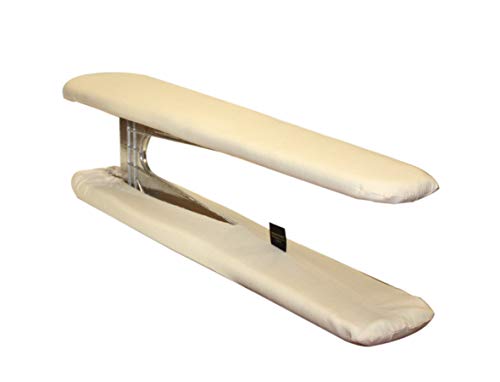
A padded sleeve board 23 inches long and 5 inches wide, built on a heavy-duty aluminum frame with a flannel surface. The maker describes one side as standard width and the other as narrow, so it handles a sleeve or a small panel. It weighs 2.7 pounds and sits on a table, and the flannel surface takes heat well.
What stands out
- Aluminum frame keeps the 23-inch board rigid under pressure
- Flannel surface grips fabric and stands up to heat
- Two widths cover sleeves and small garment panels
Watch out for
- The flannel cover is not listed as removable
- No folding stand, so it needs table space
JELIMATE Padded Pants & Sleeve Ironing Boards with Ultra Thick Padding, Double Side Ironing Board, Gray
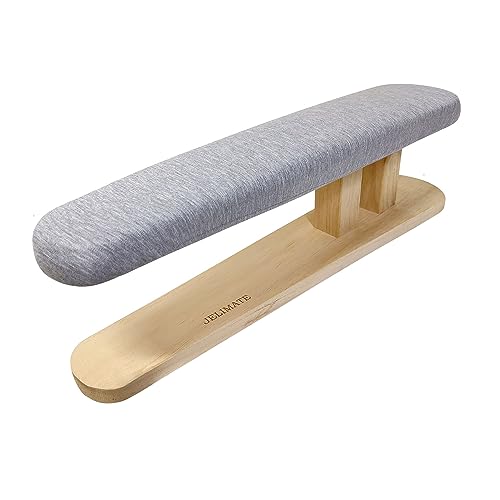
A slender sleeve and trouser board, 22.2 inches long and 2.7 inches wide, with a double layer of breathable sponge and a removable cotton cover held by an elastic band. The polished wooden base sits steady without scratching a table, and the narrow shape suits sleeves, trouser legs and collars. It stores easily in a closet or under a bed.
What stands out
- Removable cotton cover can be washed when soiled
- Breathable double sponge resists heat buildup at seams
- Slender shape fits trouser legs, cuffs and collars
Watch out for
- Only 2.7 inches wide, too narrow for larger panels
- Wooden base needs a flat table to sit level
DE-LIANG Padded Chest & Sleeve Tailor Ironing Board Long with Wooden Base for Household Tools, Tailor Dress Fo

A handmade tailor's board in ash, 22.2 inches long with a 4.3-inch front and a 2.7-inch rear, standing 6.1 inches high and weighing 3.7 pounds. The base is sanded and finished with a non-slip underside, and the surface is a sponge and cloth pad. It is built for studios where both hands stay busy at the table.
What stands out
- Hand-sanded ash base will not snag delicate fabric
- Non-slip underside keeps it planted on a table
- Tapered shape reaches deep into cuffs and collars
Watch out for
- At 3.7 pounds it is heavy to carry to a class
- Handmade finish can vary slightly from board to board
Dritz Clothing Care 82450 Collapsible Sleeve Board, 5 x 5-1/2 x 21-Inch , Gray
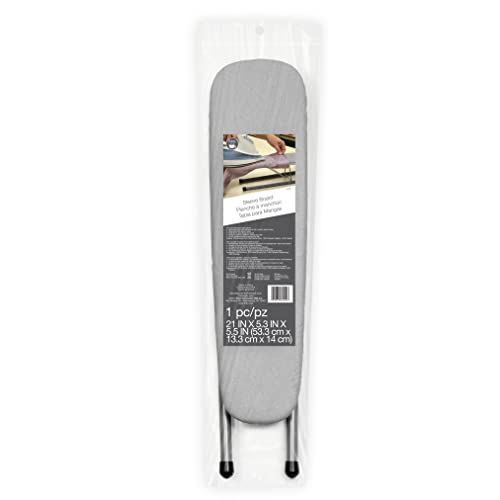
A collapsible sleeve board 21 inches long, 5 inches wide and 5.5 inches high, with an ultra-plush pad and a steel stand that locks open. It folds flat for storage or travel and weighs 1.6 pounds, making it the most portable board here. The 5-inch width handles small garments as well as sleeves, and the plush pad softens button edges.
What stands out
- Steel stand locks the board open and folds flat
- Thick plush pad cushions seams, buttons and collars
- 1.6 pounds is easy to pack or carry
Watch out for
- Light frame can shift under very heavy pressing
- Cover is not described as removable for washing
Jacobson Products Padded Chest & Sleeve Ironing Boards
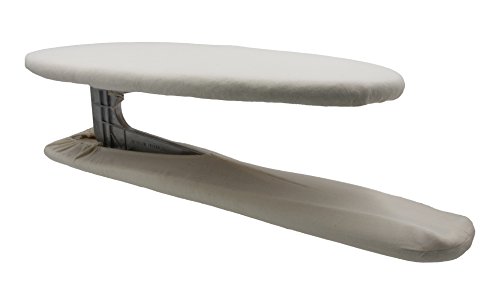
A chest-and-sleeve pressing board on a heavy-duty aluminum frame, shaped to press the chest, back and sleeves of a garment. It also works as a pin board for tailoring and alongside a garment steamer. The listed dimensions are compact at 10 by 5 by 2 inches, so it is a detail tool rather than a full-length board. It weighs 3.2 pounds.
What stands out
- Shaped for chest panels, backs and sleeve work
- Heavy-duty aluminum frame stays rigid under steady pressure
- Doubles as a pin board during tailoring fittings
Watch out for
- Compact surface will not take a whole sleeve
- Needs a table and a steady hand to use
Household Essentials Accessory Sleeve Ironing Board, Plastic top, Foam Pad and Natural Cotton Cover, Heat-Resi

An accessory sleeve board with a perforated plastic top, foam pad and natural cotton cover, 20 inches long and 4.5 inches wide. It sets up 4.62 inches high and folds to 1.5 inches, with no-scuff leg caps for tables. At 1.35 pounds it is the lightest board here, and the cotton cover resists scorching and staining.
What stands out
- Folds to 1.5 inches for drawer storage
- Perforated plastic top lets steam and heat pass through
- No-scuff leg caps protect tables and kitchen counters
Watch out for
- Plastic top is less forgiving of a hot iron
- Light 1.35-pound frame can slide on smooth tables
Newhouse Specialty Chest and Sleeve Ironing Board, Two-Sided, 9 in x 20 in Oval, 24 in x 4 in Sleeve, Heavy-Du

A two-sided chest and sleeve board with a 9 by 20 inch oval bosom surface and a 24 inch sleeve board with a 4.5-inch butt and 4-inch nose. It sits on a standard ironing board to expand what you can press, and the half-inch plywood base with a cast aluminum frame is built for professional use. It is made in the USA.
What stands out
- Oval bosom surface presses curved chest and blouse panels
- The 24-inch sleeve board handles long shirt sleeves
- Cast aluminum frame and plywood base resist flex
Watch out for
- Needs a full-size ironing board underneath for support
- Large footprint for a small laundry or sewing room
Household Essentials Basic Sleeve Mini Ironing Board
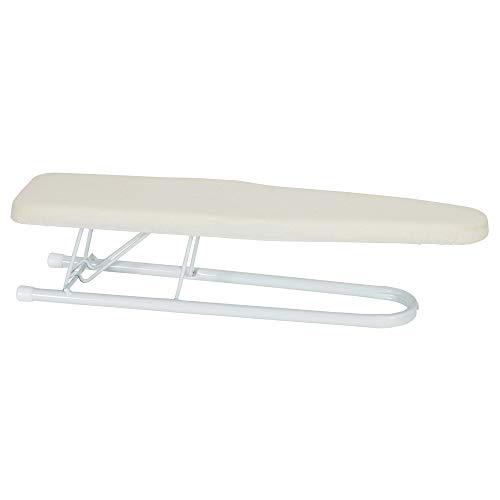
A basic sleeve mini board 20 inches long and 4.5 inches wide, with a perforated plastic top, foam pad and natural cotton cover. It stands 4.63 inches high, weighs 1.9 pounds and works on a tabletop or beside a full-size board. The size suits collars, hems and children's clothing as well as sleeves, and the cotton cover arrives installed.
What stands out
- Natural cotton cover arrives installed and ready to use
- The 20-inch length supports a full shirt sleeve
- Light enough to move from table to counter
Watch out for
- Plastic top limits how hot the surface can get
- Basic legs are less stable than a wooden base
ZOES HOMEWARE Ironing Board Cover and Pad

A replacement cover and pad set for a full-size ironing board, not a sleeve board. It measures 15 by 54 inches and fits boards 50 to 56 inches long and 13 to 17 inches wide, using elastic edges rather than straps. The cotton surface has aluminum foil dots over a three-layer pad rated to 260 degrees, and the maker advises measuring before ordering.
What stands out
- Fits a range of board lengths and widths
- Aluminum dots reflect heat back into the fabric
- Elastic edges install without straps, ties or tools
Watch out for
- Not a sleeve board despite its place in this listing
- No hook-and-loop straps to hold the nose tight
Kikihouse Wall Mounted Ironing Board Cabinet with Storage (Walnut)

A wall-mounted ironing cabinet in walnut, 42.2 inches high, 15.7 wide and 9 deep, with a foldable board that stores inside and a sliding door with built-in storage. The maker says the track supports up to 70 pounds and includes mounting hardware. At 40.2 pounds it is furniture, not a portable board, and all mounting hardware is included.
What stands out
- Board folds into the cabinet out of sight
- Sliding door saves swing clearance in tight rooms
- Track design is rated to support up to 70 pounds
Watch out for
- Not a sleeve board, and not remotely portable
- Wall mounting is really a job for two people
Buying guide
The geometry that makes a sleeve board work
A sleeve board earns its place because of its width, not its size. Three to five inches across fits inside a shirt or jacket sleeve, and a tapered nose lets you work right up to the cuff seam without crushing the button placket. The surface also has to be long enough to support the whole sleeve, which is why 20 to 23 inches is the useful range. Shorter boards force you to bunch the fabric, and a bunched sleeve presses with a crease where you folded it. The taper matters as much as the length, because a blunt end leaves the last inch of a cuff unpressed, which is exactly where a sleeve looks worst. A good nose is rounded rather than pointed, so it supports the fabric instead of stretching it.
Two-sided boards add a wider panel for shirt fronts, chest pieces and small garments. The Newhouse padded model describes one side as standard width and the other as narrow, while the chest-and-sleeve version goes further with a 9 by 20 inch oval surface on one side and a 24 inch sleeve board on the other. That oval is the part flat boards cannot imitate: it presses a curved chest panel or a blouse body without putting a hard fold where the fabric should curve. If you press jackets, the combination justifies the storage space; if you only press shirts, a single narrow board is enough. Measure the sleeve length of the shirts you wear most; a 24-inch board covers a standard men's sleeve with room to spare.
Wooden bases, folding stands and tabletop feet
Most sleeve boards sit on a table, and the base is what decides whether they feel solid. The JELIMATE and DE-LIANG use polished wooden bases, which are heavy enough to stay put and smooth enough not to scratch a dining table. The DE-LIANG is hand-sanded ash, 22.2 inches long, 3.7 pounds, and the maker notes a non-slip underside. The Household Essentials boards use folding metal or plastic legs with no-scuff caps and collapse to about an inch and a half for storage. Weight is the tell: a board under two pounds is a travel tool, while a three- to four-pound board stays where you put it. If the base has no pad, a strip of shelf liner underneath will stop it creeping across a polished table.
The Dritz takes the folding idea furthest: a steel stand locks the board in place when open and folds flat when not, and the whole unit weighs 1.6 pounds. That makes it a travel and class board rather than a permanent fixture. Its pad is described as ultra-plush, which helps with seams and buttons, and the steel stand is more rigid than the plastic legs on budget boards. Stability is the trade-off with any tabletop design. Lean hard on the unsupported end of a light board and it will tip, so keep your pressing hand over the base and use the other hand to hold the garment, not to push down. Check the locking tab by hand before you press, because a stand that folds mid-job can cost you a fingernail.
Padding and covers decide the finish
A sleeve board is only as good as its padding. Flannel, sponge and cotton covers each behave differently: flannel takes heat well and grips the fabric, sponge cushions seams, and a tight cotton cover lets the iron glide. The Newhouse uses a flannel surface over an aluminum frame, the JELIMATE uses a double layer of breathable sponge under a removable cotton cover, and the DE-LIANG uses a sponge and cloth pad on an ash base. Removable covers are worth having, because a sleeve board cover collects starch and scorch marks long before it wears out. Check that a replacement cover is sold separately before you rely on washing the original. Cotton is the safer cover for white shirts, while a synthetic blend resists scorching but can leave a sheen.
The Household Essentials boards use a perforated plastic top under a foam pad and cotton cover. The holes let steam and heat pass through instead of trapping them, which helps on wool and synthetics, but plastic is less forgiving than wood if you rest a hot iron on the surface. Whichever board you choose, keep the iron on its heel or a rest, use steam sparingly on lightweight fabrics, and replace a cover that has gone shiny or stiff. A scorched cover transfers marks to the next white shirt. Also check that the cover can be removed, since a glued-on cover turns a small fix into a new board. A dedicated iron rest clipped to the table is a better answer than balancing a hot iron on the end of the board.
Who needs one, and what to use instead
Anyone who wears pressed shirts will get use from a sleeve board, but the strongest cases are specific. People who sew need one for setting in sleeves, pressing cuffs and opening seams without stretching the curve. Tailors and alterations shops need the chest-and-sleeve format because a jacket front cannot be pressed flat without ruining its shape. Households with children get years of use out of a small board for tiny sleeves and collars, which are miserable to press on a full-size surface. If you press two or three shirts a week, the board pays for itself in time and in the creases you stop fighting. Count the shirts in the closet before deciding: five or more is a strong case for a dedicated board.
If you have no storage and iron once a month, a rolled towel inside the sleeve and a normal board will get you most of the way there. The two alternatives in this list serve different needs: the ZOES cover refreshes a full-size board that has lost its padding, and the Kikihouse cabinet replaces the board entirely with a wall-mounted unit that folds away. Both are sensible purchases, but neither is a substitute for a narrow board when the job is a sleeve. Buy the small board first; the cover and the cabinet solve problems you may not have yet. If the cabinet is the real solution, find the wall studs before you order, because the hardware has to carry 40 pounds.
Frequently asked questions
Do I really need a sleeve board if I already have an ironing board?
For shirts and jackets, it helps more than any other small tool. A full-size board cannot fit inside a sleeve, so you press a crease along the top. A sleeve board supports the tube from inside and presses the seam flat. If you rarely wear pressed sleeves, a rolled towel will do the job less neatly.
What is a chest-and-sleeve board used for?
The oval side presses curved sections such as shirt fronts, blouse bodies and jacket chest panels. The narrow side handles sleeves, collars and cuffs. Tailors use the combination because a flat board would crease where the garment should curve. For home use it is versatile, though it takes more storage than a plain sleeve board.
Can I use a sleeve board for trousers?
Yes, especially the slender models with a long, narrow surface. Slide the board inside a leg to press the seam without the opposite leg leaving an impression. Work from hem to waist and let the fabric cool before moving it. A wooden base helps because a light folding stand can tip under a leg.
How do I keep the cover from scorching?
Keep the iron moving, use the right heat setting and never rest a hot soleplate on the cover. A pad of at least a quarter inch helps, and a removable cotton cover can be washed when it stiffens. If you smell scorching, stop and lower the heat. A singed cover will mark light fabrics.
Are wooden-base sleeve boards stable enough for daily use?
Yes, if the base is wide enough and the feet are non-slip. A polished wooden base on a table is stable for normal pressing; the risk comes from leaning your weight on the unsupported end. Keep one hand on the garment and the other on the iron, and press in the middle. Folding metal stands suit travel but are less steady.
Verdict
The JELIMATE is the best pick for most households: 22.2 inches long, a double sponge pad, a removable washable cotton cover and a polished wooden base that will not skate across a table. The Household Essentials Basic is the value choice at 20 inches, with a perforated top, foam pad and cotton cover for a very small outlay, and it folds away when the ironing is done.
The Newhouse chest-and-sleeve board is the upgrade for anyone who sews or presses jackets, because the oval bosom surface and 24-inch sleeve board cover jobs the others cannot. Choose the Dritz if the board has to travel, or the Kikihouse cabinet if the real problem is that a full-size board has taken over the room.