Search for an ADA compliant washing machine and you will find a lot of listings using the phrase loosely. No washing machine carries an ADA certification, because the standard governs buildings, routes and fixtures rather than appliances. What does exist is a set of numbers for reach, grip and force that a person can meet without help, and a handful of front loaders line up with them better than the rest.
That distinction matters when you are spending real money. A machine described as accessible because it has a large display may still put its controls above the comfortable reach of a seated user. The useful questions are physical: how far does the person have to reach, how low is the drum opening, how much force does the door need, and is there room to stand or roll beside it.
We compared specifications, features and owner reports for eight front loaders, and the results are less about brand than about layout. Every machine here is a front loader, and none is officially certified for anything. What follows is reasoning you can apply to whichever model fits your room.
Top picks at a glance
Kenmore 4.5 cu. ft. Front Load Washer
Check price on AmazonSamsung 4.5 cu. ft. High Efficiency Front Load Washer with Vibration Reduction
Check price on AmazonLG 4.5 cu. ft. Capacity Smart Front Load Washer with TurboWash
Check price on AmazonCompare the shortlist
| Model | Type | Capacity | Key feature | Amazon |
|---|---|---|---|---|
| 1. Kenmore 4.5 cu. ft. Front Load Washer | Front-load | 4.5 cu ft | Steam | Check price |
| 2. Samsung 4.5 cu. ft. High Efficiency Front Load Washer with Vibra | Front-load | 4.5 cu ft | Low noise | Check price |
| 3. LG 4.5 cu. ft. Capacity Smart Front Load Washer with TurboWash | Front-load | 4.5 cu ft | Steam | Check price |
| 4. Electrolux 27 in. W 4.5 cu. ft. Front Load Washer with SmartBoos | Front-load | 4.5 cu ft | Steam | Check price |
| 5. GE PROFILE 28 Inch Smart Front Load Washer with 4.8 cu. ft. Capa | Front-load | 4.8 cu ft | Connected controls | Check price |
| 6. LG 5.2 cu. Ft Stackable Smart Front Load Washer in Black Steel w | Front-load | 5.2 cu ft | Steam | Check price |
| 7. LG WM3470CM 27 Inch Front Load Washer with 5.0 Cu. Ft. Capacity, | Front-load | 5.0 cu ft | Front-load | Check price |
| 8. Samsung 5.0 cu. ft. Extra Large Capacity Smart Front Load Washer | Front-load | 5.0 cu ft | Steam | Check price |
Detailed reviews
Kenmore 4.5 cu. ft. Front Load Washer

A 4.5 cubic foot front loader with Steam Treat, 12 cycles, Cold Clean and ENERGY STAR certification. The control panel sits on the front edge, and the machine is 27 inches wide, which fits a standard laundry alcove. Depth is the catch at about 34 inches, so measure the room behind it for hoses and a shutoff valve before delivery.
What stands out
- Standard 27-inch width fits most existing laundry alcoves
- Steam Treat handles everyday stains without any pre-treating
- Cold Clean cuts energy use on longer wash cycles
Watch out for
- About 34 inches deep before the hoses go on
- At 216 pounds, plan the delivery route carefully
Samsung 4.5 cu. ft. High Efficiency Front Load Washer with Vibration Reduction Technology+, White, WF45T6000AW
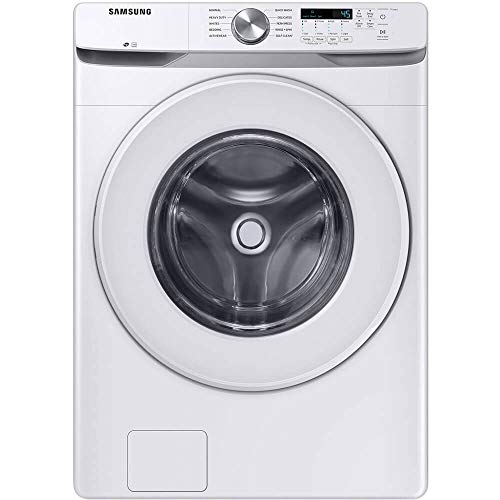
Samsung's 4.5 cubic foot front loader keeps things simple: Vibration Reduction Technology plus, a Swirl+ drum and ENERGY STAR certification, with no steam or app layer to learn. The control panel is compact and front-facing, and the machine weighs about 200 pounds. For a household where one person will run every load, fewer modes can be a feature rather than a limitation.
What stands out
- Simple control set with far fewer decisions to make
- Vibration reduction helps on wood floors and shared walls
- ENERGY STAR certified and a manageable 200 pounds
Watch out for
- No steam or sanitize cycle on this model
- Small display can be hard to read in dim light
LG 4.5 cu. ft. Capacity Smart Front Load Washer with TurboWash

An LG 4.5 cubic foot front loader with TurboWash, steam, a four-tray dispenser for prewash, main wash, bleach and softener, and SmartDiagnosis for phone-based troubleshooting. The panel is at the top front and the cabinet is 27 inches wide. Control lock and a clear cycle display round out a machine that is easy to operate without a manual. It is a straightforward machine to live with.
What stands out
- Front-mounted controls sit at a comfortable standing height
- The four-tray dispenser keeps bleach and softener fully separate
- SmartDiagnosis helps when a cycle throws an error code
Watch out for
- The dispenser drawer sits high on the front panel
- TurboWash cycles are not the quietest option in this group
Electrolux 27 in. W 4.5 cu. ft. Front Load Washer with SmartBoost, LuxCare Plus Wash System, Perfect Steam in

Electrolux's 4.5 cubic foot washer uses SmartBoost to premix detergent and Perfect Steam for stains, with the LuxCare Plus wash system and more than 11 cycles. At 38 inches tall it is the lowest machine in this group, which puts the controls and door slightly closer to a seated user. The adaptive dispenser accepts pods, liquid or powder. It suits a lower counter and a shorter user.
What stands out
- Lowest cabinet height in this group at 38 inches
- SmartBoost premixes detergent so cold washes still clean well
- The adaptive dispenser accepts pods, liquid detergent or powder
Watch out for
- About 217 pounds, heavy for an upper-floor laundry
- Deep cabinet at roughly 32 inches before hoses
GE PROFILE 28 Inch Smart Front Load Washer with 4.8 cu. ft. Capacity in White GFW550SSNWW

A 28-inch GE Profile with 4.8 cubic feet, built-in WiFi through SmartHQ, and an UltraFresh Vent System with OdorBlock that pulls moisture out after a cycle. It offers a 20-minute Quick Wash and a 35-minute Time Saver cycle. The extra inch of width buys real capacity, but check the opening before you assume a standard alcove will take it. Measure the opening before ordering.
What stands out
- Remote start and status through the SmartHQ app
- The UltraFresh vent reduces odors between wash days
- Twenty-minute Quick Wash cycle for lightly soiled clothes
Watch out for
- 28 inches wide, wider than a standard laundry alcove
- About 246 pounds and 32 inches deep before hoses
LG 5.2 cu. Ft Stackable Smart Front Load Washer in Black Steel with Steam & Turbowash Technology

An LG 5.2 cubic foot front loader in black steel with steam, TurboWash and an inverter direct drive motor. It is ENERGY STAR certified at roughly 105 kWh a year, and it can be stacked with a matching dryer. The larger drum means fewer cycles, which is its own accessibility benefit for anyone who finds loading and unloading tiring. It is the largest drum in this group.
What stands out
- 5.2 cubic feet means fewer loads every single week
- Inverter direct drive motor runs quietly and should last
- Stackable with a matching dryer to save floor space
Watch out for
- The listing does not publish usable cabinet dimensions
- A large drum puts more weight in every load
LG WM3470CM 27 Inch Front Load Washer with 5.0 Cu. Ft. Capacity, 8 Wash Programs, 1,300 RPM, SpeedWash Cycle,

A 27-inch LG with 5.0 cubic feet, eight wash programs, a 1,300 RPM spin and a Control Lock. SpeedWash shortens a normal cycle, Rinse plus Spin handles hand-washed items, and SmartDiagnosis reports faults by phone. Eight programs is a manageable number for someone who does not want to study a panel, and the control lock prevents accidental changes. The matching dryer is listed as model DLE3470M.
What stands out
- Only eight programs, so there is less to learn
- Control lock prevents accidental changes during a cycle
- 1,300 RPM spin cuts drying time on thick fabrics
Watch out for
- No steam option is listed for this model
- About 33 inches deep, tight in shallow closets
Samsung 5.0 cu. ft. Extra Large Capacity Smart Front Load Washer with Super Speed Wash and Steam, Brushed Blac

Samsung's 5.0 cubic foot front loader adds Super Speed, which washes a full load in about 28 minutes, plus steam and WiFi through SmartThings. It is ENERGY STAR certified and can be installed stacked or side by side. The fast cycle matters in a household where laundry is done in short windows between other care tasks. It suits a busy household.
What stands out
- WiFi status and end-of-cycle alerts arrive through SmartThings
- Stacked or side-by-side installation suits either kind of layout
- The 28-minute Super Speed cycle handles a full load
Watch out for
- Steam and WiFi add setup steps at installation
- 216 pounds and 33.5 inches deep before hoses
Buying guide
What ADA compliance actually means for an appliance
The Americans with Disabilities Act sets design requirements for buildings, not for washers. There is no appliance certification body issuing ADA stickers, and a listing that claims compliance without documentation is using the phrase as marketing. Manufacturers do sometimes design controls to meet the reach and force provisions, but that is a design choice, not a legal status. Treat the phrase as a prompt to check measurements rather than a guarantee. If a seller cannot tell you how high the control panel sits and how much force the door needs, the claim is not doing any work for you. A tape measure and a five-minute conversation settle more than a badge on the box, and a contractor's quote settles the rest.
The provisions that matter in a laundry room are straightforward. Operable parts should sit within a comfortable reach range, roughly 15 to 48 inches above the floor for an unobstructed forward reach, and they should work with one hand using no more than about five pounds of force, without tight grasping, pinching or twisting. The room also needs clear floor space in front of the machine and a route wide enough to get there. An occupational therapist or an accessible-design contractor can translate those numbers into your layout, and that hour of advice is usually worth more than a spec sheet. Bring the machine dimensions and photos of the room. Ask the therapist to watch the intended user load a basket, not just to measure.
Reach range: the number that decides your layout
On a full-size front loader, the controls sit on the top front edge, a few inches below the cabinet top, usually around 36 to 40 inches above the floor. For a standing adult that is comfortable. For a seated user it is at the upper edge of forward reach, and a pedestal pushes it higher by its own height. That is the central tension in accessible laundry design: the same pedestal that saves a standing user from bending can put the panel out of reach for someone in a chair. A 15-inch pedestal is enough to turn a comfortable control into a stretch. Measure from the floor to the panel, not from the top of the cabinet. A control panel a few inches below a 39-inch top is normal.
The drum opening is the other half of the equation. On a machine set on the floor, the center of the door lands near knee-to-waist height, which makes loading possible from a seated position with a basket beside you. A machine on a pedestal raises that opening by more than a foot, and a short person can end up lifting wet clothes above shoulder height. Measure the intended user's comfortable reach before you buy either accessory, and check that the door can open without hitting a wall, a dryer or a walker. The hinge side matters as much as the swing. When two people of different heights share the machine, the floor is usually the safer compromise. Write both measurements down before you shop, including the height of the person doing most of the laundry.
Front load versus top load when bending is the problem
A front loader asks for a squat and a forward reach, then lets gravity drop the laundry into a basket. A top loader asks for no squat but a deep reach over a rim and down into a tub, followed by a lift of wet fabric that can weigh several pounds. For anyone with back, hip or shoulder limits, that lift is usually the harder movement. Front loaders also put the door handle at a height where a closed fist can pull it, which helps when grip has faded. Grip often goes before mobility does, and a door pull is easier than a lid lift. A basket on a stool shortens the distance clothes fall. It is a small change with a large effect on a tired back.
Top loaders still make sense in some homes. A person who cannot kneel at all may prefer standing at a lid, and a top load with a shallow drum is easier than a deep one. But most top-load drums are deep, and the controls sit at the back of the console, which means reaching over the machine before the lid is even open. If a top load is the only option, measure the drum depth rather than the cabinet width, look for a low console height, and choose a lid that stays up on its own. A top load also needs the lid to clear any shelf above it, which rules out a lot of closet conversions. Check that clearance before delivery day, not after.
Controls, feedback and operating force
Control design separates machines that look accessible from machines that are. A rotary dial with detents tells your hand where it is without looking. A flat touch panel with small labels does the opposite, especially in a dim laundry room. Backlit displays with large digits, a loud end-of-cycle signal and a clearly marked Start button all reduce the number of things that can go wrong at seven in the morning. Look for controls that work with a knuckle if fingers cannot pinch, and avoid panels that require a long, steady press. If you can, try the panel in a dim room before buying, since glossy black plastic hides labels. Buttons with raised edges are easier to find by touch than a smooth sheet of glass.
Two features deserve specific mention. A control lock prevents a caregiver or a child from changing a cycle mid-wash, which is useful in shared homes. Remote start and status through an app let someone else begin a load, but appliances generally require the door to be closed and the machine powered, and many require a physical press to enable remote control. That makes the app a convenience for a caregiver, not a substitute for being able to reach the machine. A light in the closet is often more useful than any of it. Ask whether remote start still works after a power interruption, because older laundry rooms trip breakers. If the machine needs re-pairing after every outage, the app becomes one more chore.
Floor space, vibration and the path to the machine
The machine is only part of the project. A front loader needs clear floor space in front of the door, ideally enough to turn a walker or a chair, and the route to the laundry area needs to be wide and threshold-free. Thirty by forty-eight inches is the usual target for a forward approach, and a five-foot turning circle is better. A door that swings into the only turning space can make an otherwise usable room impossible. If the laundry is in a basement, the stairway is the real accessibility question, and no appliance choice fixes it. Measure the doorway, the turn at the bottom of the stairs and the space beside the machine, not just the alcove. A hallway that loses six inches to a door frame can stop a chair.
Vibration is the last practical concern. A front loader on a wood floor can shake a whole room during a spin, and a person with balance issues does not need a moving floor underfoot. Anti-vibration pads and a solid, level subfloor help, and so does a machine with vibration reduction built in. Keep detergent and supplies between roughly 40 and 48 inches off the floor, put a light over the controls, and make sure the water shutoffs are reachable without climbing behind the machine. A folding counter at the same height as the drum saves a lift. A pedestal moves the drum up too, so weigh the storage gain against the extra height every week. For a seated user, the floor usually wins.
Frequently asked questions
Are any washing machines ADA certified?
No. The ADA does not certify appliances, and no washer carries an ADA label. The law applies to buildings and the routes and fixtures inside them. Manufacturers can design controls to meet the reach guidelines, but that is voluntary. Verify measurements against the user.
What height should a washer be for wheelchair access?
There is no single number, because it depends on the person and the chair. Keep the controls within about 15 to 48 inches of the floor and the drum opening near lap height, which usually means no pedestal. Test the reach with the actual user first.
Is a front-load or top-load washer better for limited mobility?
For most people with back, hip or shoulder limits, a front loader is easier because the drum is at waist height and laundry falls into a basket. A top loader avoids squatting but requires lifting wet clothes from a deep tub. It depends on which movement is hardest.
Do I need a pedestal for an accessible washer?
Only if the user benefits from a higher door. A pedestal helps someone who should not bend and hurts a seated user who cannot reach higher. It also raises the controls. If storage is the goal, a wall cabinet is often the better answer.
Can a caregiver start the washer remotely?
On connected models, yes, with limits. The machine usually needs power, a closed door and remote start enabled at the panel, and some cycles require a physical press. Remote start helps after a load is in the drum; it does not remove the loading.
Verdict
The LG 4.5 cubic foot front loader is our pick for an accessible laundry room. Controls sit at the top front, the cabinet is a standard 27 inches wide, and the feature set includes steam, a four-tray dispenser, SmartDiagnosis and a control lock.
The Samsung 4.5 is the value choice: fewer features, a quieter drum and a lower price to check on Amazon for the same capacity. Choose the GE Profile 4.8 if a caregiver needs remote start and status, or if the room needs the UltraFresh vent. For a seated user, skip the pedestal and put storage on the wall instead.