An RV washer is less about the machine than about what surrounds it. A 24-inch front loader fits a surprising number of travel-trailer cabinets, but it also has to run on a 120-volt circuit, drain into a gray tank that may hold less water than a single normal cycle uses, and stay put while the rig is moving.
What remains divides into two families. The first is a compact front loader, usually 2.2 to 2.8 cubic feet, with a real spin cycle and a plumbed drain. The second is a portable top loader or mini washer that fills from a faucet, drains into a sink or bucket, and gets stowed between trips. The right one depends on whether you are a weekend camper or living in the rig full time.
We compared specifications, features and owner reports for ten machines that come up repeatedly in RV forums. A few are best understood as a laundry sink with a motor, which is fine if that is what your rig supports. The notes below flag the things that matter in a moving, water-limited space: drain type, spin speed, weight, footprint and noise.
Top picks at a glance
BLACK+DECKER Front Load Washer, 2.7 Cu. Ft. Compact Washing Machine with LED D
Check price on AmazonGODECOR 3.0 Cu.Ft Portable Washing Machine, 30 lbs Full-Automatic Top Load Was
Check price on AmazonKoolMore 24" Front Load Washing Machine, 2.7 Cu. Ft., Space Saving Unit with 2
Check price on AmazonCompare the shortlist
| Model | Type | Capacity | Key feature | Amazon |
|---|---|---|---|---|
| 1. BLACK+DECKER Front Load Washer, 2.7 Cu. Ft. Compact Washing Mach | Front-load | 2.7 cu ft | Quick cycle | Check price |
| 2. Kenmore 2.2 cu. ft. Compact Front Load Washer | Front-load | 2.2 cu ft | Steam | Check price |
| 3. KoolMore 24" Front Load Washing Machine, 2.7 Cu. Ft., Space Savi | Front-load | 2.7 cu ft | Steam | Check price |
| 4. Avanti 2.2 Cu. Ft. Front Load Washing Machine Compact Freestandi | Front-load | 2.2 cu ft | Steam | Check price |
| 5. COMFEE' Portable Washing Machine, 0.9 cu.ft Compact Washer With | Portable | 0.9 cu ft | Compact footprint | Check price |
| 6. GODECOR 3.0 Cu.Ft Portable Washing Machine, 30 lbs Full-Automati | Top-load | 3.0 cu ft | Low noise | Check price |
| 7. Compact Front Load Washer Washing Machine 2.8 cu. ft. Small Fron | Front-load | 2.8 cu ft | Low noise | Check price |
| 8. TABU 2.5 Cu.Ft. Front Load Washer with 15 Washing Cycles, White | Front-load | 2.5 cu ft | Sanitize cycle | Check price |
| 9. Samsung 2.5 Cu Ft Compact Front Load Washer, Stackable for Small | Front-load | 2.5 cu ft | Steam | Check price |
| 10. OLIXIS 1.06 Cu.Ft. Portable Washing Machine, Full-Automatic Laun | Portable | 1.06 cu ft | Low noise | Check price |
Detailed reviews
BLACK+DECKER Front Load Washer, 2.7 Cu. Ft. Compact Washing Machine with LED Display & 16 Cycles

A 2.7 cubic foot front loader in a 23-inch cabinet, with 16 cycles and a 1,300 RPM maximum spin. The stainless tub and an Add a Garment option make it feel more residential than most compact washers, and there is a Sanitary cycle for heavily soiled items. At roughly 161 pounds it is not a machine you move twice. Plan the delivery route before it arrives.
What stands out
- 1,300 RPM spin pulls more water out than any portable here
- Sixteen cycles including Sanitary, Wool, Bulky and Tub Clean
- Add a Garment and Extra Rinse can be selected mid-cycle
Watch out for
- At roughly 161 pounds, it takes two people to install
- There is no steam option on this particular model
Kenmore 2.2 cu. ft. Compact Front Load Washer

Kenmore's compact front loader trades drum size for features: a steam option at the end of the cycle, an Iron Ready setting that stops with clothes damp, Express and Accela Wash, and 15 cycles. It is ENERGY STAR certified and can sit side by side with a dryer or stack under one. The 2.2 cubic foot drum suits one or two people.
What stands out
- Steam option relaxes wrinkles and cuts down on ironing time
- Express and Accela Wash shorten the longer cycles noticeably
- ENERGY STAR certified, which helps when power is limited
Watch out for
- The small 2.2 cubic foot drum means more loads each week
- Steam and Iron Ready add time to an already long cycle
KoolMore 24" Front Load Washing Machine, 2.7 Cu. Ft., Space Saving Unit with 20-Minute Quick Wash, 12 Washing

A 24-inch, 2.7 cubic foot front loader with a quiet inverter motor, steam and a Water Plus function for bulky items. KoolMore lists a 20-minute quick wash and a stainless drum. The draw in an RV is the optional stacking kit and matching heat-pump dryer, which turn a closet into a two-appliance laundry column. Check the stacking kit price before you commit.
What stands out
- Stacks with a matching heat-pump dryer using an optional kit
- Quiet inverter motor runs on standard 120-volt household power
- Steam and Water Plus handle wrinkles and bulky items well
Watch out for
- Stacking kit and the matching dryer are both sold separately
- The 20-minute quick wash suits light soil, not heavy stains
Avanti 2.2 Cu. Ft. Front Load Washing Machine Compact Freestanding or Stackable Washer with 15 Wash Cycles, LE

Avanti's 2.2 cubic foot front loader offers 15 cycles, five wash temperatures and five spin speeds, with a see-through door and an LED display. It can stand alone or stack beneath a compatible dryer. The control set is easier to live with than a twenty-program panel in a dim camper hallway, and the glass door lets you check a load without stopping it.
What stands out
- Five wash temperatures and five spin speeds give real control
- See-through door lets you check a load without stopping it
- Freestanding or stackable, so it fits more laundry layouts
Watch out for
- About 164 pounds, which is heavy for a trailer floor
- No steam or sanitize cycle is listed for this model
COMFEE' Portable Washing Machine, 0.9 cu.ft Compact Washer With LED Display, 5 Wash Cycles, 2 Built-in Rollers

The smallest machine here with a real drum: 0.9 cubic feet, 18.1 inches wide, 44 pounds, with built-in rollers and handles. Five programs, three water levels and an 840 RPM spin, plus a clear lid, lint filter and drain pump. It connects to a faucet and drains through the pump, so the rig's plumbing does not need to be modified.
What stands out
- Only 18 inches wide and 44 pounds, light enough to stow
- Rollers and side handles make moving it across a floor easy
- 840 RPM spin is unusually high for a portable washer
Watch out for
- 0.9 cubic feet holds only a couple of outfits per cycle
- Faucet connection and drain hose need managing every time
GODECOR 3.0 Cu.Ft Portable Washing Machine, 30 lbs Full-Automatic Top Load Washer with Stainless Steel Drum, 8
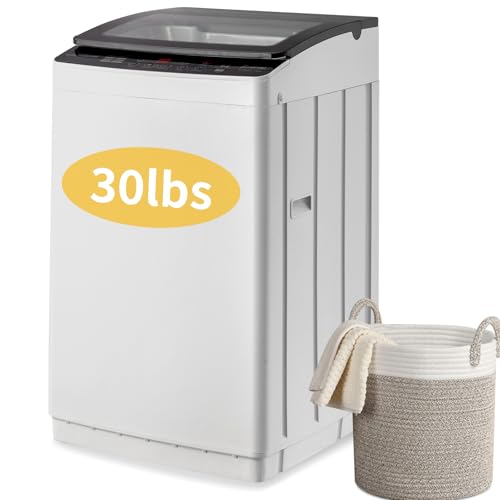
A 3.0 cubic foot top-load portable with an impeller instead of an agitator, 8 programs and 5 water levels, rated for up to 30 pounds of laundry. It adds a 24-hour delay, a child lock and automatic unbalance detection. For a toy hauler or a fifth wheel with floor space to spare, the drum is unusually large for a portable machine.
What stands out
- 3.0 cubic feet and a 30-pound capacity in a portable body
- Impeller action is gentler on delicates than an agitator
- Delay start and child lock are rare at this size
Watch out for
- The top lid needs headroom in a low trailer cabinet
- No stacking option, so it permanently claims floor space
Compact Front Load Washer Washing Machine 2.8 cu. ft. Small Front Foading Space Saving Washer 24" with 36-Minu

SMETA's 2.8 cubic foot front loader is the largest drum in a 24-inch body in this group, with a quiet inverter motor, 16 cycles and a 36-minute quick wash. Noise is listed at no more than 72 dB, and a Tub Clean cycle handles drum hygiene. The machine is stackable if you later add a dryer above it. It is a sensible choice for a small family.
What stands out
- 2.8 cubic feet fits inside a 24-inch-wide front-load cabinet
- A 36-minute quick cycle handles small daily loads
- Noise is capped at 72 dB by the manufacturer
Watch out for
- Shipping bolts must be removed before the first wash
- There is no steam option listed for this machine
TABU 2.5 Cu.Ft. Front Load Washer with 15 Washing Cycles, White

A 2.5 cubic foot front loader with 15 cycles, a dial plus display control panel, delay start and a child lock. TABU builds it for apartments, condos and RVs, and it can be stacked with a compatible dryer. The cycle list covers the essentials, including Quick, High Temp, Wool, Rinse plus Spin and Drum Clean. The controls are simple enough for guests to use.
What stands out
- 2.5 cubic feet fits a 23.4-inch-wide cabinet opening
- The dial selector is easier to use than touch-only controls
- Delay start and child lock are both included
Watch out for
- A compatible stacking dryer is sold separately from the washer
- No steam or allergen cycle appears in the cycle list
Samsung 2.5 Cu Ft Compact Front Load Washer, Stackable for Small Spaces, 40 Minute Super Speed Washing Machine

Samsung's compact front loader is the most feature-dense machine in this group: steam wash, a 40-minute Super Speed cycle, Vibration Reduction Technology plus, Self Clean and a Diamond drum in 2.5 cubic feet. It is ENERGY STAR certified and stackable. Of everything here, it behaves most like a full-size Samsung in a much smaller box. It behaves like a full-size Samsung.
What stands out
- 40-minute Super Speed cycle handles a full daily load
- Vibration reduction helps in thin-walled trailers and fifth wheels
- Steam, Self Clean and ENERGY STAR certification all included
Watch out for
- Roughly 163 pounds and 26.8 inches deep before hoses
- The premium feature set adds setup steps on delivery day
OLIXIS 1.06 Cu.Ft. Portable Washing Machine, Full-Automatic Laundry Washer

A 1.06 cubic foot portable with 10 cycles, three water levels and a 7.7-pound load limit, in a body that measures about 17 inches square. The drum is stainless, the lid is clear, and a delay start runs from 2 to 24 hours. Its one hard limitation is drainage: the 20.4-inch hose is gravity only, so the outlet must sit below the machine.
What stands out
- Gravity drain needs no pump, wiring or plumbing modification
- Delay start runs from 2 to 24 hours ahead
- At 36 pounds, one person can lift it into a locker
Watch out for
- The drain hose must run downhill to a low outlet
- The 7.7-pound load limit means frequent, very small loads
Buying guide
Fit is a cabinet measurement, not a drum size
Start with a tape measure and the actual opening, not the product photo. Most compact front loaders here are roughly 23 to 24 inches wide and 33 to 34 inches tall, close to the size of an under-counter dishwasher cabinet. Depth is what catches people. The Samsung lists 26.8 inches, and hoses need another few inches behind the machine. A closet that swallows a 24-inch box may not close its door once the water line and drain are attached. Measure width at the top, middle and bottom of the opening, because trim and door frames are rarely square, and note which side the door hinges on before you assume it can open fully. A door that swings into the only walkway in the rig will be a daily annoyance.
Weight matters as much as volume. A 2.7 cubic foot front loader can weigh over 160 pounds empty, and that load sits on a trailer floor that may be half-inch plywood over foam. Put a drip pan or a sheet of plywood underneath, secure the machine for travel if the manufacturer permits it, and check that the door swing clears the aisle. Top-load portables are lighter and more forgiving, but the lid needs clearance above, which is often the first thing a cabinet cannot give you. A washer that shifts while you drive arrives out of level, and an out-of-balance drum is the most common source of leak complaints. Strap the machine down if the maker allows it, and check the straps before every trip.
Gray tank math decides how you wash
Every gallon that goes into the drum eventually lands in the gray tank. Front loaders use less water per pound of laundry than top loaders, which is the main reason they dominate this list for full-time rigs. Published per-cycle figures are hard to find, and the real number depends on the cycle, the load size and the water level you select. If your tank is small, run a test load at a campground with full hookups before you trust the machine while dry camping. Two people can usually get by on a short cycle every other day; a family of four will fill a small gray tank in a weekend. That is the point where a laundromat stops looking like an inconvenience.
Drain type matters as much as volume. A plumbed front loader needs a standpipe or a connection to the rig's drain system, and its pump has to lift water to that point. A portable with a gravity hose has to sit higher than the sink or bucket it drains into, and the hose cannot push water uphill. Machines with a built-in drain pump are more flexible, which is why the pump-equipped portables are easier to live with in a camper. Check the hose length too, since a short drain hose pins the machine to one corner of the rig whether you like it or not. Measure that run from the cabinet to the drain before you order, and allow a little slack so the hose can reach without strain.
Power, plumbing and the 120-volt reality
Compact washers sold in the US run on 120 volts, usually on a 15- or 20-amp circuit, but that does not mean you can add one to a circuit already carrying a coffee maker and a space heater. A cycle that heats water or makes steam pulls near the top of the circuit for minutes at a time. Check which breaker feeds the laundry cabinet, and do not share it with an air conditioner in summer or a block heater in winter. Label the breaker once you find it, because a trip mid-cycle leaves a drum full of water and a reset you cannot find in the dark. A dedicated 20-amp circuit is the ideal, so ask an electrician what your panel can spare.
Water pressure is the other half of the install. RV parks range from a trickle to a firehose, and a machine that fills slowly may time out or seem to run forever. A pressure regulator at the pedestal protects the washer and the rest of the plumbing. If you winterize, drain the pump and inlet hoses and leave the door ajar so the drum dries. A machine stored wet through a freeze is how you get mold, split hoses and a cracked pump housing. In a seasonal rig, pull the drain hose from the standpipe and let it hang dry before you close up, and check the inlet screen one last time. Leave the cabinet doors open too, so air moves around the machine.
Spin speed is the real drying decision
In an RV, drying is the bottleneck. A 1,300 RPM spin pulls far more water out of fabric than an 840 RPM portable, and that gap shows up as time on a clothesline, in a dryer or at a laundromat. Front loaders generally spin faster than portable top loaders, which is much of why they cost more and weigh more. If you have nowhere to vent a dryer, spin speed is the specification to prioritize over cycle count. A fast spin also means less weight in the laundry bag on the walk to the campground dryer, which matters more than a steam setting you will use twice a season. Compare spin speeds in revolutions per minute, not wattage, and remember that spin speed matters most for towels and jeans.
Fast spins also shake. An unbalanced load at 1,300 RPM can walk a light machine across the floor, and automatic unbalance detection only does so much. Set the washer on a solid, level surface, use the shipping bolts only for transport, and level the feet before the first wash. In a trailer, place the machine where vibration will not telegraph through the whole frame, and skip a late-night spin in a quiet campground if the unit has no vibration control. Recheck the level after the first long drive, since travel works the feet out of adjustment. A rubber mat helps with noise but will not fix an unlevel floor. If the floor flexes underfoot, reinforce it before the machine goes in.
Frequently asked questions
Can you run an RV washing machine on a standard 120-volt outlet?
Yes, these are 120-volt machines, but the outlet needs circuit headroom. A cycle that heats water draws close to the limit of a 15-amp circuit, so do not share it with a space heater or air conditioner. Never run the washer from an undersized inverter.
Do RV washers need a special drain?
They need a drain that accepts the volume and, on plumbed models, a standpipe the pump can reach. Gravity-hose portables must drain downhill, while a built-in pump is more flexible. Never send a cycle into a nearly full gray tank.
How much water does a compact washer use per load?
Manufacturers rarely publish a per-cycle figure, and it changes with load size and cycle. Front loaders use less than top loaders for the same weight of laundry. Plan on several gallons per cycle and watch the tank gauge when dry camping.
Will a 24-inch front loader fit in a travel trailer?
Often, but measure the opening, the depth behind the machine and the door swing. Most are 23 to 24 inches wide and about 33 inches tall, and one is nearly 27 inches deep. These machines weigh 160 pounds or more.
Is a portable washer worth it for full-time RV living?
For one or two people with a generous fresh water tank, yes. It handles daily clothes without a laundromat trip. For a family with heavy bedding, the small drum becomes a chore. A compact front loader is the better long-term answer.
Verdict
For most full-time rigs, the Samsung 2.5 cubic foot compact front loader is the pick. Steam, a 40-minute Super Speed cycle and vibration reduction address what actually goes wrong in a camper: stains, time and noise. It is deep and heavy, so measure the cabinet and the floor first.
The BLACK+DECKER 2.7 is the value choice, with a 1,300 RPM spin and a 23-inch footprint that fits more cabinets. Choose the KoolMore 2.7 if you are building a stacked closet with a matching heat-pump dryer. For weekenders, the COMFEE 0.9 or OLIXIS 1.06 handles a small load without touching the rig's plumbing.