Nobody's back gives out because a washer has fourteen cycles. It gives out on the third load of towels, when the drum is deep, the clothes are heavy and the basket is on the floor. What matters is the height of the door, the depth of the reach and the weight of a wet bundle matter more.
That is why the useful shortlist for older buyers looks different from a general best-of list. A premium front loader with a beautiful touch panel can be worse than a plain top loader with a dial, depending on whether the person can kneel. A 5.5 cubic foot drum that halves the number of loads can be a trap if a full load is too heavy to carry. The right answer depends on which movement is already difficult.
We compared specifications, features and owner reports for eight machines, front and top load. What separates them is how much work happens before and after the wash: the reach into the drum, the press of a button, the lift onto the line. The notes below are organized around those moments rather than cycle counts alone.
Top picks at a glance
Kenmore 4.5 cu. ft. Front Load Washer
Check price on AmazonMidea MLTW41A1BMG 4.1 Cu. Ft. Gray Top Load Washer
Check price on AmazonBLACK+DECKER 4.1 Cu. Ft. Top Load Washing Machine with Agitator, BTLW41MW
Check price on AmazonCompare the shortlist
| Model | Type | Capacity | Key feature | Amazon |
|---|---|---|---|---|
| 1. Kenmore 4.5 cu. ft. Front Load Washer | Front-load | 4.5 cu ft | Steam | Check price |
| 2. Midea MLTW41A1BMG 4.1 Cu. Ft. Gray Top Load Washer | Top-load | 4.1 cu ft | Top-load | Check price |
| 3. BLACK+DECKER 4.1 Cu. Ft. Top Load Washing Machine with Agitator, | Top-load | 4.1 cu ft | Delay start | Check price |
| 4. GE PROFILE 28 Inch Smart Front Load Washer with 4.8 cu. ft. Capa | Front-load | 4.8 cu ft | Connected controls | Check price |
| 5. LG WT8400CW 5.5 Cu. Ft. White Mega Capacity Smart Top Load Washe | Top-load | 5.5 cu ft | Connected controls | Check price |
| 6. LG WM4000HBA 4.5 Cu. Ft. Smart Front-Load Washer, High-Efficienc | Front-load | 4.5 cu ft | High efficiency | Check price |
| 7. LG 4.5 cu. ft. Capacity Smart Front Load Washer with TurboWash | Front-load | 4.5 cu ft | Steam | Check price |
| 8. LG WM3470CM 27 Inch Front Load Washer with 5.0 Cu. Ft. Capacity, | Front-load | 5.0 cu ft | Front-load | Check price |
Detailed reviews
Kenmore 4.5 cu. ft. Front Load Washer

The metallic silver version of Kenmore's 4.5 cubic foot front loader, with Steam Treat, 12 cycles, Cold Clean and ENERGY STAR certification. The panel sits at the front edge and the cabinet is 27 inches wide. At about 39.6 inches tall it is a comfortable height for a standing user, though the door still asks for a bend. It differs from the white version only in finish.
What stands out
- Front controls sit at a natural standing height
- Steam Treat reduces the need for pretreating and scrubbing
- ENERGY STAR certified with a usable cold cycle
Watch out for
- Still requires a bend or a stool to load
- About 216 pounds, so plan for delivery help
Midea MLTW41A1BMG 4.1 Cu. Ft. Gray Top Load Washer
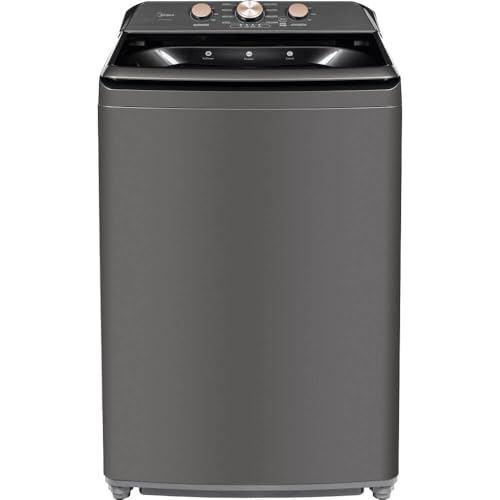
A 4.1 cubic foot top loader with eight presets, auto sensing, a high-water option and a Tub Clean cycle. The console sits at the back of a 46-inch cabinet, so the controls require a reach across the lid. The machine weighs about 128 pounds, which is manageable for two people on delivery day. It suits a household that wants a top load without much programming.
What stands out
- No kneeling needed to load or unload the drum
- Auto sensing chooses a water level for each load
- Tub Clean cycle is simple enough to run monthly
Watch out for
- Controls at the back require a long reach across
- Deep drum at 46 inches tall is hard to unload
BLACK+DECKER 4.1 Cu. Ft. Top Load Washing Machine with Agitator, BTLW41MW

A 4.1 cubic foot top loader with an agitator, 10 cycles, a glass lid and a 24-hour delay. At about 117 pounds it is the lightest full-size machine here, and the console is simpler than most. The agitator is effective on work clothes and heavily soiled items, though it is harder on delicates than an impeller. The 24-hour delay lets a load run overnight on cheaper power.
What stands out
- Lightest full-size machine in this group at 117 pounds
- Agitator handles heavy soil, work clothes and pet hair
- Ten cycles with a short, straightforward control list
Watch out for
- The agitator is rough on delicates and knits
- Deep tub still requires a full downward reach
GE PROFILE 28 Inch Smart Front Load Washer with 4.8 cu. ft. Capacity in White GFW550SSNWW

A 28-inch GE Profile with 4.8 cubic feet, WiFi through SmartHQ, an UltraFresh Vent System with OdorBlock, a 20-minute Quick Wash and a 35-minute Time Saver cycle. Remote start lets a family member begin a load that is already in the drum. The extra width and the 246-pound weight need checking before delivery. It is the most connected machine here, and the least subtle in a small room.
What stands out
- Remote start helps family members who provide care
- UltraFresh vent keeps the drum fresher between loads
- A twenty-minute cycle handles lightly soiled everyday clothes
Watch out for
- 28 inches wide, which is not a standard alcove
- Heavy at about 246 pounds before any laundry
LG WT8400CW 5.5 Cu. Ft. White Mega Capacity Smart Top Load Washer w/EasyUnload
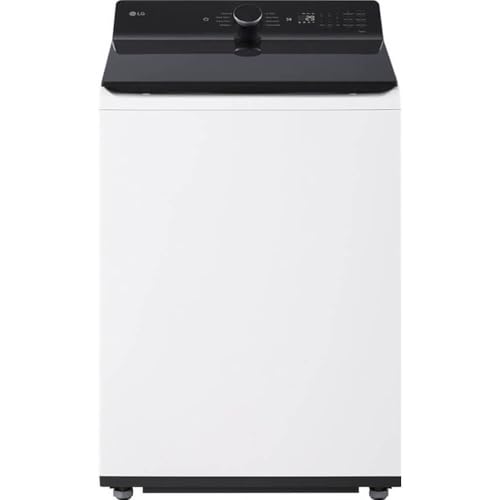
A 5.5 cubic foot top loader with LG's Ergonomic EasyUnload design, AI that selects wash settings and a reworked lid and drum layout. The design is aimed at reducing how far you reach and how much you lift, which is the usual complaint. See one in person before buying, because the benefit depends on your height and the depth of the drum.
What stands out
- The EasyUnload design targets the deep-reach lifting problem
- AI selects settings, so there are fewer decisions
- A 5.5 cubic foot drum means fewer loads every week
Watch out for
- A full load is heavy to lift and carry
- Top-load reach into the drum is still required
LG WM4000HBA 4.5 Cu. Ft. Smart Front-Load Washer, High-Efficiency Laundry Machine with Wi-Fi Connectivity, Bla

An LG front loader with TurboWash 360, ThinQ app control and an Allergiene cycle that the manufacturer says removes most pet dander and dust. The black steel finish is cosmetic, but the practical draw is the combination of a faster cycle and remote status for family members who check in on the household. It suits a home where allergies drive the purchase.
What stands out
- Allergiene cycle for pet dander and household dust
- Remote status and start through the ThinQ app
- TurboWash 360 shortens the length of a normal cycle
Watch out for
- The dark finish shows dust and lint quickly
- App setup can be fiddly for first-time users
LG 4.5 cu. ft. Capacity Smart Front Load Washer with TurboWash

A 4.5 cubic foot LG with TurboWash, steam, a four-tray dispenser and SmartDiagnosis, in a standard 27-inch width. The controls are at the top front, and the cycle list covers the essentials without demanding much reading. SmartDiagnosis is genuinely useful when a machine starts flashing a code nobody in the house understands. The four-tray dispenser also means fewer bottles on the shelf.
What stands out
- Front controls at a reachable height for most users
- Steam helps loosen set-in stains and relax wrinkles
- SmartDiagnosis explains error codes in plain language by phone
Watch out for
- Touch panel needs a firm and precise press
- Dispenser drawer sits high on the front panel
LG WM3470CM 27 Inch Front Load Washer with 5.0 Cu. Ft. Capacity, 8 Wash Programs, 1,300 RPM, SpeedWash Cycle,

A 5.0 cubic foot LG with eight wash programs, a 1,300 RPM spin, SpeedWash, Rinse plus Spin and Control Lock. Eight programs is a manageable number, and the control lock stops a cycle being changed by mistake. The 27-inch width fits a standard alcove, and a matching dryer is listed for a stacked or side-by-side pair. Choose it when a crowded panel is the main worry.
What stands out
- Eight programs that are genuinely easy to learn
- The control lock prevents accidental changes during a cycle
- 1,300 RPM spin reduces drying time and damp weight
Watch out for
- No steam cycle is listed for this model
- About 33 inches deep before the inlet hoses
Buying guide
Bending, reaching and the height of the drum
Laundry is a sequence of reaches, and the machine only controls some of them. A front loader asks you to squat, pull a door and lift a wet bundle from a drum at roughly knee height. A top loader asks you to stand, lift a lid and reach down into a tub that may be two feet deep. Neither is universally easier. The useful question is which movement the person can still do comfortably on a bad day, not on a good one. Count the movements instead: open the door, lift the basket, bend to the drum, pull the wet clothes out, stand back up. A front loader gathers those movements at waist height, while a top loader spreads them across a taller frame.
A pedestal changes the arithmetic. Raising a front loader by 15 inches brings the door closer to waist height for a standing user and removes most of the bend, but it also lifts the control panel and makes a seated reach harder. For a top loader, a lower cabinet is better, and a shallow drum is better than a deep one. Measure the height of the door opening and the depth to the bottom of the drum before deciding, and try the motion with an empty basket in hand. A pedestal also changes where the door sits relative to a walker or a chair, so test the swing with the actual equipment before you commit. A loaded basket is a better test than an empty one.
Control panels that do not need a manual
Panel design is where most washers lose people. A machine with fourteen cycles and a touch strip requires reading small type, remembering a sequence and pressing precisely. A machine with a dial and eight programs lets you turn to Cotton, press Start and walk away. The cleaning difference for everyday clothes is small. Look for large digits, labels in plain words, a Start button with a physical click and a display that stays readable in a dim basement. Contrast matters as much as size: dark text on a light panel is easier to read than gray on gray, and a backlit display beats a reflective one. If the panel sits at the back of a top loader, the labels are also farther from the eyes.
Two smaller details matter more than they sound. After a power interruption, some machines reset to a default and wait for input, which strands a load overnight; others hold the selection. A control lock is useful in a household with grandchildren or a caregiver, but it can confuse someone who does not know it is on, so write the unlock step on a card taped inside the cabinet door. An end-of-cycle chime loud enough to hear from another room saves a wet load from sitting all afternoon. Tape a card inside the door listing the two cycles the household actually uses, and the machine stops being a quiz. A laminated card beats a smartphone app for most people, and it works when the Wi-Fi does not.
Top load or front load: the honest trade-off
The honest trade-off is between kneeling and reaching. If the person can kneel or sit on a stool in front of the machine, a front loader is usually kinder to the back and shoulders, because wet clothes fall into a basket instead of being lifted over a rim. If kneeling is impossible and balance is poor, a top loader keeps them upright, but the lift out of a deep tub can be the harder movement, especially with towels or jeans. Shoulder rotation decides as much as leg strength, and a top-load lift uses both. Watch someone load a basket, not just press the buttons; the movement that reveals the problem is usually the lift out, not the lift in, and ask them how it feels the next morning.
Consider the whole path, not just the machine. A front loader on the floor needs space to stand or sit in front of the open door, and the door itself takes up room. A top loader needs clearance above the lid and somewhere to set the basket at hip height. A rolling cart level with the drum removes a lift entirely, and a stool beside the machine gives someone a place to sit while loading. These are cheap fixes that change the job more than a premium cycle does. A dryer door that folds down gives you a shelf for the basket, which is one less thing to hold. A wall shelf at hip height does the same job for a top loader.
Load size, wet laundry and the walk to the line
Smaller loads are easier to carry, easier to hang and less likely to sit in the drum because folding them feels like too much. A 4.5 cubic foot machine run half full is not wasteful if it keeps the habit going, though it does use more water than a compact machine run full. For one or two people, a 4.1 to 4.8 cubic foot drum is a sensible middle ground, and a small load of daily clothes is a better target than a week of backlog. Towels are the trap: one wet bath towel weighs more than a week of shirts, and it is the load most likely to sit. Wash towels separately, in a load you can carry with one hand.
Spin speed decides how much weight goes out to the line. A 1,300 RPM spin leaves clothes damp rather than dripping, which matters when the walk to the line involves stairs. A front loader generally spins faster than a top loader, and the difference is obvious with towels. A dryer at shoulder height is easier than one at floor level, but stacking puts the washer low or the dryer high, so decide which appliance gets the accessible position before you buy the pair. If the line is outdoors, a cart with large wheels beats carrying a basket against a hip. A second basket for dry clothes keeps the clean load off the floor while the wet one goes out, and it saves a second trip down the hall.
Noise, vibration and safe floors
Balance and flooring are the safety story. A washer on smooth concrete is stable; the same machine on glossy vinyl with a loose rug is not. Put a rubber mat under the machine, not under the person, and keep the walking path clear of baskets, hoses and detergent bottles. A spin cycle can walk a machine that is not level, so check the feet after installation and again a few months later, especially if the floor is wood. Skip the throw rug at the threshold, since it catches walker wheels and cane tips. Wipe up spills at once, and keep a towel within reach of the machine rather than across the room. A machine that shifts during a spin is a warning, not a quirk.
Lighting is the other cheap upgrade. A bright light over the controls and another over the folding surface removes the squinting that leads to wrong buttons. Keep the water shutoffs where someone can reach them without moving the machine, and know where the breaker is. If the laundry is in a basement, a handrail on both sides of the stairs matters more than any appliance feature, and keeping a phone within reach is not paranoia. Put a battery light inside the cabinet too, so a tripped breaker does not leave someone in the dark. Write the breaker number on a label at the panel and another inside the laundry door, so nobody has to guess. A phone torch is not a plan.
Frequently asked questions
What is the easiest washing machine for an older person to use?
One with a physical dial, a small number of clearly labeled programs and a Start button you can feel. Front loaders are easier on the back if the user can kneel or sit; top loaders avoid kneeling but require a deeper reach.
Is a top-load or front-load washer easier on the back?
A front loader on a low pedestal is usually easier, because the drum is near waist height and wet clothes drop into a basket. A top loader avoids squatting but requires lifting wet fabric over a rim, which is hard on shoulders. If kneeling is impossible, a shallow top-load drum with a rolling cart beside it is the safer combination.
Do senior-friendly washers need special installation?
No special installation, but a few adjustments help. A pedestal raises a front loader, anti-vibration pads steady it on wood floors, and a lever shutoff is easier to turn. Keep the outlet and hoses reachable without pulling the machine out.
How much laundry should one load hold for a single person?
A load that is comfortable to carry in one basket is the right size, regardless of what the drum can hold. For one person that is often a few days of clothes. Running smaller loads more often is easier on the body and produces less wrinkling, for a little more water and energy.
Are smart features helpful or confusing for older users?
It depends on who is helping. Remote start and status let an adult child check a cycle, which is useful. But app setup, Wi-Fi drops and re-pairing after an outage can turn a simple task into a support call. Buy smart features for the helper.
Verdict
The LG WM3470CM is the pick for most older buyers who can still bend a little. It has eight programs instead of twenty, a control lock, a 1,300 RPM spin and SmartDiagnosis that explains error codes by phone.
The BLACK+DECKER 4.1 is the value choice for anyone who cannot kneel: a familiar top load with ten cycles, a light 117-pound cabinet and an agitator that handles work clothes. The LG WT8400CW is the upgrade for a 5.5 cubic foot drum and easier unloading, though a full load will be heavy. Match the machine to the daily movement, not the brochure.