A bar towel from a Friday service does not smell like a bar towel. It smells like fryer oil, beer and the rag bucket, and it comes out of a home washer looking clean while still feeling faintly waxy. That film is the tell. Restaurant laundry is mostly fats, proteins and starch, and those need heat, enough detergent to break the emulsion, and a rinse strong enough to carry the soil out of the drum instead of spreading it across the next load.
The instinct is to buy something labeled commercial. True commercial washers, the hard-mounted on-premise units built for hotels and hospitals, run on different plumbing, different power and a service contract, and their price makes a single-location owner wince. What most restaurants actually install is the tier below: high-capacity front loaders with steam, an extra-rinse option and a drum big enough to swallow a stack of tablecloths.
That tier is what this guide covers. Eight machines, most of them 27 inches wide, all of them designed for a laundry room rather than a commercial laundry. Used inside their limits they handle a restaurant's linen well. Pushed past those limits they fail the way residential machines always fail: pump, bearings, door boot, one after another.
We compared specifications, features and owner reports from restaurant and catering operators, then sorted the list by what actually breaks first in a hot, greasy back room.
Top picks at a glance
Kenmore 4.5 cu. ft. Front Load Washer
Check price on AmazonBLACK+DECKER 4.1 Cu. Ft. Top Load Washing Machine with Agitator, BTLW41MW
Check price on AmazonLG WM4200HWA 5.0 cu ft Front‑Load Washer, Steam Wash, Allergiene™ Cycle, Large
Check price on AmazonCompare the shortlist
| Model | Type | Capacity | Key feature | Amazon |
|---|---|---|---|---|
| 1. Kenmore 4.5 cu. ft. Front Load Washer | Front-load | 4.5 cu ft | Steam | Check price |
| 2. Electrolux 27 in. W 4.5 cu. ft. Front Load Washer with SmartBoos | Front-load | 4.5 cu ft | Steam | Check price |
| 3. LG WM4200HWA 5.0 cu ft Front‑Load Washer, Steam Wash, Allergiene | Washers | 5.0 cu ft | Steam | Check price |
| 4. LG 5.2 cu. Ft Stackable Smart Front Load Washer in Black Steel w | Front-load | 5.2 cu ft | Steam | Check price |
| 5. LG WM3400CW 4.5 cu ft Front-Load Washer | Front-load | 4.5 cu ft | Low noise | Check price |
| 6. BLACK+DECKER 4.1 Cu. Ft. Top Load Washing Machine with Agitator, | Top-load | 4.1 cu ft | Delay start | Check price |
| 7. GE GTW500ASNWS Top Loading Washer with Stainless Steel Basket, 4 | Top-load | 4.6 cu ft | Top-load | Check price |
| 8. Samsung 5.0 cu. ft. Extra Large Capacity Smart Front Load Washer | Front-load | 5.0 cu ft | Steam | Check price |
Detailed reviews
Kenmore 4.5 cu. ft. Front Load Washer

A 4.5 cubic foot front loader with Steam Treat, twelve cycles and five wash temperatures. Express Wash is rated at 25 minutes for a small load, and Accela Wash shortens full-size cycles. An extra rinse helps clear detergent from thick towels, and Cold Clean cuts energy use on lightly soiled loads. The cabinet is 27 inches wide but 34 inches deep, so measure the alcove before you order. ENERGY STAR certified.
What stands out
- Steam Treat lifts kitchen grease without relying on chlorine bleach
- The 25-minute express cycle suits a quick bar towel load
- Five wash temperatures cover aprons down to delicate napkins
Watch out for
- The 34-inch cabinet depth crowds a narrow back room
- No automatic detergent dosing means staff measure every load
Electrolux 27 in. W 4.5 cu. ft. Front Load Washer with SmartBoost, LuxCare Plus Wash System, Perfect Steam in

Electrolux's 4.5 cubic foot front loader premixes detergent with water in a SmartBoost chamber before it reaches the drum, which helps in cold or hard water. Perfect Steam adds a hot option for stains and odor. The adaptive dispenser accepts pods, liquid or powder and keeps bleach and softener in separate compartments. Eleven-plus cycles cover towels, aprons and uniforms. At 27 inches wide and 32 inches deep, it is one of the shallower machines here.
What stands out
- SmartBoost premixing gets more out of detergent in cold water
- Dispenser takes pods, liquid or powder without an insert
- Perfect Steam adds heat for greasy aprons and stained whites
Watch out for
- One hinge orientation, so check which way the door opens
- Dispenser drawer needs weekly rinsing in a greasy room
LG WM4200HWA 5.0 cu ft Front‑Load Washer, Steam Wash, Allergiene™ Cycle, Large Capacity, SmartThinQ® Wi‑Fi Ena

The WM4200HWA pairs a 5.0 cubic foot drum with TurboWash 360, steam and LG's Allergiene cycle. Wi-Fi through ThinQ lets a manager start, pause or monitor a load from the office, which matters when the last cycle runs after close. ENERGY STAR certified, 27 inches wide and roughly 33 inches deep. The drum takes tablecloths and aprons in one pass, and the steam option handles grease without a bleach-heavy routine.
What stands out
- Large 5.0 cubic foot drum cuts the number of nightly cycles
- TurboWash 360 shortens the wash on full loads
- Wi-Fi monitoring covers a load left running after close
Watch out for
- App setup and account creation is a chore for new staff
- Steam adds cycle time on the heaviest soil settings
LG 5.2 cu. Ft Stackable Smart Front Load Washer in Black Steel with Steam & Turbowash Technology

A 5.2 cubic foot LG front loader in black steel, stackable with the matching dryer. Steam, TurboWash and an inverter direct drive motor are all present, and the ENERGY STAR rating reflects roughly 105 kWh a year in annual consumption. The belt-free direct drive removes a wear part and cuts vibration. This is the largest drum in the group, which suits a kitchen running linen for a full dining room rather than a counter service.
What stands out
- 5.2 cubic feet is the largest drum on this list
- Inverter direct drive motor runs quiet and has fewer wear parts
- Stackable design frees floor space in a tight back room
Watch out for
- Black steel shows grease fingerprints within a single service
- Listed dimensions vary by retailer, so confirm the cut sheet
LG WM3400CW 4.5 cu ft Front-Load Washer

LG's WM3400CW is the plain, dependable 4.5 cubic foot front loader of the group. LoDecibel construction and the TrueBalance anti-vibration system keep it steady on a wooden floor, and 6Motion varies drum movement by cycle instead of running one tumbling pattern. There is no steam, no Wi-Fi and no dispenser gimmick, just straightforward controls. ENERGY STAR certified. Where staff turnover is high, that simplicity is a feature rather than a compromise.
What stands out
- Controls are simple enough for a closing crew to learn quickly
- TrueBalance keeps vibration manageable on raised wooden floors
- The 4.5 cubic foot drum handles a full load of aprons
Watch out for
- No steam option for grease-heavy loads and stained whites
- No remote monitoring, cycle alerts or diagnostic app
BLACK+DECKER 4.1 Cu. Ft. Top Load Washing Machine with Agitator, BTLW41MW

A 4.1 cubic foot top loader with a dual-action agitator, stainless steel tub, glass lid and ten cycles. The 24-hour delay lets you schedule a load for after close, and it runs on standard 120-volt power. At under 120 pounds it is the lightest machine here, and the narrow 25.75-inch cabinet slips into spaces a front loader will not. Best treated as a second unit for bar rags rather than the main linen machine.
What stands out
- Agitator action handles heavy grease and baked-on food soil
- Lightest machine here at just over 116 pounds
- Delay start can run a load overnight after closing
Watch out for
- Uses more hot water per load than any front loader here
- Weaker spin extraction leaves towels slower to dry
GE GTW500ASNWS Top Loading Washer with Stainless Steel Basket, 4.6 Cu. Ft. Capacity, 13 Cycles, White
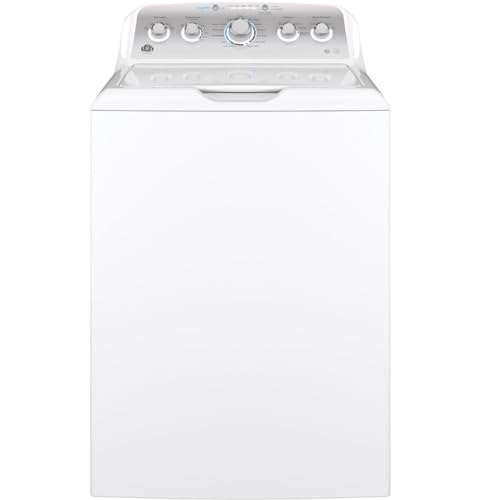
GE's GTW500ASNWS is a 4.6 cubic foot top loader with thirteen cycles, a stainless steel basket and a dual-action agitator that reverses direction during the wash. A second rinse option helps clear detergent from heavy towels and bar mops. At 44 inches tall it fits under a counter with clearance, and the 27-inch footprint matches most front loaders. It is the simplest way to add capacity without plumbing a second drain.
What stands out
- Thirteen cycles give staff room to match the load
- Second rinse clears detergent from thick bar towels
- Stainless basket resists chips and snags from utensils
Watch out for
- Top-load lid rules out installation under a low counter
- No steam cycle and no Wi-Fi diagnostics on this model
Samsung 5.0 cu. ft. Extra Large Capacity Smart Front Load Washer with Super Speed Wash and Steam, Brushed Blac

Samsung's 5.0 cubic foot front loader with Super Speed Wash, steam and SmartThings Wi-Fi. Super Speed is rated to finish a full load in about 28 minutes, the fastest claim in this group and the reason it tops this list for a restaurant. It stacks with the matching dryer or sits side by side, and it is ENERGY STAR certified. The drum takes tablecloths and aprons together without crowding.
What stands out
- Super Speed finishes a full load in roughly 28 minutes
- The 5.0 cubic foot drum takes tablecloths and aprons together
- Stackable or side-by-side layout suits awkward back rooms
Watch out for
- Fast cycles assume a correctly loaded, not overfilled, drum
- Brushed black finish shows water spots between cleanings
Buying guide
The Soil Load in a Restaurant Is Not Household Dirt
Think about what goes into the hamper. Napkins with lipstick and tomato sauce, aprons stiff with pan grease, bar rags soaked in simple syrup, dish towels carrying both oil and starch from bread service. Grease needs heat and a surfactant to lift it, starch needs enzymes and time, and protein stains like egg and blood set permanently above roughly 140 degrees Fahrenheit. One load can contain all three, which is why a single normal cycle at warm temperature leaves towels that feel clean and smell off an hour later. A prewash or heavy-soil setting earns its keep here, giving detergent a first pass at the grease before the main wash dilutes it.
The practical test is the rinse water. If the drum smells like old oil after a cycle, the soil is still in the machine rather than in the drain, and running an extra rinse on bar towels costs a few gallons and saves the towels from that waxy feel. Detergent choice matters as much as the machine: liquid cuts grease better at moderate temperatures, while powder with built-in oxygen bleach outperforms on stained whites in hot water. Overdosing is the common error in a busy kitchen, because staff pour by eye, and extra detergent in soft water leaves residue that stiffens towels and feeds odor bacteria in the door boot.
Matching Capacity to a Service Day
Capacity is not about one enormous load. It is about how many loads you can finish between the end of service and the start of the next prep shift. A 4.5 cubic foot drum handles a realistic restaurant load: a dozen aprons, a stack of bar towels and a couple of tablecloths, loosely packed. The 5.0 and 5.2 cubic foot machines mainly buy you fewer cycles, which matters when the person running them is also closing out the POS. Count the linen from one service, then count how many of those piles exist on your busiest night. That number, not the drum size in the listing, should drive the decision.
The mistake is treating the drum as a garbage bag. Front loaders need room for clothes to tumble and fall through the water, and packed solid they clean poorly and beat up the suspension. Fill to about three-quarters and stop. If your volume genuinely exceeds that, two mid-size machines running in parallel beat one overloaded machine every time, and they give you a spare when one goes down. Cycle length sets your real throughput too. A standard wash runs close to an hour, while Kenmore rates its Express cycle at 25 minutes for a small load and Samsung claims 28 minutes for a full load with Super Speed.
Steam, Temperature and the Rinse That Saves Your Towels
Steam is the most useful upgrade on this list for a kitchen. A steam option raises the temperature inside the drum and the fabric without raising the water level, which helps release oil from apron ties and collar bands where detergent struggles to penetrate. Kenmore calls it Steam Treat, Electrolux calls it Perfect Steam, LG and Samsung use Steam Wash. Whatever the label, the idea is the same: heat as a solvent. On a load of aprons, that extra heat is the difference between grease that lifts away and grease that smears into the fabric and sets in the dryer.
Steam also reduces your dependence on chlorine bleach. Bleach is effective and cheap, but it destroys cotton faster than anything else in the laundry, and towels that go through a bleach load five nights a week turn thin and gray within a year. A steam cycle plus oxygen bleach gets most of the way there without the fiber damage. Then there is the rinse. Detergent residue is what makes a towel stiff enough to stand on its own, and stiff towels get rejected by staff who would rather use paper. Look for a dedicated extra-rinse button rather than a setting buried three menus deep.
Installation Details That Decide the Purchase
Most of these washers are 27 inches wide, but the number that surprises people is depth. The Kenmore and Samsung front loaders are roughly 34 and 33.5 inches deep, and hoses plus a right-angle plug add a couple of inches behind the cabinet. A 30-inch closet door is fine; a 28-inch door on a tight landing is not, so measure the path rather than only the alcove. Height matters if you want a folding counter above the machines. At 38 to 40 inches tall, a front loader leaves room for a work surface at 42 inches, which gives the back room a prep area that does not collect dirty plates.
On the utility side, plan a dedicated circuit, a standpipe or laundry sink the drain hose can be secured into, and shutoff valves you can reach without pulling the machine out. A floor drain is worth the money in a commercial kitchen, and so is a pan underneath the washer, because a supply hose failure at 2 a.m. is the difference between a mopped floor and a closed dining room. Leave a few inches of clearance behind and above the cabinet for airflow, since a washer in a hot kitchen needs to shed heat and a tight box shortens control board life.
Maintenance in a Room Full of Grease
Front loaders trap lint, hair and grease in a pump filter behind a small access door at the bottom front. In a home that filter needs attention twice a year. In a restaurant it can pack solid in six weeks, and the first symptom is a slow drain and a load that finishes wet. Put it on a monthly list, with a towel underneath, because what comes out smells like the grease trap. The door boot is the second failure point: grease and lint collect in the fold, hold moisture, and turn into a black film that transfers onto the next load of napkins.
Once a month, run the hottest cycle with a washer cleaner and no laundry. Twice a year, check the inlet screens, look for bulging hoses, and confirm the machine is still level, since a wobbling spin will eventually crack a floor tile or walk the machine into a wall. If the washer sits in a closet, make sure service access is possible without disassembling cabinetry. Hoses and filters are cheap, a flooded prep kitchen is not, and a machine that cannot be pulled out for repair gets replaced early.
Frequently asked questions
Can a residential washer handle restaurant linen?
For a single-location restaurant doing a few loads a day, yes, with caveats. These machines are built for household volumes and will wear faster under daily commercial use. Buy one with steam and an extra rinse, keep loads to three-quarters of the drum, and expect a shorter service life than the residential warranty implies.
Front load or top load for kitchen towels?
Front load is the better fit. It uses less water, extracts more of it in the spin, and handles large items like tablecloths without wrapping them around an agitator. Top loaders are cheaper and simpler, and the agitator models handle heavy soil well, but they use more hot water and dry slower.
Do I need an NSF-certified washer for a restaurant?
Check with your local health department rather than assuming. Certification standards for laundry equipment differ from those for dish machines, and requirements vary by jurisdiction. What health inspectors consistently look for is separation: food-contact linen should not share a machine with mop heads, floor cloths or restroom rags.
How many loads a day is too many?
There is no published duty rating on consumer machines, which is exactly why this is hard to answer honestly. As a working rule, three to five loads a day is light commercial use, and most of these washers tolerate it. Ten loads a day, every day, belongs on a commercial machine with a service contract.
Why do my towels smell sour after washing?
Residual detergent and grease in the drum and boot feed bacteria, and a cool wash does not kill them. Run a hot maintenance cycle with a machine cleaner, clean the pump filter, wipe the boot, and add an extra rinse. If the smell returns within a week, switch to liquid detergent and stop overdosing.
Verdict
The Samsung 5.0 cubic foot front loader is the pick for a working kitchen. The drum takes a full load of aprons and tablecloths, Super Speed shortens the turnaround between closing and opening, and the steam option handles grease without a bleach-heavy routine. If you want the lowest entry cost that still does the job, the Kenmore 4.5 in white is the value choice: 25-minute express cycles for small loads, Steam Treat for stains, and a Cold Clean option for the loads that are not really dirty.
Step up to the LG 5.2 if linen volume is the bottleneck and the machine can be stacked or tucked into a closet. It is the largest drum here, and its inverter direct drive motor is the quietest thing in this group. Buy it for capacity and calm, not for stain performance.