The first thing to measure in a compact dryer project is not the drum. It is the doorway, the closet opening and the space between the door and the nearest wall. A 24-inch heat-pump dryer will fit a surprising number of laundry closets; the cabinet, the open door and the clearance behind it are what usually fail the test. Bring a tape measure and a notepad, and write down three numbers for every candidate space: width at the narrowest point, height under the shelf, and depth from the back wall to the door frame.
Compact heat-pump dryers follow a European convention: about 24 inches wide, roughly 33 inches tall, and deep enough to hold four cubic feet of laundry plus a refrigeration loop. That footprint lets them slot under a counter, beside a washer or on top of one. It also means every inch of depth counts, because the hose, the plug and the wall add up behind a cabinet that already fills the opening. A machine listed at 25.75 inches deep can need 28 inches of closet.
We compared specifications, features and owner reports for five of these machines, all ventless and all within a few inches of each other. The differences that matter are depth, door swing, how the water leaves the machine, and what the manufacturer expects you to supply at installation. Where two machines are close, the deciding factor is usually the closet rather than the spec sheet, and we say so instead of inventing a winner.
Top picks at a glance
Samsung 4.0 Cu Ft Heat Pump Dryer, Compact Clothes Drying Machine, Stackable f
Check price on AmazonSamsung 4.0 cu. ft. Compact Ventless Heat Pump Dryer with AI Smart Dial, Wi-Fi
Check price on AmazonSummit 3.88 cu.ft. Heat Pump Dryer, ENERGY STAR Certified, 208-240V, Slim 24”
Check price on AmazonCompare the shortlist
| Model | Type | Capacity | Key feature | Amazon |
|---|---|---|---|---|
| 1. Samsung 4.0 Cu Ft Heat Pump Dryer, Compact Clothes Drying Machin | Heat pump | 4.0 cu ft | Sensor drying | Check price |
| 2. Samsung 4.0 cu. ft. Compact Ventless Heat Pump Dryer with AI Sma | Heat pump | 4.0 cu ft | Sensor drying | Check price |
| 3. Summit 3.88 cu.ft. Heat Pump Dryer, ENERGY STAR Certified, 208-2 | Heat pump | 3.88 cu ft | Delay start | Check price |
| 4. Techomey 4.4 Cu.Ft Ventless Heat Pump Clothes Dryer, 24" Compact | Heat pump | 4.4 cu ft | Sensor drying | Check price |
| 5. SMETA 4.4 Cu.Ft Heat Pump Ventless Electric Dryer, Front Load Cl | Heat pump | 4.4 cu ft | Sensor drying | Check price |
Detailed reviews
Samsung 4.0 Cu Ft Heat Pump Dryer, Compact Clothes Drying Machine, Stackable for Small Spaces w/Sensor Dry, 12

A 4.0 cu. ft. Samsung compact built around stacking, with a reversible door and a footprint sized for compact spaces. Twelve preset cycles include a 40-minute express run for a two-pound load, and Sensor Dry adjusts time and temperature as the load dries. Smart Care handles basic troubleshooting from a phone. The cabinet measures about 23.7 inches wide, 25.75 inches deep and 33.25 inches tall.
What stands out
- Reversible door makes tight closet installations noticeably easier
- Forty-minute express cycle handles a small urgent load
- Twelve preset cycles, all with sensor-based dryness control
Watch out for
- Four cubic feet fills quickly with bedding or towels
- Some smart features work best with a Samsung washer
Samsung 4.0 cu. ft. Compact Ventless Heat Pump Dryer with AI Smart Dial, Wi-Fi Connected, Smart Dry Technology
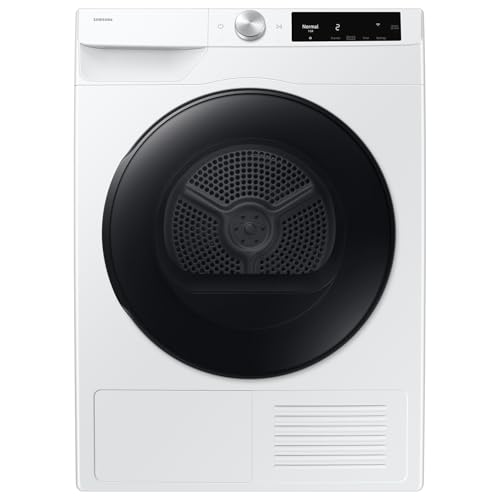
Samsung's 4.0 cu. ft. compact ventless heat pump is the most connected machine in this group, with an AI Smart Dial, SmartThings Wi-Fi and sensor-based Smart Dry. It is ENERGY STAR certified. The dial rearranges itself around the cycles you use, and the app sends end-of-cycle notifications and supports remote start or delay. The listing gives weight but not cabinet dimensions, so measure your opening carefully before ordering.
What stands out
- AI Smart Dial keeps favorite cycles within one turn
- SmartThings app supports alerts, remote start and delay
- ENERGY STAR certified, with sensor-based dryness control built in
Watch out for
- Cabinet dimensions are not published in the listing
- Wi-Fi features depend on a stable signal in the laundry area
Summit 3.88 cu.ft. Heat Pump Dryer, ENERGY STAR Certified, 208-240V, Slim 24” Width, White

Summit's slim 24-inch heat-pump dryer holds 3.88 cu. ft. and rates its drum for 17.6 pounds of fabric. Fourteen settings cover extra dry, iron dry, delicates, wool, air fluff and a half load, and the ECOEYE display reports power use while the cycle runs. The pull-out condensation tank needs emptying about every two cycles. A three-prong cord comes pre-installed for 208-240V, 15-amp service.
What stands out
- Fourteen settings, including wool, delicates and air fluff
- ECOEYE display shows power consumption during a cycle
- Pre-installed cord matches a 208-240V, 15-amp household outlet
Watch out for
- 3.88 cu. ft. drum is the smallest in this group
- Tank needs emptying every two cycles or so
Techomey 4.4 Cu.Ft Ventless Heat Pump Clothes Dryer, 24" Compact 120/240V Electric Front Load Drying Machine,

Techomey's 24-inch ventless heat pump offers 4.4 cu. ft., sixteen cycles and sensor drying that pauses when the load reaches the selected dryness. The brand says drum air stays below 50 degrees Celsius, which is gentle on wool and fine fabrics. It arrives with a four-prong power cable, so a three-prong outlet needs an adapter. The water tank must be emptied after every load, or the program stops.
What stands out
- Sixteen cycles with a low-temperature profile that suits fine fabrics
- 4.4 cu. ft. drum in a stackable 24-inch body
- Sensor dry pauses automatically at the chosen dryness
Watch out for
- Water tank must be emptied after each load
- Four-prong cable needs an adapter for older outlets
SMETA 4.4 Cu.Ft Heat Pump Ventless Electric Dryer, Front Load Clothes Dryer Machine, 24" Compact Stackable Por

SMETA's 4.4 cu. ft. heat-pump dryer can be stacked, set freestanding or slid under a counter in a 24-inch slot. Twelve cycles cover towels, quilts, baby clothes and silks, with wrinkle care and a deodorizing option. A quick cycle handles a partial load in about thirty minutes, and a My Cycle setting saves your own preferences. It ships with a four-wire plug, which saves a trip to the hardware store.
What stands out
- Stackable, freestanding or under-counter, all in one 24-inch cabinet
- Four-wire plug included in the box, unlike several rivals here
- Quick cycle handles a partial load in about 30 minutes
Watch out for
- Twelve cycles is fewer than the sixteen on some rivals
- Heat-pump drying still runs longer than vented drying
Buying guide
Measure the Opening, Not the Drum
Start with a tape measure and the rough opening: width, height and depth, taken at the narrowest point rather than at the trim. A 24-inch dryer needs a little clearance on each side for the door and for air movement, and the manual states the minimum. Then walk the delivery path. A 28-inch hallway turn will stop a 24-inch cabinet on a hand truck even when the closet itself is generous, and a stair landing with a railing can be tighter than the door. Finally, check the door swing. A dryer door that opens 180 degrees needs a clear wall; one that opens 90 degrees can live beside a shelf without complaint. Measure the closet door height as well, because a stacked pair is taller than either machine. If the closet has a bulkhead overhead, measure the clearance under it rather than at the floor.
If the machine goes under a counter, the counter depth and the toe kick matter as much as the cabinet. Under-counter installations are the least forgiving layout in a small laundry, because the counter fixes height and depth at the same time and leaves no room to fudge. Depth is the dimension people underestimate. These machines run about 25 to 26 inches deep at the cabinet, and the power cord and drain hose still need room behind the unit. Add two inches for plumbing and another inch for the plug, then compare that total with the closet's interior depth. Write the numbers on a card and take them shopping; showroom floors are optimistic about fit. A counter that overhangs by two inches still works if the door clears it.
Stack, Sit Beside, or Slide Under
Stacking is the usual answer in a closet, and most models here are described as stackable by their maker. Stacking needs a kit sized to the washer, not a generic shelf, and the washer has to be a front-loader with a flat, load-bearing top. A top-load washer cannot carry a dryer, no matter how sturdy the lid looks. If you rent, check the lease before you drill anything into a wall for an anti-tip strap, and confirm that the stacked pair will still let the closet door close. A pair that fits the opening but blocks the door from shutting is a common and avoidable mistake. A pair that leans because the washer door protrudes will work loose at the bracket within months.
Side-by-side works when the room is wider than it is tall, and it makes the dryer easier to service because you can reach the back panel without unstacking anything. Under-counter placement is the most space-efficient option and the least forgiving. The counter height has to clear the cabinet, and the dryer door has to open without hitting a cabinet run. Sketch the layout with the appliances at their real dimensions before you order, and leave the service gap the manual asks for at the back. A pencil sketch catches more problems than a product photo ever will. Leave the aisle wide enough to pull the lint filter and read the panel without standing on a stool, because you will do both more often than you expect.
Water: Tank or Drain
A ventless heat pump produces water, roughly a quart or more per load depending on the fabric and how well your washer spins. That water goes into a tank you pull out, or down a hose into a standpipe, laundry sink or floor drain. A tank is fine in a rental where you cannot touch the plumbing. A drain is better in a home where you can, because you stop thinking about the machine between loads and the dryer stops pausing halfway through a cycle with wet clothes inside. If the closet has neither a standpipe nor a sink, plan on the tank and keep a spare pitcher nearby. A tank tucked behind a stacked pair is easy to forget until the machine stops mid-load.
Tank capacity varies more than you would expect. Summit's tank wants emptying every two cycles. Techomey says every load, and the program pauses if you forget. That is less a design flaw than a consequence of a small cabinet and a low condenser. If the dryer sits on top of a washer, lifting a full tank above shoulder height twice a week gets old quickly, which is one more argument for a drain hose and a standpipe when the room has one within reach. Empty the tank at the end of the day, not the end of the week, and rinse it while you are there. If the tank is the only option, empty it into a sink rather than a toilet, and rinse the gasket.
Voltage, Cords and Adapters
Compact does not mean low-voltage. Most of these dryers want a 240-volt circuit, and several ship without the cord you need. Midea's cord is sold separately. Smad and Techomey list 120/240V, which may mean the machine can be configured either way, but the listings do not say which version you are buying. Ask the seller in writing before you pay an electrician to pull a circuit, and get the answer before the return window closes. A screenshot of the answer is worth more than a memory of a phone call, especially when the installer arrives and shakes his head. An electrician will also check whether the panel can carry the load, whether the outlet is grounded and whether the wiring is aluminum.
If your building only has a 120-volt laundry outlet, a heat-pump dryer is probably not the answer. Do not assume a plug adapter solves a voltage problem. A 120-volt circuit cannot feed a 240-volt compressor, and the adapter that makes the plug fit does not change that. This is the most common installation mistake in apartments and older homes, and it usually surfaces on delivery day when the installers refuse to connect the machine. Confirm the circuit, the breaker size and the receptacle type before you order anything, and put the electrician's estimate into the budget. A 240-volt dryer on a 120-volt circuit will trip the breaker or refuse to start, and neither outcome is the bargain the listing promised.
What Four Cubic Feet Will and Will Not Dry
A 4.0 to 4.4 cu. ft. drum handles a normal mixed load: a couple of pairs of jeans, shirts, socks and underwear. It struggles with a king comforter, which needs a commercial machine or a laundromat. It also struggles with a full set of towels plus bath mats. Owners who expect a compact dryer to behave like a seven-cubic-foot vented machine are the ones who leave one-star reviews. Set expectations by load type rather than by the cubic-foot number on the label, and keep a folding rack for the items that should not tumble at all. A duvet cover rolled into a ball will stay damp in the middle no matter how long the cycle runs, so shake everything out first.
Cycle times run longer than vented drying, and compact drums take longer still because there is less air volume moving through the clothes. Expect 70 to 90 minutes for cottons and up to two hours for heavy items. Sensor drying helps, but the sensor can only stop the cycle; it cannot speed up the physics. If you need a load dry in 40 minutes, the Samsung express cycle is the closest thing here, and it is limited to a small load. Plan laundry around the machine's rhythm rather than your own, and run the heavy items first. Start a load before dinner rather than after, and the machine will still be working when you go to bed, which is fine if you are not waiting on it.
Frequently asked questions
What size heat-pump dryer fits a 24-inch closet?
Look for a cabinet about 23 to 24 inches wide and roughly 33 inches tall, then check the depth against your opening. Most compact heat pumps are within an inch of each other, so depth and the space behind the machine usually decide the fit. Measure the closet door frame too, not just the interior.
Can a compact heat-pump dryer keep up with a family?
For two or three people, yes, if you run a load most days. For a family of five with towels and sports kit, a 4.0 cu. ft. drum means more cycles and the occasional laundromat trip for bedding. Count your weekly loads before you decide. Capacity is the one specification you cannot work around later.
Do compact heat-pump dryers need a drain?
No, but they need somewhere for the condensate to go. Every model here can collect water in a tank you empty by hand. A drain hose is more convenient and avoids mid-cycle pauses, and most units accept one. If you can reach a standpipe or laundry sink, use it.
Can I plug a compact heat-pump dryer into a regular outlet?
Usually not. These machines typically need a dedicated 240-volt circuit, and some ship without a cord. A 120-volt household outlet cannot power a 240-volt compressor, and an adapter does not change the voltage. Check the nameplate and the manual before delivery, and budget for an electrician if the room lacks the circuit.
Why do compact heat-pump dryers take so long?
They dry at a lower temperature and recycle the air instead of exhausting it, so moisture leaves the drum more slowly. A smaller drum also holds less air volume. The result is a 70- to 90-minute cotton cycle and longer runs for heavy items. Sensor drying trims wasted time but cannot make the process faster than the physics allows.
Verdict
The Samsung AI Smart Dial is the best all-round compact here. It is ENERGY STAR certified, the dial keeps your regular cycles within one turn, and the SmartThings app covers the alerts you will actually use. Samsung publishes very little cabinet data for this model, so confirm the dimensions against your opening before ordering.
The SMETA is the value pick: 4.4 cu. ft., a four-wire plug in the box, twelve cycles and a quick cycle that handles a partial load in about half an hour. Step up to the Summit if you want fourteen drying levels and a power-use display, or if a condensation tank suits a rental with no drain.