Most American dryers work by making a lot of hot air and then throwing it away. A heat-pump dryer does something different: it moves heat between two coils inside a sealed loop, condenses the moisture out of the air, and sends the same air back through the drum. Nothing goes up a duct, which is why these machines turn up in closets, kitchen alcoves and basement rooms that never had a vent.
The design has consequences worth understanding before you buy. Because the air never gets as hot as a glowing element, cycles run longer, and the water has to go somewhere: a pull-out tank you empty, or a hose that drains it for you. What you get in exchange is fabric care. Wool, elastane, printed tees and anything with a care label that warns against heat come out closer to how they went in.
The nine machines here range from a 7.8 cu. ft. LG that can keep up with a family of five to 24-inch units under four cubic feet built for apartment closets. We compared specifications, features and owner reports, and we flagged the installation details, such as cords, voltage and drains, that decide whether a model will actually work in your room.
Top picks at a glance
LG 7.8 cu. ft. Dual Inverter Heat Pump ventless Electric Dryer with DirectDriv
Check price on AmazonMidea Heat Pump Ventless Front Load Dryer Stackable 4.4 Cu.ft White
Check price on AmazonBLACK+DECKER 4.4 Cu. Ft. Electric Dryer with Heat Pump, 22 lb. Capacity , 240V
Check price on AmazonCompare the shortlist
| Model | Type | Capacity | Key feature | Amazon |
|---|---|---|---|---|
| 1. LG 7.8 cu. ft. Dual Inverter Heat Pump ventless Electric Dryer w | Heat pump | 7.8 cu ft | Sensor drying | Check price |
| 2. Midea Heat Pump Ventless Front Load Dryer Stackable 4.4 Cu.ft Wh | Heat pump | 4.4 cu ft | Sensor drying | Check price |
| 3. BLACK+DECKER 4.4 Cu. Ft. Electric Dryer with Heat Pump, 22 lb. C | Heat pump | 4.4 cu ft | Ventless | Check price |
| 4. Samsung 4.0 Cu Ft Heat Pump Dryer, Compact Clothes Drying Machin | Heat pump | 4.0 cu ft | Sensor drying | Check price |
| 5. Samsung 4.0 cu. ft. Compact Ventless Heat Pump Dryer with AI Sma | Heat pump | 4.0 cu ft | Sensor drying | Check price |
| 6. Smad 23.4" Ventless Heat Pump Dryer, 4.4 Cu.Ft Front Load Clothe | Heat pump | 4.4 cu ft | Sanitize cycle | Check price |
| 7. Summit 3.88 cu.ft. Heat Pump Dryer, ENERGY STAR Certified, 208-2 | Heat pump | 3.88 cu ft | Delay start | Check price |
| 8. Techomey 4.4 Cu.Ft Ventless Heat Pump Clothes Dryer, 24" Compact | Heat pump | 4.4 cu ft | Sensor drying | Check price |
| 9. SMETA 4.4 Cu.Ft Heat Pump Ventless Electric Dryer, Front Load Cl | Heat pump | 4.4 cu ft | Sensor drying | Check price |
Detailed reviews
LG 7.8 cu. ft. Dual Inverter Heat Pump ventless Electric Dryer with DirectDrive Motor, 6 Motion and AI Sensor

The only full-size machine in this group, with a 7.8 cu. ft. drum, LG's DirectDrive motor and a dual-inverter heat pump. An auto-cleaning condenser takes most of the maintenance off your hands, and AI Sensor Dry adjusts the cycle as the load dries. Wi-Fi through the ThinQ app adds remote start and cycle tracking, which is more useful than it sounds when a cycle runs ninety minutes.
What stands out
- Full-size 7.8 cu. ft. drum handles comforters and family loads
- Auto-cleaning condenser removes the main recurring maintenance chore
- AI Sensor Dry and ThinQ app give useful cycle control
Watch out for
- Needs a large footprint and a dedicated 240-volt circuit
- Highest up-front cost in this group of nine
Midea Heat Pump Ventless Front Load Dryer Stackable 4.4 Cu.ft White

A 24-inch, 4.4 cu. ft. heat-pump dryer that can sit beside a washer or stack on one. A humidity sensor ends the cycle when the load is dry, and the wrinkle-care phase tumbles in unheated air for about ninety minutes afterward. It is ENERGY STAR qualified. Two catches: the power cord is sold separately, and the machine needs a 240-volt outlet.
What stands out
- Stackable 24-inch body fits a closet or a tight alcove
- Humidity sensor and wrinkle care cover the basics well
- ENERGY STAR qualified with a claimed 28% energy saving
Watch out for
- Power cord is not included in the box
- Only 4.4 cu. ft., so bulky bedding needs two cycles
BLACK+DECKER 4.4 Cu. Ft. Electric Dryer with Heat Pump, 22 lb. Capacity , 240V Electric Clothes Dryer with 16

BLACK+DECKER's 4.4 cu. ft. ventless heat-pump dryer has sixteen cycles, a stainless steel drum and a 22-pound capacity rating. Condensate goes into a removable tank or out through the supplied 51-inch drain hose, which is more flexible than tank-only designs. Installation is the sticking point: the unit is meant to be hardwired by a professional, and the three- or four-wire cord is not included.
What stands out
- Sixteen cycles cover delicates, towels and everyday cottons
- Drain hose included, so you can skip the water tank
- Stainless steel drum resists rust and odor buildup
Watch out for
- Requires professional hardwiring and a cord you buy separately
- Heavier than most 24-inch competitors at about 121 pounds
Samsung 4.0 Cu Ft Heat Pump Dryer, Compact Clothes Drying Machine, Stackable for Small Spaces w/Sensor Dry, 12

Samsung's 4.0 cu. ft. compact heat pump is built for stacking, with a reversible door and a footprint built for compact spaces. Twelve preset cycles include a 40-minute express run for a small two-pound load, and Sensor Dry adjusts time and temperature as moisture drops. Smart Care handles basic diagnostics from a phone. The listed cabinet is about 23.7 inches wide, 25.75 inches deep and 33.25 inches tall.
What stands out
- Reversible door makes tight closet installations noticeably easier
- Forty-minute express cycle handles a small urgent load quickly
- Twelve preset cycles, all with sensor-based dryness control
Watch out for
- Four cubic feet is small for comforter day
- Smart Care diagnostics need a compatible Samsung washer
Samsung 4.0 cu. ft. Compact Ventless Heat Pump Dryer with AI Smart Dial, Wi-Fi Connected, Smart Dry Technology
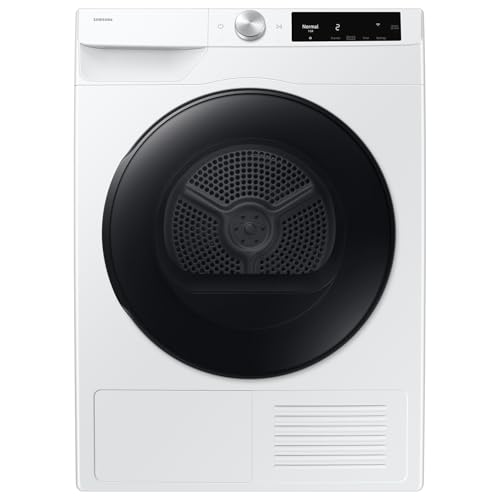
Samsung's compact 4.0 cu. ft. ventless heat pump pairs an AI Smart Dial with SmartThings Wi-Fi control and sensor-based drying. It is ENERGY STAR certified. The dial learns which cycles you use and puts them first, and the app sends end-of-cycle alerts and supports remote start. Samsung lists only the weight in its specifications, so measure your opening and compare it with the cabinet diagram.
What stands out
- AI Smart Dial learns and surfaces your regular cycles
- SmartThings app handles alerts, remote start and delay
- ENERGY STAR certified, with sensor drying to protect fabrics
Watch out for
- Samsung publishes very few cabinet dimensions for this model
- App features are useless if your laundry room has weak Wi-Fi
Smad 23.4" Ventless Heat Pump Dryer, 4.4 Cu.Ft Front Load Clothes Dryer with Wrinkle Care,10KG Load, 120/240V,

Smad's 4.4 cu. ft. ventless heat pump is a 23.4-inch-wide stackable machine with sixteen programs, a sanitize option and a wrinkle-care cycle. The LED display shows cycle status, and the drum is rated for a ten-kilogram load. Smad lists 120/240V operation, which is unusual in this class, so confirm with the seller exactly which configuration ships before you plan the outlet.
What stands out
- Sixteen programs include sanitize, wrinkle care and a quick cycle
- Stackable body with a 23.4-inch width for tight rooms
- LED display shows cycle status at a glance
Watch out for
- Dual-voltage listing is vague and needs seller confirmation
- Limited long-term owner data compared with LG or Samsung
Summit 3.88 cu.ft. Heat Pump Dryer, ENERGY STAR Certified, 208-240V, Slim 24” Width, White

A slim 24-inch heat-pump dryer with a 3.88 cu. ft. drum and a 17.6-pound fabric rating. Fourteen dry settings include extra dry, iron dry, delicates, wool and air fluff, and the ECOEYE display shows power use as the cycle runs. The pull-out condensation tank needs emptying about every two cycles, so a drain connection is worth arranging. A three-prong cord is pre-installed for 208-240V, 15-amp service.
What stands out
- Fourteen drying levels, including wool, delicates and air fluff
- ECOEYE display tracks power use during the cycle
- Pre-installed cord matches a 208-240V, 15-amp household outlet
Watch out for
- Small 3.88 cu. ft. drum fills quickly with bedding
- Condensation tank needs emptying every couple of cycles
Techomey 4.4 Cu.Ft Ventless Heat Pump Clothes Dryer, 24" Compact 120/240V Electric Front Load Drying Machine,

A 24-inch, 4.4 cu. ft. stackable heat-pump dryer with sixteen cycles and sensor drying that pauses when the load reaches the set dryness. Techomey says the drum air stays below 50 degrees Celsius, which suits wool and delicate fabrics. It arrives with a four-prong power cable, so a three-prong outlet needs an adapter, and the water tank has to be emptied after every load or the program stops.
What stands out
- Sixteen cycles and a gentle low-temperature drying profile
- Stackable 24-inch body with a 4.4 cu. ft. drum
- Sensor dry pauses automatically when clothes are ready
Watch out for
- Tank must be emptied after every single load
- Four-prong cable needs an adapter for three-prong outlets
SMETA 4.4 Cu.Ft Heat Pump Ventless Electric Dryer, Front Load Clothes Dryer Machine, 24" Compact Stackable Por

SMETA's 4.4 cu. ft. heat-pump dryer fits a 24-inch slot and can be stacked, set freestanding or slid under a counter. Twelve cycles cover towels, quilts and delicates, with wrinkle care and a deodorizing option. A quick cycle handles a partial load in about half an hour, and it ships with a four-wire plug, which saves an errand in a tight laundry room.
What stands out
- Four-wire plug included in the box, unlike most rivals
- Stackable, freestanding or under-counter, all in one 24-inch cabinet
- Quick cycle dries a partial load in about 30 minutes
Watch out for
- Twelve cycles is fewer than several rivals offer
- Condensate tank needs frequent emptying when the dryer is stacked
Buying guide
What the Heat Pump Actually Does
A heat-pump dryer runs a sealed refrigeration loop, not a heating element. Damp air leaves the drum and crosses a cold evaporator coil, where moisture condenses and drips into a sump. The same air then crosses a warm condenser coil, picks the heat back up and returns to the drum. Because the air is reheated rather than replaced, almost all the energy that enters the cabinet stays there instead of going up a duct. That is the entire efficiency story, and it explains two things owners notice in the first week: the drum feels warm rather than hot, and the room around the machine gains a little heat during a long cycle. There is no flapper, no foil duct, and no yearly climb behind the machine to vacuum out a hose.
The practical result is a gentler dry. Wool, silk blends, elastane and anything with a printed graphic tolerate a moderate drum temperature far better than a blast of hot air, which is why heat-pump machines are the default in markets where dryers sit in kitchens and closets. The cost is time. A load a vented electric dryer finishes in 45 minutes may take 70 to 90 in a heat pump, and a king comforter can run past two hours. If you dry three loads back to back on a Sunday, that matters. If you run one load most evenings, the slower cycle is easy to live with, and sensor settings close the gap by stopping when the load is actually dry. The other adjustment is psychological: you stop treating the dryer as a 45-minute appliance and start it before dinner instead of after.
Capacity and the Matching Problem
Dryer capacity is quoted in cubic feet, and the number is more honest than most appliance specs. A 4.4 cu. ft. drum takes a normal family load of mixed laundry. The LG's 7.8 cu. ft. drum swallows a comforter with room to spare. The trap is comparing a compact dryer to the 7 cu. ft. vented machine you grew up with. A household that generates a load a day will feel the difference in the number of cycles it runs, not in how any single load comes out. Two adults who wash twice a week will barely notice the gap. Compact drums also load differently: sheets go in one at a time rather than as a bundle, and a comforter takes the whole drum.
Watch the pairing with your washer, too. Stacked pairs work best when the drums are close in size, and a 4.4 cu. ft. dryer under a 5 cu. ft. washer makes the dryer the bottleneck, especially on towel day. If you are buying both machines, match them. If you already own a large front-loader and dry everything in one go, the LG is the only model here that will keep pace. Everyone else should count loads honestly before choosing a compact. A dryer that needs two cycles for one washer load is not saving anyone time or money. The exception is a household that already sorts laundry by fabric; small drums handle that pattern without complaint. Ask how many loads you run on a Sunday and multiply by the drum size, because that arithmetic is more useful than an efficiency rating.
Voltage, Cords and Where the Water Goes
Most machines here want a dedicated 240-volt circuit. Heat-pump drying is efficient, not low-voltage: the compressor and drum motor still draw real power, and the circuit has to be sized for the startup surge. The fine print matters more than the headline. Midea sells its dryer without a power cord. BLACK+DECKER expects professional hardwiring with a three- or four-wire cord that is not in the box. Techomey ships a four-prong cable and notes that a three-prong outlet needs an adapter. Smad and Techomey both list 120/240V operation, which is unusual in this class, so confirm the exact configuration with the seller before you book an electrician. If the receptacle is a standard 120-volt outlet, assume you are buying an electrician visit along with the dryer.
Water handling is the other half of installation. Condensate collects in a tank or drains through a hose. Summit's pull-out tank needs emptying about every two cycles. Techomey wants its tank emptied after each load or the program pauses. A gravity drain into a standpipe or laundry sink is the better arrangement if you can reach one, because a full tank is the most common reason a heat-pump dryer stops mid-cycle. BLACK+DECKER includes a 51-inch drain hose; check the others for what is actually in the box before you plan the plumbing. In a rental, the tank is usually the only option. Most tanks hold enough for one heavy load rather than three, and the machine will pause instead of overflowing.
Running Cost, Noise and Upkeep
Efficiency claims are easy to print and hard to verify, but the physics favors the heat pump. Midea, Summit, Samsung and BLACK+DECKER all describe their units as ENERGY STAR certified or qualified, and the sealed loop recovers heat a vented dryer would send outside. Midea and BLACK+DECKER both cite roughly 28% less electricity than a standard dryer. Treat those numbers as directional. What matters at home is how many loads you run a week and what you pay per kilowatt-hour, not the badge on the door. A heat pump that runs two hours for a load can still beat a vented dryer that finishes in 45 minutes. A household running two loads a week will wait a long time to see the savings; one running ten will notice sooner.
Noise is the complaint that shows up most in owner reports of compact heat pumps, and it comes from two places: the compressor and the tumbling. A closed laundry closet amplifies both. If the dryer shares a wall with a bedroom, choose a model with a reversible door so it opens away from the traffic path, and consider a solid door instead of a louvered one. Maintenance is simple but not optional. Clean the lint filter every load, rinse the condenser screen every few weeks, and empty the water tank at the end of the day rather than the end of the week. Neglect shows up as longer cycles. A dryer that has to be unstacked before it can be serviced is a dryer that gets repaired late.
Frequently asked questions
Do heat-pump dryers need to be vented?
No. The loop is sealed and the moisture is condensed into a tank or drained away, so there is no duct to run and no exterior wall to cut. That is the main reason they suit closets, basements and apartments. You still need clearance for air movement around the cabinet, and most models still need a 240-volt outlet.
How long does a heat-pump dryer take?
Longer than a vented dryer. A normal cotton load runs roughly 70 to 90 minutes, and heavy items like towels or a comforter can push past two hours. Sensor-dry settings help by stopping the cycle when the load is actually dry instead of running a fixed timer. Plan around the time rather than fighting it.
Can I stack one on top of my washer?
Only if both machines are designed for it and you use the right stacking kit. Several models here are 24 inches wide and about 33 inches tall, which matches compact European-style washers. A full-size American washer is wider and deeper, so check the footprints before assuming a stack will work. An unlevel dryer will vibrate and can trip its moisture sensor.
Do heat-pump dryers work in a cold garage?
Poorly. The refrigerant loop depends on a temperature difference, and performance drops as the surrounding air gets colder. Manufacturers publish an operating range in the manual, and it is usually well above freezing. If your laundry area is unheated, a vented electric dryer may be the safer choice. Check the manual for your model before you buy.
Is a heat pump better than a condenser dryer?
A condenser dryer uses a heating element and a heat exchanger; a heat pump adds a compressor and recycles the heat, so it uses less electricity per load. Both are ventless. The heat pump costs more up front and usually dries more slowly at lower temperatures, which is easier on fabrics. For regular use, the running-cost gap is what justifies the price.
Verdict
The LG 7.8 cu. ft. Dual Inverter model remains the pick for most households with room for it. It is the only full-size machine in this group, and the auto-cleaning condenser removes the chore that wears compact owners down. For a 24-inch footprint, the Midea is the value pick: ENERGY STAR qualified, 4.4 cu. ft., a humidity sensor and a wrinkle cycle, though the cord is extra.
Step up to the Samsung AI Smart Dial for app control in a smaller 4.0 cu. ft. drum, or to the SMETA if you want the four-wire plug in the box and a quick cycle for partial loads. Families of four or more should start with the LG.