Basements are where dryers go when the house runs out of better options, and they are also the room where a heat pump dryer makes the most sense. The space is usually cold, often damp, and frequently has no easy path to an exterior wall. A ventless machine turns all three problems into minor inconveniences instead of installation blockers.
There is a catch, and it is water. A heat pump dryer pulls moisture out of the clothes and collects it as condensate. In a basement you have two ways to deal with that: carry a tank upstairs, or run a hose to a floor drain, standpipe or laundry sink. The second option is the reason basements suit these machines so well.
Cold air also affects drying. Heat pump dryers move heat around a sealed loop rather than generating it with a large element, so they are slower to begin with, and a 55-degree room slows them further. That is not a malfunction. It is the trade for a machine that does not need another hole in the foundation wall.
We compared six compact heat pump dryers on the things that matter downstairs: voltage, cord type, condensate handling, stacking height and the space they need around them. Where a listing does not publish a dimension, we say so.
Top picks at a glance
Midea Heat Pump Ventless Front Load Dryer Stackable 4.4 Cu.ft White
Check price on AmazonBLACK+DECKER 4.4 Cu. Ft. Electric Dryer with Heat Pump, 22 lb. Capacity , 240V
Check price on AmazonSamsung 4.0 cu. ft. Compact Ventless Heat Pump Dryer with AI Smart Dial, Wi-Fi
Check price on AmazonCompare the shortlist
| Model | Type | Capacity | Key feature | Amazon |
|---|---|---|---|---|
| 1. Midea Heat Pump Ventless Front Load Dryer Stackable 4.4 Cu.ft Wh | Heat pump | 4.4 cu ft | Sensor drying | Check price |
| 2. BLACK+DECKER 4.4 Cu. Ft. Electric Dryer with Heat Pump, 22 lb. C | Heat pump | 4.4 cu ft | Ventless | Check price |
| 3. Samsung 4.0 cu. ft. Compact Ventless Heat Pump Dryer with AI Sma | Heat pump | 4.0 cu ft | Sensor drying | Check price |
| 4. Smad 23.4" Ventless Heat Pump Dryer, 4.4 Cu.Ft Front Load Clothe | Heat pump | 4.4 cu ft | Sanitize cycle | Check price |
| 5. Summit 3.88 cu.ft. Heat Pump Dryer, ENERGY STAR Certified, 208-2 | Heat pump | 3.88 cu ft | Delay start | Check price |
| 6. Techomey 4.4 Cu.Ft Ventless Heat Pump Clothes Dryer, 24" Compact | Heat pump | 4.4 cu ft | Sensor drying | Check price |
Detailed reviews
Midea Heat Pump Ventless Front Load Dryer Stackable 4.4 Cu.ft White

A 4.4-cubic-foot, 240-volt heat pump dryer in a 24-inch cabinet, sized to stack with a matching washer in a basement corner. The humidity sensor adjusts the cycle to the load, and wrinkle care tumbles in unheated air for about 90 minutes at the end. The power cord is sold separately, so add it to the order rather than discovering the gap on install day.
What stands out
- Humidity sensor ends the cycle when the load is dry
- 24-inch cabinet fits a narrow basement footprint beside a washer
- ENERGY STAR qualified for lower energy use per load
Watch out for
- Power cord is sold separately from the dryer
- Needs a dedicated 240-volt circuit near the machine
BLACK+DECKER 4.4 Cu. Ft. Electric Dryer with Heat Pump, 22 lb. Capacity , 240V Electric Clothes Dryer with 16

The 4.4-cubic-foot BLACK+DECKER has the largest drum here and the most useful basement feature: a 51-inch drain hose in the box, so condensate can go to a floor drain instead of a tank. It has 16 cycles and a stainless steel drum. The catch is installation: it requires professional hardwiring with a three- or four-wire cord that is not included.
What stands out
- Drain hose included for hands-free condensate disposal to a drain
- 4.4 cu. ft. drum with a 22-pound capacity for family loads
- Stainless steel drum resists rust in damp rooms
Watch out for
- Professional hardwiring is required and the cord is not included
- 121 pounds is a serious carry down basement stairs
Samsung 4.0 cu. ft. Compact Ventless Heat Pump Dryer with AI Smart Dial, Wi-Fi Connected, Smart Dry Technology
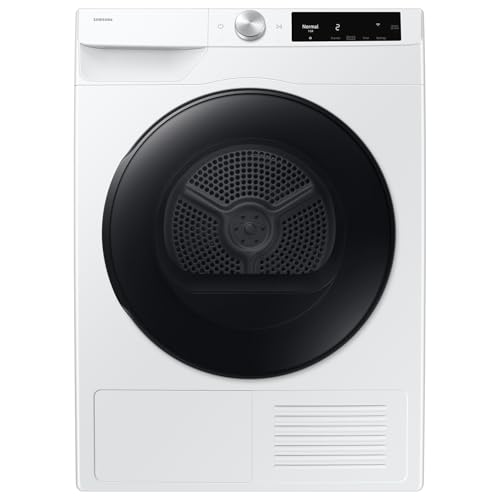
Samsung's compact ventless dryer has the smallest drum in this group at 4.0 cubic feet, and the only Wi-Fi radio. In a basement, the app is more useful than it sounds: it tells you when a load finishes so you are not walking downstairs to check. Sensor Dry adjusts time and temperature, and the AI Smart Dial reorders cycles based on use. Full cabinet dimensions are not published.
What stands out
- Wi-Fi notifications save repeated trips down the basement stairs
- AI Smart Dial learns and reorders favorite cycles
- Sensor Dry adjusts time and temperature to the load
Watch out for
- Cabinet dimensions are not published in the listing
- Smallest drum of the six at 4.0 cubic feet
Smad 23.4" Ventless Heat Pump Dryer, 4.4 Cu.Ft Front Load Clothes Dryer with Wrinkle Care,10KG Load, 120/240V,

Smad's 4.4-cubic-foot dryer is listed for 120/240V operation, which matters in a basement with an older 120-volt circuit and no easy path to a new one. It offers 16 programs, including sanitize and wrinkle care, and a 23.4-inch width that stacks on a matching washer. Running on 120 volts will stretch cycle times noticeably. The 23.4-inch cabinet also leaves room for a shelf above the stack.
What stands out
- 120/240V listing suits older basement wiring without a new circuit
- Sanitize and wrinkle care sit among 16 drying programs
- 23.4-inch width fits a compact stack in a narrow corner
Watch out for
- 120-volt operation lengthens cycles noticeably compared with 240 volts
- Tank must be monitored if no drain is used
Summit 3.88 cu.ft. Heat Pump Dryer, ENERGY STAR Certified, 208-240V, Slim 24” Width, White

Summit's 3.88-cubic-foot machine is the smallest here and the simplest to connect: a pre-installed three-prong cord for a 208-240V, 15-amp outlet. It has 14 settings, a start delay and a half-load option, and the ECOEYE display reports power use. The condensation tank needs emptying roughly every two cycles, so a floor drain is still the better long-term setup. It is also the simplest of the six to connect without an electrician.
What stands out
- Pre-installed cord suits a 15-amp, 208-240V dryer outlet
- Half-load setting suits small households and short laundry lists
- ECOEYE display tracks power consumption cycle by cycle
Watch out for
- Tank needs emptying about every two drying cycles
- 3.88 cu. ft. is tight for comforters and bedding
Techomey 4.4 Cu.Ft Ventless Heat Pump Clothes Dryer, 24" Compact 120/240V Electric Front Load Drying Machine,

A 4.4-cubic-foot, 24-inch ventless dryer listed for 120/240V and built to stack on a same-size washer. It has 16 cycles and sensor drying that pauses when the load reaches the selected level. The listing is explicit about two things: the tank must be emptied after each use or the program stops, and the four-prong cable needs an adapter on a three-prong outlet.
What stands out
- 4.4 cu. ft. drum in a compact 24-inch cabinet
- Sensor drying across 16 cycles ends loads when dry
- 120/240V listing widens installation options in older houses
Watch out for
- Tank must be emptied after every load or the cycle pauses
- Four-prong cable may need an adapter on older outlets
Buying guide
Why a Basement Suits a Ventless Dryer
The basement is the one room in the house where a conventional dryer is genuinely difficult. The rim joist is full of insulation, the foundation wall is concrete, and the shortest path outside may run ten feet up and across a finished ceiling. Every one of those conditions adds cost to a vented install, and none of them matters to a heat pump dryer, which never sends air outside at all. If the house was built before the 1990s, the old dryer may have vented through a homemade transition that was never sealed properly, and removing that run is part of the appeal of going ventless.
There is a second benefit that matters in older houses: no make-up air. A vented dryer pulls conditioned air out of the house and replaces it through every crack it can find, which is why laundry rooms feel cold in January. A ventless machine recirculates the air already in the room. It still needs a circuit and a level floor, but it does not depressurize the basement or fight the furnace. That matters more than efficiency ratings suggest: a basement laundry that pulls cold air across the floor is uncomfortable for everyone using it, and the furnace works harder to compensate.
Getting the Water to a Drain
Condensate is the defining chore of ventless drying. Every machine here can fill a pull-out tank, and most can be plumbed to a hose instead. In a basement, plumbing is almost always the better answer because the tank is the part people forget. A floor drain, a laundry sink or a standpipe for the washer gives you a place to send the water without carrying anything up a flight of stairs. Tank size varies and is not always published, so the first week tells you how often you will be carrying it upstairs. A full tank is heavier than it looks, and the stairs do not get shorter.
Gravity is the constraint. The drain hose has to slope down from the dryer outlet to the drain for its entire run. A hose that rises, even a few inches, will hold water and eventually back up into the cabinet. If your only drain is uphill, the tank is the practical choice, or you add a condensate pump. None of the kits here includes a pump, so budget for one separately if the layout demands it. Check the slope with a level before you fill the drum; a hose that sags in the middle holds water even when both ends sit lower. Keep the run as short as the layout allows.
Voltage, Cords and Old Basement Circuits
Basements often have the oldest wiring in the house. A circuit that was added for a freezer in 1978 may be 120 volts and shared with half the rec room. Before buying, find the breaker that feeds the laundry area and read the label. A 240-volt dryer circuit is usually a double-pole breaker with a large receptacle; a 120-volt circuit is not, and no adapter makes it one. If the basement was finished without permits, the laundry circuit may be tapped off a general-purpose line, which is exactly the sort of thing an electrician finds in ten minutes. Photograph the breaker and the outlet before you shop.
The cord details differ across this group. Summit arrives with a pre-installed three-prong cord rated for a 208-240V, 15-amp outlet. Techomey uses a four-prong cable and needs an adapter on a three-prong receptacle. Midea sells the cord separately. BLACK+DECKER specifies professional hardwiring with a cord that is not included. Write those requirements down before you compare features, because they decide which machine can actually be installed. None of these differences is a dealbreaker, but each one changes the cost of installation. A hardwired model may need an electrician and a permit, a cord sold separately adds a line to the order, and an adapter is a small part you want on hand before the truck arrives.
Cold Rooms, Low Ceilings and Stacking
An unheated basement in February is not the same operating environment as a second-floor laundry closet. Heat pump dryers rely on a temperature differential across the evaporator, and low ambient air makes that differential harder to maintain, so cycles stretch. Check the manual for the stated operating range if the room drops below about 60 degrees. Some machines are fine; some will struggle, and a few will refuse to start. A cheap thermometer on the wall will tell you more about your basement than any product page. If the room sits at 50 degrees all winter, plan for long cycles and consider a different location.
Height is the other basement constraint. These cabinets run 33 to 33.5 inches tall, which clears most joists but not all ductwork and not every stairwell turn. Measure the lowest obstruction on the path, not the ceiling height in the middle of the room. If you plan to stack, confirm the washer is the same footprint and add a stacking kit; the pair will be close to 70 inches tall, which is tight under a 78-inch joist. A low ceiling also limits how much you can tilt a machine to get it around a corner, and these units should stay upright once unboxed. Measure the stairwell twice.
Damp Air, Lint and the Rest of the Room
A heat pump dryer does not add much moisture to the air, but it does add some, and a basement already has plenty. Keep the area around the machine dry and avoid boxing it into a sealed closet. If the room smells musty in summer, a dehumidifier will do more for the laundry than any dryer setting. Run it on a humidistat so it works when the room needs it and stays quiet when it does not. Basement air already carries moisture from the slab and the walls, so the dryer is not the main source. Treat the room first and the appliance second; a hygrometer costs less than a service call.
Lint is the other housekeeping item. Ventless machines still produce lint, and it collects in the filter and around the door gasket rather than in a duct. Clean the filter every load and wipe the gasket weekly. Every few months, pull the machine out and vacuum the condenser grille and the floor behind it. In a basement, that is also where you will find the mouse nest, the lost sock and the reason the machine was rocking. The condenser coil is the part people neglect. It sits behind a grille and collects dust until the machine cannot move heat efficiently, which shows up as longer and longer cycles.
Frequently asked questions
Can a heat pump dryer be installed in a basement?
Yes, and it is often the easiest place to put one because no exterior vent is required. You still need a compatible circuit, a level floor and a plan for the condensate. Check the door width and stair turn before delivery; published weights here run from 110 to 121 pounds, and they do not fit through every basement entrance.
Does a ventless dryer need extra ventilation in a basement?
It does not need a duct, but the room should not be sealed. Leave a gap under the door or keep the door open during cycles so humidity does not concentrate in one corner. A small fan moving air through the room is enough. If the basement is chronically damp, fix that with a dehumidifier rather than relying on the dryer.
Can I drain a heat pump dryer into a floor drain?
Yes, if the hose can run downhill from the dryer outlet to the drain without any rise. Lay the hose out and check the slope before you push the machine into place. Secure the end so it cannot slip out of the drain, and leave a trap or loop only if the manufacturer's instructions call for one.
Will a cold basement make drying take longer?
Usually yes. Heat pump dryers work best in a conditioned space, and low ambient temperatures reduce their efficiency. Check the manual for the operating range before installing in an unheated room. Below that range, cycles stretch and some machines will not run at all. A space heater is not the answer; improving the room is.
Do I need a plumber to install the drain hose?
Not for a tank, and not usually for a hose run to an existing standpipe or laundry sink. You need a plumber if there is no drain at all and you want one added, or if the only option is a condensate pump discharging to a distant line. Keep the hose short and sloping; long horizontal runs are where clogs and backups start.
Verdict
The top pick for a basement is the BLACK+DECKER. Its 4.4-cubic-foot drum handles family loads, it includes a 51-inch drain hose for permanent condensate disposal, and the stainless drum suits a room that is not always dry. The value pick is the Summit, which arrives with a pre-installed three-prong cord for a 15-amp circuit and fits where a full-size machine will not. The upgrade is the Midea, with a humidity sensor that ends the cycle on moisture and ENERGY STAR qualification.
If the basement stairs are narrow or the ceiling is low, the Samsung has the smallest drum here, though its cabinet dimensions are not published and need confirming. For a household that will not plumb a drain, the Techomey's 4.4-cubic-foot drum is appealing, but its tank needs emptying after every load. In a basement, the drain decides more than the drum size.