The appeal is easy to see. A ventless dryer means no four-inch hole in the side of your coach, no duct to route around a slide-out, and no lint blowing onto the awning. For a park model, a destination trailer or a converted school bus, that is a genuine improvement over cutting the shell. The trouble starts when the same buyer reads the electrical label and discovers that most of these machines want 240 volts and weigh more than a large adult.
None of the six dryers here is a 12-volt RV appliance. They are compact residential heat pumps, built to sit on a floor in a closet, and treating them as drop-in camper gear leads to disappointed installations. What they can do is serve a coach with a 50-amp connection, a properly wired 240-volt circuit and enough structural floor to carry 110 to 121 pounds plus a wet load. That describes a narrower group of rigs than the search term suggests.
We compared specifications, features and owner reports for six ventless machines that owners do install in mobile settings. The useful differences are the cord each one ships with, the depth of the cabinet, how the condensate leaves the machine, and whether the controls assume a permanent drain. We have flagged where a coach needs work before the dryer arrives, because the electrical question is the one that stops most projects.
Top picks at a glance
Samsung 4.0 cu. ft. Compact Ventless Heat Pump Dryer with AI Smart Dial, Wi-Fi
Check price on AmazonMidea Heat Pump Ventless Front Load Dryer Stackable 4.4 Cu.ft White
Check price on AmazonBLACK+DECKER 4.4 Cu. Ft. Electric Dryer with Heat Pump, 22 lb. Capacity , 240V
Check price on AmazonCompare the shortlist
| Model | Type | Capacity | Key feature | Amazon |
|---|---|---|---|---|
| 1. Samsung 4.0 cu. ft. Compact Ventless Heat Pump Dryer with AI Sma | Heat pump | 4.0 cu ft | Sensor drying | Check price |
| 2. Midea Heat Pump Ventless Front Load Dryer Stackable 4.4 Cu.ft Wh | Heat pump | 4.4 cu ft | Sensor drying | Check price |
| 3. BLACK+DECKER 4.4 Cu. Ft. Electric Dryer with Heat Pump, 22 lb. C | Heat pump | 4.4 cu ft | Ventless | Check price |
| 4. Summit 3.88 cu.ft. Heat Pump Dryer, ENERGY STAR Certified, 208-2 | Heat pump | 3.88 cu ft | Delay start | Check price |
| 5. Smad 23.4" Ventless Heat Pump Dryer, 4.4 Cu.Ft Front Load Clothe | Heat pump | 4.4 cu ft | Sanitize cycle | Check price |
| 6. Techomey 4.4 Cu.Ft Ventless Heat Pump Clothes Dryer, 24" Compact | Heat pump | 4.4 cu ft | Sensor drying | Check price |
Detailed reviews
Samsung 4.0 cu. ft. Compact Ventless Heat Pump Dryer with AI Smart Dial, Wi-Fi Connected, Smart Dry Technology
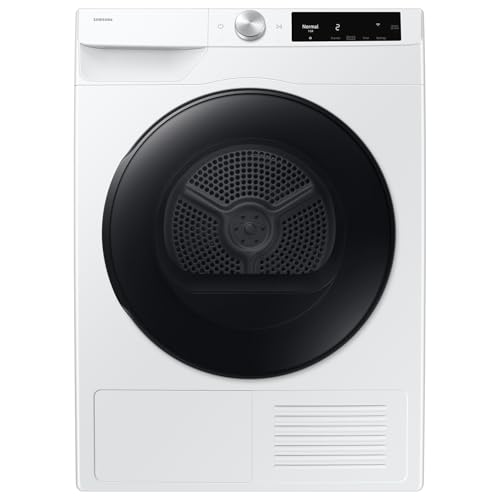
Samsung's 4.0 cu. ft. compact ventless heat pump is the most connected machine here, with an AI Smart Dial, SmartThings Wi-Fi and sensor-based Smart Dry. End-of-cycle alerts are genuinely useful in a coach, where the laundry closet is often at the far end from where you sit. It is ENERGY STAR certified and weighs 110.2 pounds. Samsung publishes no cabinet dimensions in the listing, so ask the seller for the cutout drawing before you commit to a 24-inch slot.
What stands out
- Phone alerts reach you anywhere in the coach
- ENERGY STAR certified with sensor-based Smart Dry control
- Lightest published weight in this group at 110.2 pounds
Watch out for
- No cabinet dimensions are published in the product listing
- Wi-Fi depends on a usable signal at the campground
Midea Heat Pump Ventless Front Load Dryer Stackable 4.4 Cu.ft White

Midea's 4.4 cu. ft. ventless heat pump offers the largest drum alongside a simple control set. A humidity sensor adjusts the cycle to the dry level you pick, and Wrinkle Care tumbles the finished load for about ninety minutes without heat. The cabinet is 23.4 inches wide, 25.7 deep and 33.5 tall. It is ENERGY STAR qualified and stackable. The 240-volt power cord is sold separately, so order it with the machine rather than discovering the gap on install day.
What stands out
- 4.4 cu. ft. drum holds a full coach load
- Humidity sensor ends the cycle at the chosen dryness
- 23.4-inch width suits a genuinely narrow laundry closet
Watch out for
- Power cord is not included with the machine
- No drain hose listed, so the tank is the default
BLACK+DECKER 4.4 Cu. Ft. Electric Dryer with Heat Pump, 22 lb. Capacity , 240V Electric Clothes Dryer with 16

Black+Decker's BDFH44M brings the highest fabric rating here at 22 pounds and 4.4 cu. ft., with sixteen cycles and a zinc-coated stainless drum. A 51-inch drain hose ships with it, which helps if the coach has a utility sink or a suitable container nearby. The catch is weight and wiring: about 121 pounds, professional hardwiring required, and no cord in the box. The cabinet measures 24.3 inches wide, 23.4 deep and 33.5 tall.
What stands out
- Twenty-two pound capacity, the highest in this group
- Fifty-one inch drain hose included in the box
- Sixteen cycles with a durable zinc-coated stainless drum
Watch out for
- About 121 pounds before any laundry goes in
- Cord is not included and hardwiring is required
Summit 3.88 cu.ft. Heat Pump Dryer, ENERGY STAR Certified, 208-240V, Slim 24” Width, White

Summit's SLD242W is built for tight slots. The cabinet is 23.63 inches wide, 25.75 deep and 33 inches tall, and the drum holds 3.88 cu. ft., rated for 17.6 pounds of fabric. Fourteen settings cover extra dry, iron dry, delicates, wool, air fluff and a half load. A pull-out condensation tank means no drain plumbing, though it wants emptying about every two cycles. The three-prong cord comes pre-installed for 208-240V, 15-amp service, and ECOEYE reports power use.
What stands out
- Slim 23.63-inch cabinet fits the narrowest coach closets
- Three-prong cord comes pre-installed for the 208-240V service
- Pull-out tank needs no drain connection at all
Watch out for
- 3.88 cu. ft. is the smallest drum here
- Tank needs emptying roughly every two cycles of laundry
Smad 23.4" Ventless Heat Pump Dryer, 4.4 Cu.Ft Front Load Clothes Dryer with Wrinkle Care,10KG Load, 120/240V,

Smad's 4.4 cu. ft. ventless heat pump measures 23.4 inches wide, 25.7 deep and 33.5 tall, with sixteen programs, wrinkle care and a sanitize function. The LED display and status lights are readable from across a small room. It stacks on a matching washer, which suits a park model with a purpose-built laundry nook. The listing describes 120/240V operation without specifying which version ships, so get the voltage confirmed in writing before an electrician touches the coach.
What stands out
- Sixteen programs including sanitize, wrinkle care and daily fabrics
- 23.4-inch width fits a compact laundry nook neatly
- LED display stays readable across a small room
Watch out for
- Voltage configuration is unclear in the product listing
- No drain hose mentioned, so plan on the tank
Techomey 4.4 Cu.Ft Ventless Heat Pump Clothes Dryer, 24" Compact 120/240V Electric Front Load Drying Machine,

Techomey's 4.4 cu. ft. ventless heat pump lists 120/240V operation, which is the detail to nail down before buying for a coach. Sixteen cycles with sensor drying pause at the chosen dryness, and drum air stays below 50 degrees Celsius. The spec table puts the cabinet at 25.6 inches wide, 23.5 deep and 33.5 tall, and it stacks on a matching washer. A four-prong cable is fitted, and the tank must be emptied after every load or the program stops.
What stands out
- 4.4 cu. ft. drum inside a stackable 24-inch cabinet
- Sensor drying pauses at the selected dryness level
- Low temperature ceiling protects delicate and printed fabrics
Watch out for
- Tank needs emptying after every load, or it stops
- Four-prong cable needs an adapter on older outlets
Buying guide
Ventless Is the Only Reason This Works
In a house, ventless is a convenience. In a coach, it is the whole argument. Cutting a four-inch duct through an insulated wall or a laminated side panel creates a thermal bridge, a water intrusion path and a lint trap you cannot easily clean. A heat pump avoids all three because the air stays inside a sealed loop: moisture condenses on a cold coil, drips into a tank or hose, and the dried air returns to the drum. Nothing leaves the cabinet but a little heat. That is the reason the category exists for mobile use at all, and it is worth paying for even if the dryer itself is unremarkable. Nothing on the outside of the shell has to change, which appeals to anyone who has owned a leaky duct.
That heat is worth planning for. A ventless dryer releases warmth into the room rather than pushing it outside, which is welcome in a chilly coach and unwelcome in a small bedroom on a July afternoon. The cabinet also needs clearance for air movement around it, typically an inch or two at the sides and more at the back, and the manual will state the minimum. In a tight RV closet, those gaps are the difference between a machine that runs as designed and one that cycles on its thermal limit. Build the opening around the manual, not around the cabinet, or you will be trimming trim after the first hot afternoon. Measure the opening again after the slide-out is retracted.
The 240-Volt Question Comes First
A 50-amp RV connection is a 120/240-volt split-phase feed, which is the same shape of power a residential electric dryer uses. A 30-amp RV connection is 120 volts only, and no adapter or dogbone changes that. So a coach with a 30-amp service cannot run one of these dryers, full stop, and a coach with a 50-amp service can only do it if the dryer gets its own properly sized circuit and breaker rather than being plugged into the pedestal receptacle through a homemade cord. Ask the technician to show you the load calculation in writing, because the answer decides whether the project is realistic or a fantasy. The panel, not the dryer, is usually the limiting factor. A generous dryer does not fix a panel that cannot feed it.
That work belongs to a qualified electrician or RV technician who understands how the coach's distribution panel is split. Adding a 240-volt load to a 50-amp service also means doing the arithmetic on everything else that might run at the same time: air conditioners, a microwave, a water heater. The dryer's own draw is modest for a heat pump, but the panel has to be able to carry it alongside the rest. Get the circuit designed before you order the machine, and do not rely on a generator unless it produces 240 volts at the required capacity, because most portable inverter units do not. Confirm the generator's continuous rating rather than its peak. Get the breaker size in the same conversation, because the two numbers are quoted separately.
Weight, Bracing and the Trip Home
The published weights here run from 110.2 pounds for the Samsung to about 121 pounds for the Black+Decker, before a wet load goes in. That is a point load on a floor that may be five-eighths plywood over a frame with insulation beneath, and it needs to sit over a crossmember rather than between two of them. A cabinet that flexes the floor will not stay level, and an unlevel heat pump transmits a pulse into the structure with every compressor stroke. If the floor feels springy underfoot, add blocking before the dryer goes in. A plywood pad spread across two joists is a cheap way to spread the load. Bolts through a thin floor pan need backing plates underneath.
Securing the machine for travel is the second half of the problem. The cabinet is not a tie-down point, and the leveling feet are not designed to resist a thousand miles of vibration. Owners either remove the dryer for travel and stow it, or build a cradle with a strap over the top and blocks at the base, and even then the drum should be checked for shipping bolts or a transport bracket per the manual. Nothing about a residential dryer warranty anticipates road use, so treat any mobile installation as your own engineering project. If in doubt, remove it for travel and treat it as a stationary appliance. Photograph the bracing before the cabinet hides it forever. Then check the fasteners again after the first trip.
Water in a Small Shell
A heat pump produces condensate on every load, and in a coach it has to go somewhere sensible. The tank is the easiest answer because it needs no plumbing: pull it out, carry it to the sink, empty it. Tank capacity varies. Summit says to empty its pull-out tank about every two cycles. Techomey says after every load and pauses the program if you forget, which in a moving household is a realistic failure mode. Black+Decker includes a 51-inch drain hose if you have a connection within reach. In a coach, that means a container with a lid rather than a bucket in the shower, and a routine that empties it before the next load starts. A five-gallon container is enough for two average loads.
Do not drain to the ground or into a grey tank without checking what the manufacturer and the campground allow. Condensate is close to distilled water, but it carries lint and detergent residue, and some parks prohibit any discharge. A dedicated container is simpler. The other consideration is humidity: a ventless dryer puts moisture into the air only if the condenser or tank path leaks, so a well-sealed machine should not fog a small coach, but a full tank left sitting will. Empty it at the end of the day rather than the end of the week. Check the tank seal each time you refit it, since a worn gasket drips quietly. Wipe the tank dry before it goes back into the cradle.
Fitting 24 Inches Into a Narrow Coach
The cabinets here are 23.4 to 25.7 inches wide and 23.4 to 25.75 inches deep, and between 33 and 33.5 inches tall. Add the hose and plug behind the machine, plus the clearance the manual requires, and a nominal 24-inch slot needs closer to 27 or 28 inches of depth. Measure the doorway into the coach as well, not just the closet. A 25.6-inch cabinet will not pass through a 24-inch bathroom door, and coaches are full of narrow turns that a hand truck cannot negotiate. Draw the closet in plan and elevation with the machine, the door and the clearance marked, and the answer is usually obvious before you order. Include the swing of the dryer door in that same drawing.
Door swing decides more installations than width does. A dryer door that opens 180 degrees needs a clear wall; one that opens 90 degrees can live beside a cabinet run. Summit's cabinet is the narrowest at 23.63 inches wide, and its 33-inch height gives a little more room under a shelf. Samsung publishes a weight of 110.2 pounds but no cabinet dimensions, which is a problem when the margin is an inch. Ask the seller for the cutout drawing in writing before you commit, and sketch the closet with the real numbers rather than the product photo. A cabinet that fits the closet but not the hallway is the most common failure. Take the tape measure with you when you go to look at the coach.
Frequently asked questions
Can I run a heat-pump dryer on 30-amp RV service?
No. A 30-amp RV connection supplies 120 volts, and these dryers need 240 volts. Adapters change the plug shape, not the voltage, and a 240-volt compressor on a 120-volt feed will not start. You need a 50-amp split-phase connection and a dedicated circuit installed by a qualified electrician or RV technician.
Will a heat-pump dryer run on a generator?
Only if the generator produces 240 volts at enough capacity, which rules out most portable inverter units. The start-up load of a compressor is higher than its running load, so the generator needs headroom. Confirm the figures with the generator and dryer manufacturers before relying on it. A soft-start kit may help but does not change the voltage requirement.
How much does one of these dryers weigh?
The published figures here are 110.2 pounds for the Samsung and about 121 pounds for the Black+Decker, before clothes. That is a two-person lift and a point load on an RV floor. Plan the route in, check the doorway width, and put the machine over a crossmember rather than between two of them.
Do I still need to vent the cabinet?
You do not need an outside duct, which is the point. You do need clearance around the cabinet for air movement and heat rejection, typically an inch or two at the sides and more behind. Do not box the machine into a sealed closet. Check the manual for the exact minimum gaps before you build anything around it.
Can I leave the dryer installed while driving?
That depends on how you secure it. The cabinet is not a tie-down point and the leveling feet are not built for road vibration. Owners either remove the machine for travel or build a cradle with base blocks and an over-the-top strap. Check the manual for transport guidance, and expect the warranty to assume a stationary installation.
Verdict
The Summit SLD242W is the most sensible starting point for a coach. Its 23.63-inch cabinet is the easiest to work into a narrow closet, the three-prong cord comes pre-installed for 208-240V service, and the pull-out tank means no drain plumbing. Fourteen settings including air fluff and a half load suit the smaller washes an RV generates.
The Techomey is the value pick if you want 4.4 cu. ft. and a four-prong cable in the box, though the tank needs emptying after every load. Step up to the Samsung for the largest feature set and phone alerts, but get the cabinet dimensions from the seller first. If your coach is 30-amp only, none of these will work without a service upgrade.