A heat-pump dryer at midnight sounds like a refrigerator thinking hard about something. There is a low compressor hum, a soft fan note, and every so often the gurgle of refrigerant moving through the loop. No clothes thumping against a hot metal drum, no blower pushing air out of a four-inch duct. Owners who move from a vented machine usually notice the absence of the blower before they notice anything else, which is why heat pumps get recommended for apartments and for laundry closets near bedrooms.
The catch is that none of the six machines here publishes a sound rating in decibels. Not one. That means any article claiming a quietest model is guessing, and we are not going to pretend otherwise. What can be compared is the type of noise each produces, the cabinet dimensions that determine how much air space surrounds it, and the installation details that decide whether a compressor hum stays in the laundry room or travels through a joist into the room above.
We compared specifications, features and owner reports, with attention to what people say about noise after the first month. Three themes come up repeatedly: leveling, the surface the machine stands on, and whether the door is shut. Those are dull answers to a question about quiet, but they are the ones that change the result. A well-sited Midea will be quieter in a bedroom than a badly sited premium machine.
Top picks at a glance
Midea Heat Pump Ventless Front Load Dryer Stackable 4.4 Cu.ft White
Check price on AmazonBLACK+DECKER 4.4 Cu. Ft. Electric Dryer with Heat Pump, 22 lb. Capacity , 240V
Check price on AmazonSamsung 4.0 cu. ft. Compact Ventless Heat Pump Dryer with AI Smart Dial, Wi-Fi
Check price on AmazonCompare the shortlist
| Model | Type | Capacity | Key feature | Amazon |
|---|---|---|---|---|
| 1. Midea Heat Pump Ventless Front Load Dryer Stackable 4.4 Cu.ft Wh | Heat pump | 4.4 cu ft | Sensor drying | Check price |
| 2. BLACK+DECKER 4.4 Cu. Ft. Electric Dryer with Heat Pump, 22 lb. C | Heat pump | 4.4 cu ft | Ventless | Check price |
| 3. Samsung 4.0 cu. ft. Compact Ventless Heat Pump Dryer with AI Sma | Heat pump | 4.0 cu ft | Sensor drying | Check price |
| 4. Summit 3.88 cu.ft. Heat Pump Dryer, ENERGY STAR Certified, 208-2 | Heat pump | 3.88 cu ft | Delay start | Check price |
| 5. Smad 23.4" Ventless Heat Pump Dryer, 4.4 Cu.Ft Front Load Clothe | Heat pump | 4.4 cu ft | Sanitize cycle | Check price |
| 6. Techomey 4.4 Cu.Ft Ventless Heat Pump Clothes Dryer, 24" Compact | Heat pump | 4.4 cu ft | Sensor drying | Check price |
Detailed reviews
Midea Heat Pump Ventless Front Load Dryer Stackable 4.4 Cu.ft White

Midea's 4.4 cu. ft. ventless heat pump has the simplest acoustic story here: a closed loop, no exhaust blower, and a humidity sensor that stops the cycle when the load is dry rather than running a timer to its end. Wrinkle Care adds about ninety minutes of unheated tumbling. The cabinet is 23.4 inches wide, 25.7 deep and 33.5 tall, which leaves usable clearance in a closet. It is ENERGY STAR qualified and stackable. The 240-volt cord is sold separately.
What stands out
- No exhaust blower, so there is no duct whoosh
- Sensor stops the cycle instead of running a timer
- 4.4 cu. ft. cabinet leaves room for air movement
Watch out for
- Power cord is not included with the dryer
- No decibel rating is published by the manufacturer
BLACK+DECKER 4.4 Cu. Ft. Electric Dryer with Heat Pump, 22 lb. Capacity , 240V Electric Clothes Dryer with 16

Black+Decker's BDFH44M is the heaviest machine here at about 121 pounds, and mass helps damp vibration once the cabinet is level. It offers sixteen cycles, a 4.4 cu. ft. drum rated for 22 pounds, and a zinc-coated stainless drum. A 51-inch drain hose and water tank are both included, which keeps the drain pump from running as often. Hardwiring by a professional is required and the cord is not supplied. Cabinet dimensions are 24.3 inches wide, 23.4 deep and 33.5 tall.
What stands out
- Heavy cabinet damps vibration well once it is level
- Drain hose included means less frequent drain-pump cycling
- Twenty-two pound capacity with sixteen cycles to choose from
Watch out for
- 121 pounds is awkward to move and level alone
- Cord is not included and hardwiring is required
Samsung 4.0 cu. ft. Compact Ventless Heat Pump Dryer with AI Smart Dial, Wi-Fi Connected, Smart Dry Technology
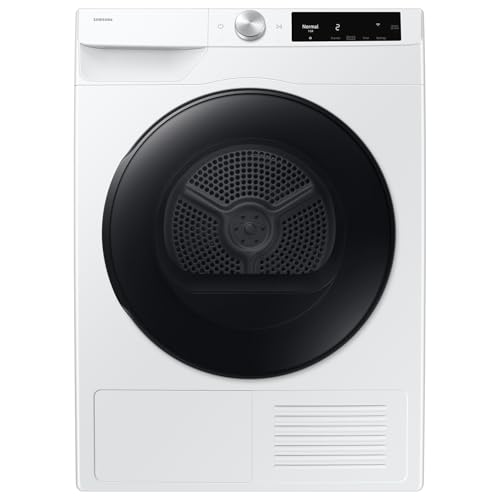
Samsung's 4.0 cu. ft. compact ventless heat pump is the one to choose if you want the machine to run while you are elsewhere. SmartThings sends end-of-cycle alerts and supports remote start, stop and delay, so nobody has to sit within earshot. Smart Dry adjusts time and temperature as the load dries, and the AI Smart Dial learns your usual cycles. It is ENERGY STAR certified and weighs 110.2 pounds. Samsung does not publish the cabinet dimensions in the listing.
What stands out
- Phone alerts mean nobody waits near a running machine
- Remote start and delay let you schedule quiet hours
- ENERGY STAR certified with sensor-based Smart Dry control
Watch out for
- Cabinet dimensions are not published in the listing
- Wi-Fi features need a reliable signal at the machine
Summit 3.88 cu.ft. Heat Pump Dryer, ENERGY STAR Certified, 208-240V, Slim 24” Width, White

Summit's SLD242W is the smallest cabinet here at 23.63 inches wide, 25.75 deep and 33 inches tall, which suits a narrow closet where a larger machine would sit tight against three walls. Fourteen settings include a start delay, a start and stop control and a half load option, so you can time cycles around quiet hours. The 3.88 cu. ft. drum is rated for 17.6 pounds. A three-prong cord is pre-installed for 208-240V, 15-amp service, and ECOEYE reports power use.
What stands out
- Start delay schedules cycles outside the household's quiet hours
- Slim 23.63-inch cabinet fits tight closets without complaint
- Half load setting avoids a full cycle for a few items
Watch out for
- 3.88 cu. ft. means more cycles for a family
- Tank needs emptying roughly every two cycles of laundry
Smad 23.4" Ventless Heat Pump Dryer, 4.4 Cu.Ft Front Load Clothes Dryer with Wrinkle Care,10KG Load, 120/240V,

Smad's 4.4 cu. ft. ventless heat pump is 23.4 inches wide, 25.7 deep and 33.5 tall, with sixteen programs, a sanitize function and wrinkle care. The LED display and status lights mean you can check progress from across the room instead of standing beside the machine, and the sanitize cycle implies a higher drum temperature for part of the run. It stacks on a matching washer. The listing describes 120/240V operation without saying which configuration ships, so confirm the voltage before ordering.
What stands out
- Status lights let you check progress from a distance
- Sixteen programs covering sanitize, wrinkle care and daily fabrics
- Stackable cabinet that measures 23.4 inches in width
Watch out for
- Sanitize cycle runs hotter and may sound different
- Voltage configuration is unclear from the product listing
Techomey 4.4 Cu.Ft Ventless Heat Pump Clothes Dryer, 24" Compact 120/240V Electric Front Load Drying Machine,

Techomey's 4.4 cu. ft. ventless heat pump holds drum air below 50 degrees Celsius, which means a shorter, gentler heat cycle and a compressor that is not working against a hot cabinet. Sixteen cycles with sensor drying pause when the load reaches the chosen level. The cabinet is listed at 25.6 inches wide, 23.5 deep and 33.5 tall, and it stacks on a matching washer. A four-prong cable is fitted, and the tank must be emptied after each load or the program stops.
What stands out
- Low temperature ceiling keeps the whole cabinet cooler
- Sensor drying pauses at the selected dryness level
- Stackable 4.4 cu. ft. design for tight spaces
Watch out for
- Tank must be emptied after every load, or it pauses
- Four-prong cable needs an adapter on older outlets
Buying guide
What a Heat Pump Actually Sounds Like
A vented dryer makes one dominant noise: the blower, a broad whoosh that carries through ducts and walls. A heat pump replaces that with three smaller sources. The compressor is a steady low-frequency hum, similar to a fridge but larger. The circulating fan is a soft mid-range rush of air inside a closed loop. The refrigerant makes occasional ticking and gurgling as pressure changes, and the drain pump adds a brief whirr when condensate is moved. None of these is loud on its own. Together they make a sound that is easier to live with than a blower because it has less high-frequency content. That single fact should decide where the machine goes long before you choose a model. It matters more than the decibel figure you will never find.
That distinction matters for sleeping. High frequencies travel through doors and around corners; low frequencies travel through structure. A compressor hum is more likely to reach the bedroom through the floor than through the air, which is why the same machine can be inaudible in an adjacent room and clearly audible in the room below. If the laundry is over a garage or beside a hallway, the airborne noise will be modest. If it sits on the second floor above a bedroom, the structure is the path that matters. A cheap fix is a rubber mat under the cabinet and a set of padded feet; a better one is a different location. Nobody wants to move a dryer twice. Move it once, to the right place.
The Room Does Half the Work
Before comparing machines, look at where the machine will stand. A concrete slab absorbs vibration. A wood-framed floor transmits it, and a joist bay acts like a drum. A closet with a hollow-core door lets sound through almost unchanged, while a solid door with a sweep at the bottom cuts it noticeably. If the laundry shares a wall with a bedroom, that wall is the first thing to treat, not the dryer. Bookshelves, a heavy rug and a sealed door frame do more than any specification on a product page. Where the wall is shared, a second layer of drywall or a heavy bookcase on the far side does more than acoustic foam. Sound leaks through gaps more than through mass, so seal the frame before you add material.
Clearance matters too, and not just for airflow. A cabinet wedged against three walls has nowhere to radiate sound, and the reflected noise inside a small closet can be worse than the machine. The manuals specify minimum gaps, typically an inch or two at the sides and more at the back for the hose. Respect them. If the closet has a door, leave it open during a cycle or fit a louvered panel, because a heat pump needs to shed heat from the cabinet even though it does not vent moisture. A closed, unventilated closet makes the compressor work harder and run louder. If the closet has no door, a curtain of heavy fabric will soften the edge of the compressor note without trapping heat.
Leveling, Stacking and Vibration
Most noise complaints trace back to a machine that is not level. A heat-pump cabinet is heavy and narrow, and a single foot carrying more load than the others will transmit a pulse into the floor with every compressor stroke. Check level front to back and side to side, then adjust the feet and lock the nuts. Press down on opposite corners; if the cabinet rocks, keep adjusting. This takes ten minutes and is the highest-value thing you can do for a quiet install. Anti-vibration pads under the feet help on a suspended floor and cost little. A spirit level laid across the top edge is more reliable than a phone app, because the cabinet has to be true in both directions.
Stacking changes the equation. A dryer on top of a washer shares the washer's suspension, so an unbalanced wash load can set the whole stack moving, and the dryer's compressor hum travels down through the washer's cabinet into the floor. Use the stacking kit specified for the pair, and level the washer first, because the dryer can only be as steady as what it stands on. Black+Decker's 121 pounds and Samsung's 110.2 pounds are the kind of mass that damps vibration well once it is sitting flat. Mass helps; a rocking cabinet defeats it. Check the stacking kit's torque after the first month, since vibration loosens bolts that felt tight on installation day. A stack that has shifted is a stack that will hum.
The Noise You Load Into the Drum
A closed-loop dryer has no exhaust to mask the sound of hardware tumbling. Zippers, snap buttons, belt buckles and riveted jeans become a metallic rattle against a stainless drum, and it is often louder than the compressor. Turn jeans inside out and close zips before they go in. Shoes should not go in a dryer at all; if you must, use a drying rack or a mesh bag and accept that the cycle will be noisy. Coins left in pockets are the classic culprit, and they also damage the drum over time. A mesh bag also keeps bra hooks and small hardware from rattling against the drum. It is a small habit that pays for itself. A single zipper can set the rhythm for an entire load.
Overloading creates a different problem. A drum packed tight cannot let clothes fall, so the load rotates as one heavy mass and the cabinet takes the imbalance. That produces a rhythmic thud rather than a hum, and it stresses the suspension. Underloading is quieter but inefficient. The sweet spot is roughly half to two-thirds full, with items shaken out and sheets untangled. Bedding is the worst offender because a duvet cover can wrap the entire load into a ball; dry it alone or with a couple of towels to keep it turning. If you regularly dry one heavy item, add a dry towel to give the load something to tumble against. That single change quiets more loads than any setting on the panel.
Timing, Alerts and Living With the Sound
The most practical quiet feature is not acoustic at all. It is knowing when the load finishes without standing near the machine. Samsung's SmartThings app sends end-of-cycle notifications and supports remote start and delay, which means a cycle can run overnight in an empty room and you deal with it in the morning. That is worth more than a few decibels in a house where the laundry is next to a nursery, because it removes the reason to hover. The others rely on a buzzer, which you can usually turn off in the settings. If your model has no app, a plug-in timer is a crude substitute, though it will not tell you when the load is dry. Schedule around the household, not the appliance.
If the laundry shares a wall with a living space, run the machine during the day and use the delay start on the models that have one. Summit includes a start delay and a start and stop control; Smad and Techomey offer delay through their program lists. A cycle that begins at six in the morning and finishes before the household wakes is quieter in practice than one running at nine at night, whatever the machine's sound profile. Sound is a schedule problem as much as a hardware problem. The machine itself is rarely the loudest thing in a laundry room once the door, the floor and the load are under control. A little planning removes most of the annoyance.
Frequently asked questions
Are heat-pump dryers quieter than vented dryers?
Usually, because they have no exhaust blower. The dominant whoosh of a vented machine is replaced by a compressor hum and a small circulating fan. The character of the sound is lower and less penetrating, though a compressor can travel through floors more readily than air noise. Installation and siting often matter more than the machine itself.
How many decibels does a heat-pump dryer produce?
None of the six machines here publishes a decibel rating, and we will not invent one. If a number matters to you, ask the manufacturer in writing before buying. In practice, a level cabinet on a solid floor in a closed room is quiet enough that most owners describe it as fridge-like rather than loud.
Can I run one at night in an apartment?
Many owners do, especially with a solid door and a level machine. The compressor hum is steady and low, which is less likely to wake a neighbor than a vented blower. Check your lease for quiet hours, and avoid stacking against a shared wall. If the machine sits on a wood floor above another unit, use anti-vibration pads.
Why is my dryer thumping instead of humming?
A rhythmic thump usually means an unbalanced load, a cabinet that is not level, or both. Stop the cycle, redistribute the clothes, and check the feet with a spirit level. If the noise continues with an empty drum, the machine needs service. Zippers and buckles can also rattle against the drum and sound worse than they are.
Does stacking make a dryer louder?
It can. A stacked dryer shares the washer's suspension, so an unbalanced wash load moves both cabinets, and compressor vibration travels down through the washer into the floor. Use the correct stacking kit, level the washer first, and avoid stacking on a suspended wood floor if quiet matters. A freestanding machine on a slab is the quietest arrangement.
Verdict
The Midea is the quiet pick by construction rather than by claim: a sealed loop with no exhaust blower, a humidity sensor that ends the cycle instead of running a timer to the end, and a 4.4 cu. ft. cabinet that leaves room for air to move. It is stackable and ENERGY STAR qualified, and the cord is sold separately. Level it carefully and it will be the least intrusive machine in this group.
The Summit is the value choice for a small apartment, with a 3.88 cu. ft. drum, a pre-installed three-prong cord and fourteen settings including a start delay. Step up to the Samsung if you want the load to finish while you are in another room and hear about it on your phone, which is the quietest feature of all.